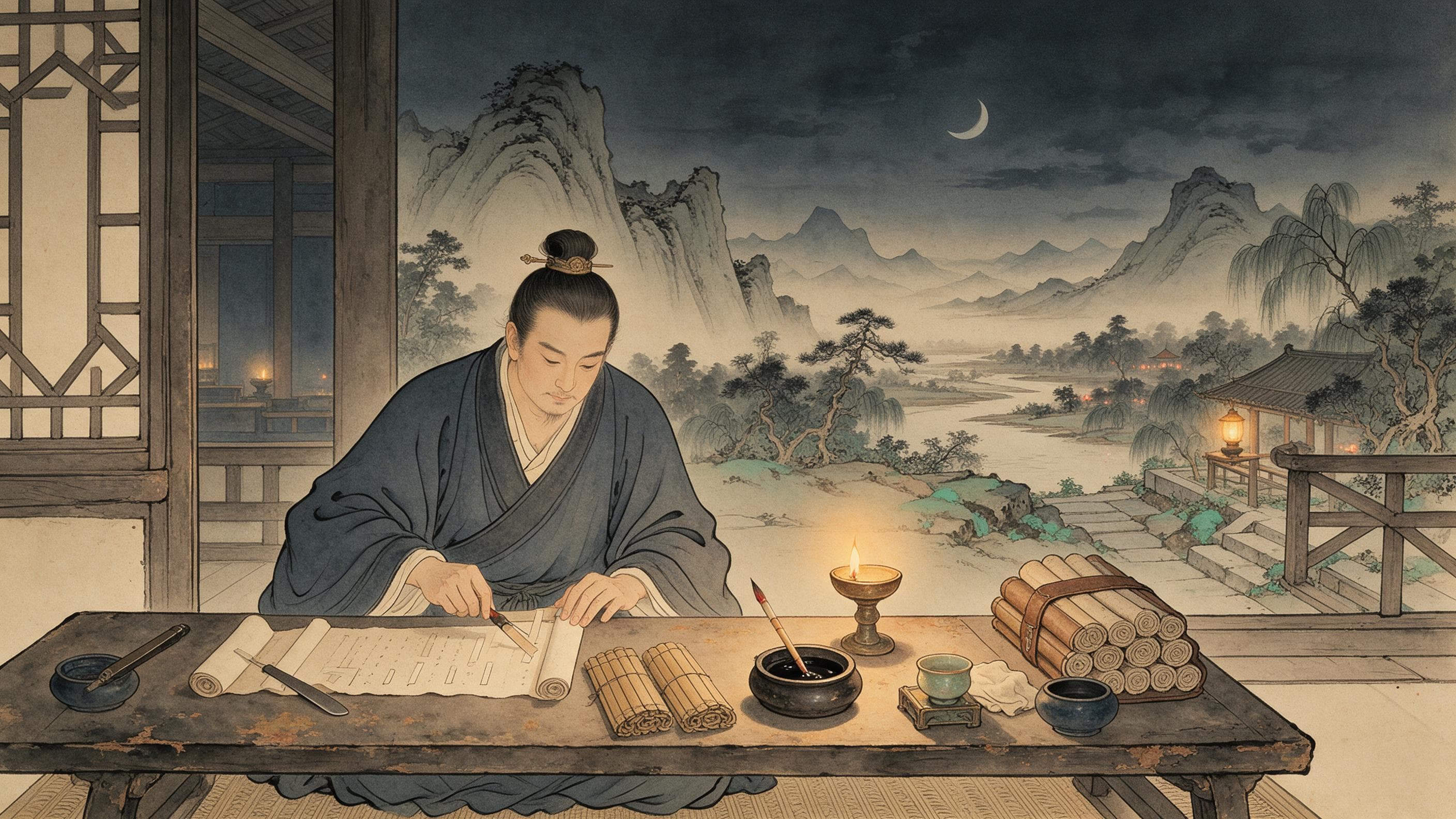
編一部書,先要有幾部書可編。皇甫謐自序裡那句話很乾脆:「三部同歸,文多重複,錯互非一……乃撰集三部,使事類相從,刪其浮辭,除其重複,論其精要,至為十二卷。」——三部書講同一件事,文字大量重複,錯互不止一處;於是把三部合起來,讓同類的事排在一起,刪掉浮辭,去掉重複,只論精要,編成十二卷。這一篇寫三件事:他自己說怎麼編、宋人進書序說怎麼校、四庫提要記下的一筆卷數賬。
一、自序:三部書與一場病
三部書是哪三部,自序交代得清楚:「按《七略》藝文志,《黃帝內經》十八卷。今有《針經》九卷,《素問》九卷,二九十八卷,即《內經》也。亦有所亡失……又有《明堂孔穴針灸治要》,皆黃帝岐伯遺事也。」——《針經》九卷加《素問》九卷,二九一十八卷,就是《內經》;另有一部《明堂孔穴針灸治要》。兩頁關於《素問》《針經》與《內經》的關係,就只有這一句「二九十八卷,即《內經》也」;本篇因此只寫這一句,不補醫學史。
為什麼動手編,自序也寫了:「甘露中,吾病風加苦聾百日,方治要皆淺近。」——甘露年間,他得了風病,又添了百日耳聾,醫方「要皆淺近」。於是有了前面那一步。書成之後他還有一句自限:「其本論其文有理,雖不切於近事,不甚刪也。若必精要,俟其閑暇,當撰核以為教經云爾。」——底本議論有理,雖不合近用,也不多刪;若真要精要本,等有空再核。這是他的自述,本篇照錄;「甘露」年號不折公曆。
二、序例:幾條編書規矩
卷首還有一段「序例」,是編書的體例,不是醫理:「諸問,黃帝及雷公皆曰『問』。其對也,黃帝曰『答』,岐伯之徒皆曰『對』。上章問及對已有名字者,則下章但言『問』言『對』,亦不更說名字也。若人異則重複更名字。此則其例也。」——問話一律稱「問」,答話黃帝稱「答」、岐伯等人稱「對」;前面已出過名字,後面就只寫「問」「對」;換人才重新出名字。接著一條是術語:「諸言『主之』者可灸可刺,其言『刺之』者不可灸,言『灸之』者不可刺,亦其例也。」——說「主之」的可灸可刺,說「刺之」的不可灸,說「灸之」的不可刺。這兩條正是「編」的動作:統一稱謂、統一術語。
三、宋人:奉詔校正
今天看到的這個本子,卷首是宋人的。林億的進書序說:「晉皇甫謐博綜典籍百家之言……取黃帝《素問》、《針經》、《明堂》三部之書,撰為《針灸經》十二卷。」又說這次校書是怎麼做的:「國家詔儒臣校正醫書,令取《素問》、《九墟》、《靈樞》、《太素經》、《千金方》及《翼》、《外台秘要》諸家善書校對,玉成繕寫,將備親覽。」——奉詔校正,取《素問》《九墟》《靈樞》《太素經》《千金方》及《翼》《外台秘要》等書來對。序末署名三人:「國子博士臣高保衡、尚書屯田郎中臣孫奇、光祿卿直秘閣臣林億等上。」
還有一層要標明:正文裡夾的注不是皇甫謐的。四庫提要說:「句中夾註,多引楊上達《太素經》、孫思邈《千金方》、王冰《素問註》、王惟德《銅人圖》,參考異同。其書皆在謐後,蓋宋高保衡、孫奇、林億等校正所加,非謐之舊也。」——夾註引的書都在皇甫謐之後,是宋人校書時加的,不是原本。所以這個本子至少有兩層手筆:西晉的編,北宋的校。
四、卷數賬:十卷、十二卷、十三卷、八卷
卷數在各家目錄裡不一樣,四庫提要要把這筆賬攤開:「《隋書·經籍志》稱黃帝甲乙經十卷,註曰音一卷,梁十二卷,不著撰人姓名。」——隋志作十卷(另有音一卷),梁作十二卷,且不著撰人。「《舊唐書·經籍志》稱《黃帝三部針經》十三卷,始著謐名,然較梁本多一卷,其並音一卷計之歟。」——舊唐志作十三卷,這才寫上皇甫謐的名字,比梁本多一卷,提要猜是把音一卷併進去算的。「《新唐書·藝文志》既有《黃帝甲乙經》十二卷,又有皇甫謐《黃帝三部針經》十三卷,兼襲二志之文,則更舛誤矣。」——新唐志兩樣都收,提要認為更錯。而提要開頭自己寫的是「《針灸甲乙經》八卷,晉皇甫謐撰」。四個卷數(十、十二、十三、八)並列,本篇不裁斷。
篇數也有兩個數,而且就在同一段裡:四庫提要先說「書凡一百一十八篇」,然後點出其中有幾篇分上、下,幾篇分上、中、下,末了說「實一百二十八篇」。兩個數都照錄,本篇不替它加減,也不推「平均每卷幾篇」。分卷結構本頁只給了前兩卷的目錄:卷一列十六個篇名(精神五臟論第一、五臟變腧第二……陰陽二十五人形性血氣不同第十六),卷二是八條(頭兩條是「十二經脈絡脈支別第一(上)(下)」,其餘奇經八脈第二、脈度第三等);卷三到卷十二,本頁只有卷名,沒有篇目。
五、兩頁之外
要注意的是:正史本傳裡沒有這本書。《晉書·皇甫謐傳》寫他「居貧,躬自稼穡,帶經而農」,寫他「後得風痹疾,猶手不輟卷」,寫他「耽玩典籍,忘寢與食,時人謂之書淫」,寫他自號玄晏先生、屢召不仕;傳末列他的著作——《帝王世紀》《年曆》《高士》《逸士》《列女》等傳、《玄晏春秋》——卻沒有《針灸甲乙經》。所以「編書經過」主要靠書的自序與宋人序,不是靠正史。
分線寫一句:寫《本草綱目》的篇目講的是李時珍個人三十年的工夫,寫《七略》的篇目講的是劉向父子校書,本篇講的是皇甫謐合三部書、宋人再校一遍的文本賬。也不寫「中醫針灸奠基」這類評價,不寫經絡理論通論——兩頁給的是序、例、目錄與著錄。
缺口列清:本頁只有卷首,各卷正文沒有逐卷讀過,所以不引條文、不談穴位;卷一之外的完整篇目、皇甫謐編書的具體年份、宋校本與唐本之間的異文,也都不給。留下的是一句「撰集三部,至為十二卷」、幾條序例、一份宋人校書名單、四個卷數與兩個篇數。
延伸閱讀:陶潛辭官的帳:五斗米、公田種秫與一篇自述 · 冰:冬天鑿、夏天頒、死人洗浴也用 · 殷人的帽子:冔、章甫與三代冠名
參考來源與延伸閱讀
- 《针灸甲乙经》宋校本卷首(维基文库本,未与点校本复核) — The front matter of the Song edition: the Siku editors' note, Lin Yi's memorial, Huangfu Mi's own preface and the editorial rules, and the table of contents. Huangfu Mi: 'according to the Seven Summaries and the Arts and Letters treatise, the Yellow Emperor's Inner Classic was eighteen scrolls. Now there are the Needle Classic in nine scrolls and the Questions in nine scrolls — twice nine, eighteen — which is the Inner Classic… There is also the Mingtang: Acupoints, Needles and Moxa, Essential Cures, all remnants of the Yellow Emperor and Qibo. The three works come to one end, their text much repeated, and their confusions are not of one kind. In the Ganlu period I fell ill with wind and added bitter deafness for a hundred days… so I compiled the three, making like matters follow one another, cutting their floating words, removing their repetitions, discussing their essentials, until it came to twelve scrolls' (乃撰集三部,使事類相從,刪其浮辭,除其重複,論其精要,至為十二卷). The rules: 'in all questions, the Yellow Emperor and Lei Gong are both said to ask; in the answers, the Yellow Emperor is said to answer and Qibo and the rest to reply… where the person differs the names are repeated. This is the rule. Where it says 'preside over it', both moxa and needle may be used; where it says 'needle it', moxa may not; where it says 'moxa it', the needle may not — this too is the rule' (序例). Lin Yi's memorial: 'he took the three books of the Yellow Emperor — the Questions, the Needle Classic and the Mingtang — and compiled the Needle and Moxa Classic in twelve scrolls'; and 'the state ordered its scholars to collate medical books, and to take the Questions, the Jiuxu, the Lingshu, the Great Simplicity, the Thousand Ducats, its Wing, and the Arcane Essentials and other good books to compare' (國家詔儒臣校正醫書……校對), signed by Gao Baoheng, Sun Qi and Lin Yi. The Siku note carries the numbers: 'the Sui treatise calls it the Yellow Emperor's Jiayi Classic in ten scrolls, with one scroll of sounds; the Liang catalogue, twelve scrolls, without an author's name'; the Old Tang catalogue, thirteen scrolls 'and first gives Mi's name'; the New Tang catalogue has both twelve and thirteen; and the note says 'the book is in all one hundred and eighteen chapters', then counts the divisions and says 'in fact one hundred and twenty-eight chapters' (實一百二十八篇). The page's table of contents lists the chapter titles of scrolls one and two only, and the bare headings of scrolls three to twelve.
- 《晋书》卷五十一〈皇甫谧传〉(维基文库本,未与点校本复核) — The biography, which never mentions the acupuncture book. It gives his origins and habits: 'Huangfu Mi, style Shi'an, childhood name Jing, of Chaona in Anding, great-grandson of the Han grand commandant Song'; at twenty still unstudious, then moved by his aunt's tears to study with Xi Tan of the same district; 'his family being poor, he worked the fields himself, carrying books to the farm' (居貧,躬自稼穡,帶經而農); 'quiet and of few desires, he first set his mind on high things, took writing as his task, and called himself Master Xuanyan'; 'later he fell ill with wind paralysis, yet his hand never left the scrolls' (後得風痹疾,猶手不輟卷); 'he was so absorbed in books that he forgot sleep and food, and people of the time called him a book-addict' (時人謂之書淫); he refused all office. The list of his writings names the Century of Emperors, the Chronology, lives of the High-Minded, the Recluses, the Women, and the Annals of Xuanyan — no Jiayi Classic. He died in the third year of Taikang, aged sixty-eight.