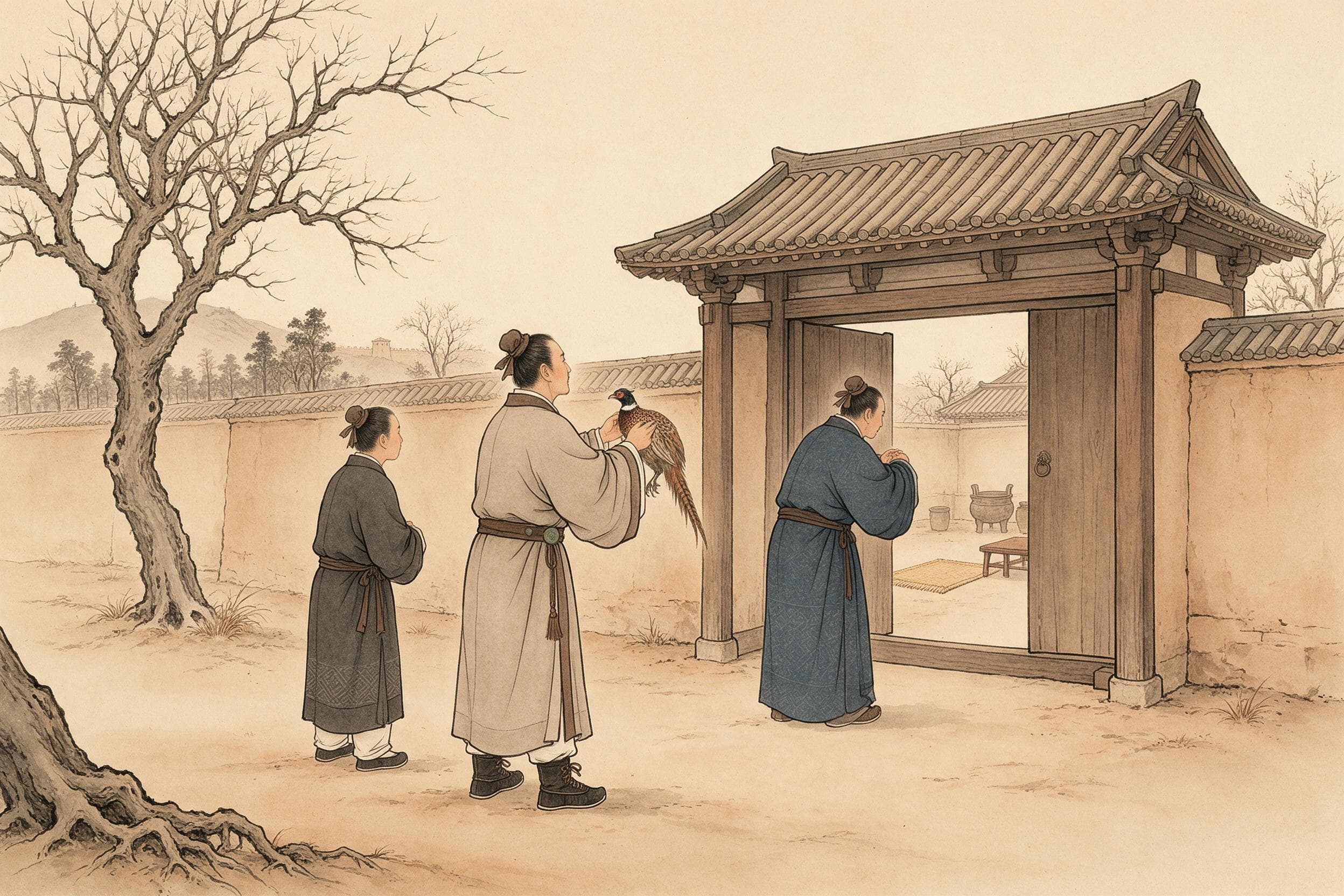
第一次正式见面,手里要拿东西。《仪礼·士相见礼》第一句就规定拿什么:「士相见之礼。挚,冬用雉,夏用腒。左头奉之。」——冬天拿一只雉,夏天拿一只干雉(郑注:「夏用腒,备腐臭也」——怕它腐臭),双手捧着,雉头朝左。这一句之后,才是怎么说、怎么进门、怎么拜。
经只记拿什么、怎么拿;为什么拿这个、为什么这样拿,要到注里才有。郑注说士用雉是「取其耿介,交有时,别有伦也」——取它耿介,交配有时;「雉必用死者,为其不可生服也」——活雉不肯就范,所以用死的;「左头,头,阳也」——头朝左,因为左属阳。到了夏天换成干雉,注只给一个理由:「备腐臭也」——天热,怕它腐臭。贾疏引《周礼·庖人》「腒,干雉」为证。
一只雉,按等级换
「挚」是见面礼,随身份换。士用雉或腒;下大夫相见用雁,「饰之以布,维之以索,如执雉」——用布裹饰,用绳系住,捧法同雉;上大夫用羔,「饰之以布,四维之,结于面;左头,如麛执之」,四角系绳,在当面打结,羔头也朝左。
等级往下减:士去见大夫,「终辞其挚」,对方送来的挚一概不收;士大夫见君,「奠挚,再拜稽首」,挚放在地上,再拜叩头,君只「答壹拜」;庶人见君,连仪容都不讲,「不为容,进退走」。若来见的是他国之人,君「使摈者还其挚」,把礼退回去。捧法也有讲究:「凡执币者,不趋,容弥蹙以为仪。执玉者,则唯舒武,举前曳踵。」——捧币帛的人不快步走,面容更加收敛,这就是「仪」;捧玉的人只是放缓步子,前脚抬起、后脚跟拖。 曾经做过他下属的另有一套:「若尝为臣者,则礼辞其挚」——挚放在堂下,主人只答一拜,再让摈者把它送到门外还给来人。士见大夫为什么连挚都不收?郑注:「终辞其挚,以将不亲答也」——因为不打算亲自回拜,就不收这份礼。
八句推让
然后是辞令,四个来回,八句推让。宾说:「某也愿见,无由达。某子以命命某见。」——我想见您,没有门路,是某子叫我来见的。主人答:「某子命某见,吾子有辱。请吾子之就家也,某将走见。」——该我去府上拜见,请您回去。宾再请,主人再辞;到第三个来回,主人改口辞挚:「闻吾子称挚,敢辞挚。」宾答得干脆:「某不以挚,不敢见。」主人说「某不足以习礼,敢固辞」,宾说「某也不依于挚,不敢见,固以请」,主人才说:「某也固辞,不得命,敢不敬从!」这八句里没有一句自我介绍,全部是把自己往下压、把对方往上抬;称呼一律用「某」,因为这是礼书的写法,不是谁真说过的话。
这八句的注是另一种工作:不解释礼,只解释话里指谁。「某子,今所因缘之姓名也」——某子是介绍人的姓名;「以命者,称述主人之意」——所谓「以命」,是介绍人转述主人的意思;「有,又也」——「吾子有辱」的「有」读作「又」;「不敢为仪,言不敢外貌为威仪,忠诚欲往也」——「不敢为仪」不是客套,是说不敢只在外面摆威仪,心里真想去。贾疏再补:哪一句是转述、哪一句是自称,要分清。经只给台词,注疏才交代谁在说话。
为什么要这样来回推?《曲礼上》给了两句底话:「礼尚往来。往而不来,非礼也;来而不往,亦非礼也。」又说:「夫礼者,自卑而尊人,虽负贩者,必有尊也,而况富贵乎!」推辞不是客套,是把「谁尊谁卑」在门口先摆清楚。
门右、门左、东阶、西阶
推辞完了才见面。《士相见礼》写得极简:「出迎于门外,再拜。宾答再拜。主人揖,入门右。宾奉挚,入门左。主人再拜受,宾再拜送挚,出。」主人在门外先拜两拜,宾回两拜;主人揖请,自己从右边进门,宾捧着挚从左边进;主人再拜受挚,宾再拜送挚,然后退出。谁走哪边、谁先拜,一句一个动作。
升堂的细则在《曲礼上》:「凡与客入者,每门让于客。客至于寝门,则主人请入为席,然后出迎客;客固辞,主人肃客而入。主人入门而右,客入门而左。主人就东阶,客就西阶……主人与客让登,主人先登,客从之,拾级聚足,连步以上。上于东阶则先右足,上于西阶则先左足。」每一道门都让客先进;到了寝门,主人先进去铺席,再出来迎;主人走东阶,客走西阶;上台阶时互相让,主人先上,客跟着,一级一级脚并齐,不能跨;东阶先迈右脚,西阶先迈左脚。还有一句:「将上堂,声必扬。」
再见,与还挚
见过之后还有一次回访,这次要把挚带回去还。原文:「主人复见之,以其挚,曰:『向者吾子辱,使某见。请还挚于将命者。』」——上次蒙您赏脸,让我见了面,现在请把这只挚还给您的传命人。对方辞,他再请,三轮之后,「宾奉挚入,主人再拜受。宾再拜送挚,出」。绕一圈,那只雉回到当初送它的人手里。见面礼不是收下的东西,是拿来做这场见面的凭据。郑注解释主人为什么还要再见一面:「请见者,为宾崇礼来,相接以矜庄,欢心未交也。宾反见,则燕矣。」——宾带着重礼来,见面时双方都矜持庄重,欢心还没交;再见面,才是「燕」,才轻松下来。
见完之后:说什么,看哪里
《士相见礼》还规定见面之后的话与目光:与君说话,说「使臣」的事;与大人说话,说「事君」的事;与老者说话,说「使弟子」的事;与幼者说话,说「孝弟于父兄」;与众说话,说「忠信慈祥」;与居官者说话,说「忠信」。看人也有尺寸:「凡与大人言,始视面,中视抱,卒视面,毋改」——开口看脸,中间看胸口,收尾再看脸,不要游移;对父亲则可以「游目」,但上不过脸、下不过腰带。这些话与目光,和前面八句推让、门右门左是同一套东西:把每一次接触都变成可以照着做的动作。
要说明的是,这一篇只写给「士」这个阶层,不写庶人、不写天子;它是礼书排出的程序,不是某一年某两家人的实录。它通篇没有一句解释「为什么」,只写拿什么、说什么、从哪边进、谁先上台阶、什么时候把东西还回去。
延伸阅读:一块石头与六斗米:明代读书人怎么起步 · 士虞礼:一场葬后祭的三层读法 · 月令:国家给每个月派活
参考来源与延伸阅读
- 《仪礼·士相见礼》(维基文库本,未与点校本复核) — The whole procedure: 'The rite of a knight's first meeting: the gift is a pheasant in winter, a dried pheasant in summer, held with the head to the left' (摯,冬用雉,夏用腒。左頭奉之). The eight-fold exchange of refusals before the visit (某也願見……敢不敬從), then 'he comes out to meet him outside the gate and bows twice; the guest answers with two bows; the host bows him in, entering on the right; the guest carries the gift and enters on the left; the host bows twice and receives it; the guest bows twice and hands it over; he goes out'. The return visit, when the host brings the gift back — 'pray return the gift to your messenger' (請還摯於將命者). The grading of gifts: a knight seeing a great officer declines his gift outright; the lower great officers exchange wild geese dressed in cloth and tied with cord; the upper great officers exchange lambs, tied at four points and knotted at the face. Seeing the ruler: gift laid down, two bows and a bow to the ground, the ruler answering with one bow; a man of another state has his gift returned. Speech and gaze: 'with the ruler speak of employing officers; with elders of teaching the young; with the young of filial duty; with officials of loyalty and good faith' (與君言,言使臣……與居官者言,言忠信); 'begin by looking at the face, in the middle at the breast, at the end at the face again, without changing' (始視面,中視抱,卒視面,毋改).
- 《仪礼注疏》卷七·士相见礼第三(汉郑玄注、唐贾公彦疏;维基文库本,未与点校本复核) — The comment and sub-commentary on the same page, quoted for the reasons the classic withholds. Zheng on the gift: 'The pheasant is taken for its firmness and independence, mating at a season and keeping apart after' (取其耿介,交有時,別有倫也); 'the pheasant must be used dead because a live one cannot be made to submit' (為其不可生服也); 'the head to the left, the head being yang' (左頭,頭,陽也); 'in summer a dried pheasant, to guard against rot and stench' (夏用腒,備腐臭也). Zheng on the rank rule: 'he declines the gift finally because he will not answer the visit in person' (終辭其摯,以將不親答也). Zheng on the return visit: 'he asks to see him because the guest came with honour, the meeting was all gravity and the glad heart had not yet been exchanged; when the guest returns the visit, then there is ease' (請見者……歡心未交也。賓反見,則燕矣). Jia explains the 'so-and-so' of the exchange as the introducer's name and the sentences as relayed speech (某子,今所因緣之姓名也;以命者,稱述主人之意).
- 《礼记·曲礼上》(维基文库本,未与点校本复核) — The general rules behind the meeting: 'Rites value reciprocity; to go and not return is not ritual, nor to come and not go' (禮尚往來。往而不來,非禮也;來而不往,亦非禮也); 'ritual is to humble oneself and honour others' (夫禮者,自卑而尊人). The passage at the gate and the steps: entering by every gate the host yields to the guest; at the chamber door the host asks leave to spread the mat and then comes out to meet him; 'the host enters on the right, the guest on the left; the host takes the eastern steps, the guest the western'; at the ascent host and guest yield, the host goes up first, the guest follows, feet together on each step and continuous; 'on the eastern steps the right foot first, on the western the left' (上於東階則先右足,上於西階則先左足); and 'going up into the hall, the voice must be raised' (將上堂,聲必揚).