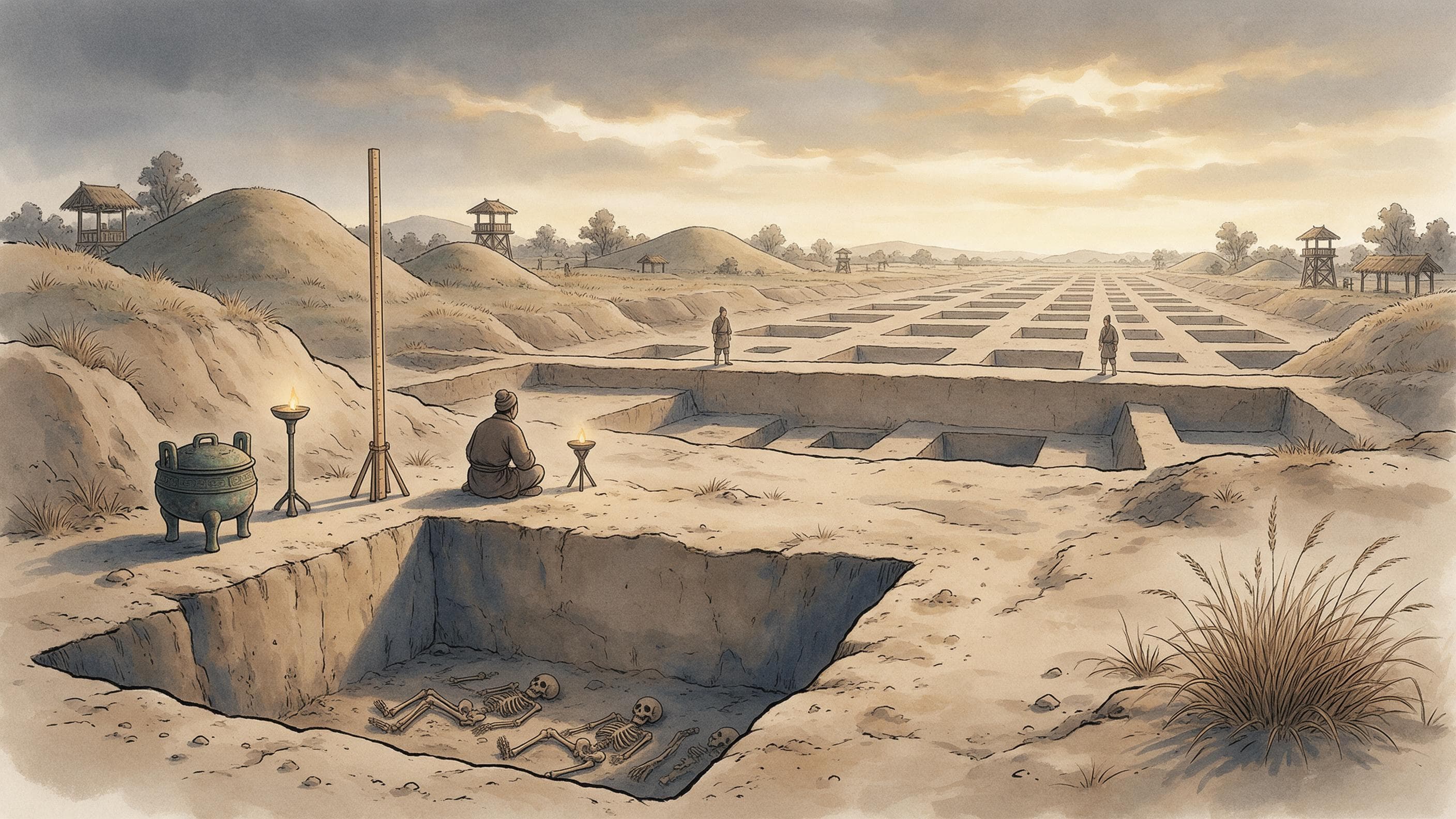
兩組數字,被研究者湊到了一起。一邊是人祭坑:坑按組排列、成排分布,按組統計坑裡的人骨,出現頻率最高的成組數字是 10、30、50、100、300。另一邊是甲骨卜辭:商王祭祖時頻頻出現「十羌」「三十羌」「五十羌」「百羌」「三百羌」。數字對上了,於是有了假設:坑裡埋的,可能是羌人。
那頁研究介紹
先說來路:這是中國社會科學院考古研究所網站「考古動態」欄目 2016 年 7 月轉載的一篇新華網報導,作者劉雅鳴、桂娟。報導說,殷墟申遺成功十週年時,考古所安陽工作站站長唐際根披露新成果:西北岡祭祀坑裡的殉人「不是奴隸」,而是商朝人抓來的俘虜;這些俘虜是羌人,原本與商朝人為鄰,後來被強大的商朝逼往西北地區。這是一篇研究介紹/報導,不是人骨鑑定報告;文中所有結論都要註明出處,寫成「研究認為」。
方法在文中說得很清楚:2013 年國家社科基金重點計畫「殷墟王陵祭祀坑人骨與羌人的種族與文化」啟動,安陽工作站與加拿大學者合作,用鍶同位素技術找殉人來源;研究團隊到甘肅、陝西一帶找寺窪文化、卡約文化的人骨,再與祭祀坑新出人骨比對,結果「比值非常接近」。報導還引了唐際根的一句解釋:「這些羌人一般是被擄來後隨即殺掉,如果當上一兩年奴隸,鍶同位素的比值就會有變化。」——方法可以寫,樣本數與具體數值,這一頁沒有,本文也不補。
頁面另給兩條旁證:一是司母戊鼎所在大墓的墓道裡有 22 個祭祀人頭骨保存完好,用鍶同位素一測,大部分也是羌人;二是胡厚宣 1974 年據他所讀的 2000 片甲骨統計,「殷墟 14000 人祭中,就有 8000 個是羌人」。後一條是甲骨文的統計,不是人骨統計,引用時要分清。
坑與規模
報導開篇給了規模:殷墟 88 年的發掘中,西北岡王陵區有「2500 座以上的祭祀坑」,以人祭為主、成排分布;「200 多年間,數以萬計的活人」被商王室當作祭品。這些數字是報導的說法,引用時要註明出處;本文不列坑號,也不在此基礎上再加總或推算總數。
值得注意的是那條推理鏈的形狀:先是坑的成組分布,再是按組統計人骨,得出 10、30、50、100、300 這組反覆出現的數字;再想到卜辭裡的「十羌」到「三百羌」;然後才提出「是羌人」的假設;最後用鍶同位素去檢測。三步:數字→假設→檢測。它不是一句「殷墟殉人是羌人」就能跳過去的結論。
墨子的說法
另一部書裡也有殉葬的數字,但性質完全不同。《墨子·節葬下》:「天子殺殉,眾者數百,寡者數十。將軍大夫殺殉,眾者數十,寡者數人。」——這是戰國人批判厚葬久喪的論辯修辭。墨子先立論:厚葬久喪使「國家必貧,人民必寡,刑政必亂」;再列王公大人之喪的排場——棺槨必重、葬埋必厚、衣衾必多、文繡必繁、丘隴必巨;然後才說「滿意,若送從」,天子、將軍大夫各殺多少人殉葬。
墨子自己的方案是反面:「棺三寸,足以朽體;衣衾三領,足以覆惡。以及其葬也,下毋及泉,上毋通臭,壟若參耕之畝,則止矣。」他反對的不只是殺人殉葬,還有整套厚葬——棺槨、衣衾、丘隴、明器、久喪。所以「數百」「數十」這些數字,是論辯裡的分量,不是登記表上的數目;引用時必須點明這是戰國人的議論,不是商代殉人數的統計。
兩邊各自回答什麼
把兩頁並排,會發現它們回答的不是同一個問題。研究這一邊回答「誰」:坑裡的人是羌人俘虜,被擄來後不久就被殺掉——依據是鍶同位素,結論掛在唐際根與研究計畫名下。墨子這一邊回答「多少」:天子數百、數十,將軍大夫數十、數人——依據是戰國人對厚葬的批判,數字服務於「厚葬有害」的結論。
所以不能互證。拿墨子的「數百」當商代殉人數的統計,或用西北岡的 2500 座坑去印證墨子的數字,都是把兩種話拼成一句。也不寫「商代人祭野蠻」這類評價句——兩頁給的是研究結論與論辯文本,不是道德判詞。兩頁能支持的只有兩句:文獻說厚葬殺人多;研究說坑裡的人是羌人俘虜。
材料沒有的
缺口要列清楚:這一頁沒有給人骨鑑定報告的方法細節、樣本數、逐坑人骨數,也沒有寫「羌人」是如何判定的;被埋者的年齡、性別組成沒有;祭祀坑的逐坑清單也沒有。墨子那邊沒有商代材料,只有戰國議論。所以本文寫的是「兩邊各自怎麼說」,不是「商代殉人是誰、有多少」。
一邊是研究介紹給的「來源」,一邊是戰國論辯給的「數量」。兩頁之間,沒有一條可以連成「商代殉人 N 人」的線;能連的只有方法:先有假設,再去找證據。至於那些被埋的人是誰、從哪裡來,這一頁給的答案是羌人俘虜——研究結論,不是定論。
參考來源與延伸閱讀
- 刘雅鸣、桂娟《研究表明:殷墟大规模殉人的来源是俘虏而非奴隶》,新华网 2016-07-26;中国社会科学院考古研究所网站「考古动态」转载(HTML,研究介绍/报道,非人骨鉴定报告) — A research notice, not a physical-anthropology report, and it must be attributed as such. It reports that Tang Jigen, then head of the institute's Anyang station, announced at the tenth anniversary of Yinxu's World Heritage listing that the people in the Xibeigang sacrifice pits were not slaves but Shang captives — Qiang people. The project behind it, launched in 2013 under a National Social Science Fund grant ('The human bone of the Yinxu royal-cemetery sacrifice pits and the race and culture of the Qiang'), used strontium-isotope analysis with Canadian collaborators, comparing bones from the pits with bones from the Siwa and Kayue cultures in Gansu and Shaanxi; the ratios were close. The notice adds that the captives were 'generally killed soon after capture — had they been kept as slaves for a year or two, the strontium ratio would have changed', that 22 sacrificial skulls from the tomb passage of the great tomb associated with the Simuwu ding were mostly Qiang, and that Hu Houxuan's 1974 count of 2,000 oracle-bone inscriptions found 8,000 Qiang among 14,000 human sacrifices. The notice opens by describing more than 2,500 sacrifice pits at Xibeigang, laid out in rows and mostly human sacrifices, and 'tens of thousands of living people' killed over two centuries. It gives no sample size, no per-pit bone counts, no criteria for identifying 'Qiang', and no age or sex breakdown.
- 《墨子·节葬下》(战国;维基文库本,未与点校本复核) — A Warring States argument against lavish burial and prolonged mourning, not a count of Shang dead. Its sentence on sacrifice: 'If one is satisfied, then follow the dead: for the Son of Heaven, those killed to accompany him are at most several hundred, at least several tens; for generals and great officers, at most several tens, at least a few' (天子殺殉,衆者數百,寡者數十。將軍大夫殺殉,衆者數十,寡者數人). The number serves the argument, which runs: the rich bury heavy coffins, many shrouds and great mounds and put gold, jade, carriages, vessels and weapons in the grave; this 'buries wealth that should have been taxed' and 'prolongs the ban on work', so that 'the state must be poor, the people few, and punishments and government disordered' (國家必貧,人民必寡,刑政必亂). Against it Mozi sets the ancient kings' rule: 'a coffin three inches thick is enough for the decaying body, three layers of shroud to cover the ugly… below not reaching the spring, above not letting the smell out, a mound like three furrows, and no more' (棺三寸,足以朽體;衣衾三領,足以覆惡). The chapter contains no Shang evidence and no figures from excavation.