The Book of Documents' chapter 'Zhaogao' begins like a work log: 'In the second month, after the full moon, six days later on yiwei, the king walked from Zhou and came to Feng. The Grand-Guardian went ahead of the Duke of Zhou to inspect the site' (惟二月既望,越六日乙未,王朝步自周,則至于豐。惟太保先周公相宅). Then comes a run of sexagenary days. Two layers should be separated first: this is a proclamation, with the schedule in front and the speech behind; the page gives Ji Dan, the Duke of Zhou, as its author, and that is a matter of attribution. What follows takes only the building sequence the text sets out, and does not read it as Zhou urban planning.
Look at the Ground First, Then Divine
The first action is to inspect: 'the Grand-Guardian went ahead of the Duke of Zhou to inspect the site'. The Grand-Guardian is generally taken to be the Duke of Shao; the page says only Grand-Guardian, so the identification is marked here as the usual reading. Then the dates: 'In the coming third month, on bingwu, the first of the month, and three days later on wushen, the Grand-Guardian at dawn reached Luo' (越若來三月,惟丙午朏,越三日戊申,太保朝至于洛). 朏 is generally read as the first appearance of the new moon; the day-counts and the month phase are printed as they stand, not converted into any calendar and not arranged into a table.
Once at Luo, the divination: 'He divined the dwelling. When the omen had been obtained, the work was laid out' (卜宅。厥既得卜,則經營). The order of decisions is plain: the work begins only after a good omen — not first a plan and then a divination. How many divinations were made, what the charge said, what was used for it, the page does not say, and nothing is added here.
Setting the Positions with the Yin People
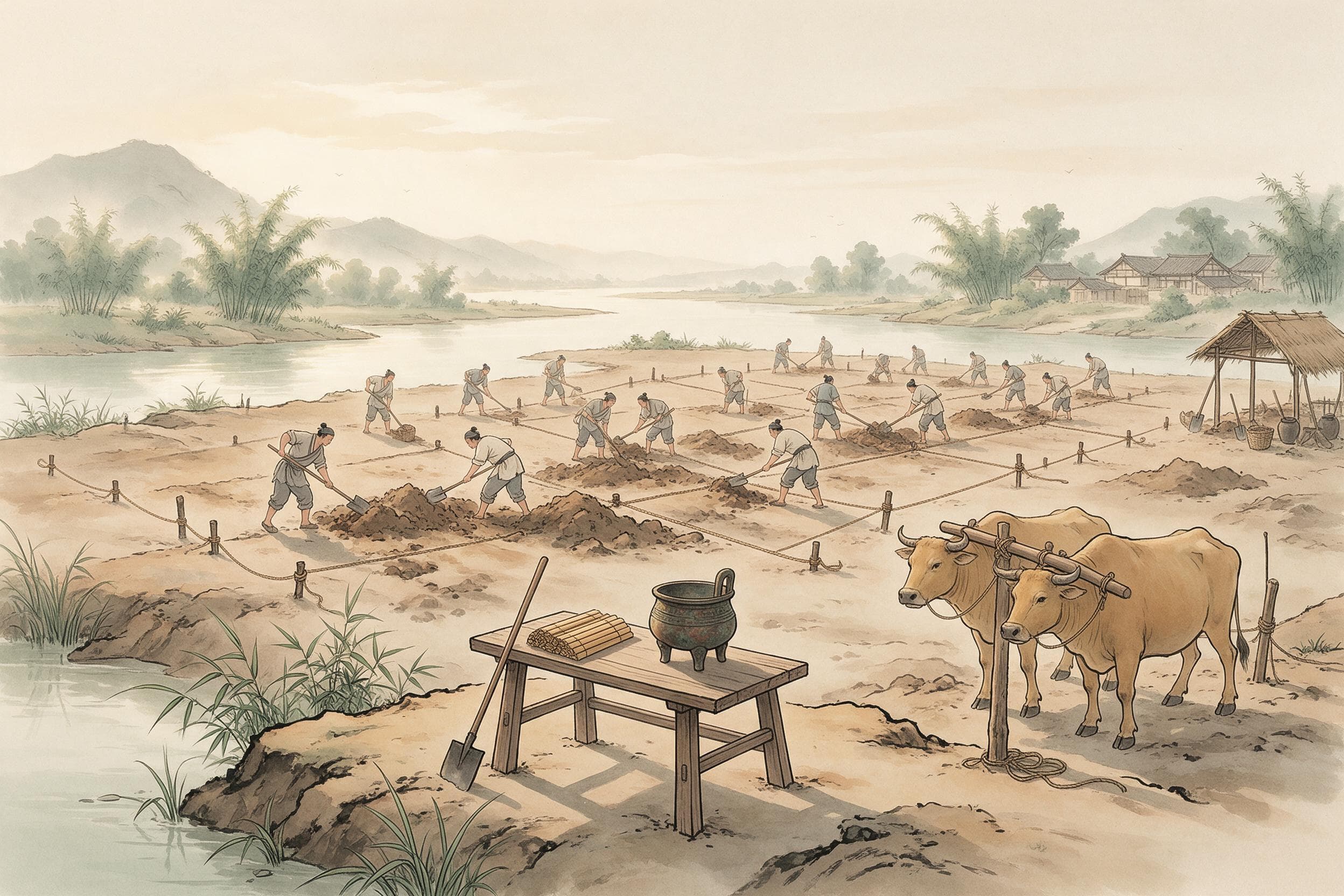
The first step of the work is not a wall but the positions: 'Three days later, on gengxu, the Grand-Guardian took the common men of Yin to order the positions by the Luo; five days later, on jiayin, the positions were complete' (越三日庚戌,太保乃以庶殷攻位於洛汭,越五日甲寅,位成). 庶殷 are the Yin remnant; 攻位 is generally understood as preparing and laying out the building plots; 洛汭 is generally taken as the stretch where the Luo enters the river, with no modern place named here. A whole policy of employing the conquered stands behind those words; this article records only the step as the text gives it.
After the positions, the Duke of Zhou arrives: 'On the next day, yimao, the Duke of Zhou at dawn reached Luo and surveyed the camp of the new city' (若翌日乙卯,周公朝至于洛,則達觀于新邑營) — 达观 being generally read as a full inspection. Gengxu to jiayin is five days, and the Duke arrives the day after; what a 'position' actually looked like — how many lines, how wide, what markers — the text does not say, and this article does not supply it.
Two Oxen, and One of Each
Then two sacrifices, each with its count. 'Three days later, on dingsi, victims were offered in the suburbs: two oxen' (越三日丁巳,用牲于郊,牛二). 'On the next day, wuwu, there was a sacrifice to the soil of the new city: one ox, one sheep, one pig' (越翌日戊午,乃社于新邑,牛一、羊一、豕一). Both counts are printed as they stand: two oxen for the suburb, one of each for the soil. Which spirits were addressed, who officiated, and what the rites consisted of are not on the page; no rank or grade of victim is inferred here.
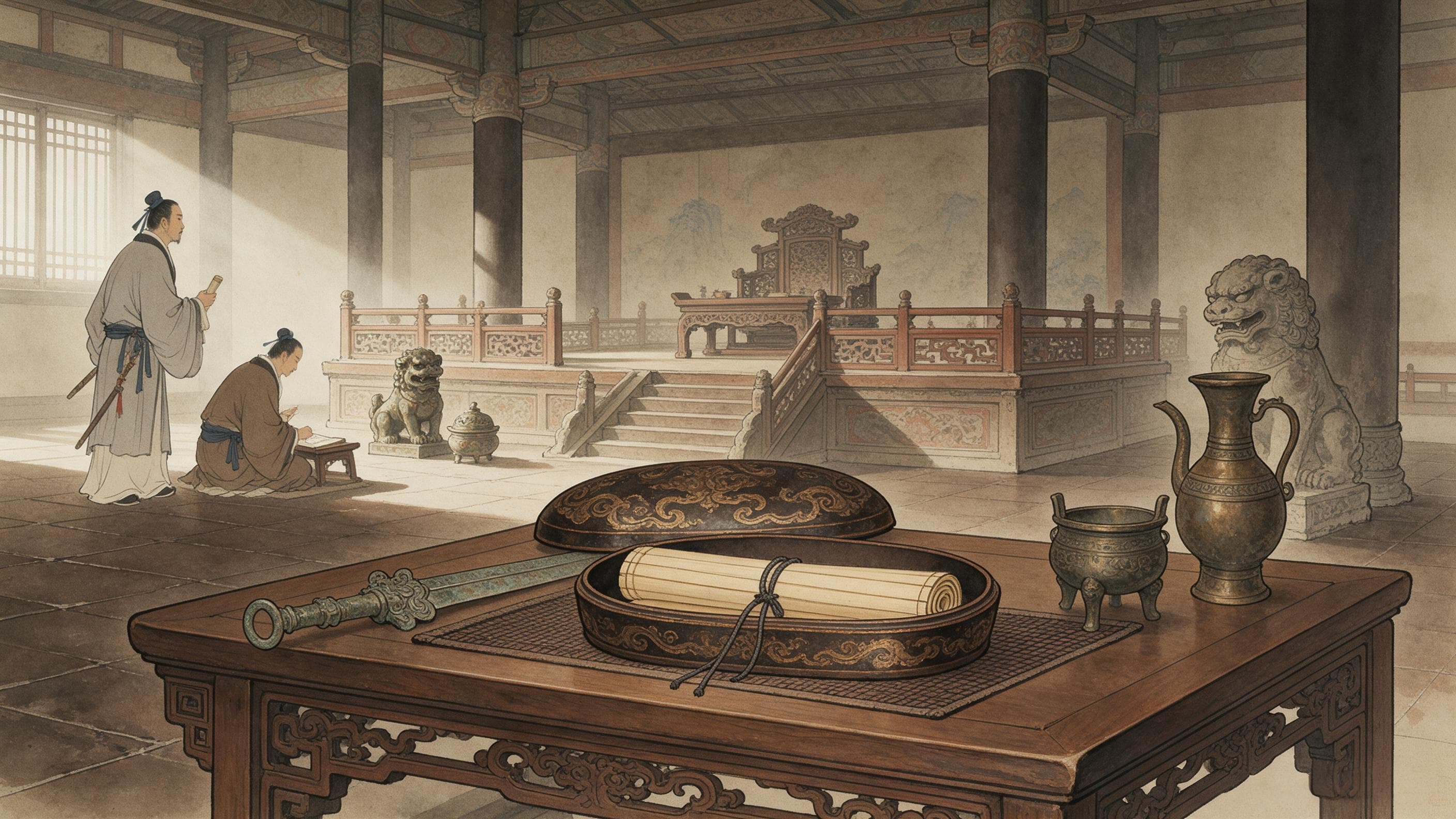
Only then the charge: 'Seven days later, on jiazi, the Duke of Zhou in the morning charged the common men of Yin by written order: the marquises, the tien, the nan and the chiefs of the states' (越七日甲子,周公乃朝用書命庶殷:侯、甸、男邦伯). 'When the Yin multitude had been charged, they set to work' (庶殷丕作) — 丕作 being generally read as a great raising of labour. Gather the days and they run in one line: yiwei, bingwu, wushen, gengxu, jiayin, yimao, dingsi, wuwu, jiazi — nine sexagenary days from the king's walk to the charge.
The Speech Is Not the Procedure
After the schedule the chapter turns into a speech, and the speech gives reasons, not methods: 'August Heaven on High changed the mandate of its eldest son, this great state of Yin' (皇天上帝,改厥元子兹大國殷之命); 'when the king received the mandate, there was boundless good and also boundless care' (無疆惟休,亦無疆惟恤); 'how can one fail to be reverent?' (曷其奈何弗敬); the people of Yin 'held their wives and children and cried to Heaven' (夫知保抱攜持厥婦子,以哀籲天); Xia and Yin are set side by side, each closing with 'now their mandate has fallen' (今時既墜厥命); and the chapter ends on 'let the king hasten to reverent virtue' (王其疾敬德). This explains why the city was built and on what ground, not how. The speech is not read here as a construction record, nor the procedure as a constitutional design.
What the History Adds, and How the Two Differ
The Records of the Grand Historian has its own few sentences: 'King Cheng was at Feng and sent the Duke of Shao to build Luoyi again, as King Wu had intended. The Duke of Zhou divined and inspected once more, and the building was finished, and the nine cauldrons were placed there. He said: "This is the centre of the world; the distances for the four quarters' tribute are equal." He made the Zhaogao and the Luogao' (使召公復營洛邑……作《召誥》、《洛誥》). Set beside the chapter, the two differ in detail: the chapter records one divination of the dwelling, the history adds a second divination and inspection; the nine cauldrons and the phrase about the centre of the world are not in the chapter and are marked here as the historian's words, not the proclamation's.
The history also records King Wu's earlier words on the ground: 'from the bend of the Luo to the bend of the Yi, the land is level and not steep — this was the dwelling of the Xia. I looked south to the three Tu mountains, north to the Yue uplands, back to the river, and to the Luo and Yi…' (自洛汭延于伊汭……) — marked as the history's report of King Wu's words, showing that the site had been surveyed long before. At the end of the chapter Sima Qian passes his own judgement: 'Scholars all say that the Zhou attacked Zhou and dwelt at Luoyi; weighed as a fact, it is not so. King Wu began it, King Cheng had the Duke of Shao divine a dwelling and placed the cauldrons there, but the Zhou still had their capital at Feng and Hao' (太史公曰……而周復都豐、鎬). That is a historian's verdict, marked as his; and because of it this article writes no general account of a Zhou eastern capital.
Neither page gives the city's form: no wall heights, no gate numbers, no wards, no quantities of earth or labour (beyond the one phrase about the Yin men), no division of 'Chengzhou' and 'Wangcheng' into two cities, and no administrative relation between Luoyi and Feng-Hao. None of it is supplied here, and the Artificers' Record is not used to fill the gap. What can be written is this: one inspection, one divination, one setting out of positions, the positions completed, two sacrifices (two oxen; one ox, one sheep, one pig), one written charge — and from the history, one line of arithmetic about the site: equal distances for tribute from the four quarters. What the city looked like, neither page says.
Related reading:How a Rammed-Earth Wall Was Built: The Walls, Gates and Moat of Han Chang'an · Ten Li, One Water Gate: Repairing the Bian Canal · Who Put Out the Fires in Song China?
Sources & further reading
- 《尚书·召诰》(维基文库本,页面白文无注,题作者为姬旦;圆括号内为录文所加异文校字,未与中华书局点校本复核) — The chapter opens as a dated work log: in the second month, six days after the full moon, on yiwei, the king walks from Zhou to Feng; the Grand-Guardian goes ahead of the Duke of Zhou to inspect the site; on bingwu, the first of the third month, and three days later wushen, he reaches Luo and 'divines the dwelling'; obtaining a good omen, the work is laid out; on gengxu the Yin people are set to 'order the positions' by the Luo, and by jiayin the positions are complete; on yimao the Duke of Zhou arrives and surveys the new camp; on dingsi a suburban sacrifice with two oxen; on wuwu a sacrifice to the soil of the new city with one ox, one sheep, one pig; on jiazi the Yin nobles are charged by written order, and the Yin people set to work. The rest of the chapter is a speech on the change of the mandate and the command to 'hasten to reverent virtue'. The page's parenthetical variant characters are kept as printed.
- 《史记》卷四·周本纪(西汉司马迁撰;维基文库本,页面白文无注,未与中华书局点校本复核) — The Shiji's summary of the same work: King Cheng at Feng sends the Duke of Shao to build Luoyi again, as King Wu had intended; 'the Duke of Zhou divined and inspected once more, and the building was finished, and the nine cauldrons were placed there'; and the reason given: 'this is the centre of the world, and the distances for the four quarters' tribute are equal.' It also records King Wu's earlier survey of the terrain with his words about the Luo and Yi, and closes the chapter with Sima Qian's judgement that although scholars say the Zhou ruled from Luoyi, in fact King Wu began it and King Cheng had the Duke of Shao divine a dwelling and placed the cauldrons there, while the Zhou still had their capital at Feng and Hao until the fall of King You.