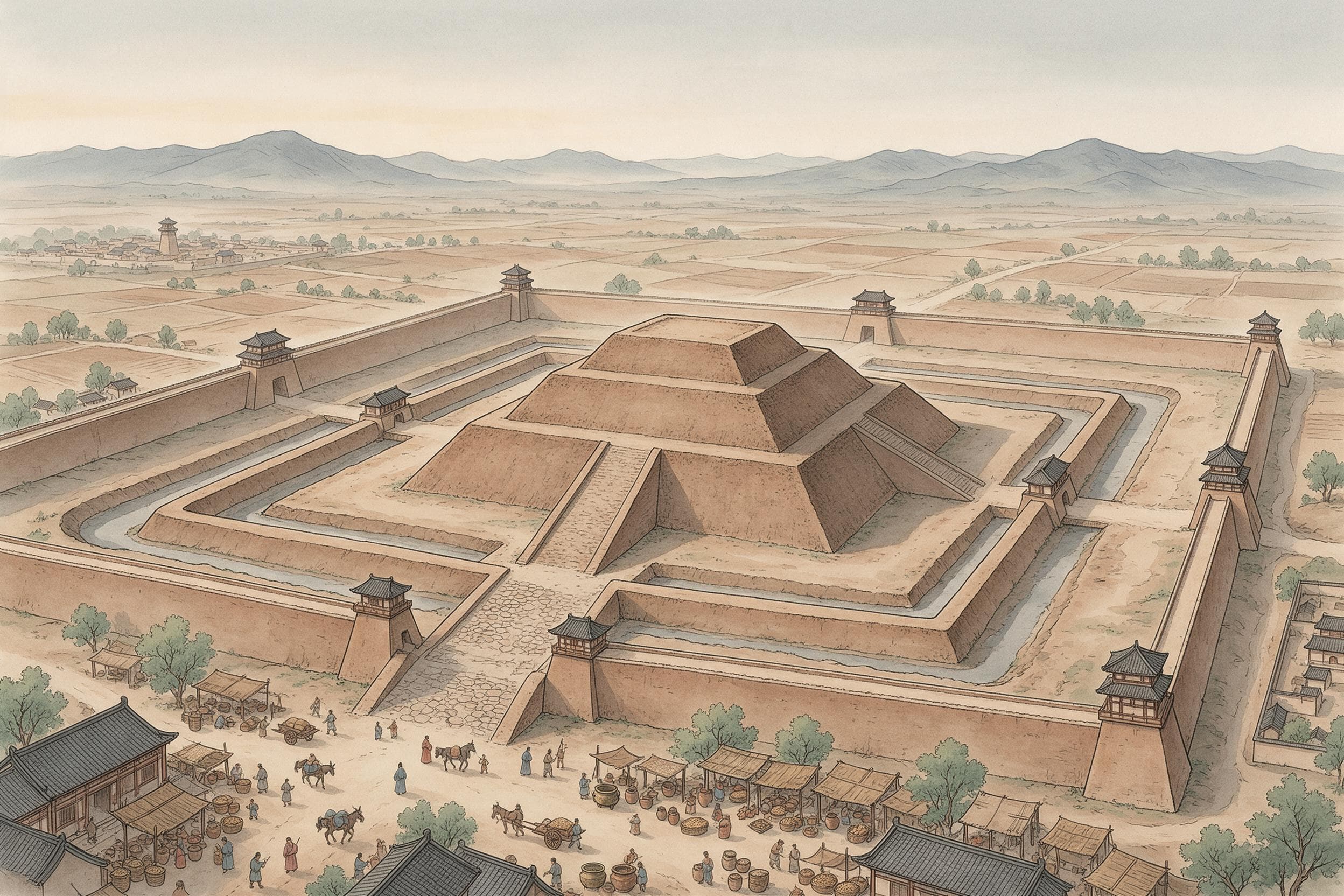
One front hall, two widths. The Records of the Grand Historian, under the thirty-fifth year of the First Emperor: 'He then built a court palace in the Shanglin park south of the Wei. First he made the front hall at Epang: five hundred paces east to west, fifty zhang north to south; on top there was room to seat ten thousand men, below there was room to set up a five-zhang banner' (乃營作朝宮渭南上林苑中。先作前殿阿房,東西五百步,南北五十丈,上可以坐萬人,下可以建五丈旗). The Sanfu huangtu (三輔黃圖), a later register of palaces and parks: 'He made the front hall at Epang: fifty paces east to west, fifty zhang north to south; on top one could seat ten thousand men, below one could set up a five-zhang banner' (作阿房前殿,東西五十步,南北五十丈,上可坐萬人,下建五丈旗). The sentences are near-identical; only the number before 步 differs — five hundred paces, or fifty.
The Entry for the Thirty-Fifth Year
The Shiji dates the work to the thirty-fifth year and gives the reason first: Xianyang was crowded and the palaces of the former kings small, so he 'then built a court palace in the Shanglin park south of the Wei' (乃營作朝宮渭南上林苑中). The front hall came first. Around it, 'a gallery road ran on all sides, from below the hall straight to the Southern Mountains; the peak of the Southern Mountains was marked out as its gate-towers' (周馳為閣道,自殿下直抵南山。表南山之顛以為闕); a double road crossed the Wei to Xianyang 'to figure the pole-star's gallery road crossing the Milky Way to reach Ying shi' (以象天極閣道絕漢抵營室也). Then the sentence that settles the status of the building: 'the Epang palace was not completed; when completed, a fine name was to be chosen for it. Because the palace was made at Epang, the world called it the Epang palace' (阿房宮未成;成,欲更擇令名名之。作宮阿房,故天下謂之阿房宮). The name was a working name.
The Sanfu huangtu begins elsewhere. 'The Epang palace, also called the Epang walled town. King Huiwen built it; the palace was unfinished when he died. The First Emperor enlarged it; its extent reached more than three hundred li. Detached palaces and separate lodges filled the mountains and crossed the valleys; carriage roads joined one to another; gallery roads reached Mount Li, more than eighty li; the peak of the Southern Mountains was marked out as its gate-towers and the Fan river was netted in as its pond' (阿房宮,亦曰阿城。惠文王造,宮未成而亡。始皇廣其宮,規恢三百餘里……表南山之顛以為闕,絡樊川以為池). On the roads it joins what the Shiji separates, and reads 'Grand Ultimate' where the Shiji reads 'pole-star': one continuous 'double road, crossing the Wei and joining Xianyang, to figure the Grand Ultimate's gallery road reaching Ying shi' (周馳為複道,度渭屬之咸陽,以象太極閣道抵營室也). Both are printed here, neither corrected against the other.
Five Hundred Paces, or Fifty
Put the two sentences together and only one figure is at issue. Both books say, word for word, that the hall was fifty zhang north to south, that ten thousand could be seated on it, and that a five-zhang banner could be set up below; both measure east-west in 步 and north-south in 丈. Only the number before 步 differs, and it differs tenfold. This article does not decide: neither figure is converted into metres, the two are not multiplied into an area, and the older book is not preferred for its age. A character dropped in copying is one possible explanation; neither page says so, and the guess is not used here as a conclusion.
The two witnesses are not of the same kind. Shiji 6 is an imperial annals written under the Han, and the Epang passage is narrative. The Sanfu huangtu is an old register of the palaces, parks, walls and shrines of the three metropolitan commanderies; its page names no author and no date of compilation, and it is quoted here as a later compilation of old records, not as a contemporaneous one. Where it repeats a Shiji sentence verbatim it follows an older text; where it differs, the page does not say whose difference it is.
Magnolia Beams, a Lodestone Gate
The fittings the Shiji leaves out are supplied by the Sanfu huangtu: 'magnolia wood for the beams, lodestone for the gate' (以木蘭為梁,以磁石為門), followed by a note on the gate — it was the north gate-tower of Epang, set in front of the palace and made wholly of lodestone, 'so that when the envoys of the four frontiers came to court, any who concealed armour or carried a blade would be stopped as they entered, to show the divine' (令四夷朝者,有隱甲懷刃,入門而脅止,以示神); it was also called the gate that repels the Hu. The note states what the gate was meant to do, not that anyone tried it; neither page describes the building as it stood.
The numbers of people are as unstable as the numbers of paces. The front hall seats ten thousand, in both books. But the Sanfu huangtu has a separate entry for a 'court palace', with the same thirty-fifth year and the same recollection of the Zhou kings, and it ends: 'in its courtyard ten thousand could be received; carts served wine, riders served roast meat, a thousand sang and ten thousand answered' (庭中可受十萬人,車行酒,騎行炙,千人唱,萬人和). Whether that court palace is Epang, the page does not say, and this article does not merge the two figures into one capacity.
Not Finished
Both pages say the palace was never finished, and the Shiji follows the project past the First Emperor's death. The Second Emperor argued that his father had built it because the court at Xianyang was small, that the funeral had stopped the work, and that to leave it unbuilt would 'make plain the First Emperor's error in raising works'; and so 'the Epang palace was built again' (復作阿房宮). Then the objection: the right and left chancellors and General Feng Jie asked that 'the builders of the Epang palace be stopped for the present, and the garrisons and transport on the four frontiers reduced' (請且止阿房宮作者,減省四邊戍轉). The Second Emperor refused; two of the three took their own lives rather than face trial, and Li Si was imprisoned and died under the five punishments.
The chapter ends with the historian's own verdict, which is a verdict and not a record: 'when the First Emperor had died, Huhai was utterly foolish; Mount Li was unfinished and he built Epang again, to carry out the former plan' (始皇既歿,胡亥極愚,酈山未畢,復作阿房,以遂前策). That is Sima Qian writing under the Han, judging the Second Emperor; it is not part of the year-by-year entry.
Seven Hundred Thousand, and Three Hundred Li
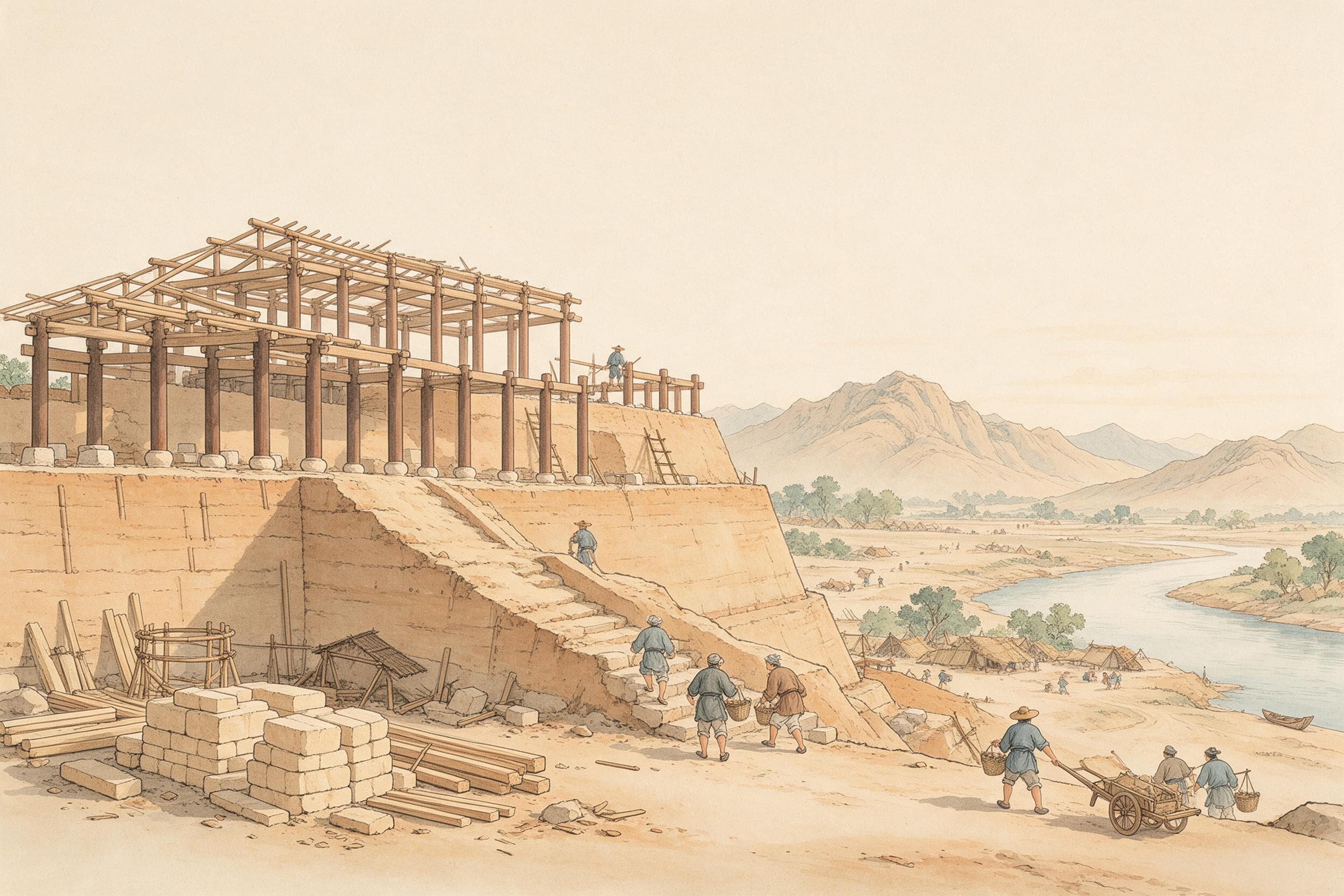
The largest number in either page is not a measurement of the building. Shiji 6: 'of convicts and palace labourers, more than seven hundred thousand men were divided to work on the Epang palace, or on Mount Li' (隱宮徒刑者七十餘萬人,乃分作阿房宮,或作麗山) — and the Sanfu huangtu repeats the sentence almost exactly. That is a labour force split between two projects, one a tomb; it says nothing about the size of the hall, and the two are kept apart. The same entry gives the materials: stone from the northern hills, timber from Shu and Jing. The 'more than three hundred li' belongs to the other book and to the detached palaces, not to the front hall; the Shiji for its part counts palaces rather than li — 'three hundred palaces within the passes, more than four hundred beyond' (關中計宮三百,關外四百餘).
What survives of Epang is a file of texts that do not match. Two widths, ten times apart; two accounts of who began the building; a name never formally given; beams of magnolia and a gate of lodestone, described for what they were meant to do; seven hundred thousand convicts divided between a palace and a tomb; and, on both pages, the plain statement that the palace was never finished. No dimension is converted here, no area computed, no site described: this is what the documents say, and the documents disagree. The building they describe has no date of completion, because it never had one.
Related reading:Ten Li, One Water Gate: Repairing the Bian Canal · Grain to Chang'an: How the Capital Was Fed · A County Before a Tomb: The Western Han's Tomb Towns
Sources & further reading
- 《史记》卷六·秦始皇本纪(西汉司马迁撰;维基文库本,未与点校本复核) — The entry for the thirty-fifth year: 'he then built a court palace in the Shanglin park south of the Wei. First he made the front hall at Epang: five hundred paces east to west, fifty zhang north to south; on top there was room to seat ten thousand men, below there was room to set up a five-zhang banner.' Then the gallery road to the Southern Mountains, the double road across the Wei, the statement that the palace was never finished and that a fine name was to be chosen once it was, and: 'of convicts and palace labourers more than seven hundred thousand were divided to work on the Epang palace, or on Mount Li.' Also the Second Emperor's resumption of the work, the protest of the two chancellors and General Feng Jie, and Sima Qian's closing verdict on Huhai.
- 《三辅黄图》卷一·秦宫(维基文库本,不署撰人、不标成书年代,未与点校本复核) — The Epang entry: King Huiwen built it and it was unfinished when he died; the First Emperor enlarged it until its extent reached more than three hundred li, with detached palaces and lodges filling the mountains, gallery roads to Mount Li, the Southern Mountains marked as gate-towers and the Fan river netted as a pond. Then 'he made the front hall at Epang: fifty paces east to west, fifty zhang north to south; on top one could seat ten thousand men, below one could set up a five-zhang banner', the beams of magnolia and the lodestone gate with its note (the north gate-tower, made wholly of lodestone so that envoys carrying hidden armour or blades would be stopped), the double road to Xianyang, the seven hundred thousand convicts, and a separate entry for a 'court palace' whose courtyard held a hundred thousand.