In the fourth month of the twelfth year of Yongping the emperor sent the palace builder Wang Wu to repair the Bian canal, 'from Xingyang to the mouth of the sea at Qiancheng' (自滎陽至于千乘海口). In the fourth month of the next year the canal was finished, and the emperor went in person to Xingyang to inspect the river works (行幸滎陽,巡行河渠). Between those two notices sits one of the largest water projects of the Han, and the account of it is split between two chapters of the same book — one an imperial annals, one a biography.
Sixty Years of a Broken Canal
The biography of Wang Jing begins the story earlier. 'At the beginning, in the time of Emperor Ping, the Yellow River and the Bian canal broke and were never repaired' (初,平帝時,河、汴決壞,未及得修). In the tenth year of Jianwu the magistrate of Yangwu, Zhang Si, asked for the work: 'the river has been broken a long time; day and month it eats away; the Ji canal has flooded several tens of counties. The cost of repair is not great' (河決積久,日月侵毀,濟渠所漂數十許縣…修理之費,其功不難). The Guangwu emperor called out labourers; then the magistrate of Junyi, Yue Jun, argued against it: 'now households are few and fields are wide; though it is not repaired, the harm is bearable. We have just suffered war, and to raise labour now… the people cannot bear it. It should wait for quiet' (今居家稀少,田地饒廣,雖未修理,其患猶可…宜須平靜,更議其事). The emperor stopped.
So the canal went on failing. 'Afterwards the Bian flowed east, and day by day and month by month spread wider, until the old places of the water gates all stood in the middle of the river' (後汴渠東侵,日月彌廣,而水門故處,皆在河中). The people of Yan and Yu complained that the government was always raising other works and never attending to what pressed them. By the twelfth year of Yongping the repair had become a matter of debate again.
The Man, the Books, the Work
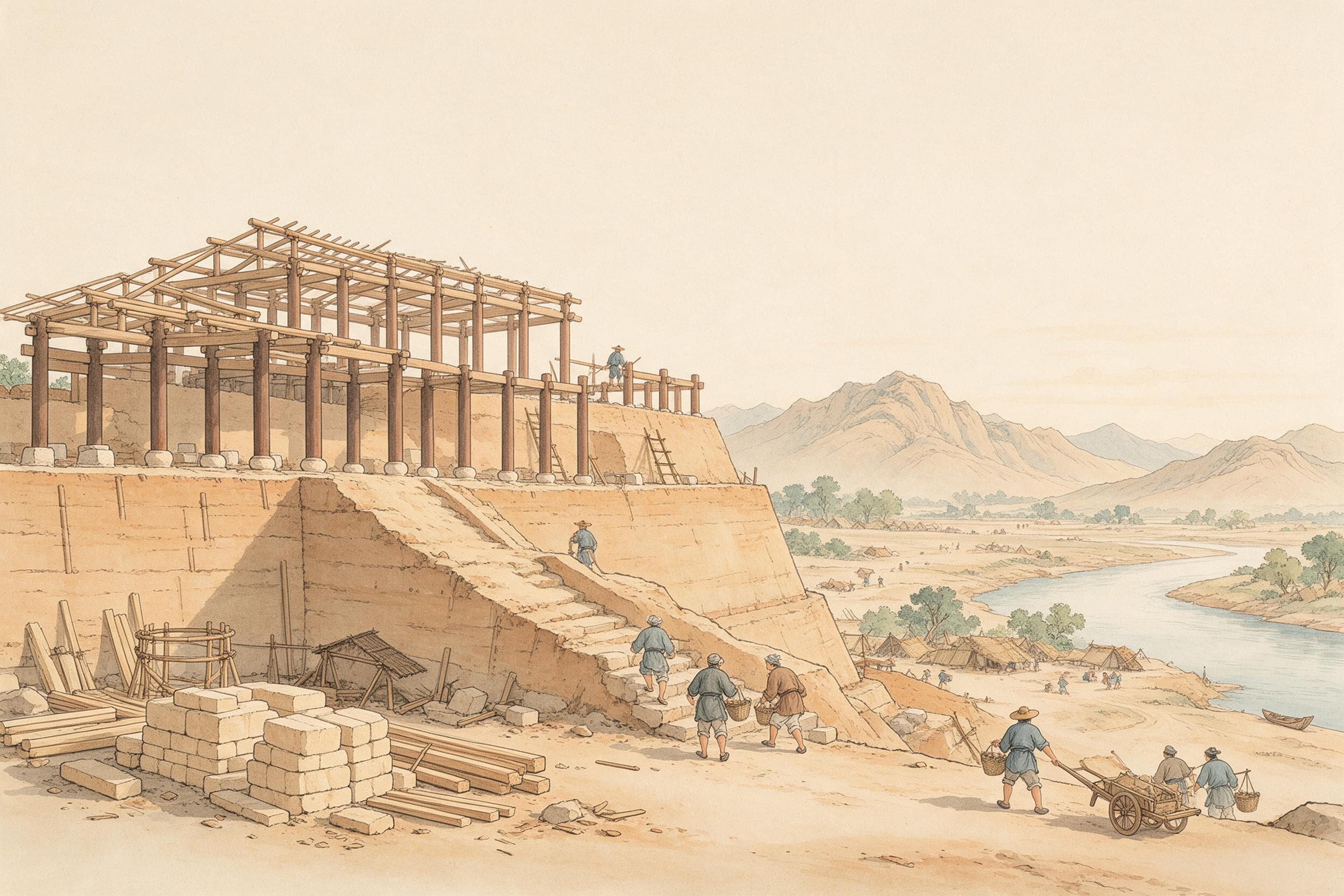
The court summoned Wang Jing and asked him about the lay of the water. He set out the advantages and difficulties 'quickly and to the point' (應對敏給), and the emperor was pleased. Because he had already repaired the works at Junyi with success, he was given the Shanhaijing, the 'Book of Canals and Channels' (河渠書) and a map of the Yugong, with money, silk and clothes (賜景《山海經》、《河渠書》、《禹貢圖》及錢帛衣物). The biography writes the passage like an appointment: first the question, then the gift, then the levies. Then, in summer, 'tens of thousands of labourers were raised, and Jing was sent with Wang Wu to repair the canal and build the embankments, from Xingyang east to the sea mouth at Qiancheng, more than a thousand li' (發卒數十萬,遣景與王吳修渠築堤,自滎陽東至千乘海口千餘里).
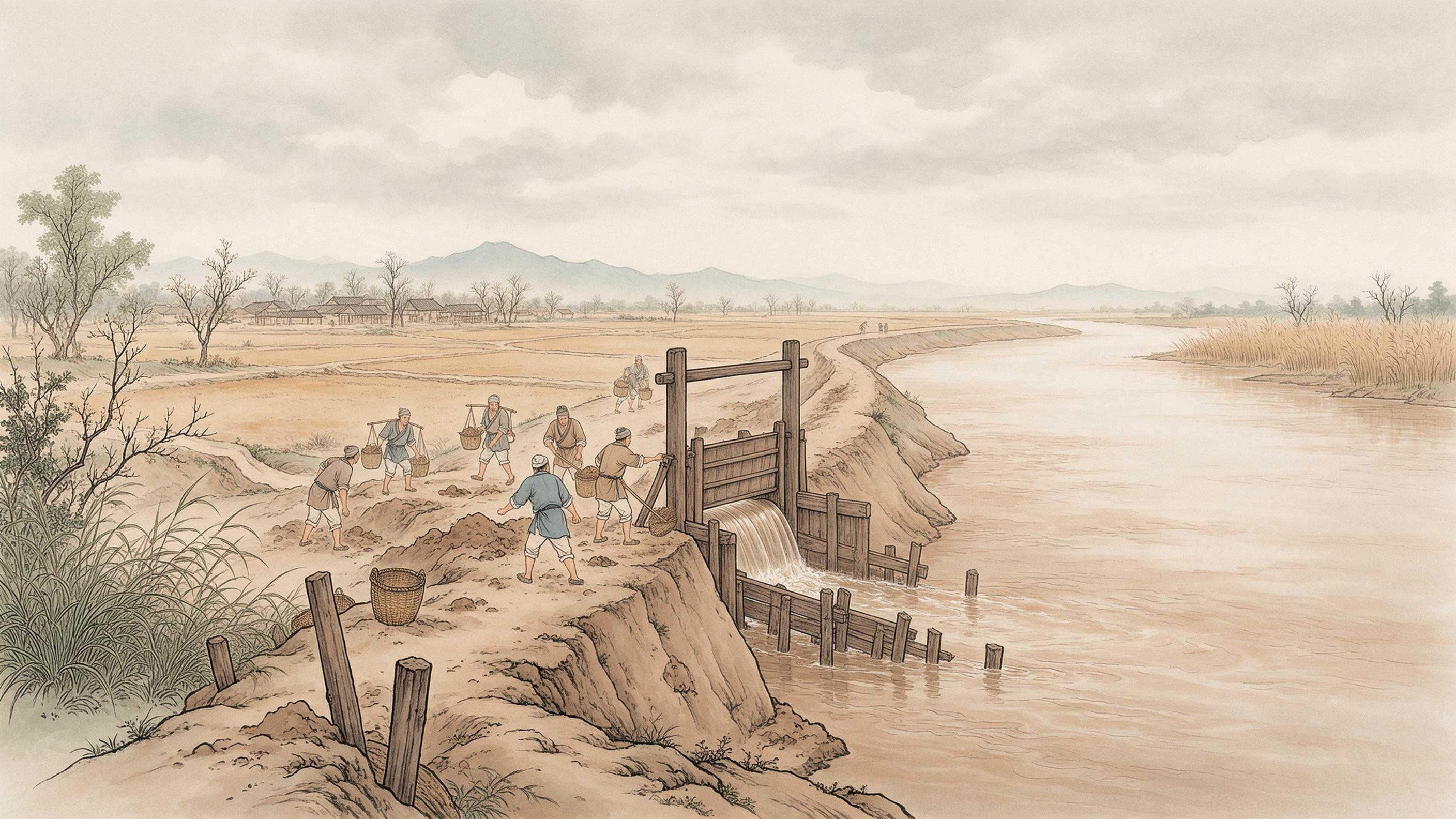
The biography gives the work as a string of verbs, without a single measurement of the channel: 'Jing then surveyed the lie of the ground, cut through hills, broke the standing reefs, straightened the gullies and streams, closed off the points of pressure, and opened the blockages' (景乃商度地勢,鑿山阜,破砥績,直截溝澗,防遏衝要,疏決壅積).
Then the one number in the middle of it: 'every ten li he set up a water gate, so that they should flow back into one another, and there was no further trouble of breach or leakage' (十里立一水門,令更相洄注,無復潰漏之患). Ten li to a gate, on a line more than a thousand li long; the gates were meant to take the force of the current out of each stretch of bank by letting the water pass back and forth between them. What a gate was made of, how wide it was, how it was opened and shut, the chapter does not say.
The Bill
The cost is given in four characters, with no breakdown and no unit stated: 'though Jing kept the labour and expense small, it still came to a hundred billion' (景雖簡省役費,然猶以百億計). The canal was finished 'in the summer of the next year' (明年夏,渠成). The emperor went himself to inspect it, and ordered the commanderies and kingdoms along the river to appoint river-embankment officers, 'as in the Western Han system' (詔濱河郡國置河堤員吏,如西京舊制). Wang Wu and the clerks under him each had their rank raised by one degree; Wang Jing was promoted three times to attendant censor.
The annals' version of the finished work is the emperor's edict. 'Since the Bian canal broke, more than sixty years have passed' (自汴渠決敗,六十餘歲); the water flowed east, the old water gates stood in the river, the flood 'spread wide, and the banks could not be found' (漭瀁廣溢,莫測圻岸). The edict also recalls the arguments it had to settle: that the government was always raising other works and never the pressing one, and that the water might be left to go where it would, with people moving to the high ground (宜任水埶所之,使人隨高而處). Now, the edict says, 'the embankments have been built and the channel ordered, the water cut off and the gates set up, and the river and the Bian flow apart, each in its old course' (今既築隄理渠,絕水立門,河、汴分流,復其舊跡). It ends with an instruction about the fields: 'the low fields along the canal are to be given to the poor, and the great families are not to be allowed to hold them as their own profit' (濱渠下田,賦與貧人,無令豪右得固其利).
Two Chapters, One Work
The two pages do not tell the same story in the same shape. The annals name only one officer for the work — 'Wang Wu, palace builder and messenger' — and record the dates and the edict; the biography names Wang Jing as the man who surveyed the ground, gives the string of verbs, the ten-li gates and the bill, and puts Wang Wu second in the phrase 'Jing with Wang Wu' (景與王吳). Both are printed here; the pages do not say which of the two was in charge, nor what Wang Wu himself did.
Nor do they agree on what is worth counting. The biography gives labourers in tens of thousands, a length in a thousand li, a gate every ten li, and a cost in hundreds of billions; the annals give no length, no labour, no cost, and only the one phrase 'more than sixty years' for the time the canal had been broken. The channel's width and depth, the number of days the work took, and the number of men who died at it are not in either page.
What the Pages Do Not Give
Neither page is a construction report. There is no plan, no section, no list of materials, no wage, and no measurement of the finished canal; the 'hundred billion' is a total without a breakdown, and the 'tens of thousands' is a round figure without a muster. The edict promises the bank fields to the poor; whether they got them, the pages do not say. What is left is a sequence of verbs and three numbers: a thousand li, ten li to a gate, a hundred billion. The canal was finished in the summer of a year and inspected by an emperor, and the biography's last word on Wang Jing is that he was made a river-embankment messenger and given horses, silk and money. Whether the gates held after that year, the pages do not answer.
Related reading:Grain to Chang'an: How the Capital Was Fed · A County Before a Tomb: The Western Han's Tomb Towns · Ditches with Names: Draining a Field by the Zhouli
Sources & further reading
- 《后汉书》卷二·显宗孝明帝纪(南朝宋范晔撰;维基文库本,未与点校本复核) — The annals' notices: in the fourth month of Yongping 12 the palace builder Wang Wu was sent to repair the Bian canal from Xingyang to the sea mouth at Qiancheng; in the fourth month of Yongping 13 the canal was finished, the emperor went to Xingyang to inspect the works, and the edict says the canal had been broken 'more than sixty years', that the embankments were built and the gates set so that river and canal flowed apart again, and that the low fields along the canal were to go to the poor.
- 《后汉书》卷七十六·循吏列传·王景(南朝宋范晔撰;维基文库本,未与点校本复核) — Wang Jing's biography: the canal broken since Emperor Ping, Zhang Si's request in Jianwu 10 and Yue Jun's objection; the interview at court in Yongping 12 and the gift of the Shanhaijing, the Book of Canals and Channels and a map of the Yugong; tens of thousands of labourers, Jing with Wang Wu, more than a thousand li from Xingyang to Qiancheng; the survey, the cutting and opening; a water gate every ten li 'so that they flow back into one another'; the cost 'counted in the hundreds of billions'; the canal finished the next summer; the river-embankment officers after the Western Han pattern.