In the Zhanguoce's Yan chapter, a map is a ticket of admission. Jing Ke tells the crown prince: 'if I could truly get General Fan's head, together with the map of Yan's Dukang territory, and present them to the King of Qin, he will certainly be pleased and grant me an audience' (誠能得樊將軍首,與燕督亢之地圖獻秦王,秦王必說見臣). To see the king you had to bring two things: a head and a map. The map was not there to be consulted; it was there to buy one audience — a map to be given away, not a map on a wall.
A map as a ticket
The map was prepared in advance. Jing Ke sees Fan Yuqi privately, Fan cuts his own throat, and 'the head was taken up and boxed and sealed' (函封之). The dagger was prepared too: the crown prince 'sought out the sharpest daggers under heaven, got one from Xu Furen of Zhao for a hundred pieces of gold, and had the smith steep it in poison… a smear of blood and a man died at once' (血濡縷,人無不立死者). Then 'Qin Wuyang was made his second'. Map, head and dagger are all props of the same errand, and the cast is complete.
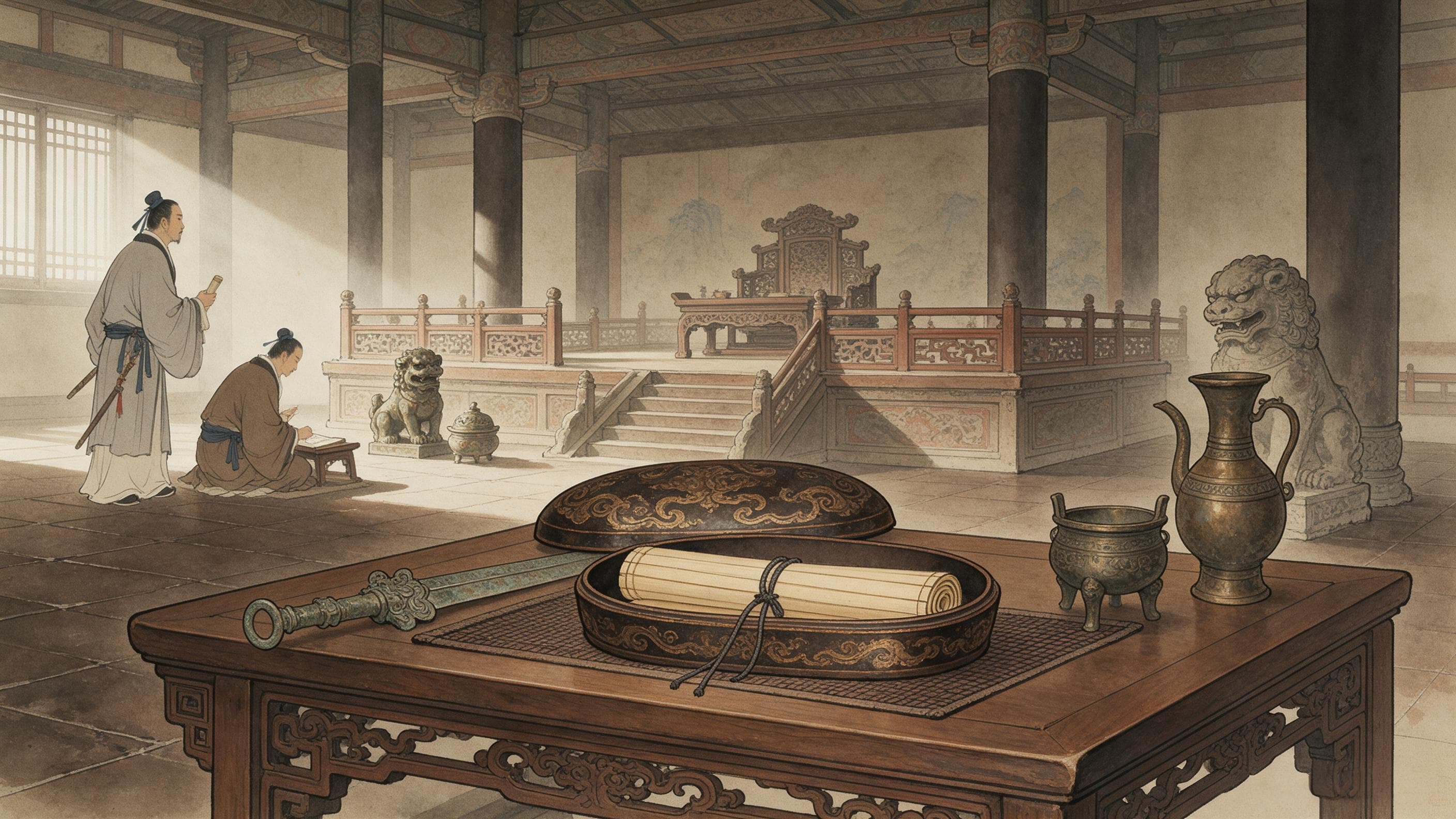
At Qin the handling of the map is recorded in detail. Meng Jia tells the king that the King of Yan 'has cut off Fan Yuqi's head and presents the map of Yan's Dukang territory, boxed and sealed, the King of Yan bowing and sending it from his court, sending an envoy to inform the great king' (謹斬樊於期頭,及獻燕之督亢之地圖,函封). The king 'puts on court dress, sets out the nine guests, and receives the envoys of Yan in the Xianyang palace'; and as they advance, 'Jing Ke carried the box with Fan Yuqi's head, and Qin Wuyang carried the map box, and they came forward in order to the steps' (秦武陽奉地圖匣,以次進至陛下). The map is part of the entry, placed inside the ceremony.
Unrolling: at the end of the map, the dagger
The essential sentences, as written. Wuyang's colour changes; 'Jing Ke turned and smiled at Wuyang and stepped forward to apologise for him.' The king says, 'rise, take the map Qin Wuyang is holding'; 'Jing Ke took the map and presented it, unrolled the map, and at the end of the map the dagger appeared. Then with his left hand he seized the king's sleeve and with his right held the dagger and struck at him. Before it reached his body the king started, drew back and rose, and the sleeve tore away' (發圖,圖窮而匕首見……絕袖). 發 is to unroll, 窮 is to reach the end; the dagger is at the end of the roll. Note the string of verbs — take, present, unroll, end, appear — one after another, not an adjective among them. Here the map is a container: it wraps the weapon, and it wraps the whole reason for the audience.
The idiom and the text must be kept apart. The text has one sentence of five characters: 'the map was unrolled to its end and the dagger appeared' (圖窮而匕首見). Later usage squeezes this into four characters, 图穷匕见, and uses it as a metaphor for the truth coming out at the last. That is a later summary, not the original; the original simply gives one action after another — take the map, unroll it, reach the end, the dagger shows. What is quoted here is the sentence, not the idiom.
The other page: maps as government property
In the Rites of Zhou's chapter on the minister of education, a map is something else entirely. The Grand Minister 'has charge of establishing the map of the land of the state and the number of its people, to aid the king in tranquillising the state' (掌建邦之土地之圖,與其人民之數); and 'by the map of the land under heaven he knows comprehensively the numbers of the regions and the breadth and length of the nine provinces, and distinguishes the names and things of mountains and forests, rivers and marshes, hills and mounds, dikes and lowlands, plains and wet grounds' (以天下土地之圖,周知九州之地域廣輪之數). Here the map is the state's own register, and it stands in one sentence beside the count of the people.
Its uses are listed one by one: 'in disputes among the people, the neighbourhood decides them; in disputes over land, the map decides them' (地訟,以圖正之); the officer Tu Xun 'has charge of expounding the map of the land, to instruct on the affairs of the land' (掌道地圖,以詔地事); the Superintendent of Fields 'by the map of the land lays out the fields and makes the rules for counties and villages' (以土地之圖經田野,造縣鄙形體之法); the mining officer, when ore is taken at the proper season, 'marks the ground and gives a map of it' (圖而授之). Litigation, tours of inspection, laying out fields, mining — the map is in all of it. But these are job descriptions, not cases: who judged a case with a map, or how a map was drawn, this page does not give.
Between the two pages
Both pages are later texts, and their layers must be separated. The Zhanguoce is a Han compilation of materials about the persuaders (this is generally held), and the story of Jing Ke is narrative; the Rites of Zhou is a design for offices from between the Warring States and the Han (this is generally held), not an archive of practice. So a map as a token belongs to a story, and a map as state property belongs to a job description. Both speak of maps; neither gives a map's material, size, method of drawing or filing.
Dukang, and the gaps
And Dukang itself? The main text gives only 'the map of Yan's Dukang territory' — a place name, with no location. The page's smaller-type notes do carry several identifications (Bao Biao's note citing the later gazetteer, the Zhengyi, Liu Xiang's catalogue, and so on), placing it in Zhuo commandery or south-east of Fanyang in Youzhou, and calling it rich farmland; but those are notes, not main text. This article does not use the notes as text, and does not guess the location: it writes as far as the main text goes.
What neither page gives: the physical map, how it was drawn, its size, its material, the filing system, or where Dukang lay on the map. The gaps are listed, not filled; no map is named and no mapmaker is named. In the story a map is a ticket and a container for a weapon; in the job descriptions it is the evidence for a lawsuit and the basis for planning; between the two uses lies a whole apparatus of surveying and archiving that was never written down.
Related reading:Building Luoyi: Divination First, Then the Lines, Then Two Oxen · How a Rammed-Earth Wall Was Built: The Walls, Gates and Moat of Han Chang'an · Ten Li, One Water Gate: Repairing the Bian Canal
Sources & further reading
- 《战国策·燕策三》荆轲刺秦王章(士礼居丛书本,维基文库录文,未与点校本复核) — The map as the price of admission. Jing Ke tells the crown prince: 'if I could truly get General Fan's head, together with the map of Yan's Dukang territory, and present them to the King of Qin, he will certainly be pleased and grant me an audience' (誠能得樊將軍首,與燕督亢之地圖獻秦王,秦王必說見臣). At Qin, Meng Jia announces that Yan has 'cut off Fan Yuqi's head and presents the map of Yan's Dukang territory, boxed and sealed' (謹斬樊於期頭,及獻燕之督亢之地圖,函封); the king puts on court dress, sets out the nine guests, and receives the envoys. 'Jing Ke carried the box with Fan Yuqi's head, and Qin Wuyang carried the map box, and they advanced in order to the steps' (秦武陽奉地圖匣,以次進至陛下). The king says 'rise, take the map Qin Wuyang is holding'; Jing Ke takes it and presents it, 'unrolls the map, and at the end of the map the dagger appeared' (發圖,圖窮而匕首見). The page carries Bao Biao's and Wu Shidao's notes in smaller type; only the main text is quoted here.
- 《周礼·地官司徒》(维基文库本,未与点校本复核) — Maps as government property. The Grand Minister of Education 'has charge of establishing the map of the land of the state and the number of its people, to aid the king in tranquillising the state' (掌建邦之土地之圖,與其人民之數), and 'by the map of the land under heaven he knows comprehensively the numbers of the regions and the breadth and length of the nine provinces, and distinguishes the names and things of mountains and forests, rivers and marshes, hills and mounds, dikes and lowlands, plains and wet grounds' (以天下土地之圖,周知九州之地域廣輪之數). Elsewhere in the chapter: 'in disputes over land, the map decides them' (凡民訟,以地比正之;地訟,以圖正之); the officer Tu Xun 'has charge of expounding the map of the land, to instruct on the affairs of the land' (掌道地圖,以詔地事); the Superintendent of Fields 'by the map of the land lays out the fields and makes the rules for counties and villages' (以土地之圖經田野,造縣鄙形體之法); the mining officer, when ore is taken, 'marks the place and gives a map of it' (則物其地,圖而授之).