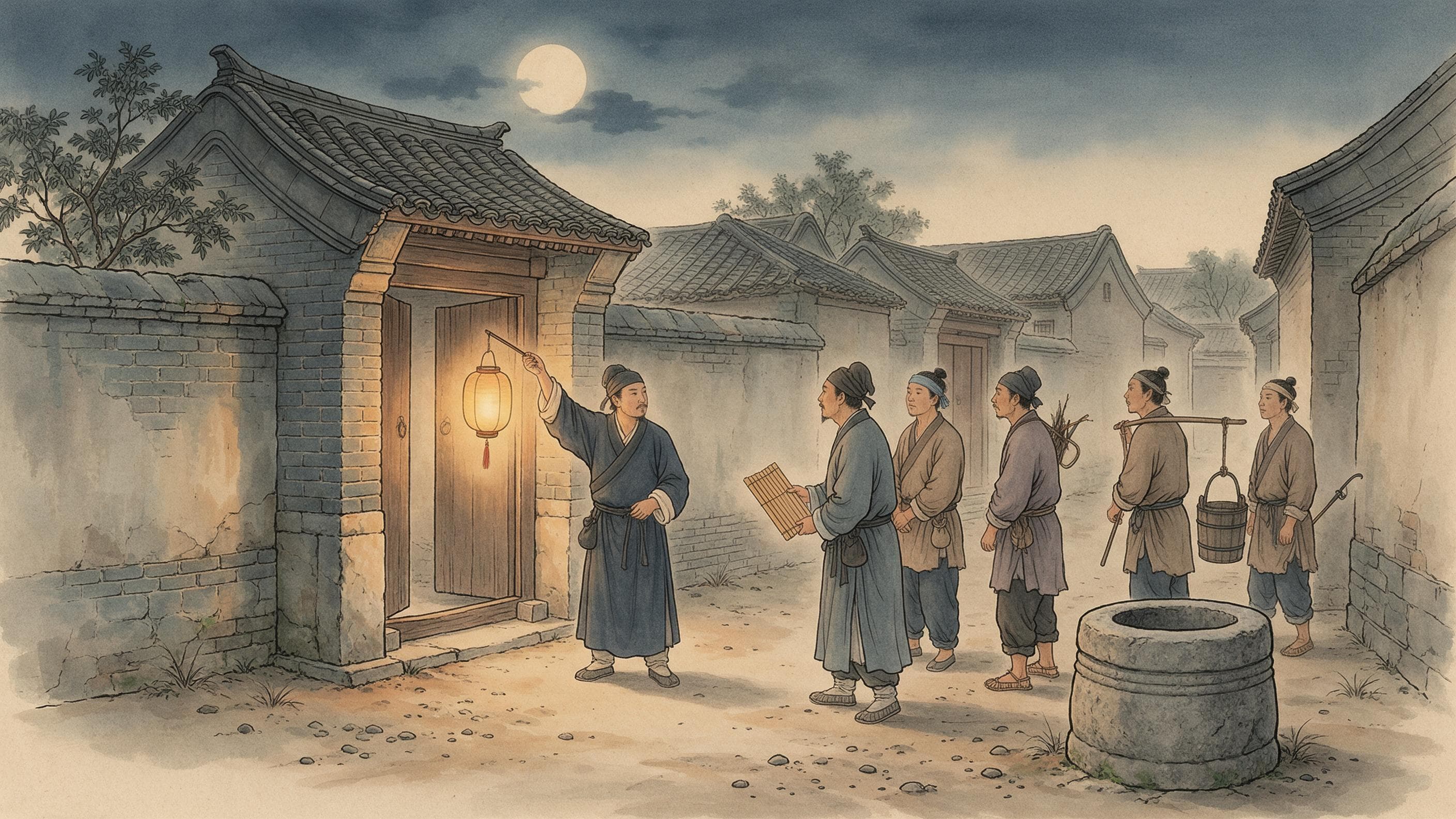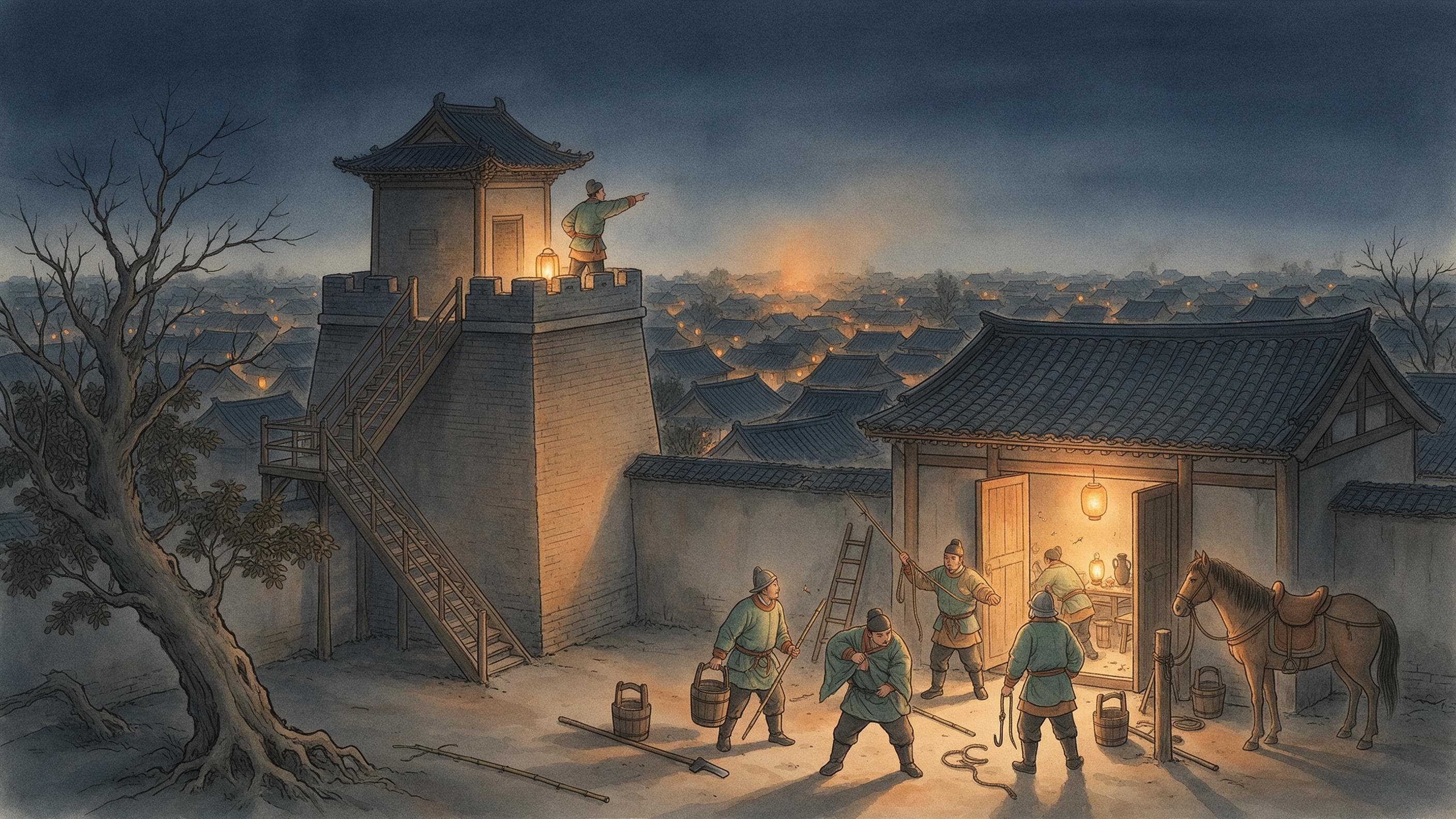
In the Northern Song capital of Kaifeng, fire protection was measured in paces. Every three hundred paces along a lane or ward stood a junxun pu (軍巡鋪), a patrol post with five soldiers who walked their beat at night. Three hundred Song paces come to about four hundred and seventy metres, by a conversion from the Song foot. Above the crowded quarters rose brick watchtowers, wanghuo lou (望火樓): a lookout at the top, and below, in a few rooms of official housing, more than a hundred troops quartered with the tools of the trade. This is not a description of an emergency. It is a standing arrangement, and Meng Yuanlao, writing after Kaifeng fell in 1127, set it down as it had been.
Five men to three hundred paces
The patrol post was a military unit, not a neighbourhood committee. Five men to a post, with orders to patrol at night and to handle official business that came their way. The three hundred paces were the spacing between posts, not the length of a wall: about 470 metres apart, if the conversion holds. It is an estimate, since it depends on the length of the Song foot, which is generally put at roughly 31 centimetres, five to a pace.
The tower stood "in a high place". How high, how many towers there were, where they were placed — the text does not say. Below each tower were several rooms of government housing and a hundred-odd troops. Whether that hundred was posted at each tower or was the total, the sentence does not settle, and it should not be given an "each".
The alarm was a flag code
In Lin'an, the Southern Song capital, the system was finer. Patrol posts came every two hundred-odd paces, with three to five soldiers each. Their duties were wider than fire: they watched for thieves and for street trouble, and anyone with a complaint could come to the post, which referred the matter to the ward office for trial.
Lin'an divided the city into yu (隅), fire districts. Each had a fangyu guanwu (防隅官屋), an official fire station with troops quartered in it, and watchtowers, with soldiers assigned to the lookout in rotation. The list runs to more than twenty districts: the east district's tower stood south of the tax office at Chaiduo Bridge, the west district's at the White Turtle Pond, the prefectural district's against the left wall of the prefect's compound, the west-city district's outside Qiantang Gate at Qinghua Bridge.
The alarm itself was positional, not vocal. Where there was smoke, flags pointed the direction; at night the flags became lamps. Three flags for inside the Chaotian Gate, two for outside the gate, one for beyond the wall — and at night three lamps, two, one, the same three grades. A whole city could read a fire's location from a tower top. That is not a shout. It is a code.
Lin'an's spacing is shorter than Kaifeng's, and this is not a copying error. They are two cities under two governments: Kaifeng three hundred paces, Lin'an two hundred-odd. The same passage of the Meng Liang Lu explains why the risk differed: Lin'an's houses were "tall and dense, joined eave to eave, with not a foot to spare, the lanes blocked and the alleys too narrow to walk". Denser housing and narrower lanes meant higher risk, and shorter spacing may follow from that. The book does not say so directly; that is an inference. The two figures cannot be averaged into a "Song standard".
What stood in the shed
The equipment survives as a list of names: large and small buckets, sazi (洒子), hemp mops (mada, 麻搭), axes and saws, ladders, fire forks (huocha, 火杈), heavy ropes, and iron "cats" (tie mao'er, 鐵貓兒). The text does not explain their uses. The usual accounts, and inference from the shapes, go like this: the buckets carried water; the hemp mop was a long pole trailing loose hemp, soaked and used to beat at flames; the fork pried apart burning beams; rope and iron hook were for pulling down a house or dragging a beam clear to make a break. These are received explanations, not Song instructions.
Even the words shifted in copying: the SK1074 edition has 洒子 and 火杈, where the Wikisource text reads 酒子 and 火叉. The names are less stable than the objects.
The report went by horse
In Kaifeng the chain is written into the same short entry. Whenever a fire broke out, cavalry rode to report it; the commander of the military ward (軍廂主), the cavalry and infantry, the three palace commands (殿前三衙) and the prefectural government each led troops to fetch water and put it out. Four columns, one fire — the capital's garrison was written directly into the fire service. The entry ends with a claim of Meng's own: the people were not put to work. That describes how the system was meant to run, not proof that residents never joined a bucket line; rules differed between periods, and it should not be read as a Song ban on civilians fighting fires.
Lin'an added a layer of command. When smoke was sighted, the military governor (shuai chen, 帥臣) went to the district in person with six companies from the prefectural compound, joined by the officers and men of the four household bodyguard companies and a dacai dui (搭材隊), a squad for pulling down buildings, all taking orders together. Rewards were paid afterwards; anyone who did not exert himself was punished under military law. At the fire stood the army, the civil government and an inspectorate of blame.
The bill, and what is missing
Why a standing force was worth its cost is in the Song Shi. In 1074 a fire in the offices of the Three Commissions (三司) burned from mid-morning to dusk, destroyed 1,800 bays of buildings and consumed the office's paper records. In 1085 fire broke out at the Kaibao Monastery, where the Ministry of Rites had lodged its examination hall: three examiners — Zhai Man, Chen Zhifang and Ma Ximeng — were burned to death, with fourteen clerks and soldiers. In 1208 a fire in Lin'an burned 58,097 households across more than ten li, killed fifty-nine people, destroyed seven-tenths of the city's buildings and left officials living on boats.
Then the record stops. The pay and rations of the patrol soldiers are in neither book. The total strength is not given; nor the list of posts in Kaifeng; nor any training or drill; nor how equipment was maintained or replaced; nor any count of fires — the Song had nothing like modern fire statistics, only entries in the Five Phases treatise, selected and uneven.
What survives is a geometry: five men, three hundred paces, a count of flags, a lamp at night. How it ran, what it cost, who climbed the towers in the dark — the ledger does not say. The archive kept the machine and lost the men.
Sources & further reading
- 孟元老《东京梦华录》卷三「防火」(Meng Yuanlao, Dongjing Meng Hua Lu, juan 3, "Fire Prevention") — Patrol posts, brick watchtowers, the firefighting equipment, the cavalry report and the four columns that turned out.
- 吴自牧《梦粱录》卷十「防虞巡警」(Wu Zimu, Meng Liang Lu, juan 10, "Fire Watch and Patrols") — Lin'an patrol posts, fire stations, the flag-and-lamp signal code, the list of fire districts and the chain of command.
- 脱脱等《宋史》卷六十三《五行二上·火》(Tuotuo et al., Song Shi, juan 63, "Five Phases II: Fire") — Major fires in Kaifeng and Lin'an, with casualties and buildings destroyed.
- 马泓波《略谈宋代的消防制度》,《光明日报》2010-02-09 (Ma Hongbo, "A Brief Discussion of Song Firefighting", Guangming Daily, 9 February 2010) — Secondary study; its figures must be checked against the original texts and are not relied on in the body.
- 孟元老《东京梦华录》卷三「防火」(维基文库本,异文对照)(Meng Yuanlao, Dongjing Meng Hua Lu, juan 3, Wikisource edition, for textual comparison) — This edition reads 酒子 and 火叉 where SK1074 reads 洒子 and 火杈.