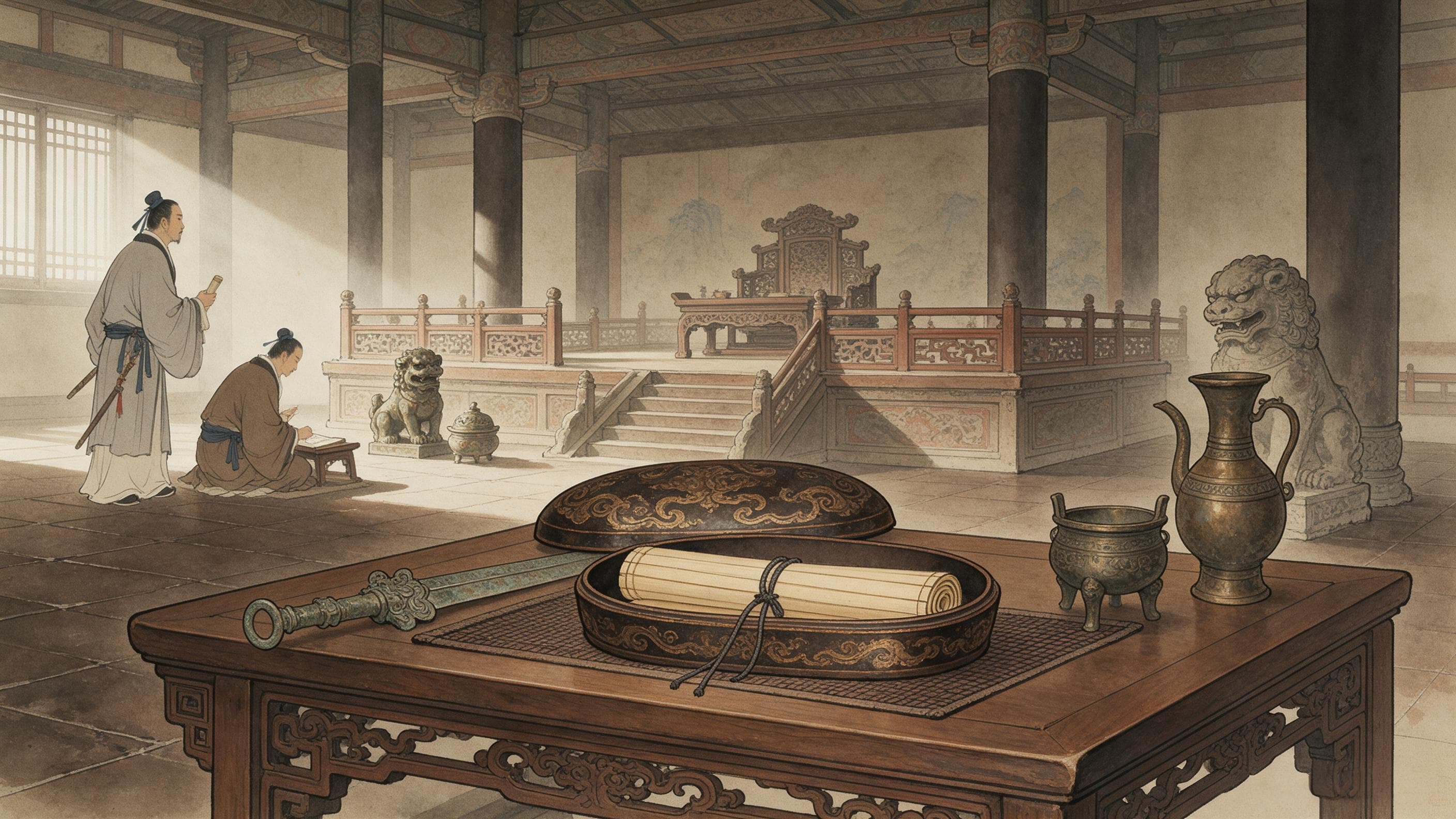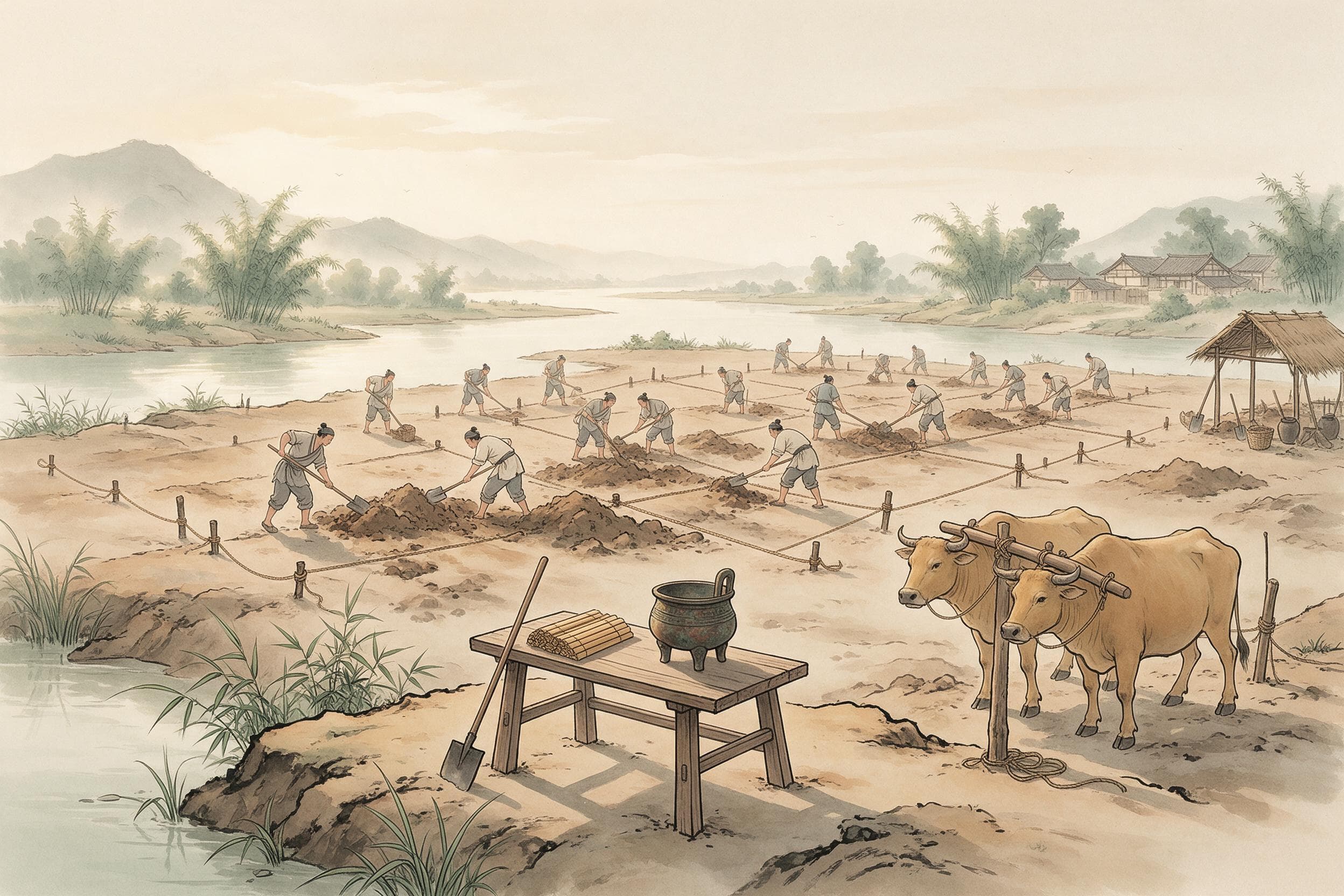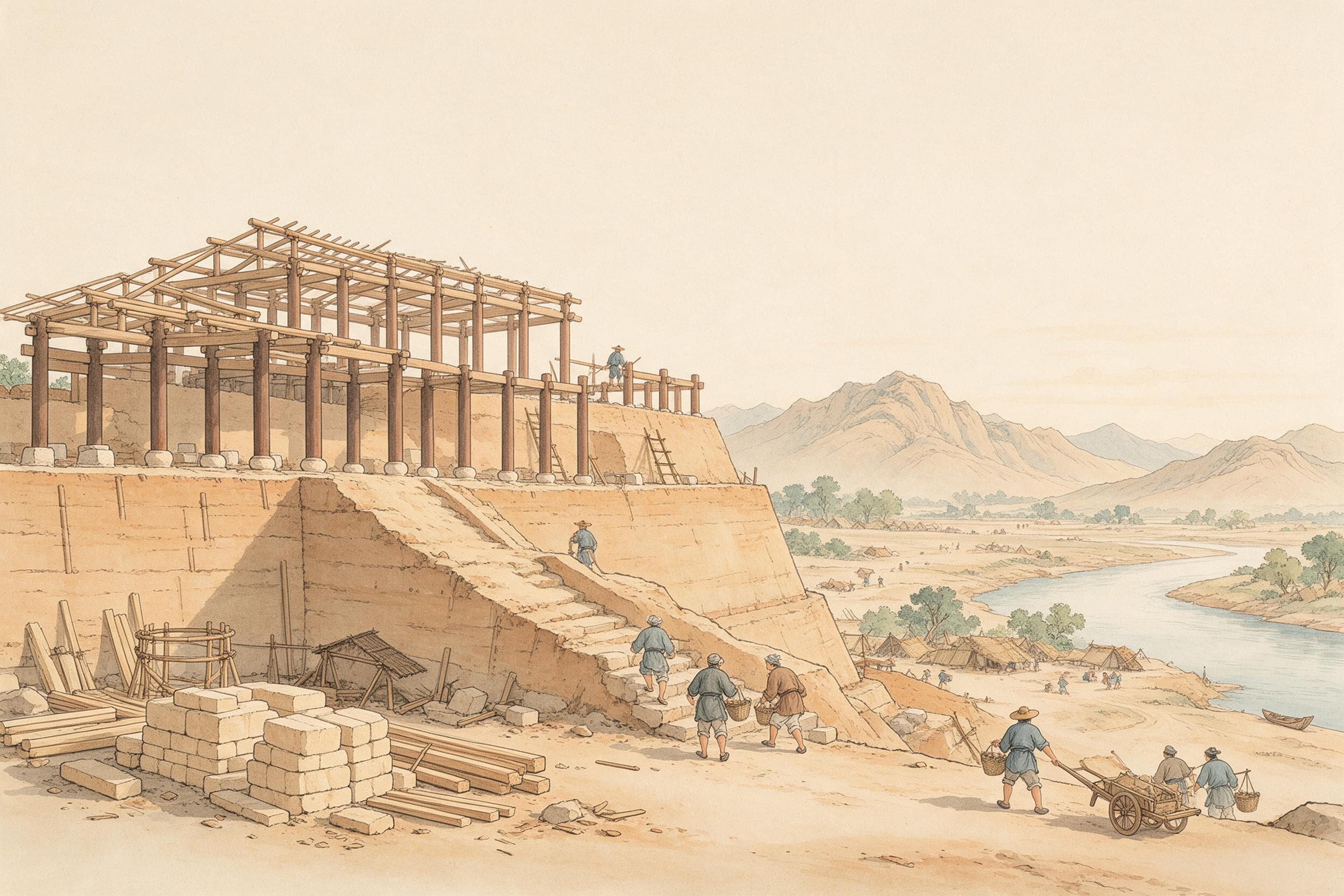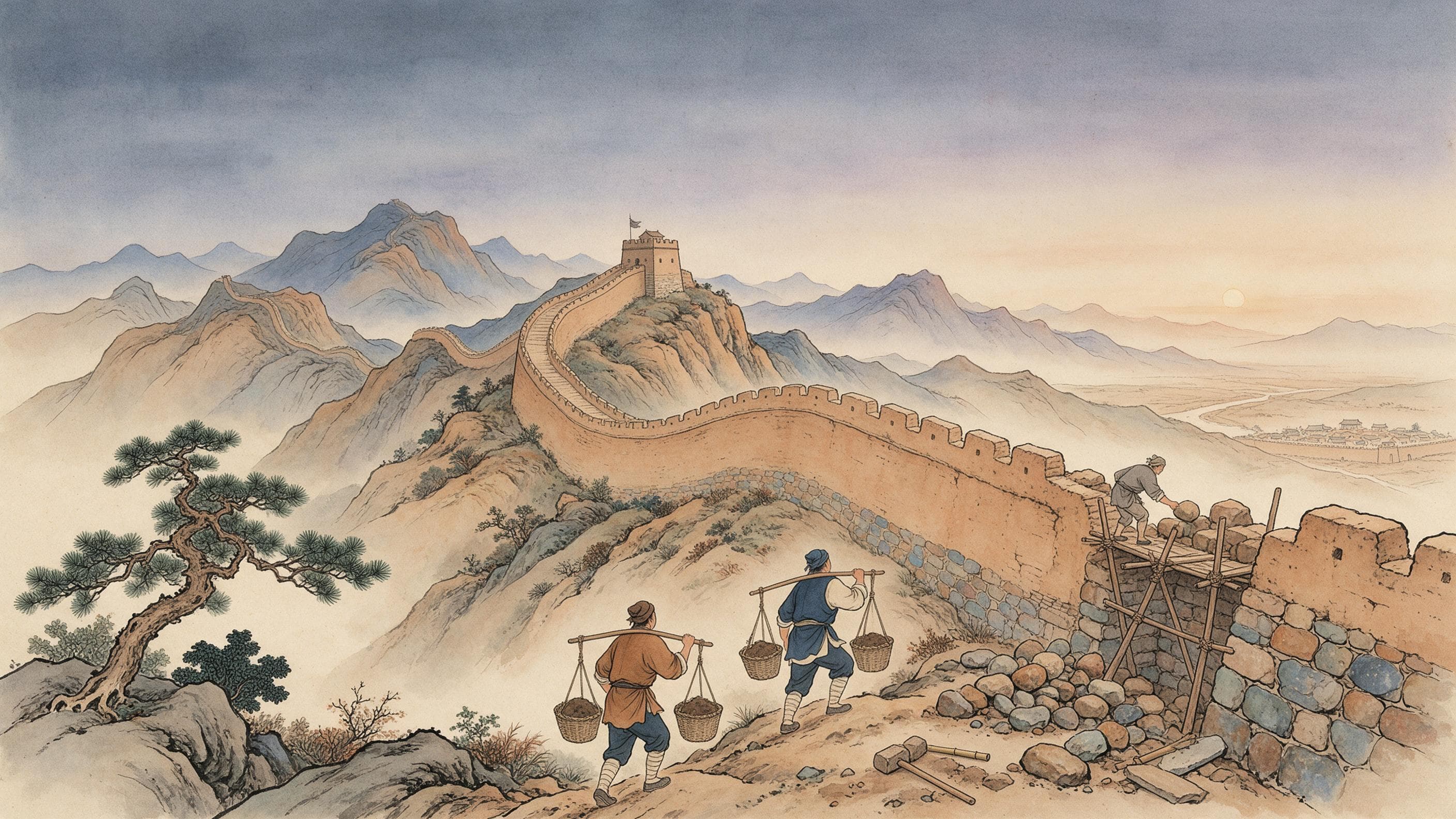
One sentence: 'the wall was built following the ground, using the passes as defences, from Lintao to Liaodong, stretching more than ten thousand li' (筑長城,因地形,用制險塞,起臨洮,至遼東,延袤萬餘里) — from the Shiji's life of Meng Tian. The distance is printed as it stands, not converted into kilometres or any other measure. This article treats the wall itself and how it was built; the passes and the imperial roads are separate subjects, fenced off here and not opened. As for the tale of Meng Jiangnü, it is a later legend, absent from both pages, and is not pursued.
The Method and the Extent in One Sentence
Put the sentence back in its place: 'after Qin had united the realm, Meng Tian was sent with three hundred thousand men north to drive out the Rong and Di and take the land south of the bend. The wall was built following the ground, using the passes as defences, from Lintao to Liaodong, stretching more than ten thousand li. Then the river was crossed, the Yang mountains occupied, and the line wound north. The army was kept in the field more than ten years and stationed at Shang commandery' (秦已并天下……暴師於外十餘年,居上郡). Three hundred thousand is the army sent north; 因地形,用制險塞 is the principle — follow the ground and turn the naturally strong points into defences. Lintao at one end, Liaodong at the other, 'more than ten thousand li' as it stands. How high or thick the wall was, what earth was used, how many layers were rammed, how much earth was moved — none of that is on the page.
The Book of Han's treatise on the Xiongnu gives another version, with three more practices: 'following the mountain barriers, cutting the valleys, repairing what could be repaired, from Lintao to Liaodong more than ten thousand li' (因邊山險,塹谿谷,可繕者繕之……). The four characters 可繕者繕之 matter: old walls were taken up and used. The same passage adds the supporting works: 'making the river the defence, building forty-four county towns on the river and moving convicts to fill them' (因河為塞,築四十四縣城臨河,徙適戍以充之), and 'again crossing the river to hold the Yang mountains and the northern lands'. Both versions are printed; they are not fused.
The Wall Did Not Begin with the First Emperor
The Book of Han first records three earlier walls. Under King Zhao of Qin, with Longxi, Beidi and Shang commandery in hand, Qin 'built a long wall to keep out the Hu' (築長城以距胡). King Wuling of Zhao 'changed customs and wore Hu dress, practised archery on horseback, broke the Linhu and Loufan in the north, and from Dai along the Yin mountains to Gaoque made a frontier', setting up Yunzhong, Yanmen and Dai commanderies. After the Yan general Qin Kai broke the Eastern Hu, 'Yan also built a long wall, from Zaoyang to Xiangping', with Shanggu, Yuyang, Youbeiping, Liaoxi and Liaodong commanderies behind it. At that time, of the seven warring states, three bordered the Xiongnu. Only then comes the First Emperor, 'following the mountain barriers… repairing what could be repaired'.
So the wall was not raised from nothing: Qin, Zhao and Yan each had stretches already, and the First Emperor's line was built on them by repairing what could be repaired. Which stretch was new and which was repaired, the two pages do not divide; how the stretches were joined, or where, they do not say. No sectioning is supplied here.
The Men and the Cost
For labour there is one number: 'three hundred thousand men sent north'. That is the army of the northern campaign, not a workforce for wall-building; how many labourers built it, how much earth was moved, how many died, neither page says. No construction technique is added here, and no volume of earth.
Each page carries one judgement, and each must be attributed. Meng Tian before his death: 'from Lintao to Liaodong the wall and moat run more than ten thousand li — somewhere in all that, did I not cut the earth's veins? This is my crime' (此其中不能無絕地脈哉?此乃恬之罪也) — his own words, the charge he makes against himself, not a statement of fact. Sima Qian at the end of the chapter: 'I went to the northern frontier and came back by the straight road, and saw what Meng Tian built for Qin — the wall, the watchtowers, the cutting of mountains and filling of valleys, the straight road: truly he made light of the people's strength' (固輕百姓力矣). That is a historian's judgement, not a statistic.
What Became of the Wall
The Book of Han also follows the aftermath. After Meng Tian's death, 'the feudal lords rebelled against Qin, the realm was in disorder, and all those Qin had moved to the frontier went away again; the Xiongnu thus had room, and gradually crossed the river south, with the old frontier as the boundary with China' (諸秦所徙適邊者皆復去……與中國界於故塞). Under Emperor Wu, the Han 'again repaired the old defences built by Meng Tian for Qin, and made the river their stronghold' (復繕故秦時蒙恬所為塞,因河而為固). The wall was abandoned and repaired again; the pages give no detail of the fabric's later condition, and do not describe what the wall later became.
What Neither Page Gives
Neither gives the wall's height or thickness, its rammed-earth method, the arrangement of beacon towers and barriers, the volume of earth, the number of labourers or deaths, how many convicts were moved into the forty-four county towns, or a division between new building and repair; excavation and survey are not in the materials. Distances are printed as they stand, not converted into kilometres. No modern language about the wall as a symbol of the nation is used, and Meng Jiangnü is fenced off in one clause as a later legend that neither page contains.
Nor do the pages say how wall and straight road worked together — they are recorded side by side, with no relation given — or what happened between Qin and the Han repairs, or what a pass looked like. What can be written is this: the principle (follow the ground, use the passes, repair what can be repaired), the extent (Lintao to Liaodong, more than ten thousand li), the supporting works (the river as defence, forty-four county towns, convict settlers), the army (three hundred thousand sent north), one self-accusation by Meng Tian, and one judgement by Sima Qian.
On one side the method, on the other the verdict. 'Following the ground, using the passes as defences' says how the line was laid to the land; 'truly he made light of the people's strength' says what it cost. Both sentences are in the same book, a chapter apart; what the wall itself looked like, neither page says.
Related reading:The Dukang Map: How a Warring States Map Was Used · Building Luoyi: Divination First, Then the Lines, Then Two Oxen · How a Rammed-Earth Wall Was Built: The Walls, Gates and Moat of Han Chang'an
Sources & further reading
- 《史记》卷八十八·蒙恬列传(西汉司马迁撰;维基文库本,页面白文无注,未与中华书局点校本复核) — Meng Tian's biography: after Qin united the realm, 300,000 men were sent north against the Rong and Di and the land south of the bend was taken; 'the wall was built following the ground, using the passes as defences, from Lintao to Liaodong, stretching more than ten thousand li'; then the Yellow River was crossed, the Yang mountains occupied, and the army kept in the field more than ten years at Shang commandery. The same juan records the straight road from Jiuyuan to Ganquan, 'cutting mountains and filling valleys, 1,800 li', unfinished; Meng Tian's last words, that from Lintao to Liaodong the wall and moat ran more than ten thousand li and must somewhere have cut the earth's veins; and Sima Qian's own judgement after travelling the northern frontier, that the wall, the watchtowers and the straight road 'truly made light of the people's strength'.
- 《汉书》卷九十四上·匈奴传(东汉班固撰;维基文库本,页面白文无注,未与中华书局点校本复核) — The Xiongnu treatise gives the earlier walls — Qin under King Zhao 'building a long wall to keep out the Hu', Zhao Wuling from Dai along the Yin mountains to Gaoque, Yan from Zaoyang to Xiangping, each with commanderies set up behind it — and then the First Emperor's work: taking the land south of the bend, 'making the river the defence, building forty-four county towns on the river and moving convicts to fill them', opening the straight road from Jiuyuan to Yunyang, and 'following the mountain barriers, cutting the valleys, repairing what could be repaired, from Lintao to Liaodong more than ten thousand li'. It also records that after Meng Tian's death the settlers left, the Xiongnu recrossed the river, and that under Emperor Wu the Han 'again repaired the old Qin defences and made the river their stronghold'.