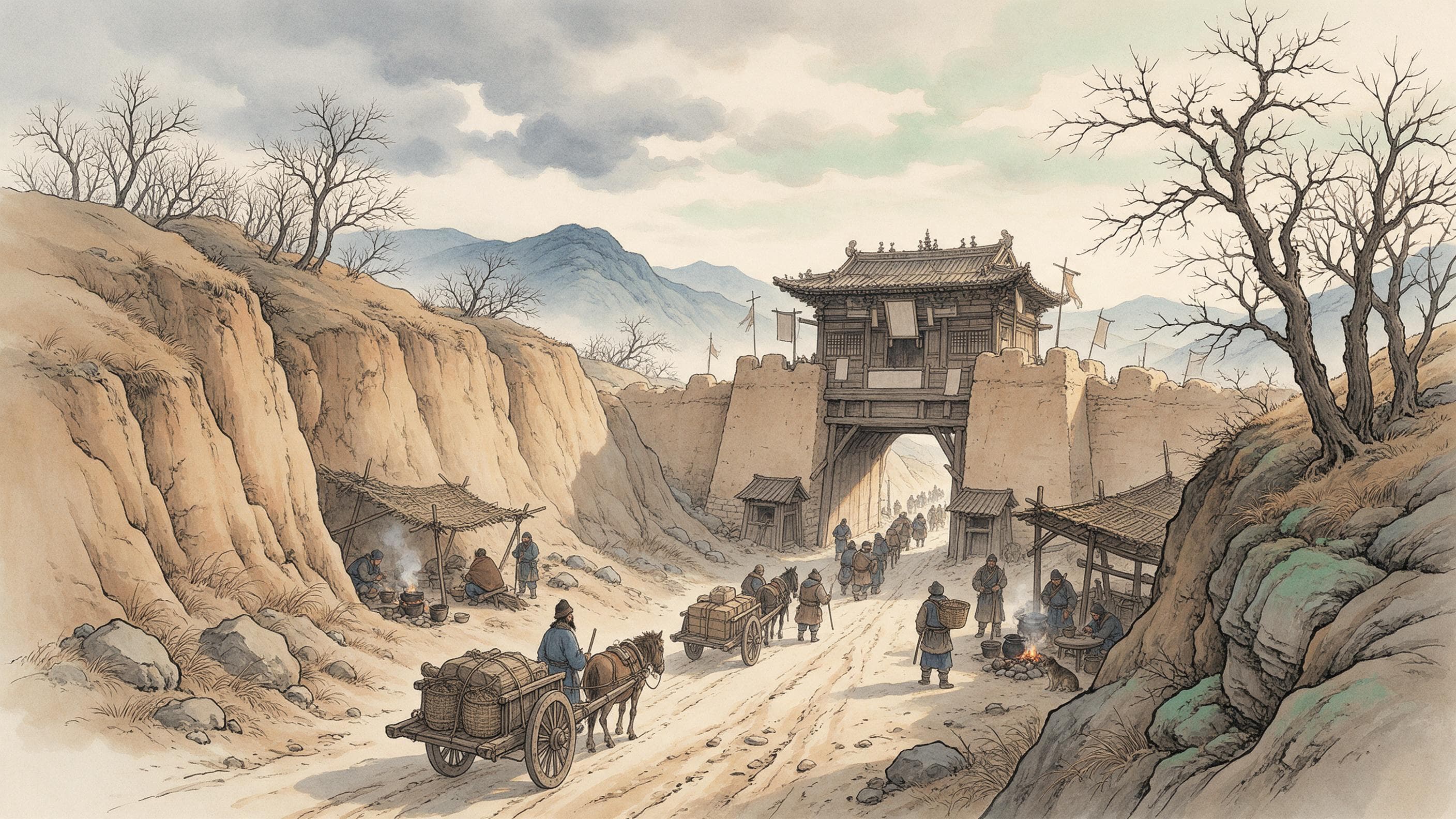
The Hangu pass first appears as the fourth item on a list. In the Strategies of the Warring States, Su Qin tells King Hui of Qin: 'Your majesty's state has, in the west, the profits of Ba, Shu and Hanzhong; in the north, the use of the Hu and Dai horses; in the south, the barrier of the Wu and Qian mountains; in the east, the firmness of Yao and Han' (東有肴函之固). The eastern item is four characters: Yao, Han, of, firm. What the gate looks like, the sentence does not say.
An Inventory of Assets
The rest of the list follows: 'fields fat and fine, people rich and numerous, ten thousand war chariots, a million shock troops, a thousand li of fertile plain, stores abundant, terrain convenient — this is what is called a heavenly storehouse, the dominant state of the world. With your majesty's wisdom, the multitude of officers and people, the use of chariots and cavalry, the teaching of military method, you could join the feudal lords, swallow the world, and rule as emperor.' The four directions are drawn first, to make Qin a closed box; only then does the persuader say that the man inside the box can break out. The king does not take it: 'I have heard that feathers not yet full cannot fly high… you have come a thousand li to instruct me in my court; I beg another day.'
The only sentence on this page about the gate itself is a note: 'Yao is west of Mianchi; the Han pass was formerly outside the north gate of Hongnong city, now east of Xin'an; "firm" means hard to attack and easy to hold' (肴在澠池西,函關舊在弘農城北門外,今在新安東,固牢堅難攻易守也). The text gives one adjective; the note turns it into a location and a military judgement. It goes no further: no height of wall, no width of road, no garrison. This volume of the Siku edition carries Gao You's Han commentary and Yao Hong's Song continuation in one run, so the note is cited here simply as 'the note'.
The Same Persuasion in Two Books
The Shiji's biography of Su Qin has the same persuasion with different words: 'Qin is a state of four barriers, backed by mountains and girdled by the Wei; east it has the passes and the Yellow River, west Hanzhong, south Ba and Shu, north the horses of Dai — this is a heavenly storehouse' (秦四塞之國,被山帶渭,東有關河……此天府也). Here the eastern boundary is 'the passes and the Yellow River', not 'Yao and Han'; the phrase 'state of four barriers' is not in the Strategies' version. The king's refusal is also reworded: 'feathers not yet grown cannot fly high; patterns not yet clear cannot annex' (毛羽未成,不可以高蜚;文理未明,不可以并兼), and the chapter adds why: Shang Yang had just been executed, and the king 'disliked persuaders and did not use him'.
Set side by side, the difference is plain: one page says 'in the east the firmness of Yao and Han', the other 'in the east the passes and the Yellow River'; one says feathers 'not yet full', the other 'not yet grown'. One persuasion survives in two versions; which came first these pages do not say, and this article does not decide. What can be used is only this: in a persuader's mouth the gate is a name for the eastern boundary, not a surveyed work.
The Third Text: Jia Yi's Argument
At the end of Shiji juan 6, Sima Qian quotes Master Jia: 'Duke Xiao of Qin, resting on the firmness of Yao and Han and holding the land of Yongzhou, his ruler and ministers held fast and watched the house of Zhou, with the will to roll up the world, to wrap up the universe, to bag the four seas and swallow the eight wastes' (秦孝公據殽函之固,擁雍州之地……). And later: 'the world was not small or weak; the land of Yongzhou and the firmness of Yao and Han were as before' (雍州之地,殽函之固自若也).
Its nature must be stated: this is Jia Yi's 'Faults of Qin', a political essay, quoted by Sima Qian at the close of the annals — not a record of the time. It uses the pass as an argument: the terrain had not changed, men had, and so 'benevolence and righteousness were not applied, and the circumstances of attack and defence differed'. That is how an essay works, not a survey. The same essay also says that Qin 'repaired the fords and passes, held the strategic points, and kept armour and weapons there' (繕津關,據險塞,修甲兵而守之), and that when Chen She rose, 'the men of Qin did not hold the barriers, the gates and bridges were not closed' (秦人阻險不守,關梁不闔).
Three Roles in Three Texts
Three roles, each in its own page. In the Strategies, the gate is the fourth item of an inventory: it is called 'firm' so that the king will believe he can break out. In the Shiji's covenant, it is the direction of a threat: 'if the six states join in kinship and treat Qin as a guest, Qin's armour will not dare come out of the Hangu pass to harm the east' (秦甲必不敢出於函谷以害山東矣); once the alliance is sworn, 'for fifteen years Qin's armies did not dare peep at the Hangu pass' (秦兵不敢闚函谷關十五年). In Jia Yi's essay it is the evidence for a thesis: the pass was as before, and Qin was gone. The same gate is an asset, an exit, and an exhibit.
The name has three spellings too: 'Yao-Han' in the Strategies, 'Hangu' in the Shiji biography, 'Xiao-Han' in the Faults of Qin. the characters 肴, 殽 and 崤 are variant writings of the same mountain; Han is the pass. The three pages do not agree, and this article does not make them.
What the Three Pages Do Not Give
No dimensions of the gate, no height of wall, no width of road, no number of garrison troops, no procedure for passing through, no tolls — this article is about terrain and war only; tolls belong to a separate piece, and none of these pages mentions a tax. Nor is there any ranking as 'the first pass', any history of the gate being moved, or any estimate of how many troops could pass. 'Fifteen years without peeping at the pass' is a claim in Su Qin's biography, not a gate record. So the only thing to write is this: on these three pages the Hangu pass is a word, used by three kinds of writers in three kinds of argument. How the gate was held, and by whom, none of them says.
Related reading:Two Graves in Detail: M102 and M110 at Shaojiapeng · Anyang's Other Shang City: Huanbei · Linzi: Two Walled Cities, Eleven Gates, Four Drains
Sources & further reading
- 《史记》卷六十九·苏秦列传(西汉;维基文库本,未与点校本复核) — Su Qin's two speeches and their results. To King Hui of Qin: 'Qin is a state of four barriers, backed by mountains and girdled by the Wei; east it has the passes and the Yellow River, west Hanzhong, south Ba and Shu, north the horses of Dai — this is a heavenly storehouse' (秦四塞之國,被山帶渭,東有關河……此天府也); the king answers 'feathers not yet full cannot fly high' (毛羽未成,不可以高蜚) and, because Shang Yang had just been executed, 'he disliked persuaders and did not use him'. In the covenant Su Qin later sells to Zhao: 'if the six states join in kinship and treat Qin as a guest, Qin's armour will not dare come out of the Hangu pass to harm the east' (秦甲必不敢出於函谷以害山東矣); and after the alliance, 'for fifteen years Qin's armies did not dare peep at the Hangu pass' (秦兵不敢闚函谷關十五年). Note: this juan's version of the first speech says 'the passes and the Yellow River' (關河), not 'Yao-Han'; it contains no 崤/殽.
- 《战国策》卷三·秦策一(汉高诱注、宋姚宏续注;四库全书本,维基文库本,未与点校本复核) — The persuader's inventory: 'Your majesty's state has, in the west, the profits of Ba, Shu and Hanzhong; in the north, the use of the Hu and Dai horses; in the south, the barrier of Wu and Qian mountains; in the east, the firmness of Yao and Han' (東有肴函之固). The king declines with 'feathers not full cannot fly high' and 'I beg another day'. The commentary in this edition (the volume carries Gao You's and Yao Hong's notes in one run, so it is cited here simply as 'the note') places the barrier: 'Yao is west of Mianchi; the Han pass was formerly outside the north gate of Hongnong city, now east of Xin'an; 'firm' means hard to attack and easy to hold' (肴在澠池西,函關舊在弘農城北門外,今在新安東,固牢堅難攻易守也). After Su Qin's success in Zhao, 'Su Qin being chancellor in Zhao, the pass was not open' (故蘇秦相於趙而關不通). No width, garrison, road or toll procedure appears.
- 《史记》卷六·秦始皇本纪(篇末太史公曰引贾谊《过秦论》;维基文库本,未与点校本复核) — Used for one quotation only, and it is political argument, not record: in Sima Qian's closing judgement he quotes Master Jia — 'Duke Xiao of Qin, resting on the firmness of Yao and Han and holding the land of Yongzhou, his ruler and ministers held fast and watched the house of Zhou, with the will to roll up the world' (秦孝公據殽函之固,擁雍州之地,君臣固守而窺周室); and later, 'the land of Yongzhou and the firmness of Yao and Han were as before' (雍州之地,殽函之固自若也). This is Jia Yi's 'Faults of Qin', a political essay, quoted inside the Shiji; it argues about attack and defence, and is not evidence for the pass's construction or garrison.