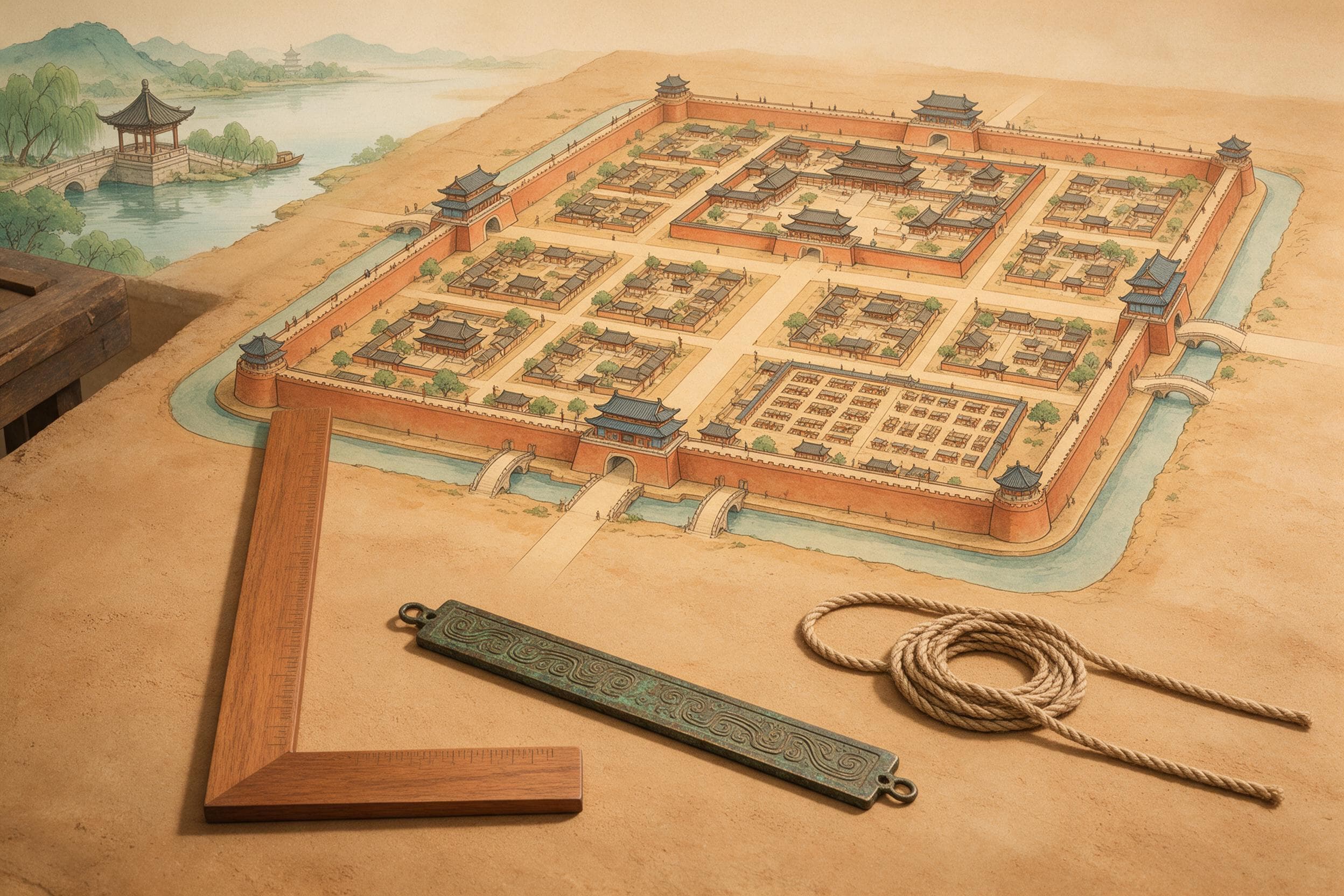
On the north bank of the Huan river, at the north-eastern edge of the Yinxu site near Anyang, there is a second walled city. It was found in 1999, after surveys going back to the 1960s; the plan is roughly square, the area about 4.7 square kilometres, and its edge slightly overlaps the boundary of the Yinxu protected area fixed in 1961. It is not Yinxu. It is another city, earlier than Yinxu, and that is the first thing to say about it. The 2002 report is a news account of the excavation: after eight months' work the no. 1 palace foundation was 'clearly and directly shown to people', and the city's existence was 'further confirmed'.
Two cities, two periods
The distinction is chronological. The 2002 report quotes the excavator Tang Jigen: Huanbei and its remains fill the gap between the early Shang culture represented by Erligang at Zhengzhou and the late Shang culture represented by Yinxu, and so complete the chronological frame of Shang culture. If that is right, the city belongs to the middle Shang, not the late Shang; it is earlier than Yinxu and cannot be treated as part of it. One Anyang, two Shang cities, with a period between them. That is a statement about the sequence of Shang culture, and it depends on the site's material being what the excavators take it to be.
The report says little about the city itself. It lies close to the north bank of the Huan, at the north-eastern outer edge of Yinxu, overlapping the 1961 protection boundary a little. The walled area is roughly square and about 4.7 square kilometres. No wall length, gate count or street plan is given in the report used here; only the outline and the area. The report does not say who cut the artificial ditch, when, or why; the section was simply there to be used.
Where the palace was
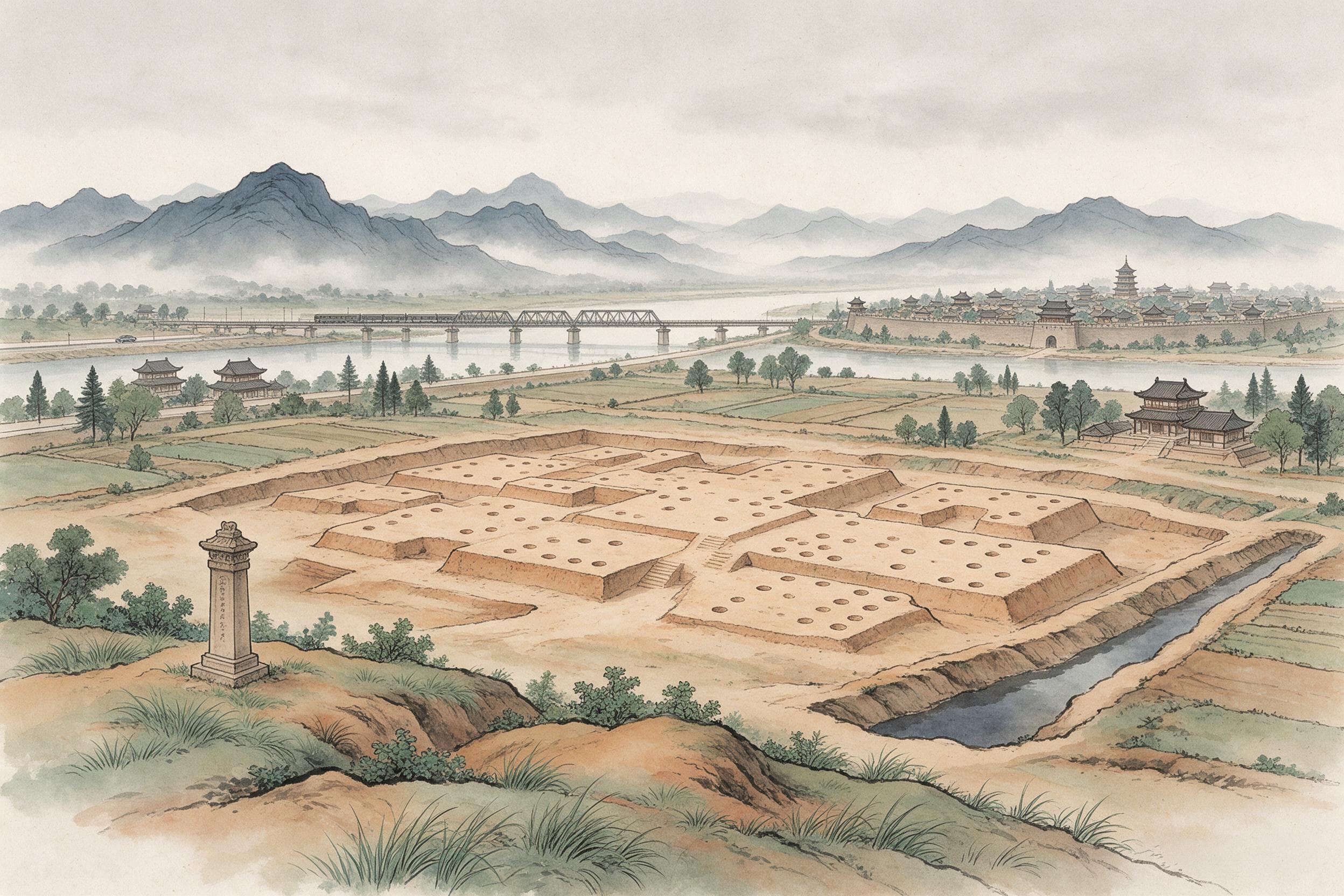
In the autumn of 2001 the excavators used the section cut by an artificial ditch to locate a large group of rammed-earth palace foundations on the southern stretch of the north-south axis. The group runs 500 metres north-south and more than 200 metres east-west; its western part lies under the Beijing-Guangzhou railway and National Highway 107 and was not probed. The report says the group is comparable in scale to the palace and ancestral-temple area north-east of Xiaotun village within the older Yinxu site. Xiaotun is the late Shang palace area; the comparison means 'as big as the old one', not 'the same kind of building'.
The group consists of 25 separate rammed-earth foundations. Foundation no. 1 lies south of the axis centre, slightly east, and is built on a 'hui'-shaped plan: about 170 metres east-west, 90 metres north-south, some 16,000 square metres in all. Its platform, post-holes, steps and gateways are preserved. The south wing has two gateways five metres wide; the main hall stands more than 0.7 metres above the old ground level; before its steps were found dismembered animal bones used in sacrifice. The post-holes follow a clear pattern, and the plan can be reconstructed from them. The 'hui' plan is a courtyard enclosed on four sides — a square within a square; the report names the wings and places the two gateways in the south wing.
Whose city
The literary side is less helpful than it looks. In the Shiji's annals, when Pan Geng came to the throne 'the Yin had already been settled north of the river'; Pan Geng crossed south, 'returned to the old dwelling of Cheng Tang', moved five times with no fixed place, and finally 'crossed the river south and governed at Bo'. The Shiji does not say that Pan Geng moved to Yin; 'Pan Geng moved to Yin' is a later formulation. That Yinxu is a late Shang capital is established by the oracle bones and by excavation. The match between the texts and the two sites is therefore not a simple one. Pan Geng's speech, as the Shiji gives it, appeals to the founders: 'Formerly the high ancestor Cheng Tang with the ancestors of you all settled the world; his rules can be cultivated.'
Tang Jigen is quoted as saying that Huanbei is a Shang capital site found by deliberate survey and that its discovery helps explain why the Shang chose the Yinxu area for a capital. But which king's capital it was, and what relation it has to Pan Geng, is not settled in the report. The identification is a working hypothesis, and this article treats it as one. The report supplies no absolute dates for the city; its dating rests on the period-gap argument, not on a sequence of finds.
The limits of a report
The 2002 text is a newspaper report, not an excavation report. The dimensions above are the report's; there is no published wall length, gate count, street layout or dating sequence in the material used here. The report also contains claims that Huanbei has the largest single Shang building so far found, and that all four Shang royal capitals are in Henan; those are the report's rankings and identifications, and they are not used here as measurements. The text reads as a press account of a visit: it names the reporter and the team, and gives no sections, no stratigraphy and no pottery counts.
What can be measured is the scale: 4.7 square kilometres of walled area; a foundation group 500 by 200 metres; one building 170 by 90 metres and about 16,000 square metres; gateways 5 metres wide; a hall raised 0.7 metres above the old ground. Those are the report's figures, and they are quoted as such. The numbers are round in the report — 'about 4.7', 'more than 200', 'some 16,000' — and they are quoted round here.
What can and cannot be said
The limits: middle Shang is not late Shang; the report is not an excavation report; the identification of the city and its date are hypotheses, not findings; the two cities are not merged; the report's rankings are not carried over; no wall, gate or street data are invented; and Yinxu is not called Huanbei, nor Huanbei Yinxu. No date in years is given for either city.
What is left is a plain fact with large consequences: Anyang has two Shang cities. One is the late Shang Yinxu, with its oracle bones, palace and royal tombs; the other is the earlier Huanbei, a square walled site with a large palace foundation group on its axis. How the two relate, and whose capital Huanbei was, the material still argues over. But since 1999 the sentence 'Anyang has one Shang capital' has not been true. Two cities, one plain; the second one changed the question.
Sources & further reading
- 司马迁《史记》卷三·殷本纪 (Sima Qian, Shiji, juan 3, 'Basic Annals of Yin') — The literary passage used here: when Pan Geng came to the throne the Yin had already been settled north of the river; he crossed south, returned to the old dwelling of Cheng Tang, moved five times with no fixed place, and finally 'crossed the river south and governed at Bo'. The text does not say that Pan Geng moved to Yin; that formulation is later. Used only as the literary side, not as a record of the Huanbei site.
- 《河南日报》〈河南洹北商城发现大型宫殿基址群〉2002-06-24(新浪转载页)(Henan Daily, 'Large palace foundation group found at Huanbei Shang city', 24 June 2002; Sina repost) — Newspaper report, not an excavation report. The site was found in 1999 after surveys from the 1960s, close to the north bank of the Huan and at the north-eastern outer edge of Yinxu, slightly overlapping the 1961 protected area; the walled area is roughly square and about 4.7 square kilometres. In autumn 2001 a section cut by an artificial ditch revealed a palace foundation group on the southern part of the north-south axis, 500 m north-south and over 200 m east-west (west part under the railway and highway, unprobed); 25 separate rammed-earth foundations; foundation no. 1 on a hui-shaped plan, about 170 by 90 m, some 16,000 sq m, with two 5 m gateways in the south wing, the main hall more than 0.7 m above the old ground, dismembered animal bones before its steps, and post-holes regular enough to reconstruct the plan. Tang Jigen is quoted saying the site fills the gap between Erligang early Shang and Yinxu late Shang.