Start with one object: a bronze ding, number M102∶6, 19.8 cm tall, mouth 15.6 cm across, belly 15.9 cm, legs 7.7 cm, weighing 1,718 g; round-mouthed with a flared rim, two bridge handles, a deep rounded belly, three columnar legs, a band of three eye motifs around the upper body, and animal bones still inside it. An object recorded down to the gram and the centimetre — that is what 'described in detail' means.
Twenty-Seven Graves, Two Described
Shaojiapeng lies about 2.4 km north-west of the Yinxu palace-temple area. The 2020-2021 excavation covered about 6,700 square metres and cleared 18 building foundations, 27 burials, 4 chariot pits, 127 ash pits and 3 wells. Of the 27 Shang burials, one is a large 'middle'-shaped tomb and 26 are small or medium shaft graves; the brief describes only M102 and M110 in detail.
The other twenty-five appear only in summary figures — counts taken over the whole twenty-seven, since M102 and M110 themselves have ledges and waist pits too: 13 have second-tier ledges, 15 have waist pits, 17 have grave goods, 5 contain bronze vessels, 7 contain pottery; most were robbed and yielded nothing; the human bone is badly preserved and the occupant often missing; a few graves have human victims and dogs. These are counts in an overview, not a grave-by-grave register, so no proportions or cross-tabulations can be drawn from them. The brief has no register of objects at all: dimensions and weights are scattered through the prose, object numbers follow the site's own 'M102∶n' style, and are quoted as they stand.
M102
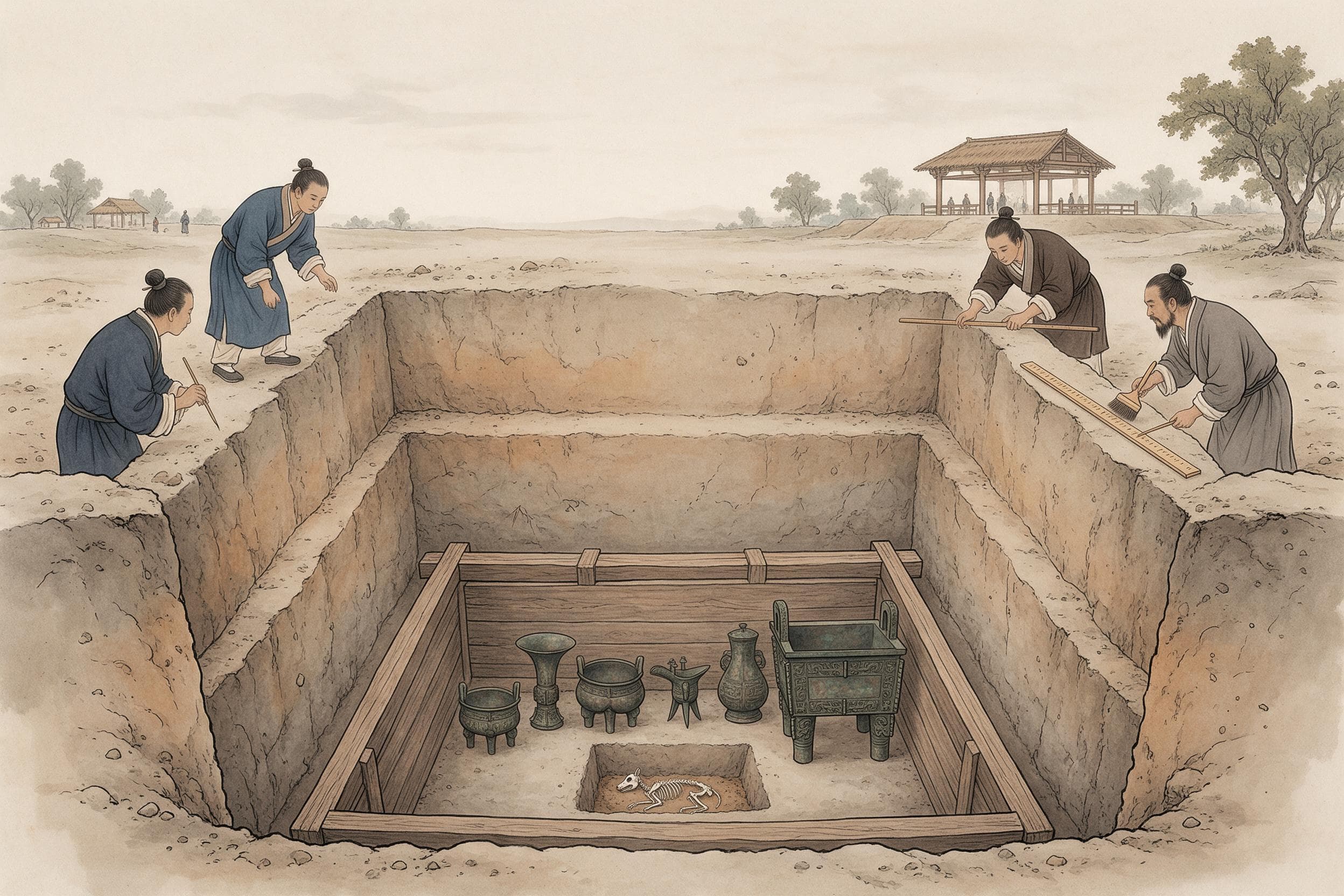
M102 is a rectangular shaft grave, oriented 8 degrees, narrower at the mouth than at the base: mouth 280 cm long, 130 cm wide at the north and 145 at the south, 410 cm from mouth to base; the earthen ledge is 22-40 cm wide and 70 cm high; the waist pit is 75 by 34 by 30 cm at the centre of the floor; the fill is yellow earth mixed with red-brown, containing calcareous nodules and rammed hard. One coffin and one chamber: the chamber boards run east-west, single boards 80-95 cm long and 10 cm wide, flat inside and curved outside, lacquered yellow; the coffin is badly decayed, only part of its floor left, with cinnabar and black lacquer. On each of the east and west ledges lies a human victim, face down and stretched out, heads north (sex and age unknown); beef and mutton shanks were placed on the chamber; a dog lies in the waist pit, head north, back east. The occupant's bones are decayed; the teeth suggest an elderly person with the head to the north, posture and sex unknown.
Ten bronzes: the ding M102∶6 (1,718 g); a gui M102∶7 (11 cm tall, 1,242 g, inscription on the inner base); a pair of gu, M102∶9 and M102∶10 (676 and 734 g); a pair of jue, M102∶11 and M102∶12 (853 and 737 g); a lidded you with a rope-twist handle, M102∶8 (23.6 cm tall, 3,194 g, heavily corroded, lid cannot be opened and handle cannot turn); bells M102∶1 and M102∶13; and bronze fragments M102∶20, some identifiable as spear fragments.
Four pottery vessels (a gui, a basin, a gu and a jue), of which the gui, basin and gu are too broken to restore, while the pottery jue M102∶5 is 8.2 cm across the mouth and 7 cm tall; two jades (a hare, M102∶14, 4.2 by 2.4 cm; a bird, M102∶15, 4.2 by 2.3 cm); a whetstone M102∶2, found at a victim's waist; and three groups of shells, 43, 29 and 56 in number, one group inside a jue.
M110
M110 is smaller and simpler: a rectangular shaft grave, oriented 205 degrees; mouth 230 cm long, 95 cm wide at the north and 105 at the south, 340 cm from mouth to base, base the same size as the mouth; the ledge is 8-12 cm wide and 80 cm high; the waist pit is 60 by 45 by 30 cm; only one coffin, decayed, with traces of red and black lacquer; one occupant, reduced to powder, head to the south, sex and age unrecorded; a dog in the waist pit, head north, back east.
The grave goods: four bronzes — two bells (M110∶18, 8.1 cm tall; M110∶19, 8 cm) and two arrowheads (M110∶15-1, 5.5 cm long; M110∶15-2, 5.4 cm). Eleven pottery items: one yan steamer (M110∶13, only the mouth and the li part (鬲) survive), two jue (M110∶7 and 14), one zhi cup (M110∶6), four jars (M110∶1-4), one pan basin (M110∶17), one gui foot-ring (M110∶5), and a group of sherds (M110∶9). Also a whetstone M110∶20, a stone tool M110∶12, two bone arrowheads (M110∶16), two mirror clams, 13 hard clams and 9 cowries. Position: the jars, gui, zhi, jue and clams lie at the south end of the chamber; a bone awl and a stone tool lay under the occupant's head, and nine shells in the waist pit.
How to Read the Two Graves
The dates are the brief's judgement: M102 is placed in Yinxu period IV, by comparison of its ding with vessels from Guojiazhuang M50 and Xu Jiaqiao M1; M110 in a late stage of period IV, by comparison of its pan with material from Miaopu Beidi. This is dating by analogy, not scientific dating, and should be written as 'the brief dates it'. The differences between the graves can be described directly: one faces north and the other south; one has coffin and chamber, the other only a coffin; ten bronzes against four; ritual vessels against weapons and jingles. But they are two graves described, not a ranking.
The limits must be stated: two graves cannot stand for the 27, still less for Yinxu; the summary figures for the 25 cannot be turned into a grave-by-grave count; nothing missing from the brief — objects, sex, age — may be supplied. One background sentence is allowed for the other site: at Dasikong village's south-east area, 49 Shang burials were excavated in 2016-2017 with a burial register. That is all it is here — one site with a register, one with two graves in prose, so the two cannot be levelled on object counts. The Dasikong material belongs to another article. Nor does this article write about the occupants' status, social stratification or population.
What Is Not Here
The gaps: no register of objects, no comprehensive table; M102's posture and sex unknown, the two victims' sex and age unknown, M110's occupant's age and sex unrecorded; 'elderly' is inferred from the teeth; the brief infers the occupants' standing, which this article does not pursue. Nor is there any grave-by-grave count for the 27 — those figures exist only in the overview.
So these two graves give an account fine to the gram and the centimetre: 8 degrees, 280 cm, 410 cm, coffin and chamber, a victim on each ledge, a dog in the waist pit, ten bronzes; 205 degrees, 230 cm, 340 cm, one coffin, four bronzes, bells and arrowheads. The finer the account, the more its scope matters: these are two graves, not a cemetery, and certainly not an age.
Related reading:277 Square Metres: A Shang Bone Workshop's Ledger · The Market North of the Palace: Liao's Southern Capital · A River of Mercury: The Lishan Tomb in a Chronicle and a Memorial
Sources & further reading
- 安阳市文物考古研究院、中国社会科学院考古研究所、北京联合大学《河南安阳殷墟邵家棚遗址 M102、M110 发掘简报》,《中原文物》2026 年第 4 期(总第 250 期)「夏商文明探研」专栏,11 页 PDF(一手发掘简报;维基文库无录文,未与纸本复核) — The primary brief. At Shaojiapeng (about 2.4 km north-west of the palace-temple area) the 2020-2021 excavation covered about 6,700 square metres and cleared 18 building foundations, 27 burials, 4 chariot pits, 127 ash pits and 3 wells. Of the 27 Shang burials — one 'middle'-shaped tomb and 26 small or medium shaft graves — only M102 and M110 are described in detail; the rest appear only in summary counts (13 with second-tier ledges, 15 with waist pits, 17 with grave goods, 5 with bronze vessels, 7 with pottery), and most were robbed. The brief has no register of objects: dimensions and weights are given piece by piece in the text, with object numbers of the form M102∶n quoted as they stand. M102: 8 degrees, mouth 280 cm long, 130-145 cm wide, 410 cm deep, one coffin and one chamber, a human victim on each of the east and west ledges, a dog in the waist pit, ten bronzes (ding M102∶6, 1,718 g; gui M102∶7, 1,242 g; a pair of gu M102∶9-10; a pair of jue M102∶11-12; a you M102∶8, 3,194 g; bells M102∶1 and 13; fragments M102∶20), four pottery vessels, two jades, a whetstone and three groups of shells. M110: 205 degrees, mouth 230 cm long, 95-105 cm wide, 340 cm deep, a single coffin, four bronzes (two bells M110∶18-19, two arrowheads M110∶15-1 and 15-2) and eleven pottery items. The brief dates M102 to Yinxu period IV and M110 to late period IV by comparison of vessels — the author's judgement, not a scientific date.
- 中国社会科学院考古研究所安阳工作队《河南安阳殷墟大司空村东南地 2016—2017 年发掘报告》,《考古学报》2026 年第 3 期,48 页 PDF(一手发掘报告;本稿仅作背景一句) — A primary report from the same capital, used in this article for a single background sentence only: the 2016-2017 excavation at Dasikong village's south-east area, over 3,800 square metres, cleared 49 Shang burials besides 11 house foundations, 2 roads, 2 wells and more than 230 ash pits, and appends a burial register with columns for position, layer relation, orientation, form, chamber size, waist pit, ledge, coffin and chamber, posture, human victims and offerings, grave goods, period and disturbance. Its houses and register belong to a separate article; here it serves only to mark that one site has a register and the other has two graves described in prose, so the two cannot be levelled.