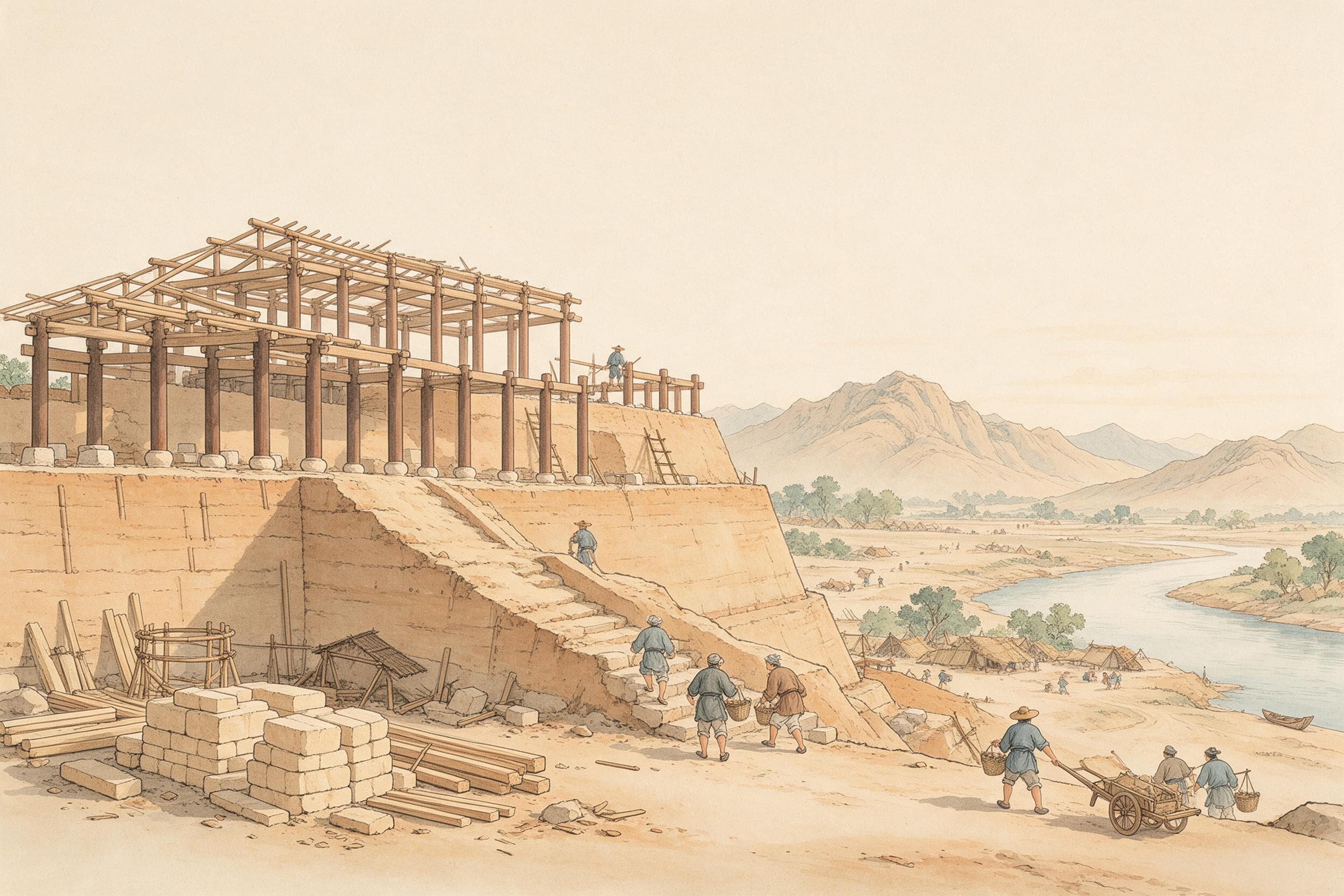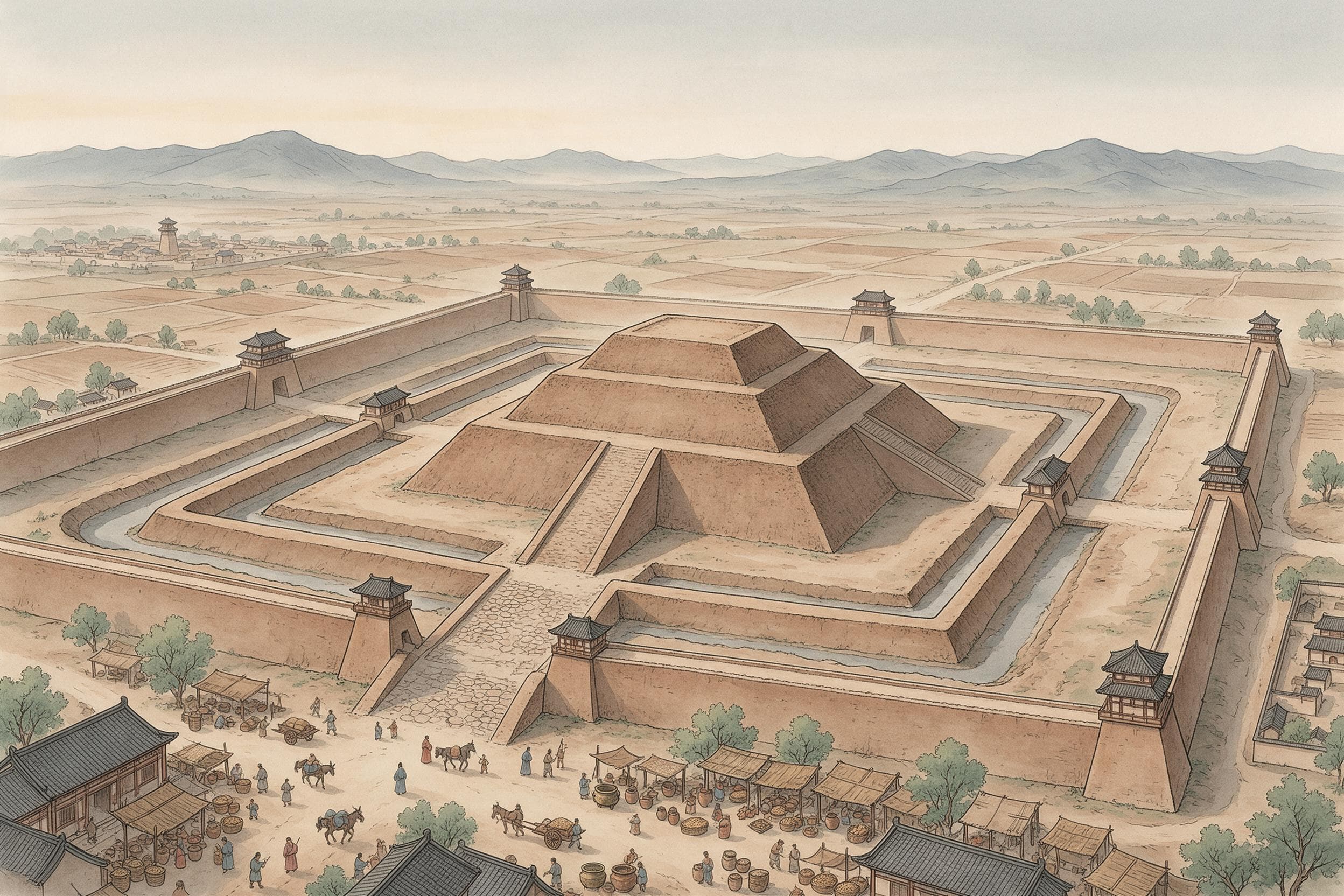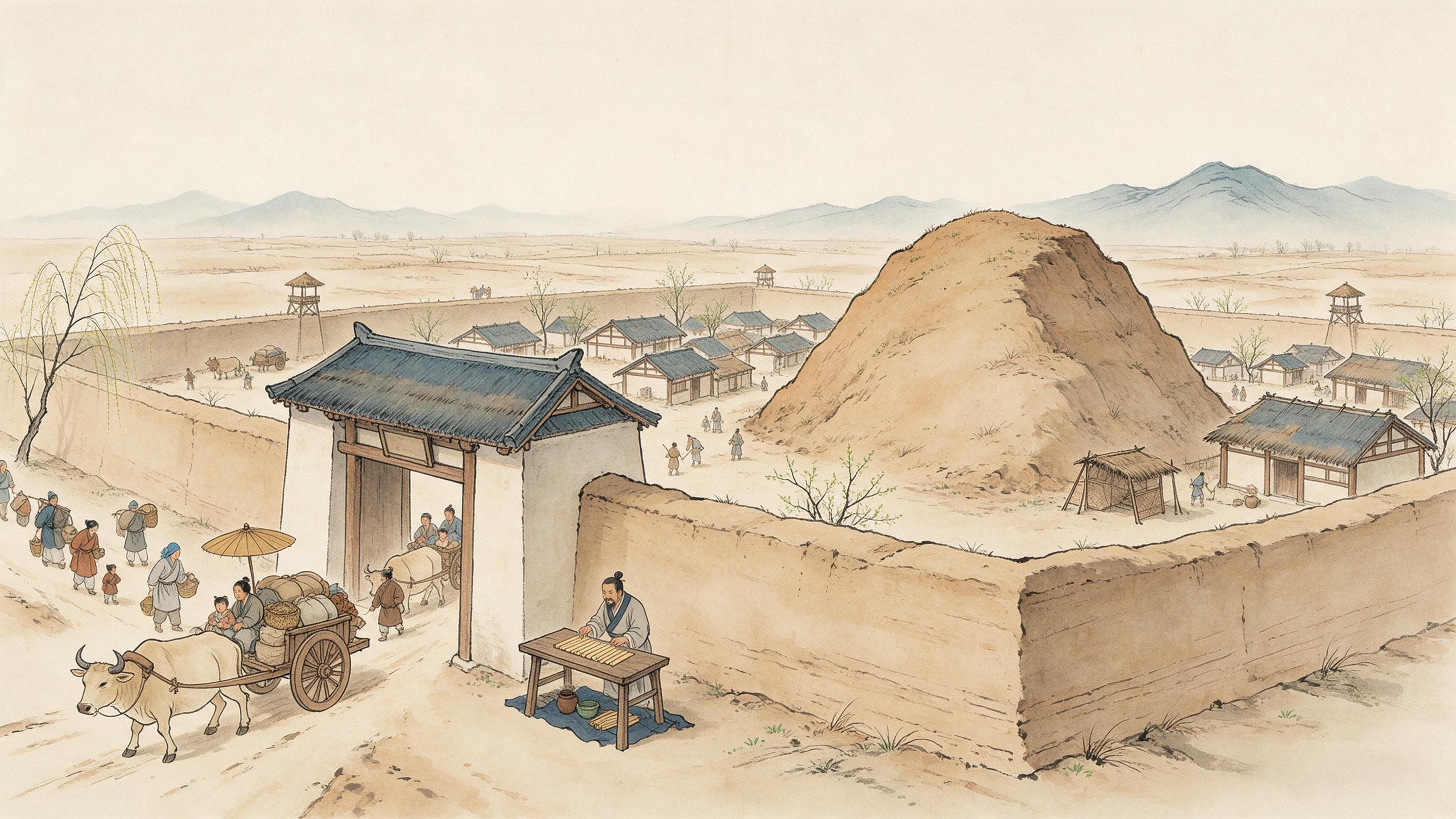
Spring, the fifth year of Emperor Jing: 'he made the town of Yangling' (作陽陵邑). Summer of the same year: 'he recruited people to move to Yangling and gave them twenty thousand cash' (募民徙陽陵,賜錢二十萬). Autumn of Zhongyuan 4: 'he pardoned the convicts working at Yangling of their death sentences; those who wished to undergo castration were permitted.' Then the emperor died, and in the second month, on the guiyou day, he was buried at Yangling. The county was created and paid for before the man buried in it had died — which is the first thing to notice about these counties.
A county before a tomb
The verb the annals use is 作, to make. Whether walls were built, how large the county was, how many households were moved, and what twenty thousand cash bought, the page does not say. Nor does it say whether the money went to households or to individuals: the text has no word for 'per household', and this article will not add one. What is certain is the order: a county in the first month of spring, recruits in summer, convicts still being handled at Yangling in Zhongyuan 4, the burial only in the last year of the reign. 募 means to recruit, not to deport; 賜錢 means a gift of cash, not a tax remission. Both words are kept as they stand.
The Treatise on Geography lists the counties of the three capital-region units, and the tomb counties sit inside the lists. Jingzhao Yin, twelve counties: Chang'an, Xinfeng, Chuansikong, Lantian, Huayin, Zheng, Hu, Xiagui, Nanling, Fengming, Baling, Duling. Zuo Fengyi, twenty-four, ending with Yunling, Wannian, Changling, Yangling, Yunyang. You Fufeng, twenty-one, ending with Anling, Maoling, Pingling, Wugong. Nine of the counties in the three units carry 'ling', tomb, in their name. The treatise gives the names only; it does not say whose tomb each one served, and this article will not supply the pairing. Fengming, also in the Jingzhao list, has no 'ling' in its name; whether it belongs to the same class the page does not say.
Who was moved in
The rule for filling them is set out later in the same treatise. First Changling: 'when Han arose and made its capital at Chang'an, it moved the Tian of Qi, the Zhao, Qu and Jing of Chu, and the families of the meritorious officials to Changling.' The old ruling clans of the defeated states and the new founding elite, moved together to the side of the founder's tomb. Then the standing practice: 'later generations moved administrators of the two-thousand-bushel rank, the wealthy, and the powerful and annexing families to the various tombs.' Senior officials, rich men, local magnates, generation after generation. Taken together, the tomb counties were not places to resettle the homeless; they were places to pull powerful households out of their home ground and set them down near the capital.
Why, the treatise says twice over: 'to tend the tomb parks' (奉山園) and 'to strengthen the trunk and weaken the branches' (彊幹弱支). Tending the tomb park is the public reason; draining the provinces of their magnates is the political one. The sentence is 'this was also to strengthen the trunk and weaken the branches, not only to tend the tomb parks' — the 'also' and the 'not only' keep both in view, and a reading that keeps only the tomb misses half of it. Note too that Yangling's entry uses 募, to recruit, while Changling's uses 徙, to move by order. Two different verbs; this article keeps them apart.
What the county was like
The result follows immediately in the treatise: 'therefore the five quarters were mixed together and the customs were impure' (五方雜厝,風俗不純). It then sorts the population: old official families fond of ritual and letters, rich men trading for profit, strongmen acting as knights-errant and colluding in crime. Then the ground itself: 'near the Southern Mountains, close to Xiayang, full of defiles, light and thin in character, apt to become robbers, regularly the worst trouble in the empire.' That is the treatise's own judgement while describing local custom, not a modern aside.
One more passage describes what the inflow did: 'the commanderies and kingdoms converge on it, many live without working, the people leave the root and go to the branch.' And then consumption: 'marquises and nobles exceed their station in carriages and dress, the crowd copies them and is ashamed to fall behind, weddings above all go in for extravagance, and burials overspend.' A county meant to tend a tomb appears in the treatise as a consumption town: officials, rich men, strongmen, and a large population that does not produce.
The population figures for the three units are given for Yuan Shi 2. Jingzhao Yin: 195,702 households, 682,468 persons. Zuo Fengyi: 235,101 households, 917,822 persons. You Fufeng: 216,377 households, 836,070 persons. These numbers describe the three units together; the text says commandery, not county. The treatise gives no county-level population, so nothing can be subtracted out to yield 'how many people lived in Changling'. The figures are copied as they stand, with no division and no multiplication. Note as well that the year is marked once, before Jingzhao Yin; the next two units continue in the same format without repeating it.
A county is not a tomb
The treatise has no category called 'tomb county' (陵邑). It simply lists counties under commanderies, and Changling and Yangling stand beside Chang'an, Xinfeng and Lantian on equal footing: all counties. 'Tomb county' is a later label, useful for pointing at the group, not Ban Gu's word — the only 陵邑 in the book is Hulingyi, a county name in Lujiang commandery, which has nothing to do with tombs. What this article describes is the county: its name, its commandery, the people moved in, the registers, the customs. The tomb itself — mound, underground chambers, the layout of the park — is not given on these pages, and is not described here.
What came later
Neither page records the abolition of the tomb counties. The treatise carries information as late as the county lists and registers of Yuan Shi 2; the annals end with the burial at Yangling in the last year of Emperor Jing. What became of these counties afterwards, and when the practice stopped, neither page says, and this article does not supply it. The entries that can close the account are the annalistic ones: a county made in the first month of spring of the fifth year, recruits and twenty thousand cash in summer, convicts pardoned at Yangling in the autumn of Zhongyuan 4, the emperor buried there in the second month of the final year. A county's founding and an emperor's burial, set down in the same annals, years apart — county first, burial after.
Related reading:Ditches with Names: Draining a Field by the Zhouli · A Square Enclosure and a Name: The Qin Tomb at Shangzhaoyao · Measuring a Street: Three Land Prices, Ward Gates and Four Rules on a Signboard in Luoyang
Sources & further reading
- 班固《汉书》卷五〈景帝纪〉(维基文库本,未与点校本复核) — The entries that make a tomb county visible as an act of government: 'in the first month of spring of the fifth year he made the town of Yangling' (五年春正月,作陽陵邑); 'in summer he recruited people to move to Yangling and gave them twenty thousand cash' (夏,募民徙陽陵,賜錢二十萬); in the autumn of Zhongyuan 4, 'he pardoned the convicts working at Yangling of their death sentences; those who wished to undergo castration were permitted' (赦徒作陽陵者死罪;欲腐者,許之). The reign ends with 'in the second month, on the guiyou day, he was buried at Yangling' (二月癸酉,葬陽陵).
- 班固《汉书》卷二十八上〈地理志上〉(维基文库本,未与点校本复核) — The three capital-region units and their county lists, with Yuan Shi 2 population figures: Jingzhao Yin 195,702 households and 682,468 persons in twelve counties including Nanling, Fengming, Baling and Duling; Zuo Fengyi 235,101 households and 917,822 persons in twenty-four counties including Yunling, Changling and Yangling; You Fufeng 216,377 households and 836,070 persons in twenty-one counties including Anling, Maoling and Pingling. The same chapter explains the resettlement: 'when Han arose and made its capital at Chang'an, it moved the Tian of Qi, the Zhao, Qu and Jing of Chu, and the families of the meritorious officials to Changling; later generations moved administrators of the two-thousand-bushel rank, the wealthy and the powerful and annexing families to the various tombs — this was also to strengthen the trunk and weaken the branches, not only to tend the tomb parks' (徙齊諸田……於長陵。後世世徙吏二千石、高訾富人及豪桀并兼之家於諸陵。蓋亦以彊幹弱支,非獨為奉山園也), and describes the result: 'the five quarters were mixed together and the customs were impure' (五方雜厝,風俗不純).