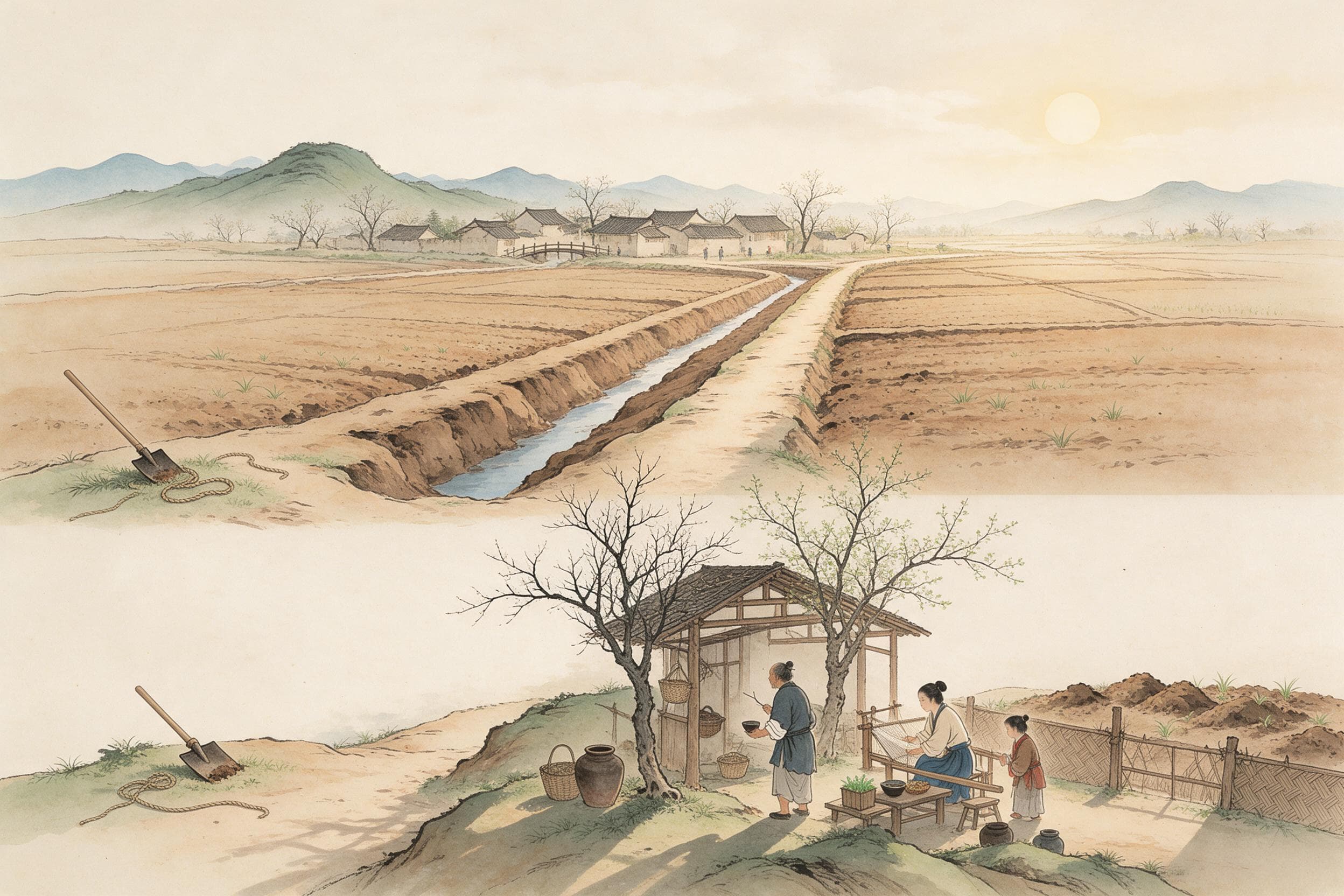
The smallest unit of the Zhouli's drainage plan is one furrow. Two ploughshares make a pair; one cutting of the pair, a chi wide and a chi deep, is a 畎 (quan). The furrow is the width of one plough-pair's cut, and every size in the Artificers' chapter is measured from that first chi (a foot-length unit, 尺). From it the water is meant to leave the field through a series of channels, each one wider and deeper than the last, until it reaches a river. The two chapters that describe it do not count it the same way.
From One Furrow to the River
The Subordinate Officers chapter, in the office of the Superintendent of the Fields (遂人), gives the ladder in tens: 'Between one man's fields there is a 遂, and on the 遂 a path; for ten men a 溝, and on the 溝 a raised path; for a hundred men a 洫, and on the 洫 a road; for a thousand a 澮, and on the 澮 a cart road; for ten thousand a 川, and on the 川 a highway, reaching to the royal domain' (夫間有遂,遂上有徑;十夫有溝,溝上有畛;百夫有洫,洫上有涂;千夫有澮,澮上有道;萬夫有川,川上有路,以達于畿).
Every channel has a road on its bank, and the text uses five different words for the five roads (徑, 畛, 涂, 道, 路), from the narrow 徑 between two men's fields to the 路 along the 川. Water and traffic are printed as one sentence: the water goes out, and people and carts go with it. The chapter that lays out the 遂人's territories also says they are marked 'with ditches and trees' (溝樹之): the channel and the planting on its bank are one work. What the chapter does not give is a width or a depth for any of the five channels, nor the width of a bank or the surface of a road.
The Measured Ladder
The Artificers' Record does give them, in a section that opens 'the artificers make the ditches' (匠人為溝洫), and starts from the same furrow: 'A ploughshare is five cun wide; two shares make a pair. One cutting of the pair, a chi wide and a chi deep, is called a 畎. At the field's head, double it: two chi wide and two chi deep is called a 遂. Nine men make a 井; between the wells, four chi wide and four chi deep is called a 溝. A square of ten li is a 成; between the 成, eight chi wide and eight chi deep is a 洫. A square of a hundred li is a 同; between the 同, two 尋 wide and two 仞 deep is called a 澮' (耜廣五寸,二耜為耦;一耦之伐,廣尺深尺謂之畎;田首倍之,廣二尺、深二尺謂之遂;九夫為井,井間廣四尺、深四尺謂之溝;方十里為成,成間廣八尺、深八尺謂之洫;方百里為同,同間廣二尋、深二仞謂之澮). It ends: 'It reaches the river on its own; each carries its name' (專達於川,各載其名).
The grid beneath these names begins with a nine: nine men to a 井; the next steps are squares of ten li and a hundred li (成, 同). The ladder of water runs 畎 → 遂 → 溝 → 洫 → 澮, and only at the end does it reach the river. The sizes are given in the text's own measures — the chi (尺), the 尋, the 仞 — and they are left in those measures here.
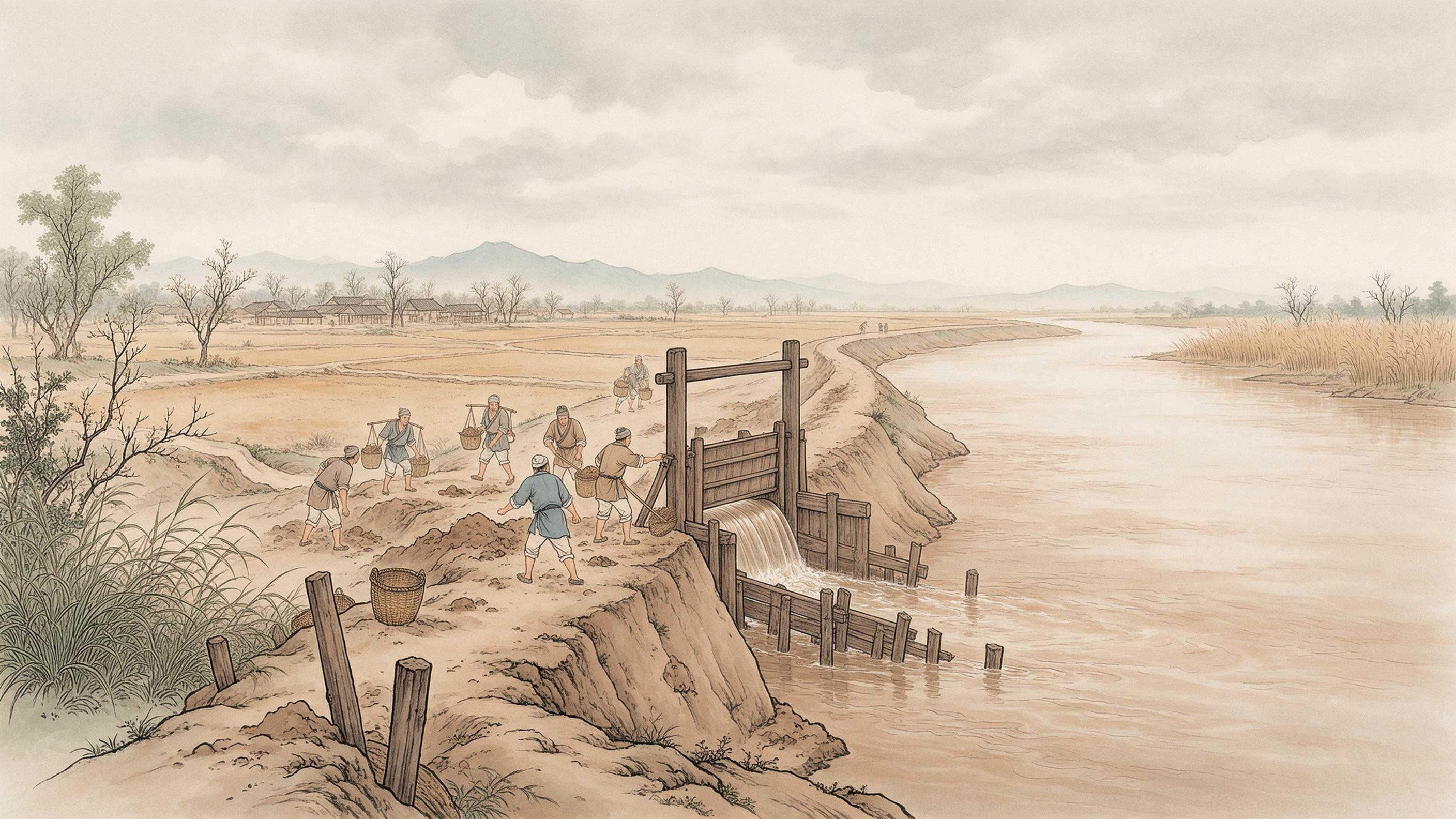
Most of the rest of the chapter is about how to dig. 'Every ditch must follow the lay of the water, every embankment the lay of the ground' (凡溝必因水勢,防必因地勢); 'a long ditch doubles its width in thirty li' (梢溝三十里而廣倍); still water is let run 'at a bend of three to five' (磬折以叄伍); an embankment is 'as wide as it is tall, tapered by a third' (廣與崇方,其殺叄分去一), with a great bank sloping on its outer side (大防外殺); and the standard set for a gang is 'one day's depth first, and with a li as the measure, the labour of many can then be joined' (必一日先深之以為式,里為式然後可以傅眾力).
The Water-Keeper
A third office works the water from the other end. The 稻人 'manages the crops of the low ground: with a 潴 he stores water, with a 防 he stops it, with a 溝 he moves it, with a 遂 he spreads it, with a 列 he lets it settle, with a 澮 he drains it away' (以潴畜水,以防止水,以溝蕩水,以遂均水,以列舍水,以澮寫水), wading in to scatter the cut weeds (以涉揚其芟). In a wet year 'in summer he kills the weeds with water and cuts them' (夏以水殄草而芟荑之). Six verbs, and not one of them is a dimension: this office is written as a set of actions on water, not as a survey of channels.
Two Grids That Do Not Fit
Now the two counts side by side. The 遂人 counts men in tens — ten to a 溝, a hundred to a 洫, a thousand to a 澮, ten thousand to a 川. The 匠人 counts a 井 in nines, then measures the next steps by squares of ten and a hundred li. The same five names appear in both, but on different grids, and they end differently: in the 遂人 the last channel is the 川, while in the 匠人 the 澮 'reaches the river on its own'. The 遂人's ladder has no 成 and no 同; the 匠人's has no 川. Two offices of one book, two ladders. This article prints both as they stand and reconciles neither — the pages themselves offer no bridge.
What the Pages Do Not Give
Neither chapter is a survey. No district is named, no channel is measured on the ground, no work is costed, and no page reports a ditch being dug; nothing in them names a single ditch, a single field or a single village. What the Zhouli contains is an office design — who is responsible for the water, and in what proportions the channels are laid out — not a description of how any particular field drained. It cannot be used to say that fields in Zhou China were drained this way, only that a book said they should be.
The numbers are the book's own and are quoted, not converted; and each page supplies only half the picture. The 遂人 gives the channels and their roads but no width or depth; the 匠人 gives widths and depths but no roads and no 川; the 稻人 gives actions but no sizes. Set beside each other, the three entries almost make a whole system — almost, because the two grids still will not meet.
What remains is a vocabulary of water and earth: 畎, 遂, 溝, 洫, 澮, 川, each with a size or a position; five roads on five banks; and one rule that outlasts the numbers — dig with the water, bank with the ground. The unit that holds the two chapters together is the first one, the 畎: both start there, and after that they part. The ladder is the book's, not the land's. Whether any field was ever drained by it is a question the pages do not answer.
Related reading:A Square Enclosure and a Name: The Qin Tomb at Shangzhaoyao · Measuring a Street: Three Land Prices, Ward Gates and Four Rules on a Signboard in Luoyang · 277 Square Metres: A Shang Bone Workshop's Ledger
Sources & further reading
- 《周礼·地官司徒》(遂人、稻人;战国至汉初成书;维基文库本,未与点校本复核) — The 遂人's ladder in tens: between one man's fields a 遂 with a path, ten men a 溝, a hundred a 洫, a thousand a 澮, ten thousand a 川, each channel with its own kind of road, reaching the royal domain; no width or depth given. The 稻人's six actions on water — store, stop, move, spread, settle, drain — with no dimensions at all.
- 《周礼·冬官考工记》(匠人为沟洫;战国至汉初成书;维基文库本,未与点校本复核) — The measured ladder from the same furrow: 畎 a foot by a foot, 遂 two feet by two, 溝 four by four between wells of nine men, 洫 eight by eight between squares of ten li, 澮 two 尋 by two 仞 between squares of a hundred li, 'reaching the river on its own, each carrying its name'; with the rules for digging with the water and banking with the ground, and a day's depth as the standard for a work-gang.