On the eighth day of the sixth month of 931, the officers of the military patrol submitted a report. Inside the wards of Luoyang, households had built over the official streets and over the fields within the lanes, "without any sealed document from the authorities". The remedy was not simply demolition. It ended with an instruction that turns a street into paperwork: the width left open was to be measured in chi and zhang and reported street by street.
Forbid new building, then keep it passable
The report is specific about the abuse. Soldiers and commoners were treating taxed fields as vacant land, staking boundaries and putting up walls; elsewhere the original holder had a deed of sale, and title was unclear in layers. The response had three parts. Along the imperial way, no further building was allowed at all beyond what already stood. Lanes had to keep a working width: both sides of the lanes in every ward "must always let ox carts through", and even the small lanes must let horses and riders pass — two separate standards, for freight and for riding. And anything that had already pushed out beyond the line, lean-tos and shed galleries alike, was to be demolished within the time limit.
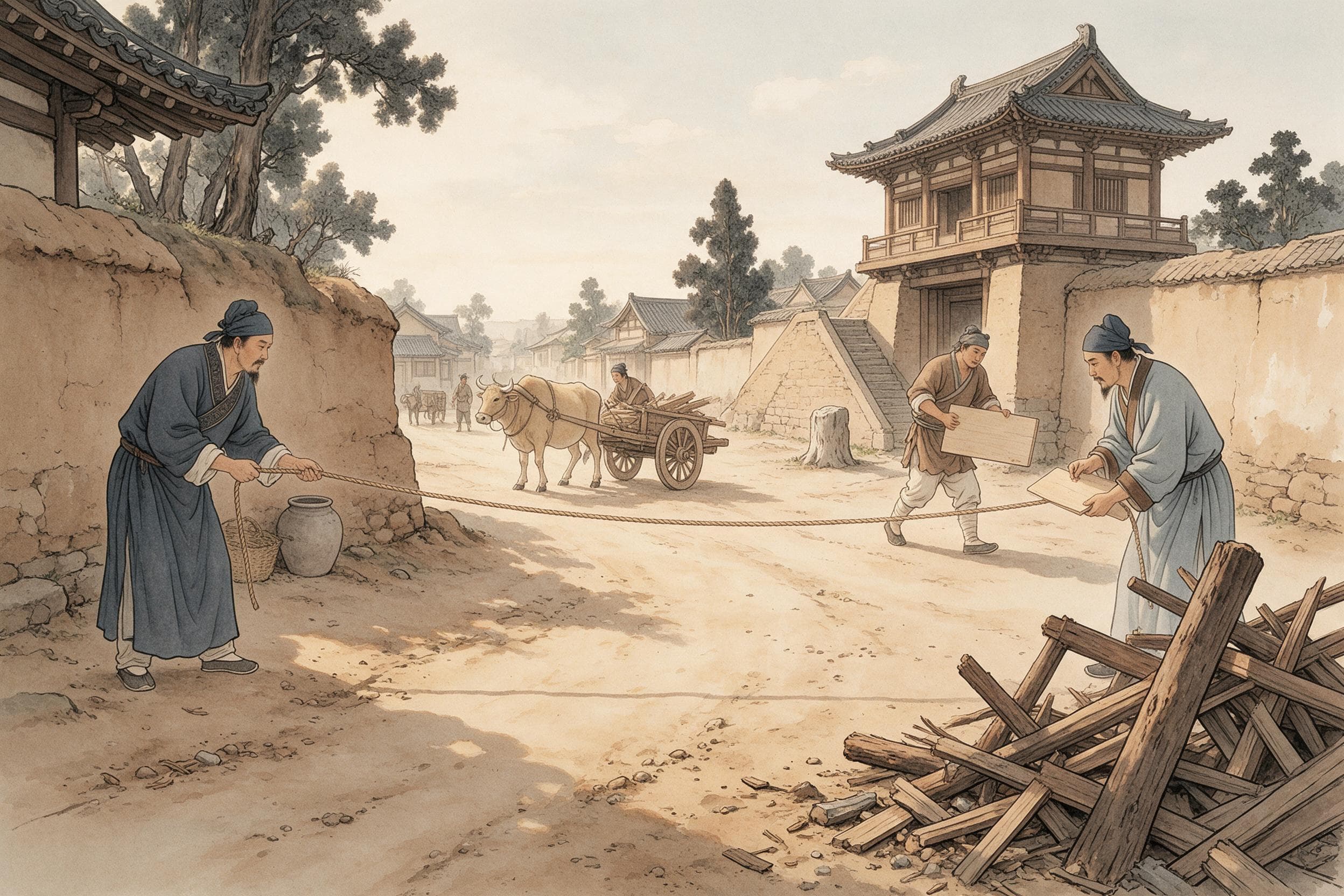
Then comes the sentence that matters most: after the demolition, the width of street left open was to be measured and "reported item by item, in chi and zhang". This is not rhetoric; it is a procedure that could be checked. The same memorial adds a rule easy to overlook: no one may dig earth from the roadway, except for drains, and where digging had already happened the households along that stretch were to fill it back in at once.
Seven thousand, five thousand, three thousand per mu
If streets were to be cleared, the people occupying them had to be settled, and the state's method was to buy them out. For frontage good enough for shops, the Henan prefecture was to make the valuation, shop by shop, using a unit the text gives as "each bay reckoned at seven rafters between the open bays" — a phrase the original never explains, so it is repeated here as an estimating unit, not as architecture. For fields with shops on them, a price per mu was fixed: seven thousand cash, then five thousand for the next band, then three thousand — graded outward from the street. The work of drawing the lines was given to three offices together: the censorate, the two street commissioners and the Henan prefecture were to mark out the main street and the boundary of each ward.
These are official purchase prices, not market sales, and not house prices; they cannot be used to estimate land values in Luoyang. The conditions attached are strict: building had to begin within three months, one buyer could not take two plots, and the land might be used only for houses — not for orchards or grain fields — with the censorate watching. There was also a softer provision. A poor household that bought a vegetable plot and lived by selling greens was to have its compensation raised by grade.
Ward gates, and four sentences on a board
In the eighth month of the same year an edict took up precedence on the street: following the ceremonial statutes, on roads, streets and lanes, "the base yield to the noble, the young to the old, the light load to the heavy, those going to those coming". The four rules were to be carved clearly on boards and hung at busy ward gates and on bridge pillars to warn travellers; local officers were to patrol, and offenders were to be punished for violating an edict. This is old Tang statute restated, with the boards added; the four sentences concern ritual precedence — who gives way to whom — not traffic law.
The same memorial on streets also ordered that the boundary of the main street and of each ward be marked out, that "ward gates be set up, each with its name board hung". Measure the street, raise the gate, carve the four sentences where people pass: in that one year the order of a Luoyang street was made of a measuring cord, money and a signboard.
A city without an outer wall
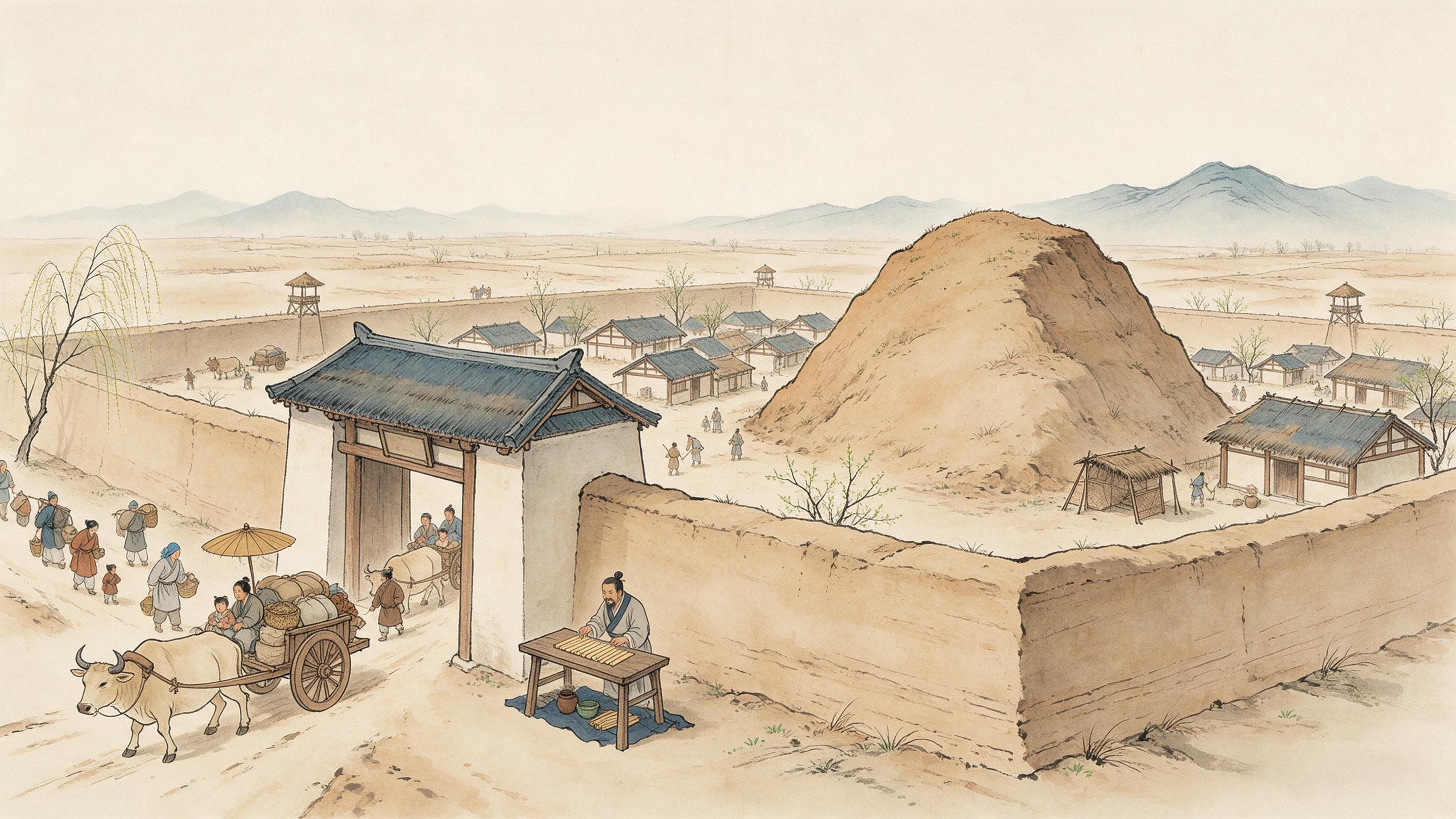
The background explains the urgency. In 924 an edict stated that within the capital "there has never been an outer city wall since antiquity"; warlords had held their own ground, and the earthworks of Zhang Quanyi and the stockade of Li Hanzhi were still there. Rather than disturb the population with labour levies, the court told the Henan prefecture to mark out the old streets first, allowed the moat to be filled in and built upon, and laid down one decisive rule: where a lane had existed inside the old wall line, a lane it remained, and no one was to encroach on it in the confusion. The old lines and the new measuring support each other.
Two boundaries belong here. These texts come from the Wudai huiyao, a Northern Song compilation of Five Dynasties edicts and memorials by Wang Pu; they are regulations and proposals, not on-site archives, so it cannot be said that Luoyang's streets became orderly as a result. The widths that were reported back do not survive, the ward names and positions are not listed in this juan, and the total area bought and the sum paid are equally absent. The Kaifeng figures — fifty-five thousand labourers at the Luo wall, streets fifty paces wide — belong to an article already published and are not used here. What these two juan do show is a government treating the width of a street as a thing it could specify, measure, price and finally carve on a board.
Related reading:277 Square Metres: A Shang Bone Workshop's Ledger · Grain to Chang'an: How the Capital Was Fed · A Lord's Fief: Twelve Counties for Lord Chunshen
Sources & further reading
- 王溥《五代會要》卷二十六「街巷」(Wang Pu, Wudai Huiyao, juan 26, "Streets and Lanes") — The long memorial of 931 on streets built over: the ban on new building along the imperial way, the requirement that lanes stay passable for ox carts and horses, the order to report every street's width in chi and zhang, the ban on digging earth from the roadway, and the three fixed buy-out prices per mu for land with shop frontage.
- 王溥《五代會要》卷二十六「城郭」(same juan, "City Walls") — In 924 Luoyang was said to have had no outer wall since antiquity; the Henan prefecture was told to mark out the old streets and lanes, keep lanes where lanes had been inside the former wall line, and allow the moat to be filled and built on.
- 王溥《五代會要》卷二十五「道路」(Wang Pu, Wudai Huiyao, juan 25, "Roads") — An order of the same year that the four rules of precedence taken from the Tang ceremonial statutes - noble before base, young before old, light before heavy, going before coming - be carved on boards at busy ward gates and bridge pillars.