On 18 September 2026 the Shaanxi Academy of Archaeology announced the results of work at a site beside Xi'an Xianyang International Airport. The work began in 2018, to clear a protected site inside the airport's third-phase expansion; in 2022 the team excavated the northern part of the enclosure and surveyed the whole. The site has been named the Shangzhaoyao Qin tomb (上召窑秦陵), after the village that stood there; the site had a protected-site name, Gongling, and the new name is taken from the village. What follows in the first sections of this article is the report's account, not the excavation's.
The Site by the Airport
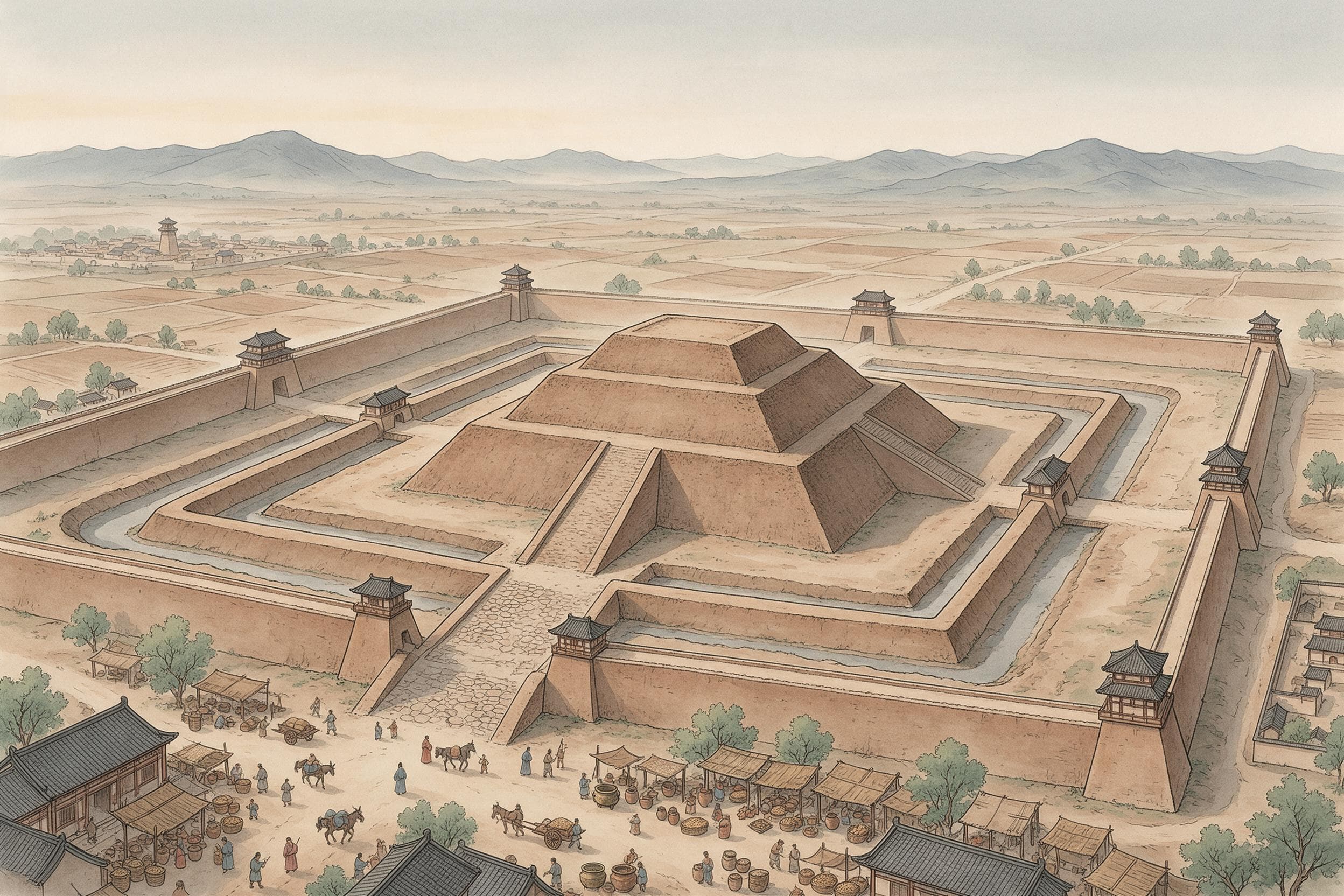
According to the report, the enclosure is nearly square, laid out in a '回' shape — an outer ditch, an inner ditch, an inner wall, the main tomb, satellite burials (陪葬墓), attached burials (祔葬墓) and sacrificial pits; the two ditches (兆沟) mark out the bounds of the enclosure, and the report says the remains are complete, with every formal element present. At its centre, on the north-south axis of the inner enclosure, sits the main tomb: a '亞'-shaped pit under a truncated-pyramid mound (覆斗形封土), with a square chamber and one sloping ramp on each of its four sides. The report calls this the typical form of a high-ranking royal tomb of the late Warring States in Qin.
The excavation produced 258 objects or groups (258件组) — the report's own phrase, and its total for the work so far; in pottery, bronze, iron, lead and jade. The pottery includes 鼎, 盒, 壶, 罐, 盆 and 釜, and several vessels carry potters' inscriptions — 咸广里高, 咸重成未, 咸宜都次 — which the report calls valuable evidence for local administration and craft production. The bronze came mainly from the attached burials, mostly ritual 鼎 and 壶; one bronze 鼎 is inscribed 宋氏, which the report says offers a clue to the tomb owner's identity and the family's line — though the 鼎 itself came from an attached burial, and the report does not explain how the clue reaches the main tomb.
Why They Think It Is Huayang
The identification is stated as an inference. The report notes that this enclosure closely matches the Sijiazhuang tomb nearby in plan and layout, that the two were built at about the same time, and that their occupants were 'very likely' connected; then, combining the burial system of Qin royal tombs, the transmitted texts and the excavated evidence, the team 'preliminarily infers' (初步推断) that the occupant was Huayang Taihou, a powerful figure of the late Warring States. The report's wording keeps two strengths apart: the connection between the two tombs is 'very likely' (大概率), the identification of the occupant is a preliminary inference.
What the report does not give is a direct identification. No inscription names the occupant; the 宋氏 bronze comes from an attached burial, not from the main chamber. No length is given for the ramps, no count of objects by category, no dimensions for the enclosure. Nor does the report say which transmitted text it means, or which sentence in it supports the inference. It is a news report on the academy's website, taken from a radio network, not the excavation report.
Who Huayang Was in the Shiji
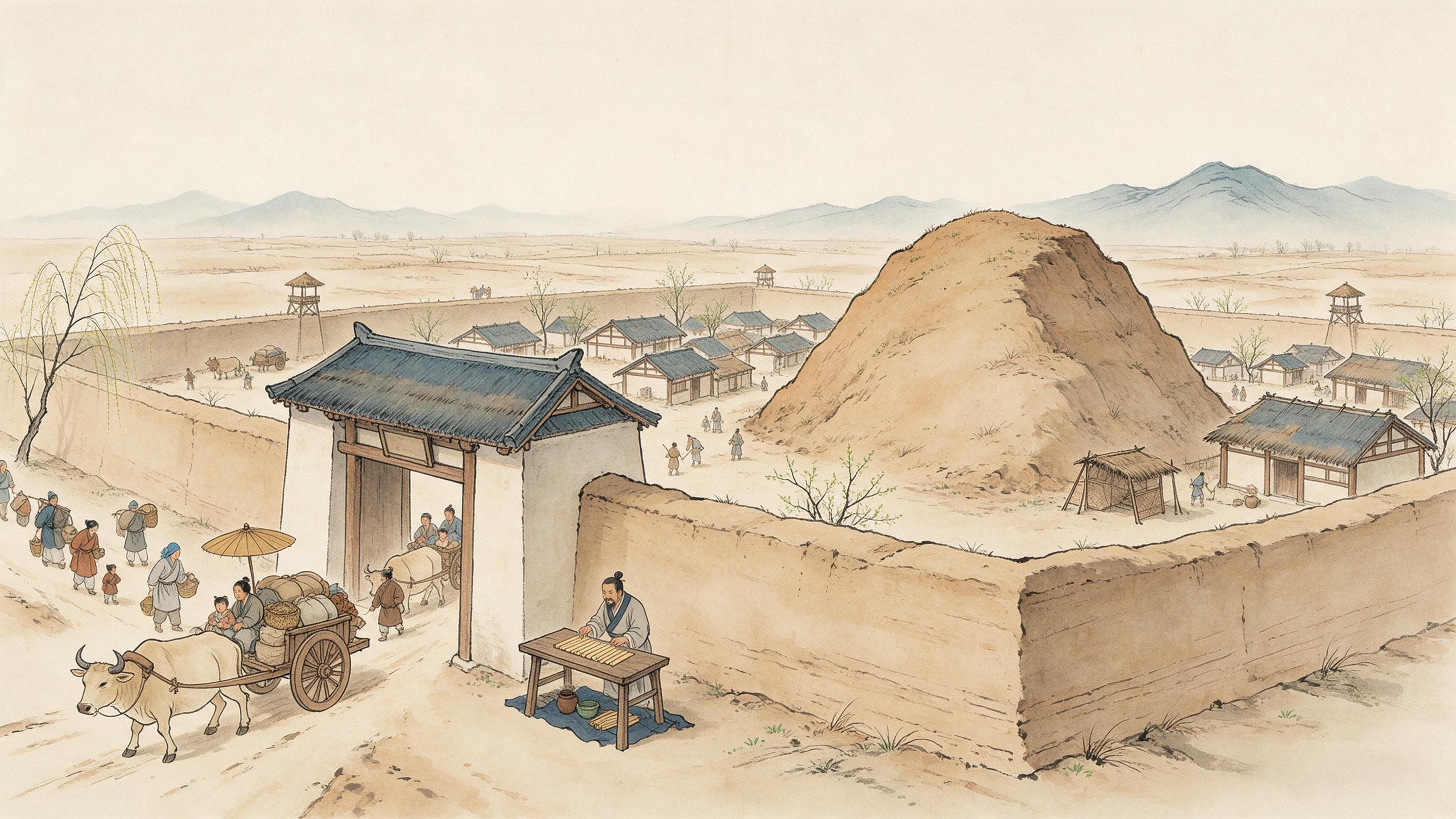
The Shiji's chapter on Lü Buwei supplies the person. Lord Anguo, son of King Zhao of Qin, had a favourite concubine whom he made his principal wife, titled Huayang Furen; she had no son (華陽夫人無子). He had more than twenty sons; his middle son Zichu, whose mother Xia Ji was out of favour, was a hostage in Zhao. Lü Buwei, meeting him in Handan, judged him 'a rare commodity worth hoarding' (此奇貨可居), and told him: 'the only one who can establish the legitimate heir is Huayang Furen' (能立適嗣者獨華陽夫人耳). He went west with gifts, saw Huayang Furen's elder sister, and had her argue that a woman who serves by beauty loses favour when beauty fades, so the childless lady should now bind to herself the worthy among the sons and make him heir. Huayang Furen agreed, wept before Lord Anguo, asked that Zichu be made heir, and the lord and she cut a jade tally as the pledge.
The rest of the line: when King Zhao died, Lord Anguo became king, Huayang Furen became queen and Zichu the heir; when Lord Anguo died after a year — his posthumous name was King Xiaowen (謚為孝文王) — Zichu became King Zhuangxiang and Huayang became Huayang Taihou (華陽太后). The chapter closes her story with one sentence: 'The queen of King Xiaowen, called Huayang Taihou, was buried with King Xiaowen at Shouling' (孝文王后曰華陽太后,與孝文王會葬壽陵).
A Name and a Grave
That sentence is where the two pages meet, and where they do not quite meet. The Shiji places Huayang Taihou at Shouling, buried with King Xiaowen. The 2026 report places the great tomb at Shangzhaoyao, a site it calls by an old protected name, Gongling (恭陵), and infers that its occupant is Huayang Taihou. The report calls Gongling a protected site (文保单位) and does not say where the name comes from. The report does not say what relation Gongling has to Shouling, and it does not quote the Shiji sentence.
Both statements are quoted here; neither is adjusted to fit the other. If the inference is right, how the tomb on the ground relates to 'buried with King Xiaowen at Shouling' is a question the report leaves open. If the inference is wrong, the name in the text belongs to another tomb. Nothing in these two pages decides between them — whether she lay in the same enclosure, in a separate one, or elsewhere is not stated. A reader can hold both at once: a text that places her at Shouling, and a report that places a great tomb at Shangzhaoyao and calls it probably hers.
What the Report Does Not Give
So the archaeological half of this article is the report's: the plan, the 亞 shape, the ramps, the 258 objects and the inscriptions are all 'according to the report', and the owner is 'possibly' Huayang Taihou. What the report does not give — ramp lengths, object counts by type, enclosure dimensions, the date of the burial within the late Warring States — is not supplied here either. The news report carries no plan or section drawing, no inventory of the finds, and no dating for the tomb beyond "late Warring States". Nor is this a piece about Qin tomb architecture in general, or about any other Qin tomb: it is about one report, one tomb and one name.
Read side by side, the two pages give a shape and a name. One is a news report from 2026 about a square enclosure, four ramps and 258 objects; the other is a chapter written two thousand years ago about a childless queen and a hostage son. The step between them — matching the grave to the name — the report calls a preliminary inference, and does not call it certain.
Related reading:Ditches with Names: Draining a Field by the Zhouli · Measuring a Street: Three Land Prices, Ward Gates and Four Rules on a Signboard in Luoyang · 277 Square Metres: A Shang Bone Workshop's Ledger
Sources & further reading
- 陕西省考古研究院〈陕西咸阳发现战国晚期秦王级墓葬 据推测墓主或为华阳太后〉(央广网,记者苏睿楠,2026-09-24;中国社会科学院考古研究所网站转载) — A news report, not the excavation report: the enclosure near Xi'an Xianyang International Airport, excavated from 2018 and named for the village; a nearly square plan with outer and inner boundary ditches, inner wall, main tomb, satellite and attached burials and sacrificial pits; a '亞'-shaped tomb under a truncated-pyramid mound with four ramps, called typical of a late Warring States Qin royal tomb; 258 objects or groups, with potters' inscriptions and a 宋氏 bronze from an attached burial; the occupant 'preliminarily inferred' to be Huayang Taihou on grounds of the tomb system, transmitted texts and the excavated evidence.
- 司马迁《史记》卷八十五·吕不韦列传(西汉;维基文库本,未与点校本复核) — The Huayang Furen line only: Lord Anguo's childless principal wife; Zichu the hostage son; Lü Buwei's argument that 'the only one who can establish the legitimate heir is Huayang Furen'; the jade tally; Huayang becoming queen and then Huayang Taihou; and the closing sentence that she was 'buried with King Xiaowen at Shouling'.