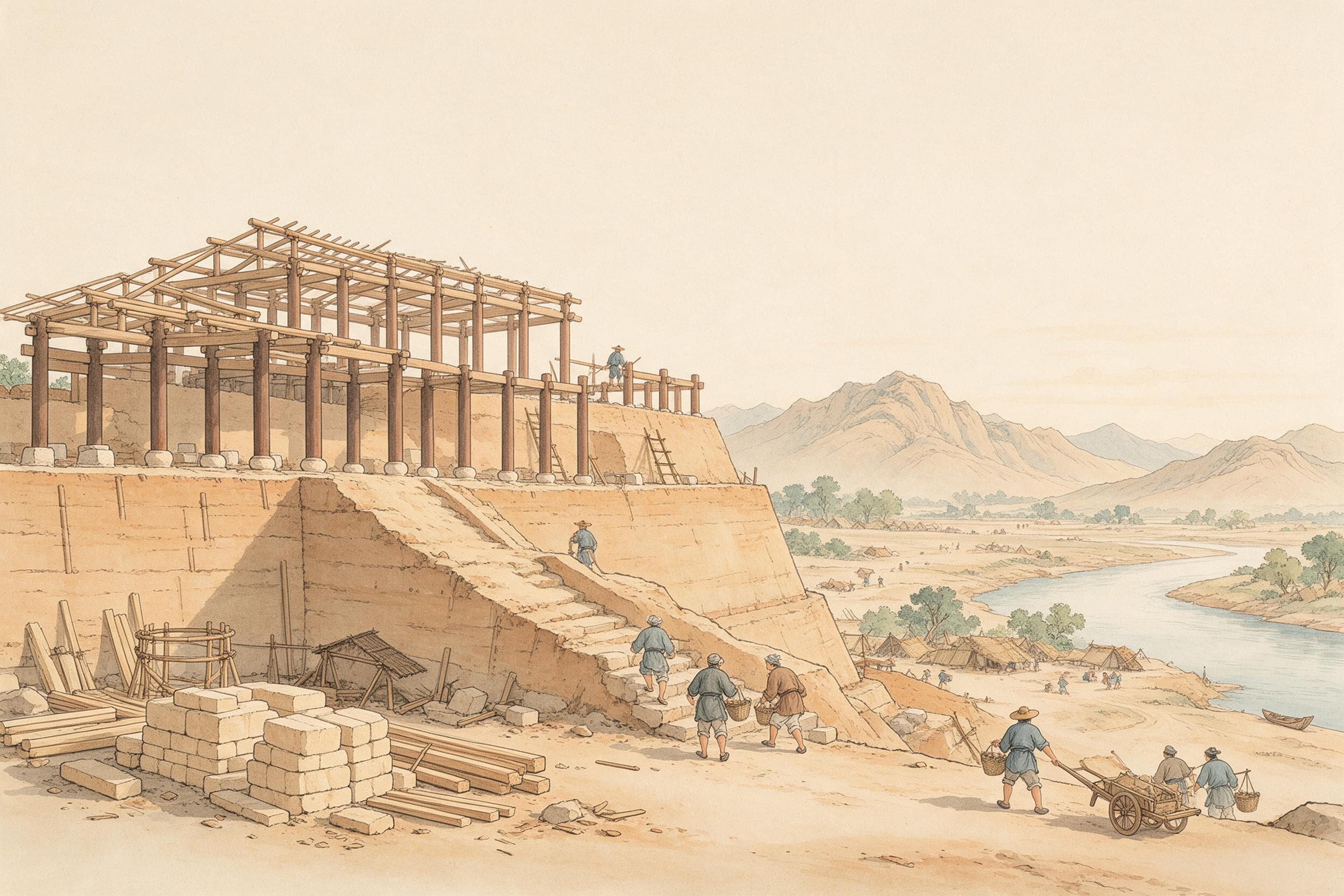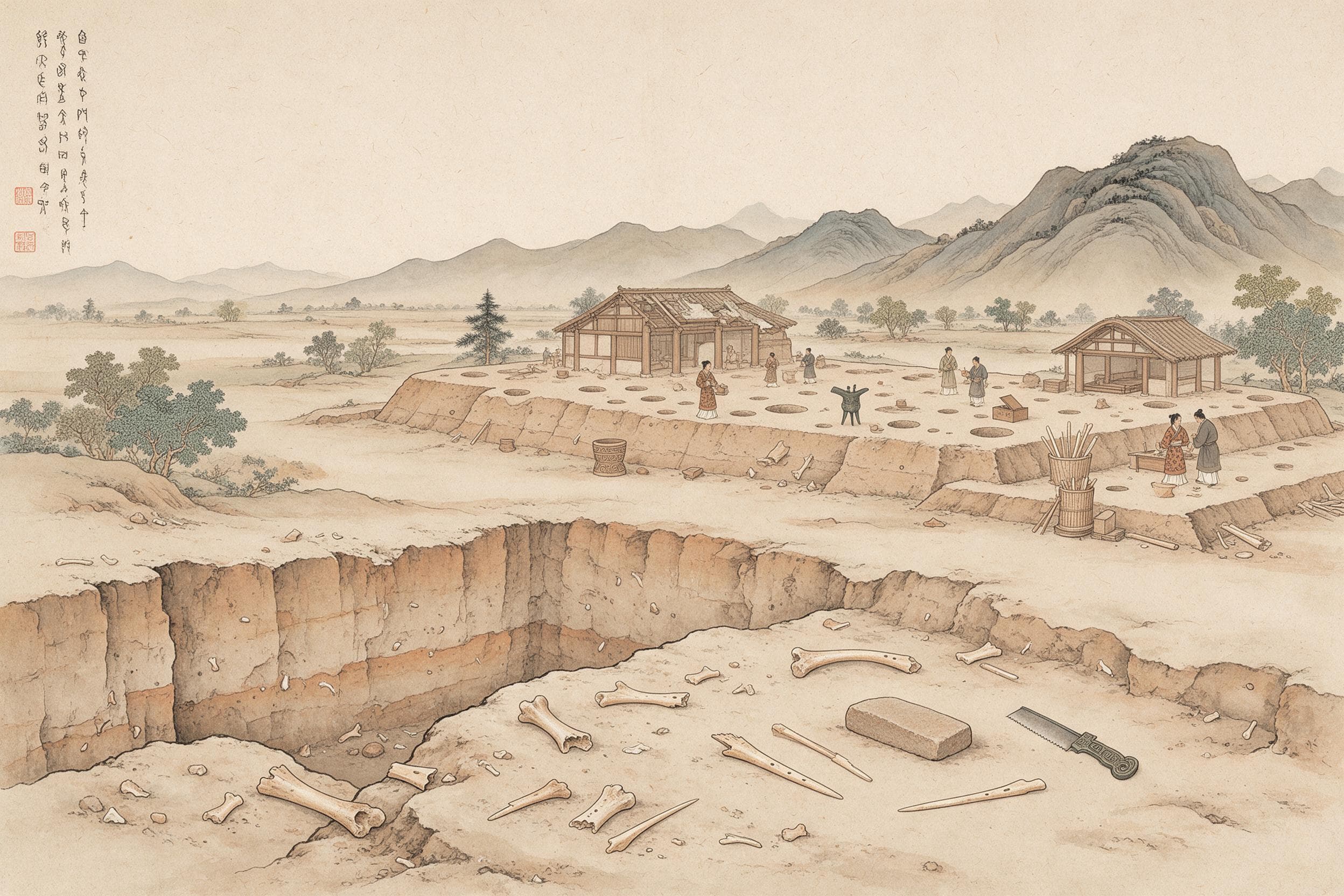
Start with the numbers. A Shang bone workshop: seven trenches laid out, 277 square metres actually excavated. Inside those 277 square metres were eight bone-waste pits, four pottery kilns, 116 ash pits, six house foundations, six wells and twenty burials (M16 left unexcavated). The numbers come from an excavation report, not from inference.
277 and 1,200
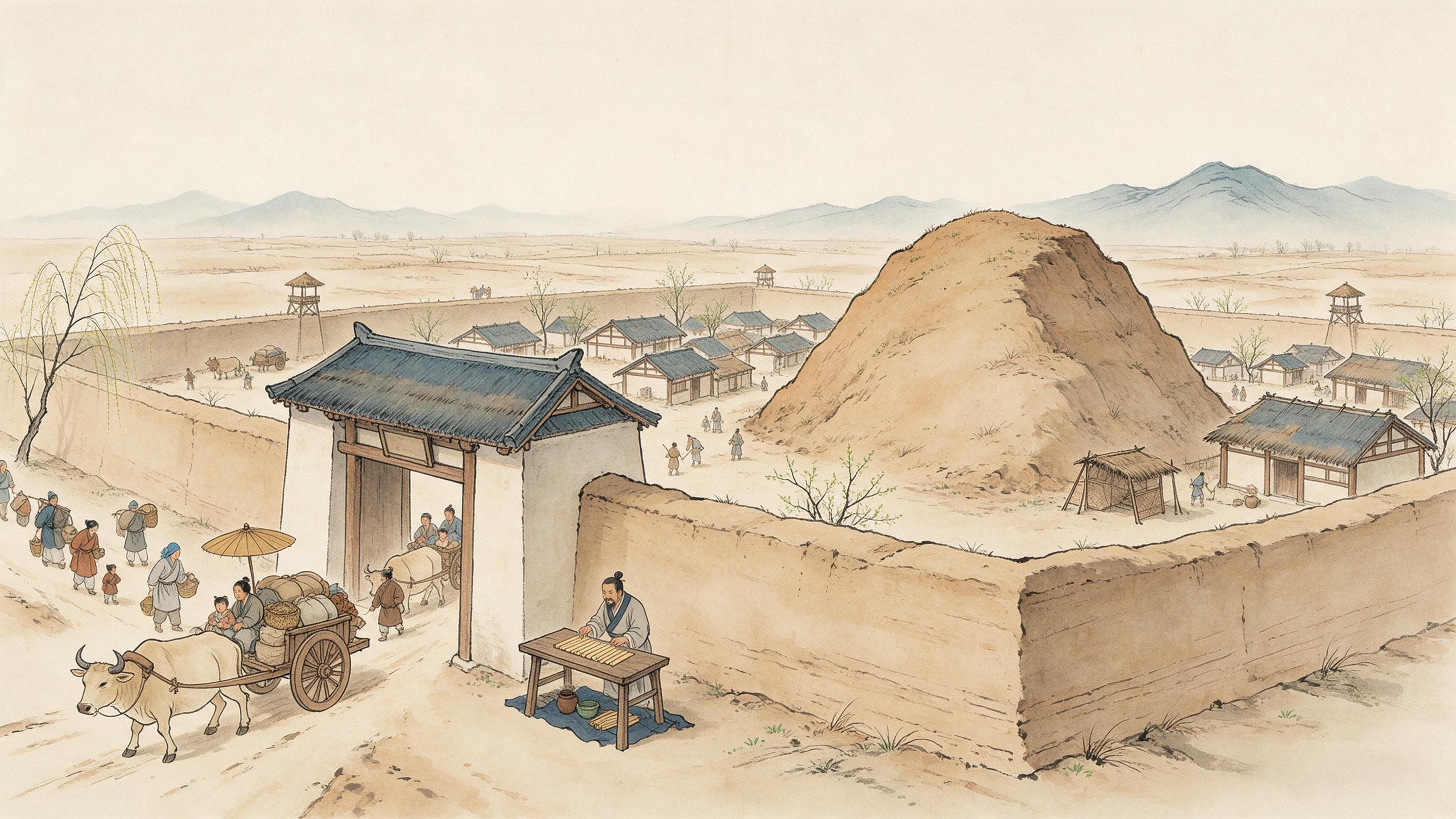
The report gives two areas that must be kept apart. 277 square metres is what was excavated. The bone-working core, as estimated by survey, is 'no less than 1,200 square metres' — that is the extent underground, not the extent opened. So the 277 is one corner of the workshop, and the report does not claim it is the whole. The site lies north of Hanwangdu village, with a bronze-casting workshop about 200 m to the east and a pottery workshop interleaved with it; three workshops side by side, but this article follows only the bone.
The kilns, houses, wells and burials found in the same excavation are the site's inventory; they cannot all be counted as facilities of the bone workshop. The report lists them side by side, and this article lists them the same way. What can be tied to bone-working directly is the eight waste pits and what was in them.
The Waste Is the Main Character
The report's classification is blunt: 'most of the bone is waste related to bone-working production, including the joint ends of limb bones, the shafts left after blanks were cut, the blanks themselves and their rejects, and the offcuts from further working; there is also a small amount of semi-finished and broken finished bone implements. Bones that are not bone-working material are few.' A workshop's ledger runs heavily to waste, not to products.
That fits the sequence. Joint ends mean the two ends were cut off; the shafts left behind mean the blank had been taken; rejected blanks mean some blanks failed; offcuts mean the piece was still being shaped. Finished work is scarce because it left the workshop; waste is plentiful because it stayed. To see how bone became an implement, the waste is more useful than the product.
The report gives only words like 'most' and 'a small amount', no percentages, and this article invents none. What it can give is the classification and the find-spot: which kind of waste, from which pit.
One Cattle Leg Bone
Cattle dominate the bone material; pig, dog and sheep follow, and deer antler is counted separately — 'antler material is generally the beam of large or medium deer'. The parts taken are listed precisely: humerus, radius, ulna, femur, tibia, metacarpal, metatarsal, mandible, scapula and rib — mostly limb bones, which fits what was said above: limb bones are what can be cut into strips for blanks.
The F2 deposit shows the floor of the workshop best. At its base lay a 1.4 by 1 m deposit of bone waste and animal bone, and in it 'at least six pieces were found whose proximal and distal joints and attached bones were still connected' — bones not yet taken apart, the state before the blank was cut. With them came bone hairpins, bone ladles, bone awls, and oracle bones and shells.
H29 gives the tool hint: pottery fragments and a whetstone superimposed with bone material. A whetstone is for grinding. Saws and chisels are mentioned in the report, but their individual counts were not verified here, so this article gives no itemised tool list. Tables 1 and 2 tabulate the bone material pit by pit; the H29 column runs to more than three thousand pieces — a figure in a statistical table, not the workshop's output.
Report and Paper
A research paper stands beside the report, and its standing must be kept distinct. The report is primary: trenches, layers, assemblages, all dug up. He Yuling's paper is interpretation: he argues that 'the production of a bone workshop was economic behaviour, its products mainly commodities for sale', while bronze casting was 'mainly political behaviour', its products consumed politically or ritually. That is the author's view, not the report's conclusion, and this article attributes it — 'the researcher argues'.
The paper also offers a methodological caution: 'to judge from a waste-bone pit alone that a large workshop stood nearby is clearly insufficient evidence.' That is exactly why this article stays inside the 277 square metres: a waste pit proves bone was worked here; how much and how large needs more than one pit.
What Is Not Here
The gaps: no number of craftsmen, no working hours, no annual output; no percentages for the stages, only 'most' and 'a small amount'; no itemised count of saws and chisels; and no extrapolation from one workshop to the whole of Yinxu. The hairpins and oracle bones from F2 are not the product mix of the whole workshop, and lying interleaved with the bronze and pottery workshops does not license adding them into one total.
So what this report can give is the bone, waste and semi-finished pieces within 277 square metres, and the traces of how one cattle leg bone was taken apart — joints cut off, shaft removed, blank cut, shaped, ground. What it cannot give is how developed Shang bone-working was. Read it as a ledger: count the pits, count the pieces, read the layers — not as a verdict.
Related reading:The Market North of the Palace: Liao's Southern Capital · A River of Mercury: The Lishan Tomb in a Chronicle and a Memorial · Six Chi Six Cun: A War Chariot's Measurements and Two Ways of Counting a Sheng
Sources & further reading
- 中国社会科学院考古研究所安阳工作队《河南安阳洹北商城制骨作坊2020—2022年发掘报告》,《考古学报》2025年第4期(PDF 50 页;维基文库无录文,未与纸本复核) — The primary excavation report. It records: seven trenches laid out, 277 square metres actually excavated; eight bone-waste pits, four pottery kilns, 116 ash pits, six house foundations, six wells and twenty burials (M16 left unexcavated); a surveyed bone-working core area of no less than 1,200 square metres north of Hanwangdu village, with a bronze-casting workshop about 200 m to the east and a pottery workshop interleaved with it. Most of the bone is production waste — joint ends, shafts left after blanks were cut, blanks and rejects, offcuts — with only a little semi-finished and broken finished work, and few bones that are not bone-working material. Cattle dominate, with pig, dog and sheep, plus deer antler; the parts taken are humerus, radius, ulna, femur, tibia, metacarpal, metatarsal, mandible, scapula and rib. In F2, a 1.4 by 1 m deposit of bone waste and animal bone at the base contained at least six pieces whose proximal and distal joints and attached bones were still connected, together with bone hairpins, bone ladles, bone awls, and oracle bones and shells. In H29 a whetstone lay superimposed with bone material. The report gives no number of craftsmen, no working hours and no output figures.
- 何毓灵《论殷墟手工业作坊遗址考古的相关问题》(研究论文,PDF 6 页;作者观点,非一手发掘记录) — A research paper, used only as attributed opinion, never as the report's conclusion. Its argument: 'in a sense the production of a bone workshop was economic behaviour, its products mainly commodities for sale, while the bronze casting that embodied the Bronze Age level of the Three Dynasties was mainly political behaviour, its products consumed politically or ritually' (制骨作坊的生产行为是经济行为,其产品主要是商品…铸铜生产主要是政治行为). It also warns that a waste-bone pit alone is 'clearly insufficient evidence' for concluding that a large workshop stood nearby — a methodological caution used in this article to explain why it stays inside the 277 square metres.