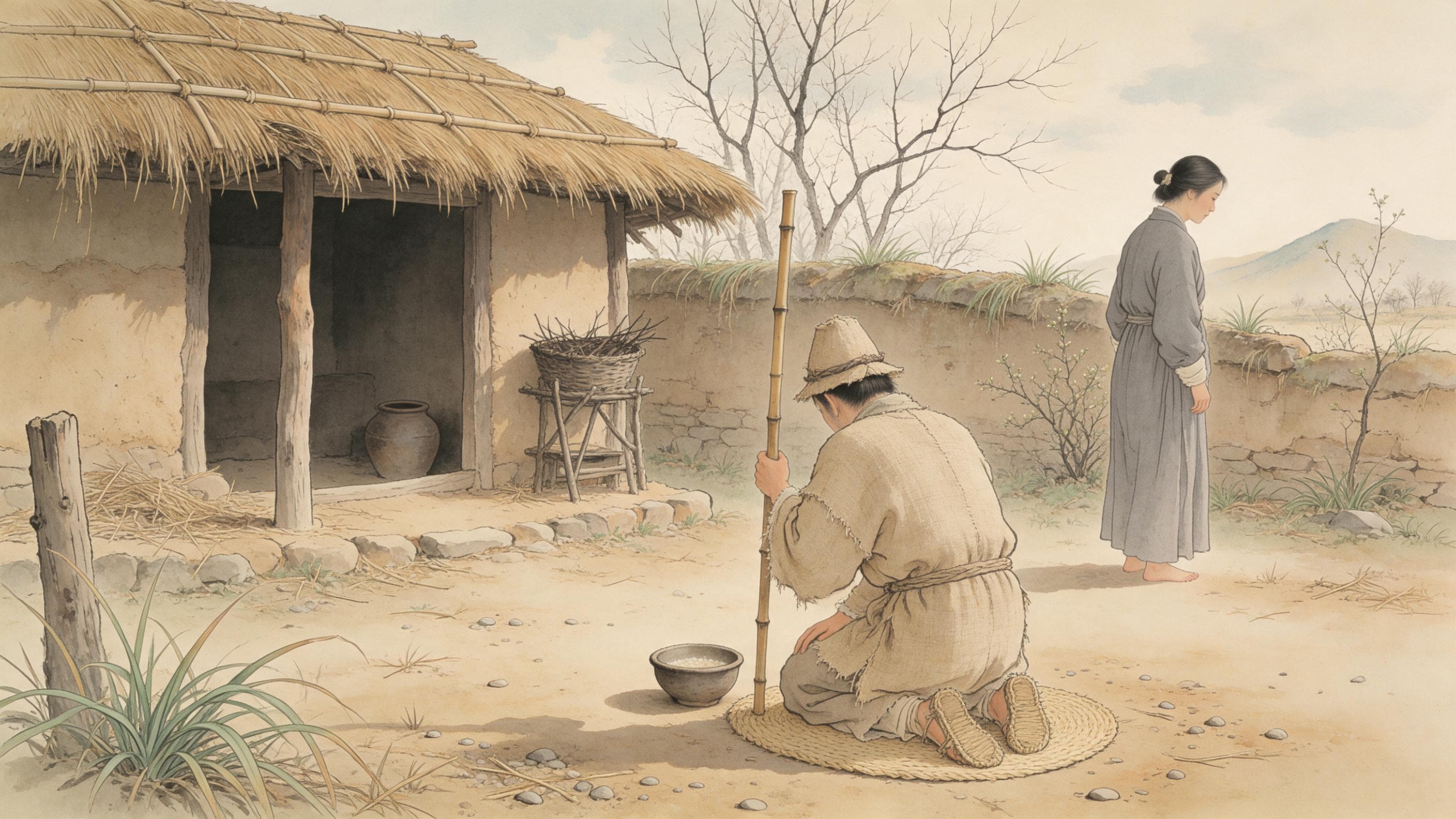
最重的一件丧服,礼书写得很具体:「丧服,斩衰裳,苴绖杖,绞带,冠绳缨,菅屦者。」——粗麻做的上衣下裳,边不缝;苴麻做的腰带;一根竹杖;绞麻的带子;麻绳做帽缨;草鞋。然后是穿它的人:诸侯为天子,臣为君,父为长子,出继为别人后嗣的人;妻为夫,妾为君,未嫁的女儿为父。三年。
五个名目,不止五等
「五服」是五个名目:斩衰、齐衰、大功、小功、缌麻。《仪礼·丧服》正是按这个次序往下排:斩衰裳(斩衰)——疏衰裳齐(齐衰)——大功布衰裳(大功)——繐衰——小功布衰裳(小功)——缌麻。名目五个,等第不止五个:光齐衰就有三年、期、不杖期、三月几等,大功还分殇服与成人服,另有一等「繐衰」——诸侯之大夫为天子,「既葬除之」。
只举齐衰里的几种:三年者,「父卒则为母,继母如母,慈母如母,母为长子」;期者,「父在为母,妻,出妻之子为母」;不杖期者,「祖父母,世父母,叔父母」,还有昆弟、众子、昆弟之子;三月者,「寄公为所寓」「庶人为国君」「曾祖父母」。同一件「齐衰」,落在不同关系上,期数就不同。
服制是怎么排的
丧服篇的排法是:每一等丧服下面挂一串人。不是按感情排,是按关系与身份排——父、母、夫、君、长子、祖父母、世叔父母、姑姊妹、从父昆弟……同一等里既有「为父」也有「为君」。为什么?《礼记·丧服四制》说:「其恩厚者其服重,故为父斩衰三年,以恩制者也」;「资于事父以事君,而敬同,贵贵尊尊,义之大者也,故为君亦斩衰三年,以义制者也」。一套是恩,一套是义,两条线并进。
这张表的坐标是亲属距离。《礼记·丧服小记》给了一句骨架:「亲亲以三为五,以五为九,上杀、下杀、旁杀,而亲毕矣。」——从自己数上去、数下去、数到旁边,服随亲疏递减,减到尽头就没有服了。所以五服是从一个中心往外推的同心圈,不是身份等级。
五等落到布、哭、食、住
《礼记·间传》把五等落成可感的东西。先是布:「斩衰三升。齐衰四升、五升、六升。大功七升、八升、九升。小功十升、十一升、十二升。缌麻十五升去其半。」——用「升」计布的精粗,数字越小布越粗,最重的丧服最粗。丧服篇末的记另有一组数:斩衰三升、三升有半,其冠六升;齐衰四升,其冠七升;大功八升或九升;小功十升或十一升。与《间传》不完全一致,照录不合并。再是哭:「斩衰之哭,若往而不反;齐衰之哭,若往而反;大功之哭,三曲而偯;小功、缌麻,哀容可也。」再是不食:「斩衰三日不食,齐衰二日不食,大功三不食,小功、缌麻再不食。」再是住:「父母之丧,居倚庐,寝苫枕块……齐衰之丧,居垩室……大功之丧,寝有席;小功、缌麻,床可也。」
三年之丧为什么是三年?《礼记·三年问》说:「三年之丧,何也?曰:称情而立文……三年者,称情而立文,所以为至痛极也。」又说「三年之丧,二十五月而毕」——三年之丧,二十五个月就结束;之所以加倍,是「加隆焉尔也,焉使倍之,故再期也」;篇末引孔子曰:「子生三年,然后免于父母之怀。夫三年之丧,天下之达丧也。」《礼记·服问》则给了一句总纲:「罪多而刑五,丧多而服五。上附下附,列也。」——刑罚五等,服制五等,都靠「往上附、往下附」来归类。
礼书规定,不是执行记录
这一层必须说清:《仪礼》是礼书,丧服是一张规定表。它规定某类人为某类人服某服、服多少个月,不记录谁真的穿了、穿了多久。实际执行的程度、地域差别、时代变化,这两页都不回答。所以不能写「周代人都服三年丧」——只能说礼书这样规定。
这张表主要覆盖贵族与士的亲属关系。普通人在篇中只在个别条目里露面——「庶人为国君」是一条,「公士、大夫之众臣为其君布带、绳屦」是一条;除此之外,礼书对普通人的日常服制几乎没有材料。礼书规定的对象,不等于当时全体人口。
材料没有的
没有一次实际服丧的记录;没有「二十五月而毕」这套期数被执行的证据;没有庶人、奴婢的完整服制表;没有各地差异。能读到的《仪礼·丧服》页有经与记,没有传(问答式的解释),本文只用经与记。丧服篇本身也有难读与异文:殇服分长殇、中殇、下殇,期数各异(大功条目里「其长殇皆九月,缨绖;其中殇,七月,不缨绖」),繐衰只系在诸侯之大夫为天子一条上,都是读的时候要留神的地方。
所以五服是一张以亲属距离为横轴、以身份为纵轴的表。它的力量在后世——法律与礼俗都用它来定亲疏;但它本身是礼书条文。读它最该记住的不是「五种心情」,而是五种布、五种杖、五种居处、五种不食的天数:礼把哀痛拆成了可以规定的动作。
延伸阅读:九世之乱:《史记》里的一段商代继统 · 五十个博士弟子:汉太学的初置 · 「卜其昼,未卜其夜」:一场酒、一个孩子与两套问法
参考来源与延伸阅读
- 《仪礼·丧服》(战国至汉初成书;维基文库本,未与点校本复核) — The table itself. It opens with the heaviest grade: 'Mourning dress: sackcloth upper and lower garments with unhemmed edges, a coarse hemp belt and staff, a twisted band, a cap with rope strings, straw sandals' (喪服,斬衰裳,苴絰杖,絞帶,冠繩纓,菅屨者) — and under it a list of persons: the feudal lords for the Son of Heaven, a subject for his lord, a father for his eldest son, one who has become another's heir; a wife for her husband, a concubine for her lord, an unmarried daughter for her father: for three years. The chapter then works down by grade: a trimmed-hemp version for three years (father deceased, then for mother; stepmother and foster mother as mother; mother for eldest son), a one-year version (father alive, for mother; for wife; a divorced wife's son for his mother), an unstaffed one-year version (grandparents, uncles and aunts, elder and younger brothers, brothers' sons…), three months (the exiled lord for his host, a commoner for his ruler, great-grandparents…), then the nine-month, five-month and three-month grades, and an extra grade of fine hemp, worn by a feudal lord's minister for the Son of Heaven 'and removed after the burial'. It is a schedule of who wears what for whom: it gives no record of anyone actually wearing it. The page used here carries the chapter's schedule and its closing notes (記) with cloth measurements, but not the tradition (傳) that explains individual clauses in question-and-answer form; this article cites only the schedule and the notes.
- 《礼记》间传、三年问、服问、丧服小记、丧服四制(战国至汉初成书;维基文库本,未与点校本复核) — The commentary and rationale, in several chapters. 間傳 turns the five grades into cloth and behaviour: the cloth is reckoned in sheng — three for the heaviest, four to six for the trimmed grade, seven to nine for the nine-month, ten to twelve for the five-month, fifteen halved for the three-month; the wailing differs by grade (the heaviest 'goes and does not return'); the fasts differ (three days without food for the heaviest, two for the next, three skipped meals for the nine-month, two for the lightest); and the dwelling differs (a thatched hut with a straw mat and a clod for a pillow for parents, a mud-plastered room for the trimmed grade, a mat for the nine-month, a bed for the lightest). 三年問 explains the three years: 'the three years' mourning is finished in twenty-five months' (三年之喪,二十五月而畢), 'it is doubled because it is made heavier' (加隆焉爾也,焉使倍之,故再期也), and quotes Confucius on the three years a child is carried. 服問 gives the summary sentence: 'crimes are many but punishments five; mourning is many but its grades five' (罪多而刑五,喪多而服五). 喪服小記 gives the kinship frame: 'kin by three, extending to five, extending to nine; cut above, cut below, cut to the side, and kinship is exhausted' (親親以三爲五,以五爲九,上殺、下殺、旁殺,而親畢矣). 喪服四制 explains that the heaviest grade is worn for a father 'by grace' and for a lord 'by right' (以恩制者也…以義制者也), and that a father alive means a one-year grade for the mother, 'for there are not two honoured ones' (見無二尊也). The other chapter pages are https://zh.wikisource.org/wiki/禮記/三年問, /禮記/服問, /禮記/喪服小記 and /禮記/喪服四制. All are prescriptions; none records an actual funeral. Note that the Yili's closing notes and the Liji's 間傳 give slightly different sheng counts for the same grades; this article records both rather than merging them.