元封七年的诏书里,有一句七个字:「其以七年为元年。」年号就这么换了。而这次改历的核心,在《汉书》里只有一句:「法,一月之日二十九日八十一分日之四十三。」其余全是过程:问了谁、试了什么、立了哪两件仪器、谁的法被废、二十七年之后还有谁在争。
改历以前:袭秦正朔
《汉书》从一份报告和一道诏书讲起。元封七年,「汉兴百二岁矣」,大中大夫公孙卿、壶遂、太史令司马迁等说「历纪坏废,宜改正朔」。天子让御史大夫兒宽与博士共议,博士们的回答是原则:「帝王必改正朔,易服色,所以明受命于天也。」然后是诏书,先认账再下令:「乃者有司言历未定,广延宣问,以考星度,未能雠也……其以七年为元年。」注意这道诏里没有什么:没有月长,没有岁实,没有一个数字。
《史记》把同一件事往前拉。开篇是一句原理:「王者易姓受命,必慎始初,改正朔,易服色,推本天元,顺承厥意。」接着是没改成的历史:汉兴,自以为得水德,「故袭秦正朔服色」;文帝时鲁人公孙臣以终始五德上书请改,丞相张苍以为非是,罢了;后来新垣平以望气进言正历服色,作乱被诛,文帝「废不复问」。在《史记》的写法里,改历是几十年拖延之后的一次收尾。
三正:正月在哪个月
「改正朔」到底改什么,《史记》正文有一句说得很清楚:「夏正以正月,殷正以十二月,周正以十一月。盖三王之正若循环,穷则反本。天下有道,则不失纪序;无道,则正朔不行于诸侯。」三代的正月分别是正月、十二月、十一月,用的是月序,不是今天的日期;本篇也只用月序,不折成公历。
新历选的是哪一边,也只用一句写:「然后日辰之度与夏正同。」回到夏正,就是这次改历的方向。至于夏正那一个月相当于今天的几月,两页都不说;秦的正朔是哪个月,两页也不说,只说汉初「袭秦」。
第一批人算不出来
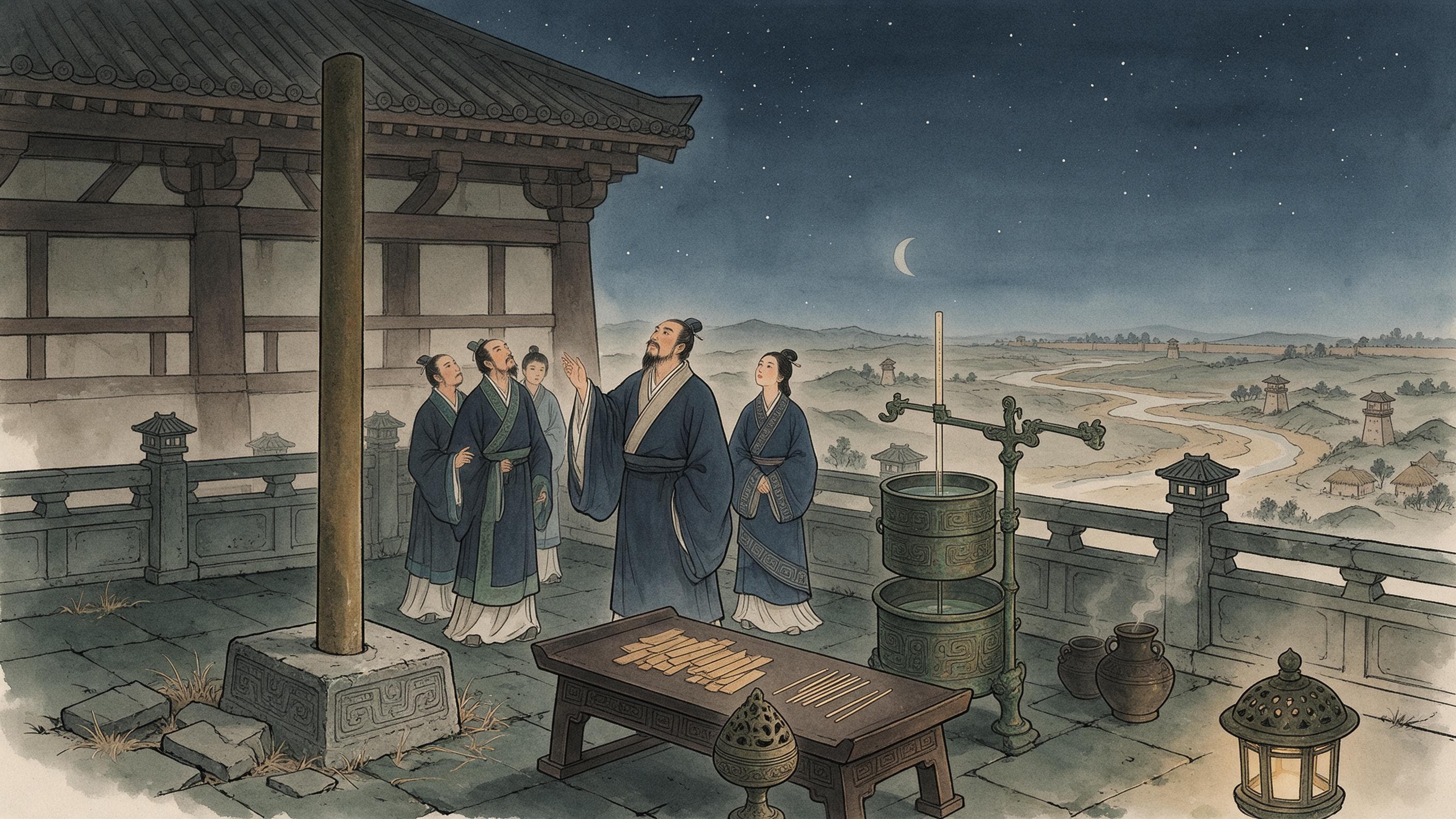
第一道任命是一串名字加一套仪器:诏「卿、遂、迁与侍郎尊、大典星射姓等议造汉历」;方法是「乃定东西,立晷仪,下漏刻,以追二十八宿相距于四方,举终以定朔晦分至,躔离弦望」。然后是一句失败:「姓等奏不能为算,愿募治历者,更造密度,各自增减,以造汉太初历。」第一批人算不出来,才改成广募——改历不是一次成功,是先认输,再找人。
二十余人:名单与分工
第二批是那串常被引用的名单:「乃选治历邓平及长乐司马可、酒泉候宜君、侍郎尊及与民间治历者,凡二十余人,方士唐都、巴郡落下闳与焉。都分天部,而闳运算转历。」人数照录「二十余人」,不给确数。名单里有官、有边地小吏、也有「民间治历者」;「迁」一般认为就是司马迁,但本页只写一个「迁」字。两句分工也很具体:唐都分天部,落下闳运算转历——一个划天区,一个推数字。
一句话的历法,和没完的争论
定下来的法是分数,不是小数:「法,一月之日二十九日八十一分日之四十三。」本篇不化成小数,也不反推任何「月长」的现代值。分母从哪来,同页给了自家说法:「其法以律起历,曰:『律容一龠,积八十一寸,则一日之分也。』」历名也由此而来:「邓平所造八十一分律历。」
同一场改历里还有两套算法在争,选哪一套的理由写得很实在:「先藉半日,名曰阳历;不藉,名曰阴历……平曰:『阳历朔皆先旦月生,以朝诸侯王群臣便。』」——挑阳历,是因为朔在黎明前生,诸侯王群臣朝见方便。随后是裁决与复核:「乃诏迁用邓平所造八十一分律历,罢废尤疏远者十七家」;宦者淳于陵渠复覆太初历的晦朔弦望,「皆最密,日月如合璧,五星如连珠」——「最密」「合璧」「连珠」是赞语,照录并标明是赞语;邓平由此为太史丞。
《史记》给的是另一套,也缺另一套:没有邓平,没有「二十余人」,全书没有「八十一分」这个词;它有同一道诏的另一种措辞——「其更以七年为太初元年」,年名「焉逢摄提格」,月名「毕聚」,日得甲子,夜半朔旦冬至(《汉书》同处作「閼逢摄提格」,用字不同,两存);它还有一张表,「历术甲子篇」,列大余小余,「大余者,日也;小余者,月也」。表只提到这里,数不换算。争论也没有完:二十七年后元凤三年,太史令张寿王上书说「今阴阳不调,宜更历之过也」,主历使者鲜于妄人诘问,他不服;麻光等二十余人杂候日月晦朔弦望、八节二十四气,参校凡十一家,最后太初历第一。两页都不给的是:观测记录、误差、这部历行用到哪一年。
延伸阅读:封禅:泰山顶上站过的那几个人 · 下棺那一天:既夕礼的启、迁、发引与反哭 · 一部官制,一本配方:周礼的酒正与《齐民要术》的神麴
参考来源与延伸阅读
- 班固《汉书》卷二十一〈律历志上〉(维基文库本,未与点校本复核) — The reform in order. In Yuanfeng 7, 'a hundred and two years after Han arose', Gongsun Qing, Hu Sui and the grand astrologer Sima Qian say the calendar record is ruined and the first month should be corrected; the scholars argue that a king must 'correct the first month and change the colours' to show he has the mandate; the edict admits the star measures could not be matched and ends 'make the seventh year the first year' (其以七年為元年). The first commission — Qing, Sui, Qian, the court gentleman Zun and the grand astrologer She Xing — sets up gnomon and water clock, then reports it 'could not do the calculations' (不能為算) and asks to recruit others. The second team: Deng Ping, a Ke of Changle, Yi Jun of Jiuquan, the court gentleman Zun and calendar men from among the people, 'twenty-odd in all', with Tang Du dividing the sky and Luoxia Hong turning the calculations. The rule adopted is one line: 'one month is twenty-nine days and forty-three eighty-firsts of a day' (一月之日二十九日八十一分日之四十三), with the denominator explained by 'the capacity of one yue is eighty-one cun, and that is the division of one day'. The yang and yin calendars differ by borrowing half a day, and the yang is chosen because its new moon rises before dawn, 'convenient for the marquises, kings and ministers to appear at court'. Seventeen schools are abolished, a eunuch re-checks the result as 'the closest', and Deng Ping is made assistant to the grand astrologer. Twenty-seven years later Zhang Shou Wang is still disputing it.
- 司马迁《史记》卷二十六〈历书〉(维基文库本,未与点校本复核) — A different account, longer in principle and shorter in personnel. It opens with the rule that a new dynasty 'must be careful of the beginning, correct the first month, change the colours, and trace back to the celestial origin' (改正朔,易服色,推本天元); recalls that Han 'carried on Qin's first month and colours' (襲秦正朔服色); that under Wendi Gongsun Chen's proposal was dismissed by Zhang Cang and Xin Yuan Ping's ended in rebellion, after which the matter was dropped. It states the three first months in full: 'the Xia took the first month, the Yin the twelfth, the Zhou the eleventh; the first months of the three kings are like a cycle' (夏正以正月,殷正以十二月,周正以十一月). After Tang Du and Luoxia Hong, 'the degrees of the sun and the day were the same as the Xia first month'; the edict then reads 'make the seventh year the first year of Taichu' (其更以七年為太初元年), with the year name Yanfeng Tige, month name Biju, day jiazi, midnight, new moon at dawn, winter solstice — followed by the Ganzhi Sequence table of great and small remainders, 'the great remainder is the day, the small remainder is the month'. The Shiji has no Deng Ping, no twenty-odd men, and never uses the phrase 'eighty-one parts'.