The first sentence is self-deprecation. The master holds the arrows and says: 'I have crooked arrows and a lopsided hu; let me offer them for the guests' pleasure' (某有枉矢哨壺,請以樂賓). 'Crooked' and 'lopsided' are his own words against his own equipment. This piece takes the Liji's touhu chapter in two layers: the rite (who holds what, how to ask, how to decline, what music is played) and the win (counters, horses, the penalty cup). The two are kept apart.
One: three offers, three refusals
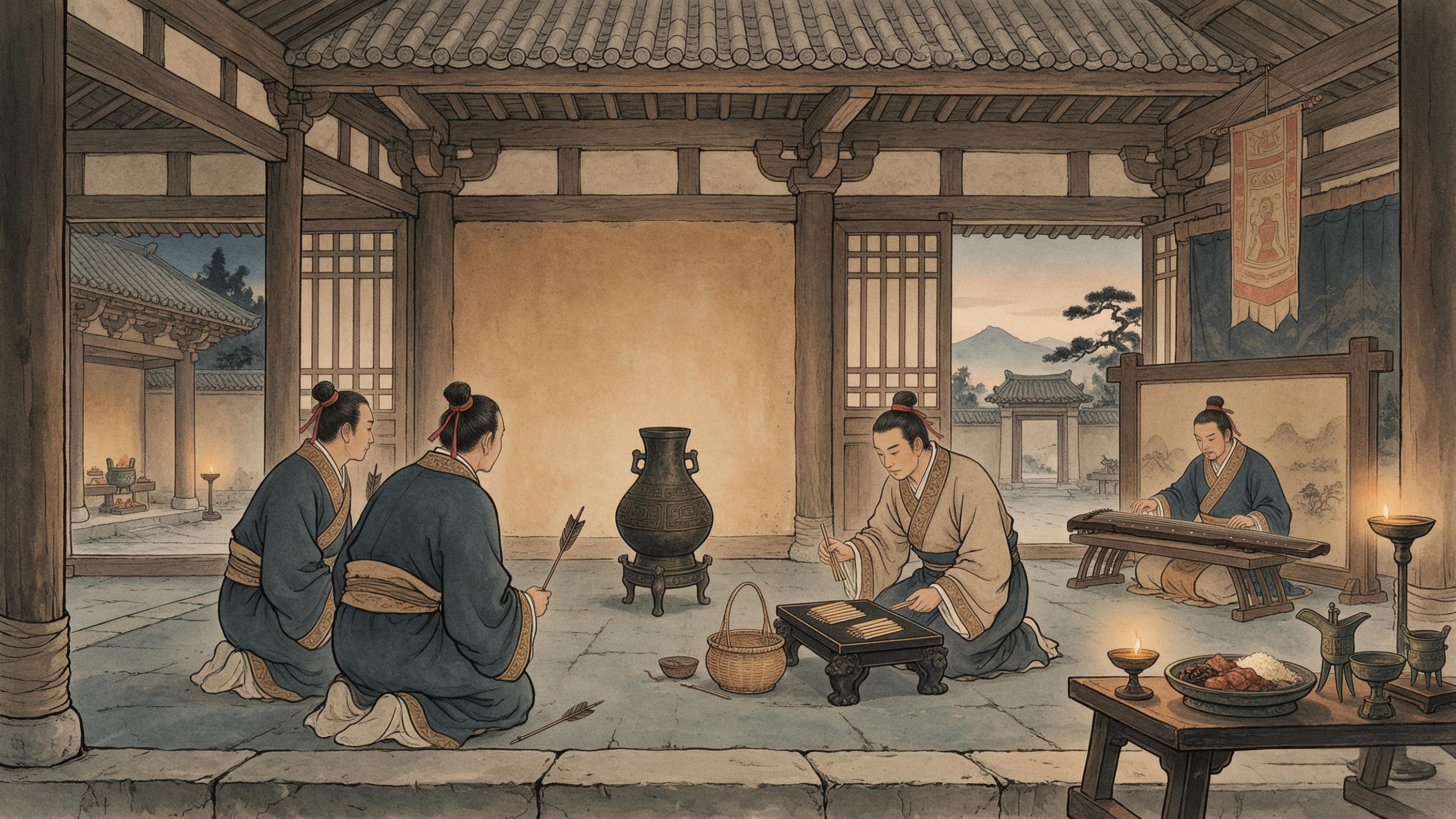
Three men hold three things: 'in the rite of touhu, the master holds the arrows, the master of archery holds the tally vessel, and someone is made to hold the hu' (主人奉矢,司射奉中,使人執壺). Then three rounds of refusal: the master asks, the guest declines; the master presses ('I venture to ask again'), the guest declines again; the master presses a third time, and the guest says he cannot refuse the command and will respectfully obey. Then: 'the guest bowed twice and received them; the master turned aside and said: I beg to decline; the master bowed and sent him from the eastern steps, and the guest turned aside and said: I beg to decline; the bows done, he received the arrows, advanced to between the two pillars, returned to his place, and bowed the guest to his mat' (賓再拜受……揖賓就筵). Every bow and every turn is written down.
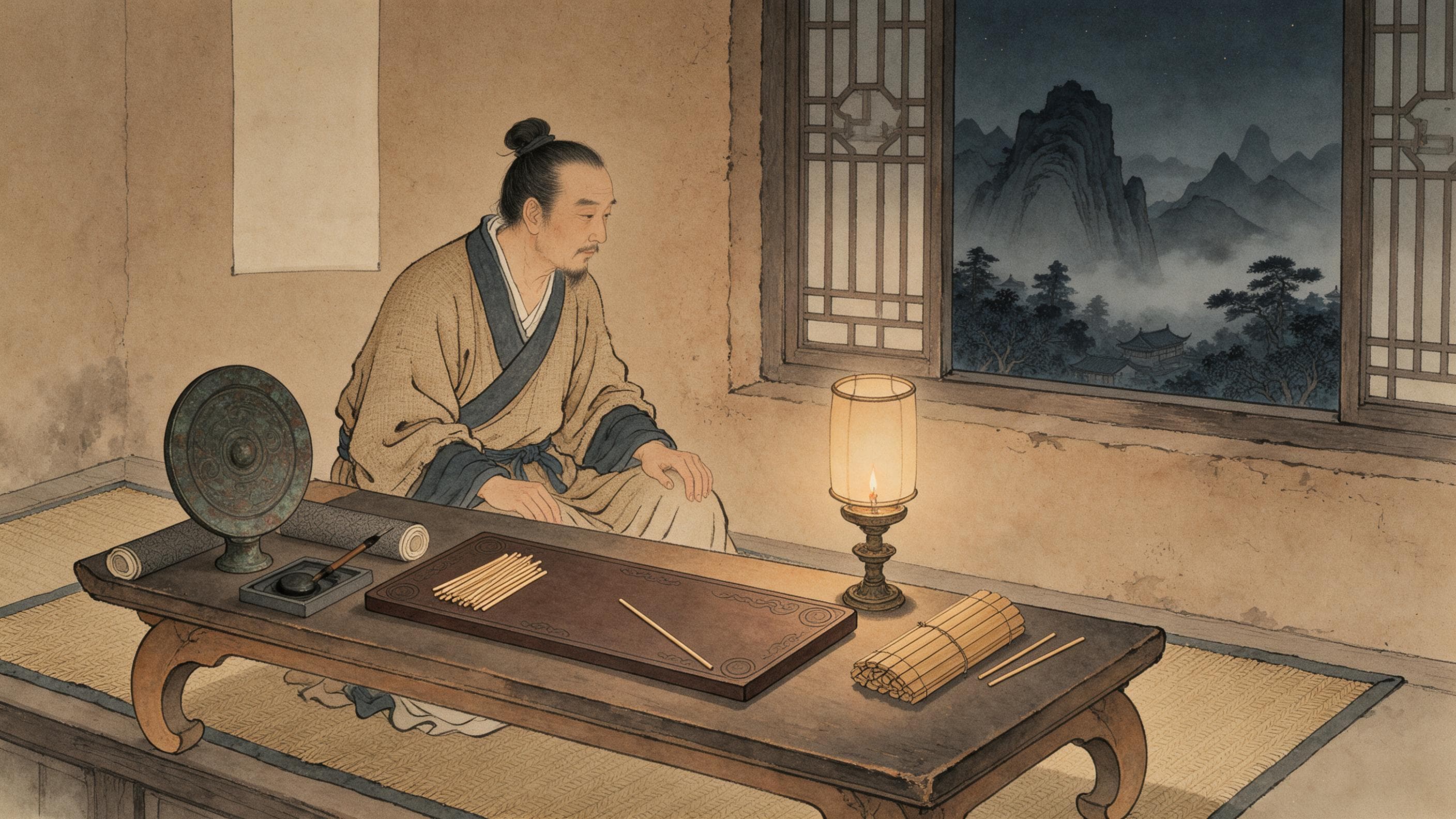
Then the master of archery: 'he advanced and measured the hu, two and a half arrows apart, returned to his place, set the tally vessel facing east, took eight counters and stood up' (司射進度壺,間以二矢半……執八筭). Then the music: 'he ordered the string players: play the Lishou, with equal intervals. The grand master said: Yes' (請奏貍首,間若一). Then 'left and right announced the arrows were ready, and asked them to throw in turn'. That is the skeleton: who holds what, where they stand, how far the hu is, what is played. How the Lishou was sung, how the drums went, the page gives only as strings of circles and squares at the end, unreadable as notes; this piece does not quote them.
Two: counters, horses, and the cup
The rules of winning are in the same chapter, in a few sentences: 'a straight throw is in; successive throws are not counted; the winners drink the losers. When the proper cup has gone round, ask to set up a horse for the winner; one horse follows two; when three horses are set, ask to congratulate the one with more horses' (順投爲入,比投不釋,勝飲不勝者……三馬既立,請慶多馬). That is this piece's wager layer: not money or goods, but counters, horses and cups.
The counting has its own formulas: 'when the throwing is over, the master of archery holds the counters and says: left and right have finished, please count. Two counters make a chun; take them a chun at a time; a single counter is a ji. Then he announces with the odd counters: so-and-so is so many chun better than so-and-so. If odd, he says odd; if equal, he says left and right are equal' (二筭爲純……鈞則曰左右鈞). These are the text's own counting terms and its own way of announcing the score; they are copied, not turned into a modern scoreline.
The penalty is written in actions: 'he ordered the pourer: please pass the cup. The pourer said: yes. Those who were to drink all knelt and held up the cup saying: we are granted a drenching. The winners knelt and said: we respectfully nourish you' (當飲者皆跪奉觴曰賜灌,勝者跪曰敬養). Then: the proper cup goes round, the horses are set up, 'each horse stands by its counters; one horse follows two, for congratulation; the congratulation says: three horses being complete, we congratulate the one with more; host and guest both say: yes; the proper cup having gone round, ask to remove the horses' (馬各直其筭……請徹馬). Kneeling, raising the cup, two phrases, setting horses beside counters, congratulating, removing them: all in a few lines.
Three: the vessel and its measurements
The hu is given by measurement: 'neck seven inches long, belly five inches, mouth two and a half inches across, holding a dou and five sheng' (壺,頸脩七寸,腹脩五寸,口徑二寸半,容斗五升). One detail explains itself: 'dried beans are put inside the hu, so that the arrows leap out when they enter' (壺中實小豆焉,爲其矢之躍而出也). Position has a figure too: the hu is 'two and a half arrows from the mat'. The arrows are 'of zelkova or jujube, with the bark not removed'.
The counters and tallies have their own figures: 'the counters: five fu in a room, seven fu on a hall, nine fu in a courtyard; the tallies are a foot two inches long' (籌,室中五扶,堂上七扶,庭中九扶。筭,長尺二寸). What a fu is the page does not gloss, and this piece does not convert it into modern lengths; feet, inches, dou and sheng are all copied as they stand.
Four: another page, another banquet
Touhu appears once in the Zuo Commentary, and it is another kind of thing: 'the Marquis of Jin was drinking with the Marquis of Qi, and Zhonghang Muzi attended. They threw into the hu. The Marquis of Jin went first; Muzi said: There is wine like the Huai, meat like a mound — if our ruler hits this, he will be the model for the feudal lords. He hit it. The Marquis of Qi raised his arrow and said: There is wine like the Mian, meat like a hill — if I hit this, I shall rise in your place. He hit it too' (有酒如淮……與君代興). Then Boxia's reproach ('you have spoken amiss'), Muzi's answer, and Gongshun Sou's 'the sun is late and the ruler is weary; we may go', with which the Marquis of Qi was led out.
This must be kept separate: it is not a ritual text but a scene of toasts and precedence. The Liji gives the rite; the Zuo Commentary gives this one evening and these words. They are set side by side, not merged, and this passage is not used to fill in the Liji's ritual — it does not say who threw first, where the hu stood, or how the counters were counted.
Five: beyond these two pages
What the pages do not give: the material of the hu (only its measurements and capacity, not whether bronze, clay or other), the size of the ground, the tune of the Lishou, how to read the strings of symbols for the Lu and Xue drums, or any physical stake — there is none. None of it is supplied, and this piece writes no general essay on the drinking culture of antiquity. One boundary at the end: it keeps rite and wager apart and stops there; whether touhu was a rite or a gamble, the Liji itself writes both in one chapter, and this piece does not classify it.
Related reading:The Bo Altar: What to Do with a Conquered Capital's Earth Shrine · Wrestling and Conjurors: Two Shows for Foreign Guests · Paper Dear in Luoyang: How One Rhapsody Raised a Price
Sources & further reading
- 《礼记·投壶》(维基文库本,未与点校本复核) — The full rite in one chapter: 'the master of the house holds the arrows, the master of archery holds the tally vessel, and someone is made to hold the hu' (主人奉矢,司射奉中,使人執壺); the master's three requests and the guest's three refusals (某有枉矢哨壺,請以樂賓); the master of archery measuring the hu 'two and a half arrows apart' (間以二矢半), setting the tallies, holding eight counters; the order to the musicians, 'play the Lishou, with equal intervals' (請奏貍首,間若一); the scoring (二筭爲純,一純以取,一筭爲奇), the announcement (某賢於某若干純…鈞則曰左右鈞), the wine (當飲者皆跪奉觴曰賜灌,勝者跪曰敬養) and the horses set up to be counted (一馬從二馬,三馬既立,請慶多馬); the measurements — counters 'a foot two inches long' (筭,長尺二寸), the hu 'neck seven inches, belly five inches, mouth two and a half inches, holding a dou and five sheng' (壺,頸脩七寸,腹脩五寸,口徑二寸半,容斗五升), the dried beans inside it 'so that the arrows leap out' (壺中實小豆焉), the hu 'two and a half arrows from the mat', and arrows of zelkova or jujube with the bark left on. The page is marked textquality 75%, and it ends with drum notation in circle-and-square symbols which is not decipherable as notes and is not quoted.
- 《春秋左氏传》昭公十二年(维基文库本,未与点校本复核) — A real banquet with a real hu, used as a separate layer: 'the Marquis of Jin was drinking with the Marquis of Qi, and Zhonghang Muzi attended. They threw into the hu. The Marquis of Jin went first; Muzi said: There is wine like the Huai, there is meat like a mound — if our ruler hits this, he will be the model for the feudal lords. He hit it. The Marquis of Qi raised his arrow and said: There is wine like the Mian, there is meat like a hill — if I hit this, I shall rise in your place. He hit it too' (有酒如淮……與君代興). Then the remonstrance of Boxia, Muzi's answer, and Gongshun Sou's 'the sun is late and the ruler is weary; we may go' — a scene about words and precedence, not a ritual text. The page is plain text without Du Yu's commentary.