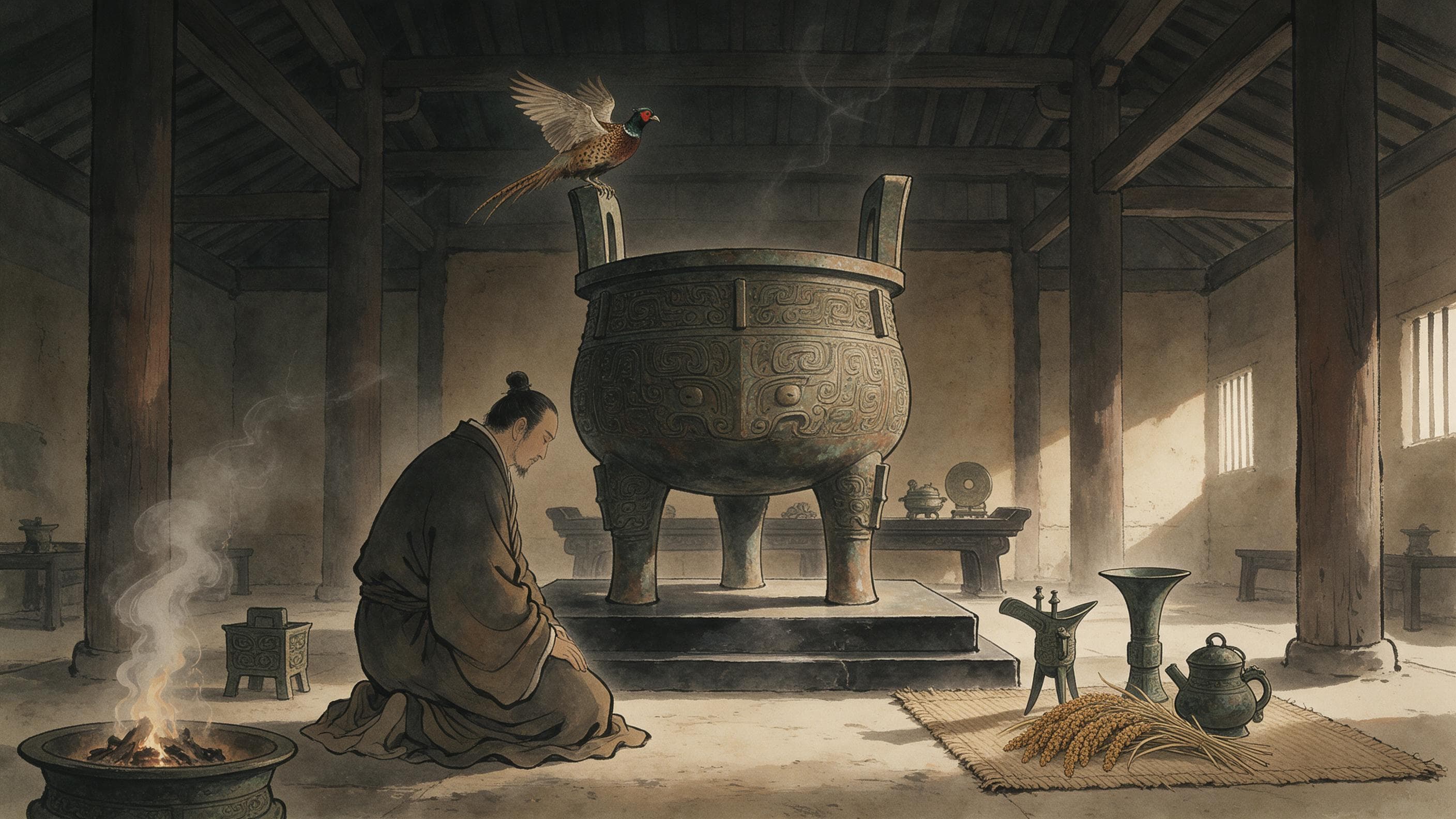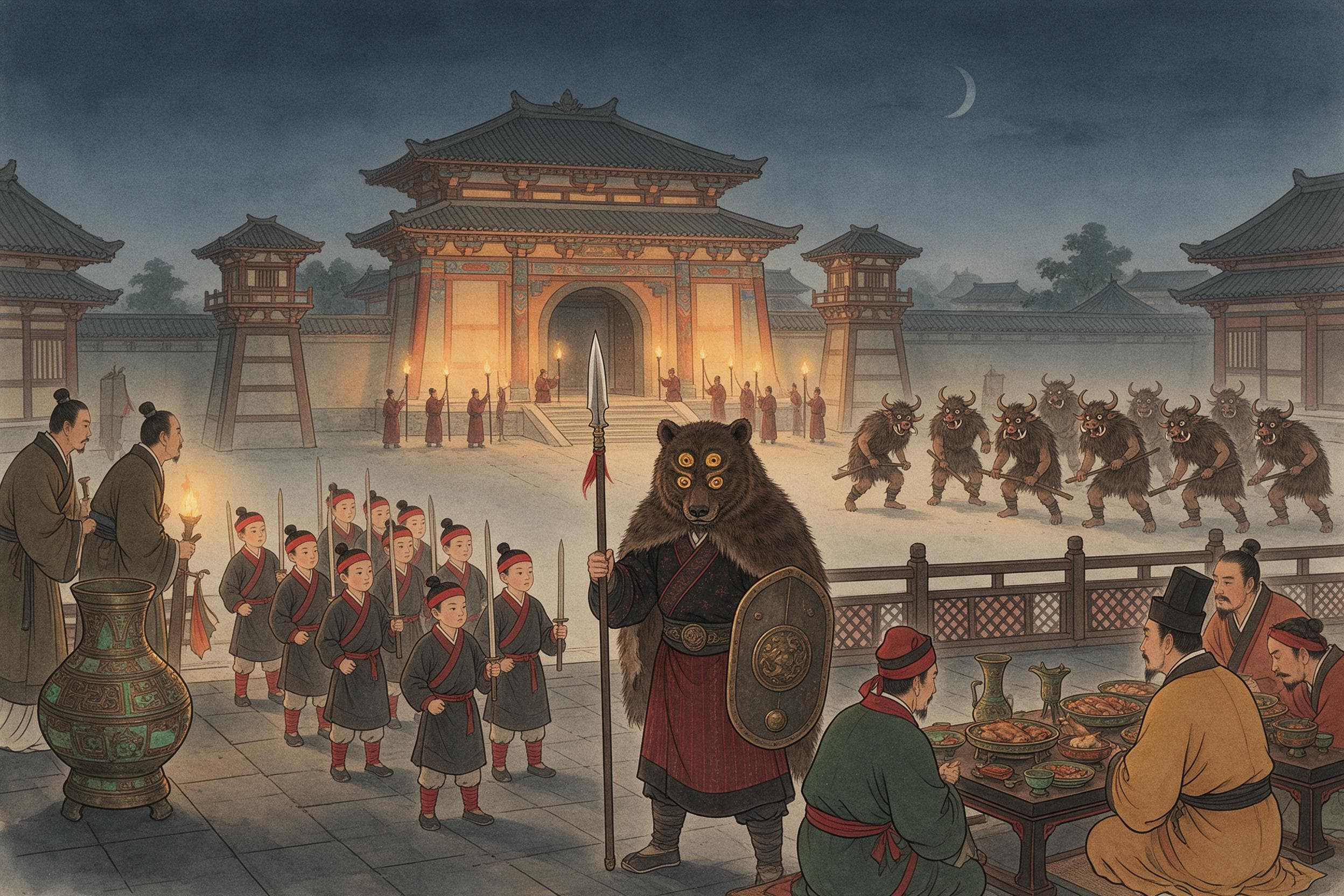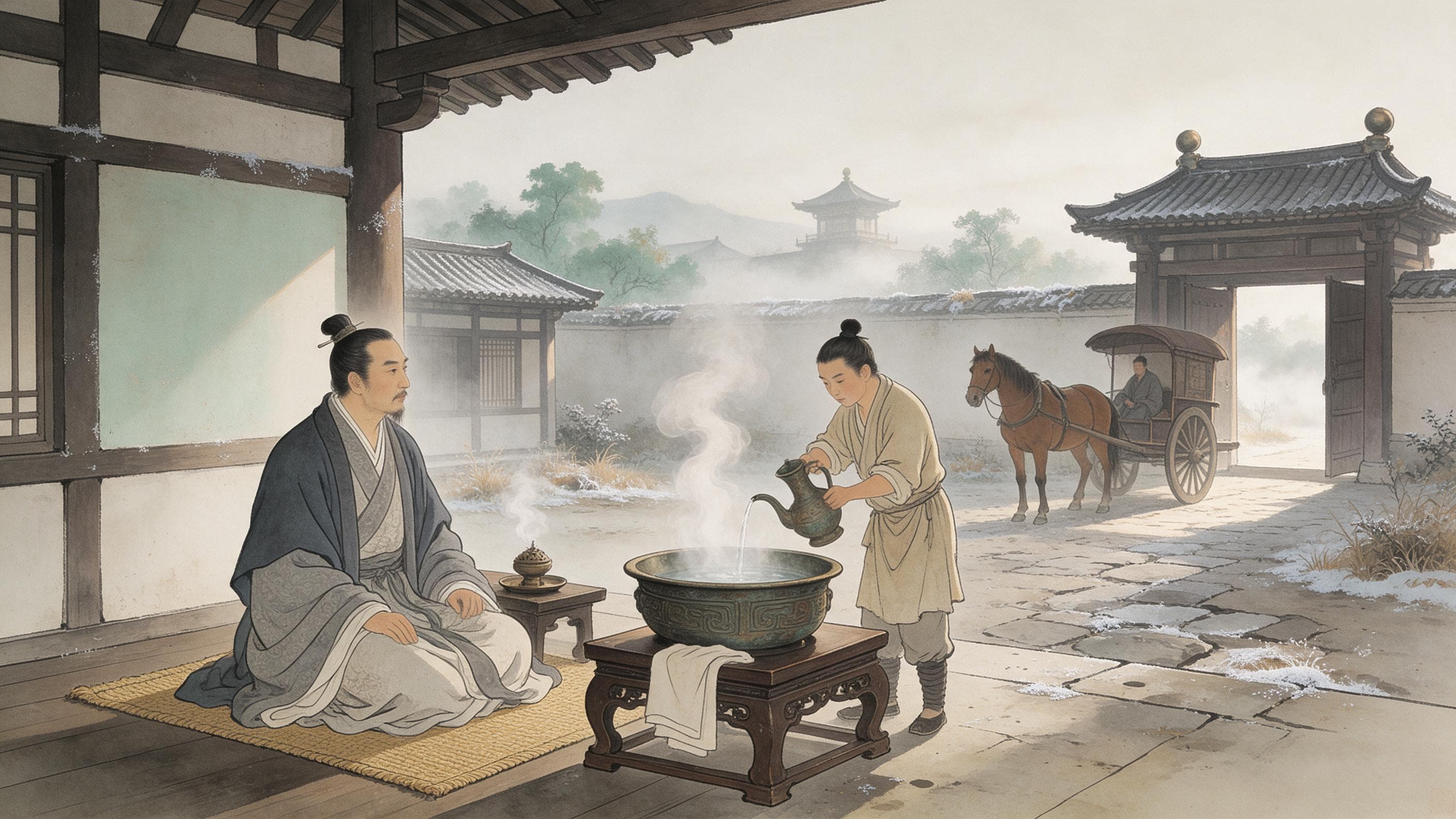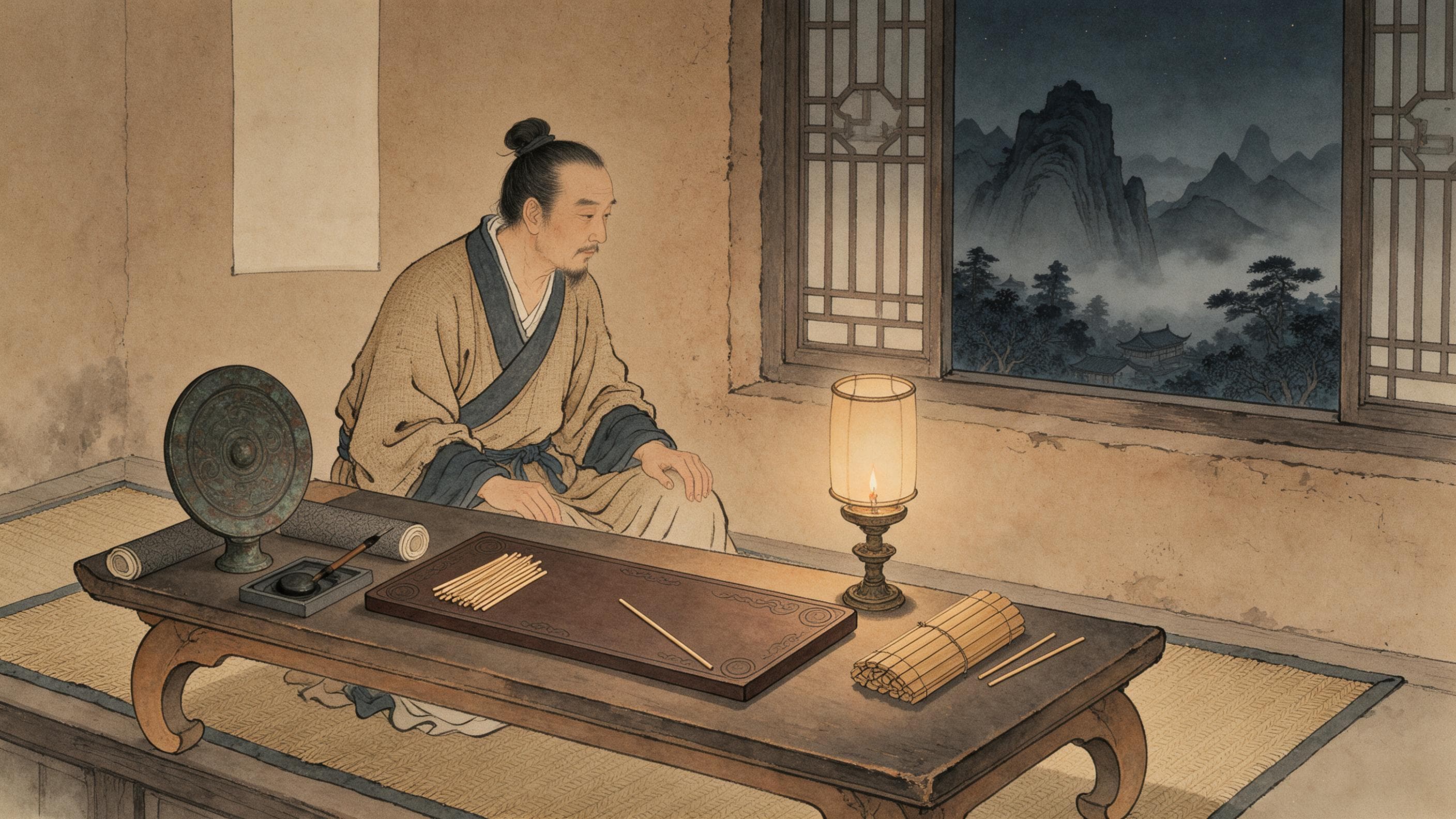
Guo Pu, styled Jingchun, was of Wenxi in Hedong. The two pages show him differently: the Book of Jin gives a full life, from his teacher to his offices and his death; the New Account of Tales of the World, in its chapter on technical expertise, gives a handful of anecdotes, short and full of dialogue. Neither was written by his contemporaries — the life was compiled in the early Tang, the anecdotes under the Liu Song — and Liu Xiaobiao's commentary quotes the Separate Biography and an older Book of Jin. This article keeps the life, the anecdotes and the quoted notes in three layers.
Where It Came From
The life begins with learning: 璞好經術,博學有高才,而訥於言論,詞賦為中興之冠。好古文奇字,妙於陰陽算曆 — he loved the classics, was broad in learning and high in talent, slow of speech, first in letters of the revival, fond of ancient graphs and skilled in yin-yang and calendrical calculation. The transmission has names: 有郭公者,客居河東,精於卜筮,璞從之受業。公以《青囊中書》九卷與之,由是遂洞五行、天文、卜筮之術,攘災轉禍,通致無方,雖京房、管輅不能過也 — a Master Guo, living in Hedong and expert in divination, took him as a pupil and gave him the nine scrolls of the Qingnang zhongshu, after which he penetrated the five phases, astronomy and divination, averting disaster and turning ill fortune, so that even Jing Fang and Guan Lu could not surpass him. The book was lost: 璞門人趙載嘗竊《青襄書》,未及讀,而為火所焚 — his pupil Zhao Zai stole it and had it burned before he could read it (the page writes 青囊 in one place and 青襄 in the other, and both are given).
Why he went south is told twice. The life: 惠懷之際,河東先擾。璞筮之,投策而歎曰:「嗟乎!黔黎將湮於異類,桑梓其翦為龍荒乎!」 — in the troubles of Hui and Huai, Hedong was disturbed first; he cast, threw down the stalks and sighed that the common people would sink among barbarians and the homeland be cut down to a dragon waste — so he quietly gathered several dozen households of kin and friends to move southeast. The New Account's note quotes the Separate Biography: 璞少好經術,明解卜筮。永嘉中,海內將亂,璞投策歎曰:「黔黎將同異類矣!」便結親暱十餘家,南渡江,居於暨陽 — a dozen households against several dozen, and the two figures are printed side by side.
The Horse and the Beans
The first case is a horse. General Zhao Gu's fine horse had died and he would see no visitors; Guo Pu came to the gate and said 吾能活馬, I can bring the horse back to life. His method: 得健夫二三十人,皆持長竿,東行三十里,有丘林社廟者,便以竿打拍,當得一物,宜急持歸。得此,馬活矣 — take twenty or thirty strong men with long poles, go thirty li east, and where there is a grove with a shrine beat the bushes; you will get something, bring it back quickly, and the horse will live. They did, 果得一物似猴,持歸。此物見死馬,便噓吸其鼻。頃之馬起,奮迅嘶鳴,食如常,不復見向物 — they got a thing like a monkey, and when it saw the dead horse it breathed into its nostrils, and the horse rose, stamped, neighed and ate as usual, and the creature was not seen again. The men, distance and actions are as given; no pharmacology is supplied.
The second case is beans. At Lujiang the governor Hu Mengkang had been summoned to the capital and had no wish to cross the river; Guo Pu cast for him, said 敗, defeat, and was not believed. Wanting to leave, and 愛主人婢,無由而得 — taken with his host's maid and with no way to get her — 乃取小豆三斗,繞主人宅散之: he took three dou of small beans and scattered them around the house. Next morning 主人晨見赤衣人數千圍其家,就視則滅 — the master saw thousands of red-coated figures surrounding the house, and when he went close they vanished. He asked for a casting; Guo Pu said 君家不宜畜此婢,可於東南二十里賣之,慎勿爭價,則此妖可除也 — this house should not keep this maid; sell her twenty li to the southeast, do not haggle, and the prodigy will stop. The master did; Guo Pu 陰令人賤買此婢, had her secretly bought cheap, then threw a talisman into the well and 數千赤衣人皆反縛,一一自投於井 — the thousands of red figures tied their own hands and threw themselves into the well. He left with the maid, 後數旬而廬江陷, and weeks later Lujiang fell.
The Donkey-Rat
At Xuancheng the governor Yin You took him as staff officer. A creature came to the foot of the wall: 大如水牛,灰色卑腳,腳類象,胸前尾上皆白,大力而遲鈍 — big as a water buffalo, grey, low-legged, feet like an elephant's, white on chest and tail, strong and slow. It was caught, and Guo Pu cast, getting Dun changing to Gu. The hexagram text is rhymed: 《艮》體連《乾》,其物壯巨。山潛之畜,匪兕匪武。身與鬼並,精見二午。法當為禽,兩靈不許。遂被一創,還其本墅。按卦名之,是為驢鼠 — and by the casting's name it is a donkey-rat. Then the men lying in wait stabbed it with a halberd 深尺餘,遂去不復見, more than a foot deep, and it went and was not seen again. The commandery reported it and asked leave to kill it; a medium relayed the shrine god's words: 此是䢜亭驢山君鼠,使詣荊山,暫來過我,不須觸之 — this is the rat of the donkey mountain lord of Qiong Pavilion, on its way to Jing Mountain, passing through; do not touch it.
The life also gives his position: 璞既好卜筮,縉紳多笑之 — since he liked divination, the gentry mostly laughed at him. And 性輕易,不修威儀,嗜酒好色,時或過度 — easy in manner, careless of dignity, fond of wine and women, sometimes to excess; the director of writings Gan Bao warned him, and he answered 吾所受有本限,用之恆恐不得盡,卿乃憂酒色之為患乎 — what I have received has its limit, and I fear only that I shall not use it all; why worry about wine and women? The life's own words, not a case.
The Thunder Calamity
The sharpest case in the life is Wang Dao. Wang Dao valued him and 引參己軍事 — took him onto his staff; 嘗令作卦,璞言:「公有震厄,可命駕西出數十里,得一柏樹,截斷如身長,置常寢處,災當可消矣。」導從其言。數日果震,柏樹粉碎 — he cast, said the duke had a thunder calamity, told him to drive west several tens of li, find a cypress, cut it to his own height and set it where he slept; the duke did so, and days later the thunder came and shattered the cypress.
The New Account has it with dialogue: 王丞相令郭璞試作一卦,卦成,郭意色甚惡,云:「公有震厄!」王問:「有可消伏理不?」郭曰:「命駕西出數里,得一柏樹,截斷如公長,置床上常寢處,災可消矣。」王從其語。數日中,果震柏粉碎,子弟皆稱慶 — several li against several tens, and 數日 against 數日; the two are set side by side. The commentary quotes Wang Yin's Book of Jin: 璞消災轉禍,扶厄擇勝,時人咸言京、管不及 — he averted disaster and turned ill fortune, and people said Jing Fang and Guan Lu could not match him — which is a quoted opinion, not the life's verdict; and it adds the general's remark 君乃復委罪於樹木, so you lay the blame on a tree.
The Dragon's Ear, the Grave, and the End
Another anecdote has Emperor Ming of Jin as its lead: 晉明帝解占塚宅,聞郭璞為人葬,帝微服往看。因問主人:「何以葬龍角?此法當滅族!」主人曰:「郭云:此葬龍耳,不出三年,當致天子。」帝問:「為是出天子邪?」答曰:「非出天子,能致天子問耳。」 — the emperor, who read graves, went in disguise to a grave Guo Pu had sited, asked why it was placed on the dragon's horn, which should destroy the clan, and was told Guo called it the dragon's ear and that within three years it would bring the Son of Heaven; would it produce one? No — it would bring the Son of Heaven to ask. Guo Pu never appears; the whole hinge is one character, horn or ear.
There is also his own grave: 郭景純過江,居于暨陽,墓去水不盈百步,時人以為近水。景純曰:「將當為陸。」今沙漲,去墓數十里皆為桑田。其詩曰:「北阜烈烈,巨海混混;壘壘三墳,唯母與昆。」 — his grave stood less than a hundred paces from the water and people thought it too near; he said it would become dry land; by the compiler's time the sand had silted and for tens of li around the grave it was mulberry fields; and his poem on the three graves is quoted. The 'now' is the compiler's, not Guo Pu's; the tens of li are printed as given.
What the two pages give is stories, not a method: how a casting was made, how the stalks were laid out, how the figures were read — none of it is here, and none is supplied (that is another article). The numbers — twenty or thirty men, thirty li, three dou, twenty li, more than a foot, less than a hundred paces — stand as written, not converted. No verdict on superstition or science, and Guo Pu is not made into a prophet: in these pages he is a learned, stammering, hard-drinking man whom the gentry laughed at for liking divination, leaving behind a series of cases with names and places attached.
Related reading:Sima Xiangru: Four Walls, One Lute, One Wine Shop · Touhu: The Rite and the Wager at a Drinking Party · The Bo Altar: What to Do with a Conquered Capital's Earth Shrine
Sources & further reading
- 《世说新语·术解》(南朝宋刘义庆撰,刘孝标注;维基文库本,页面白文夹注,未与中华书局点校本复核) — Four anecdotes about Guo Pu: he wept over the death of Chen Shu and called out 'how do you know it is not a blessing?', and the general's rebellion followed; Emperor Ming of Jin, who read grave-sites, went in disguise to see a grave Guo Pu had sited and asked why it was placed on the dragon's horn, which should destroy the clan — the owner said Guo called it the dragon's ear, and that within three years it would bring the Son of Heaven; the emperor asked whether it would produce one, and was told it would bring the Son of Heaven to ask. Guo's own grave at Jiyang stood less than a hundred paces from the water, and he said it would become dry land, which it did, with his poem on the three graves quoted. And Wang Dao's divination: Guo's face fell, he said the duke had a thunder calamity, had him fetch a cypress west of the city and cut it to his height; the tree was shattered by lightning. The commentary quotes the Separate Biography for his early mastery of divination and his move south.
- 《晋书》卷七十二·郭璞传(唐房玄龄等撰;维基文库本,页面白文无注,未与中华书局点校本复核) — The official life: Guo Pu of Wenxi in Hedong, master of the classics, broad learning, slow of speech, first in letters of the revival, devoted to ancient graphs and skilled in yin-yang and calendrical calculation; he studied divination under a Master Guo, who gave him the nine scrolls of the Qingnang zhongshu, and his pupil Zhao Zai stole the book and had it burned before reading it. Then the cases: he tells General Zhao Gu he can revive his dead horse, sending thirty men east with long poles to beat a thing like a monkey out of a grove shrine, which breathes into the horse's nose and revives it; at Lujiang he scatters three dou of small beans around a house to make a thousand red-coated figures, so that the owner sells him the maid he wanted, and the commandery falls weeks later; at Xuancheng he casts on a beast like a water buffalo and names it the 'donkey-rat', with the hexagram text quoted; and he tells Wang Dao he has a thunder calamity, has a cypress cut to his height, and the tree is shattered by lightning. The life also says gentlemen laughed at his fondness for divination, and records Gan Bao's warning about his drinking and women and his answer.