Two short entries. The Annals of Emperor Wu: 'in the third year, in spring, the juedi show was made, and everyone within three hundred li came to watch' (三年春,作角抵戲,三百里內皆來觀). Three years later: 'in summer, the people of the capital watched the juedi at the Pingleguan in Shanglin' (京師民觀角抵于上林平樂館). This piece writes those two entries, and two more passages where the court put on shows for foreign guests.
One: two bare entries
Both entries come from the Annals and both are spare: a season, an act, a place, an audience. In the spring of the third year of Yuanfeng the show is 'made' (作) — newly put together — and the audience is measured in distance: everyone within three hundred li. In the summer of the sixth year the audience is 'the people of the capital' and the place is named: the Pingleguan in Shanglin. What was performed, how many performed, how long it ran, how large the ground was — the page gives none of it.
The word is 角抵, and this piece does not translate it. The Han treatise writes 角抵; the Shiji, in the same kind of context, writes 觳抵 — two graphs for one word, quoted side by side. Neither page defines the term, and this piece does not fit it with 'wrestling' or 'acrobatics'; it keeps the text's word. Counting is worth doing: the annals use it twice, the western-regions treatise twice, and the Shiji twice, each time as 觳抵.
Two: the Pingleguan, for guests
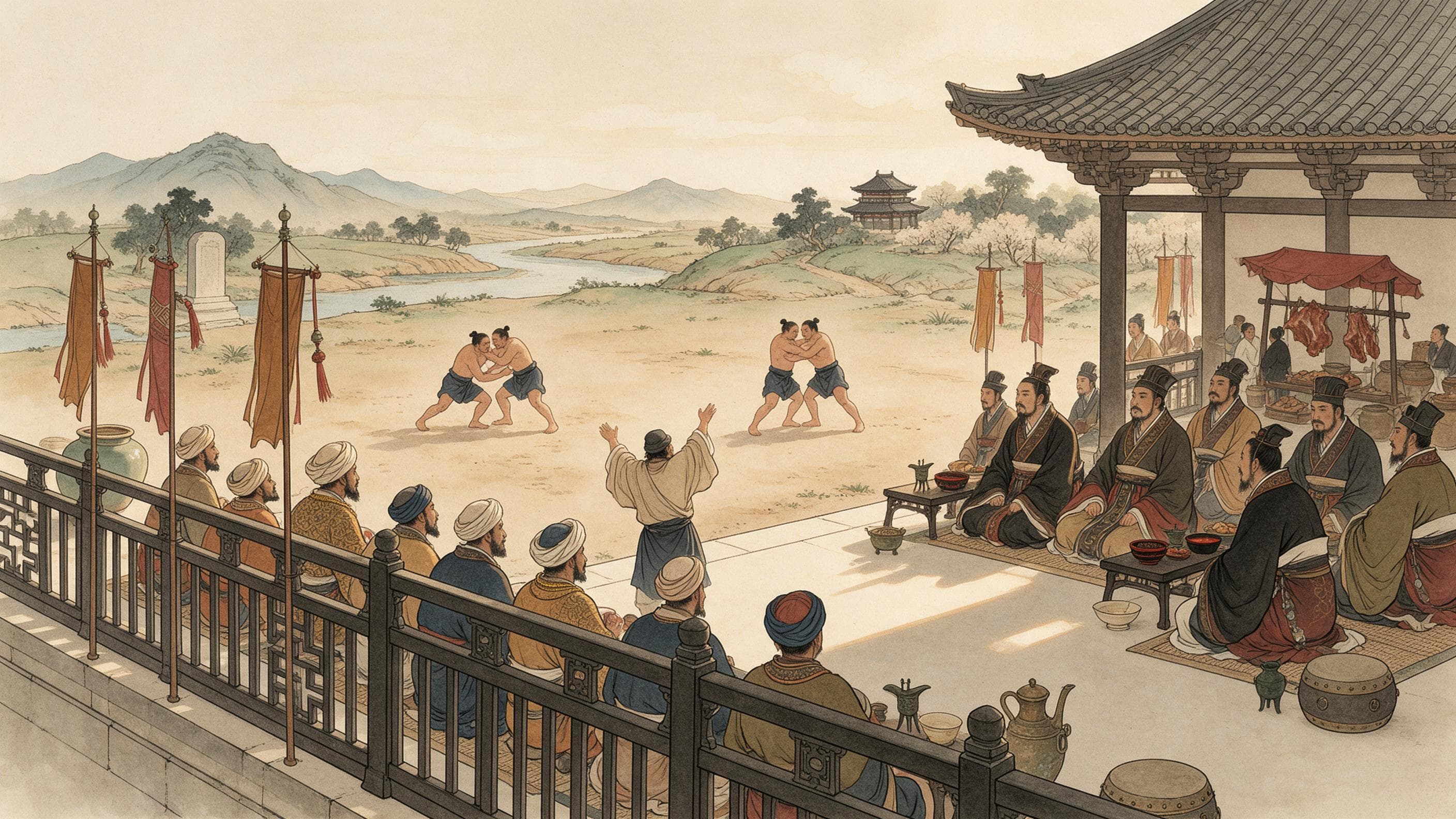
The show for guests is in the Han treatise on the western regions, and it is part of a farewell: 'the Son of Heaven went in person to the Pingleguan, met the Xiongnu envoys and the foreign chiefs in a great juedi, set out music, and sent them off' (天子自臨平樂觀,會匈奴使者、外國君長大角抵,設樂而遣之). The occasion is given just above: the Wusun had sent 'more than three hundred men' to fetch a bride, and a princess was being sent to them. So it is a send-off, and the envoys who had come for the bride were in the audience. The page dates the mission with an era name — the second year of Yuankang — and gives the Wusun party as more than three hundred men.
Another passage gives a programme, but not this occasion: 'he set out a pool of wine and a forest of meat to feast the guests of the four Yi, and had performed the Ba-Yu and Dulu, the Haizhong Dangji, the many-figured fish-dragon, and the juedi show, to display them' (設酒池肉林以饗四夷之客,作《巴俞》都盧、海中《碭極》、漫衍魚龍、角抵之戲以觀視之). Five names, copied as written: Ba-Yu, Dulu, Dangji, the fish-dragon, juedi. This piece does not merge the list with the Pingleguan farewell: they come from different passages, and the pages do not say they were one performance.
Three: in the Shiji, a display on the move
The Shiji's account is a travelling display rather than a single show: 'at this time the emperor was often touring the sea and took all the foreign guests with him; where a city was large and crowded he passed through it, scattering goods and silks as rewards, supplying them richly, to display Han's wealth. Then there was a great juedi, with strange shows and various monsters, and many gathered to watch; rewards were given, a pool of wine and a forest of meat, and the foreign guests were made to see the stores of every warehouse and treasury, to see Han's greatness and be shaken by it' (於是大觳抵,出奇戲諸怪物……傾駭之). Show and display of wealth are written in one breath; this piece copies the sentence without pulling it apart or appraising it.
Then a summary sentence: 'and as the conjurors' skill was added, the juedi and the strange shows increased and changed every year, and from this they became very flourishing' (及加其眩者之工,而觳抵奇戲歲增變,甚盛益興,自此始). That is the history's judgement, and is marked as judgement; 'increased and changed every year' says a fashion was escalating, and gives no timetable.
Four: the conjurors of Lixuan
The conjurors come as a gift. In the Shiji's account of Anxi: 'the Han envoys returned, and afterwards envoys were sent who came with the Han envoys to see Han's greatness, and presented to Han great bird eggs and skilful conjurors of Lixuan' (以大鳥卵及黎軒善眩人獻于漢). The subject is Anxi, named just before; Lixuan is only a name here, and the chapter elsewhere gives a relative bearing — that to Anxi's north lie Yanqui and Lixuan. What the conjurors did is not written. Neither is Lixuan a place the chapter describes: the only other mention of the word is a line of bearings, and the only other people called skilled in 眩 are those of Tiaozhi, in the far west, of whom the chapter says simply 'the state is skilled in conjuring' (國善眩).
The word 眩 is likewise only copied: the Shiji has 'skilful conjurors' (善眩人) and 'the conjurors' skill' (眩者之工); the Han treatise's passage does not mention them. Neither page says what a 眩 consisted of — no knives, no fire, nothing swallowed. So this piece supplies no act at all: it keeps the two phrases and the fact that they were presented to Han.
Five: beyond these pages
The layers must be kept apart: two bare entries in an annals (season, act, place, crowd); a farewell at the Pingleguan with Xiongnu and foreign envoys present; a programme list in another passage; and a touring display in the Shiji, with the conjurors' arrival and the sentence that the shows grew stranger every year. They are separate passages and must not be stitched into one 'Han variety show'; nor is this a piece on cultural exchange or on the origins of variety theatre.
What the pages do not give: the performers' actions, their number, the length of a show, the ground or the stands, any cost or ticket, any performer's name. Names are copied as the text gives them — 角抵/觳抵, Ba-Yu, Dulu, Dangji, fish-dragon, the conjurors of Lixuan — and nothing is added. What is left is one line about spectators from three hundred li, one about envoys at the Pingleguan, a list of five show names, one conjuror from Lixuan, one far-western state that 'is skilled in conjuring', and the sentence saying the shows grew stranger every year.
Related reading:Paper Dear in Luoyang: How One Rhapsody Raised a Price · Praying for Rain: Dong Zhongshu's Rite and Wang Chong's Doubt · Wang Hai: The Ancestor the Youyi Killed
Sources & further reading
- 《汉书》卷六〈武帝纪〉(维基文库本,未与点校本复核) — Two bare entries, both under the Yuanfeng era. 'In the third year, in spring, the juedi show was made, and everyone within three hundred li came to watch' (三年春,作角抵戲,三百里內皆來觀); and 'in summer, the people of the capital watched the juedi at the Pingleguan in Shanglin' (京師民觀角抵于上林平樂館). The page marks the era once with a template and then counts the years; its bracketed Western dates are the transcribers' additions and are not quoted. Neither entry says what was performed, by how many, or for how long.
- 《汉书》卷九十六下〈西域传下〉(维基文库本,未与点校本复核) — The show for guests, and a programme list. 'The Son of Heaven went in person to the Pingleguan, met the Xiongnu envoys and the foreign chiefs in a great juedi, set out music, and sent them off' (天子自臨平樂觀,會匈奴使者、外國君長大角抵,設樂而遣之) — a few lines above, the Wusun have sent 'more than three hundred men' to fetch a bride. Another passage gives the list: 'he set out a pool of wine and a forest of meat to feast the guests of the four Yi, and had performed the Ba-Yu and Dulu, the Haizhong Dangji, the many-figured fish-dragon, and the juedi show, to display them' (設酒池肉林以饗四夷之客,作《巴俞》都盧、海中《碭極》、漫衍魚龍、角抵之戲以觀視之). The page uses 角抵 where the Shiji writes 觳抵.
- 司马迁《史记》卷一百二十三〈大宛列传〉(维基文库本,未与点校本复核) — The touring display and the conjurors. 'The emperor was often touring the sea and took all the foreign guests with him… scattering goods and silks as rewards… to display Han's wealth. Then there was a great juedi, with strange shows and various monsters, and many gathered to watch… and the foreign guests were made to see the stores of every warehouse and treasury, to see Han's greatness and be shaken by it' (於是大觳抵,出奇戲諸怪物……傾駭之); then 'as the conjurors' skill was added, the juedi and strange shows increased and changed every year, and from this they became very flourishing' (及加其眩者之工,而觳抵奇戲歲增變,甚盛益興,自此始). The conjurors arrive as a present from Anxi — 'great bird eggs and skilled conjurors of Lixuan, presented to Han' (以大鳥卵及黎軒善眩人獻于漢) — and the page never says what a 眩 was.