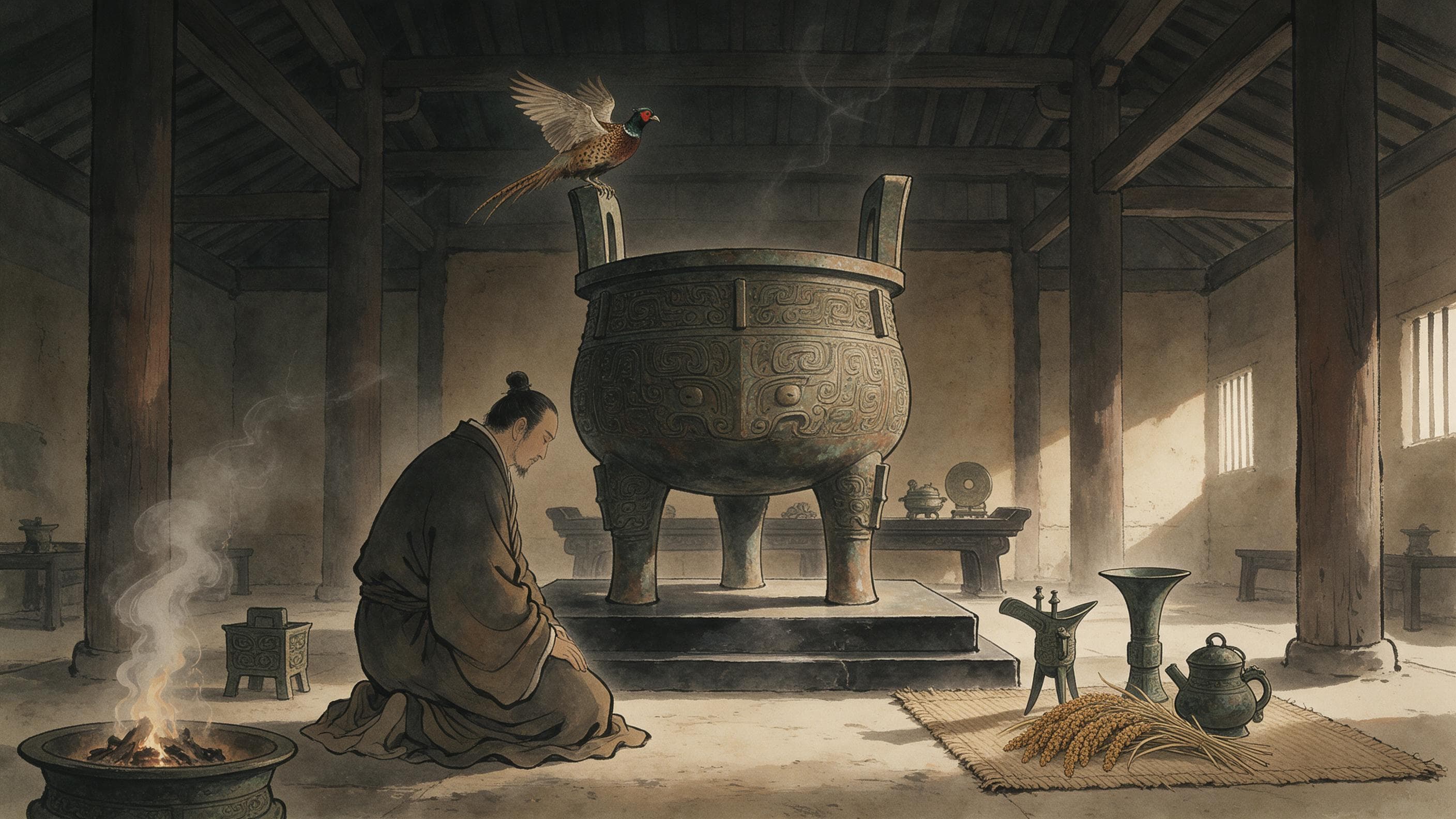
Start with a date: 'one day before the la sacrifice, the great nuo was held, and it was called driving out pestilence' (先臘一日,大儺,謂之逐疫). That is the Han treatise on ritual. The next thing named is not a god but a group of children: 'they chose sons of the middle Yellow Gate, ten years and above and twelve and below, one hundred and twenty of them, to be zhenzi' (選中黃門子弟年十歲以上,十二以下,百二十人為侲子). This piece keeps two pages apart: one is an office description, one is a night's programme, and what the notes add is counted separately.
One: the Fangxiang, a job description
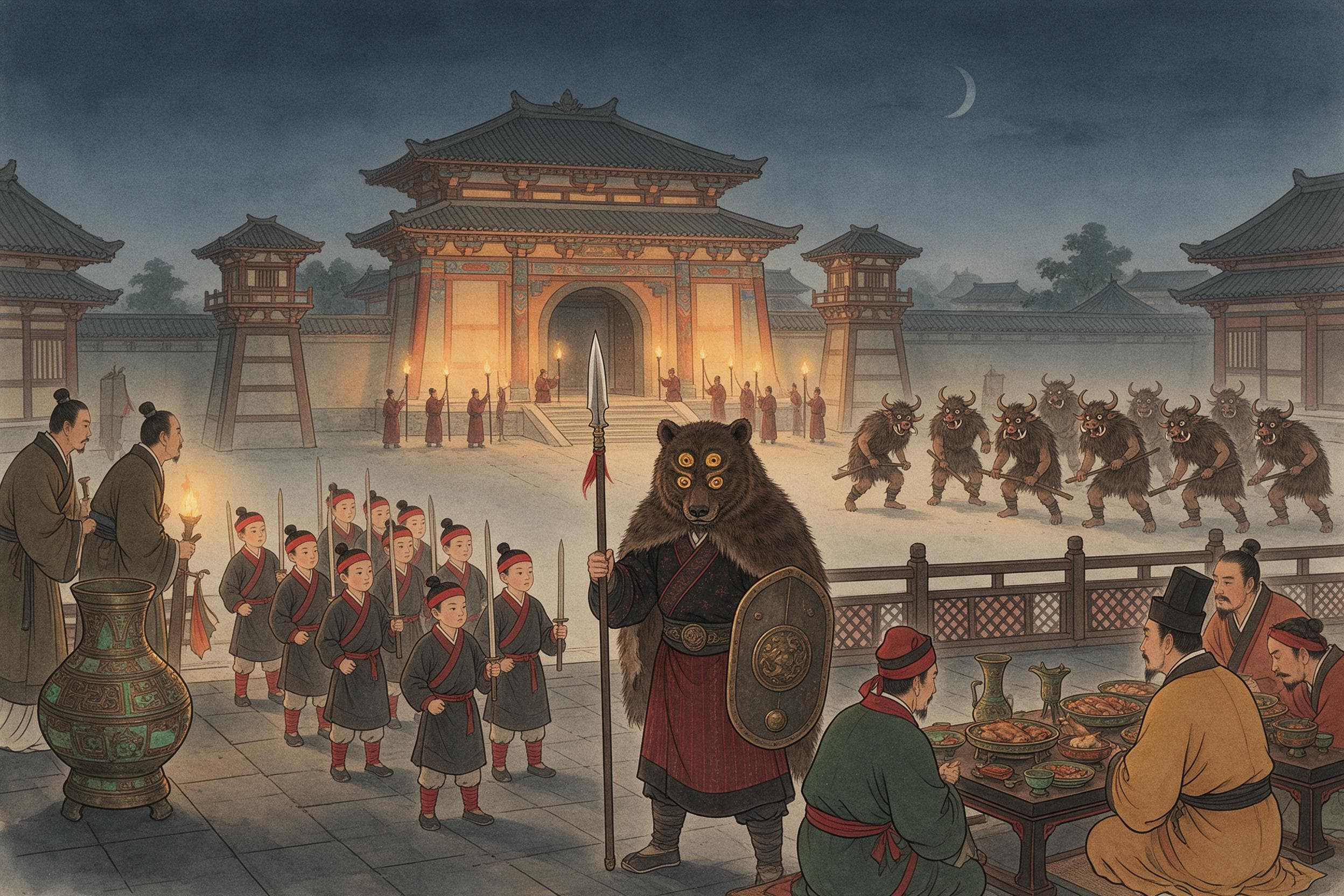
The oldest sentence is in the Rites of Zhou, among the offices of the summer ministry: 'Fangxiangshi: he has charge of wearing a bear's skin, with four golden eyes, black upper garment and red lower, holding a spear and raising a shield; he leads the hundred servants in the seasonal nuo, to search the chambers and drive out pestilence. At a great mourning he goes before the coffin; at the grave he enters the pit and with his spear strikes the four corners, to drive out the Fangliang' (方相氏:掌蒙熊皮、黃金四目、玄衣朱裳、執戈揚盾,帥百隸而時難,以索室驅疫……以戈擊四隅,驅方良).
This is a list of duties, and it stops where a rite would begin. No date, no route, no number besides 'a hundred servants', no words to shout, no place. 'Seasonal nuo' (時難) is generally taken to be the same exorcism under another graph, but the page glosses neither word. The funeral duty is a separate charge, and this piece does not fold it into the exorcism.
Two: the night in the Han treatise
The Han treatise gives the people and their clothes. The zhenzi, one hundred and twenty boys of ten to twelve, 'all with red headbands and black uniforms, holding great 〔□〕' — the page has a lacuna there, and this piece leaves it as one. Then 'the Fangxiangshi, with four golden eyes, wearing a bear's skin, black upper and red lower garments, holding a spear and raising a shield'. Then 'twelve beasts, with garments of hair and horns'. Then the officers who conduct them: 'the middle Yellow Gate carried it out, and the 〔□〕 attendant led them, to drive the evil ghosts out of the forbidden palace' (以逐惡鬼於禁中).
The order of the night is given step by step. The water-clock rises; the court officials assemble; stewards, secretaries, censors, ushers, tiger guards and feathered-forest officers on duty all stand on the steps in red headbands; the emperor comes to the front hall; the Yellow Gate director announces: 'the zhenzi are ready; we ask to drive out the pestilence' (侲子備,請逐疫). Only then: 'the middle Yellow Gate led the chant, and the zhenzi answered.' The chant is written out: the twelve spirits each eat something — 'Jiazuo eats 〔□〕, Fuyu eats tigers, Xiongbai eats spectres, Tengjian eats the inauspicious…' — and it ends with words to the evil: 'they make the twelve spirits pursue the evil and the fierce: scorch your bodies, pull out your trunks, dismember your flesh, draw out your lungs and guts. If you do not go quickly, those who come after will be food' (赫女軀,拉女幹,節解女肉,抽女肺腸。女不急去,後者為糧).
Then the movement: 'thereupon they made the Fangxiang and the twelve beasts 〔□〕; they shouted, and went three times round the palace, before and behind; holding torches, they sent the pestilence out of the Duan gate' (因作方相與十二獸□。嚾呼,周□前後省三過,持炬火,送疫出端門). Outside, the relay: 'the mounted attendants outside the gate passed the torches out of the palace; at the Sima gate the riders of the five camps passed the fire on and threw it into the Luo' (傳火棄雒水中).
What is left over is listed alongside: 'the officials of every office, having finished acting as exorcists in wooden animal masks, set out peach-wood figures, Yulü and reed cords; the attendants on the steps were dismissed; reed halberds and peach-wood staves were given to the dukes, ministers, generals, marquises and lords' (設桃梗、郁櫑、葦茭畢……葦戟、桃杖以賜公、卿、將軍、特侯、諸侯云). What peach-wood figures, Yulü and reed cords were the page does not explain, and this piece does not supply it.
Three: what the notes add
The notes carry two things the rite does not, and they are marked as notes. First the origin of the pestilence ghosts, quoting the Han jiu yi: 'Zhuanxu had three sons who died at birth and became pestilence ghosts: one dwelt in the Jiang river and was the plague ghost; one dwelt in the Ruo river and was the wangliang and yuyu ghost; one dwelt in the corners of houses and loved to frighten small children' (顓頊氏有三子,生而亡去為疫鬼……善驚人小兒). Second the officer's gear in the same quotation: 'the Fangxiang led the hundred servants and the boys, with peach-wood bows, jujube arrows and earthen drums, drumming and shooting at them, scattering red pellets and the five grains' (桃弧、棘矢、土鼓,鼓且射之,以赤丸、五穀播灑之), and a further note that reed arrows were used. Bows, arrows, drums, pellets and grain are in the notes, not in the programme.
Four: why the last night
Why before the la sacrifice, the page answers only through commentators, and more than one. The Yue Ling zhangju: 'the sun travels in the northern mansion; the north is great yin, and it is feared that it may be suppressed, so the officers are ordered to hold the great nuo, to support yang and press down yin' (扶陽抑陰). Lu Zhi's note to the Liji: 'it is to drive out decay and welcome the new' (逐衰而迎新). The two explanations stand side by side and are not decided here; the rite itself gives no reason.
Five: beyond these two pages
The two pages are different layers and cannot prove each other. The Rites of Zhou passage is an office in a design of offices — that book is generally taken as a Warring States or Han construction, not a record of a performance. The Han treatise is a ritual programme for one night, but its page is marked textquality 25%, with many square lacunae and bracketed corrections, and its notes are later quotations. So the first is quoted as a job description and the second as a programme; neither fills the other's gaps.
What the pages do not give: the size or material of the masks beyond 'bear skin', 'four golden eyes' and 'wooden animal masks'; the route and its length; the number of torches; the cost; where the idea of pestilence ghosts came from beyond that one note; the numbers besides the hundred and twenty boys. None is supplied, and no general essay is written on exorcist custom. What is left is one date, one job description, one night's order — the announcement, the chant and its answer, the dance, the shouting, three circuits, the torches relayed and the fire thrown into the Luo — a few objects, peach figures, Yulü, reed cords, reed halberds and peach staves, and the hard words of the chant.
Related reading:Guo Pu's Divinations: A Horse, Beans, and a Donkey-Rat · Ji Kang: Hammering Under a Willow, and a Tune at the Execution Ground · Sima Xiangru: Four Walls, One Lute, One Wine Shop
Sources & further reading
- 《周礼·夏官司马》方相氏条(维基文库本,未与点校本复核) — The office description, not a performance record: 'Fangxiangshi: he has charge of wearing a bear's skin, with four golden eyes, black upper garment and red lower, holding a spear and raising a shield; he leads the hundred servants in the seasonal nuo, to search the chambers and drive out pestilence. At a great mourning he goes before the coffin; at the grave he enters the pit, and with his spear strikes the four corners, to drive out the Fangliang' (方相氏:掌蒙熊皮、黃金四目、玄衣朱裳、執戈揚盾,帥百隸而時難,以索室驅疫。大喪,先柩;及墓,入壙,以戈擊四隅,驅方良). The page gives no date, route, number besides 'a hundred servants', or spoken text. The Rites of Zhou is generally taken as a design of offices rather than a record of an actual rite.
- 《后汉书》志第五〈礼仪中〉大傩条(维基文库本,未与点校本复核) — The night itself: 'one day before the la sacrifice, the great nuo was held, and it was called driving out pestilence' (先臘一日,大儺,謂之逐疫). The rite: one hundred and twenty sons of the middle Yellow Gate, ten to twelve years old, as zhenzi, 'all with red headbands and black uniforms, holding great [lacuna]'; the Fangxiangshi with four golden eyes, bear skin, black and red garments, spear and shield; twelve beasts 'with garments of hair and horns'; the officers who conduct them; the water-clock, the court assembled, the emperor at the front hall, the Yellow Gate director's announcement 'the zhenzi are ready; we ask to drive out the pestilence'; the chant led and answered, with the twelve spirits' names and the closing threat 'if you do not go quickly, those who come after will be food' (後者為糧); the dance, the shouting, three circuits, the torches carried out of the Duan gate and passed from rider to rider until the fire is thrown into the Luo; and the leftovers — peach-wood figures, Yulü, reed cords, reed halberds, peach staves given to the nobles. The page is marked textquality 25% and is full of square lacunae; its bracketed characters are the transcribers' corrections, and its notes are later quotations (Han jiu yi, Yue Ling zhangju, Lu Zhi, the Dongjingfu). Lacunae are shown as 〔□〕 in quotation here and are not filled.