The Bo altar (亳社) was one of the altars of Lu. Two pages mention it: the Zuo Tradition for Duke Ai's reign, where an entry records a fire at it and, four years later, a presentation of captives there; and the Rites' chapter on the suburban sacrifice, which states how the altar of a destroyed state is to be treated. The first is a chronicle of Lu; the second is a ritual chapter. One is a chronicle, one is a rule of ritual, and this article keeps them apart: the chronicle says what happened, the book says what should be done, and neither vouches for the other. The characters differ too — 亳社 in the chronicle, 薄社 in the book — and both are printed as they stand. Lu was the state of the duke of Zhou, and the altar of a former dynasty stood inside it; neither page explains how it came to be there.
The Fire
The 'classic' for Duke Ai's fourth year records, in the sixth month, on the xinchou day: 亳社災 — the Bo altar burned. That is the whole entry: a month, a day of the sexagenary cycle, and two characters. The day stands as written, not converted; xinchou is a day of the sixty-day cycle, and the entry gives no year-number beyond the duke's fourth. The entry does not say how the fire began, what was destroyed, whether anyone was called to account, or what was done afterwards.
The 'tradition' for that year says nothing about it: its narrative runs through Cai and Chu and the Man clans, and the altar is not mentioned again. So for the fire there are only those five characters, the chronicle's minimum. A chronicle that says nothing is still saying something: in that year's narrative the fire did not earn a sentence. Nothing is explained, and nothing is supplied here.
Presented at the Altar
Four years later the same altar appears again, in use. In Duke Ai's seventh year Ji Kangzi wished to attack Zhu; Zifu Jingbo objected that to turn against a great state is faithlessness and to attack a small one is not benevolence, and was not heard. In autumn the army marched: 師遂入邾,處其公宮,眾師晝掠……師宵掠,以邾子益來,獻于亳社,囚諸負瑕 — it entered the capital of Zhu, occupied its palace, plundered by day and by night, brought back its lord Yi, presented him at the Bo altar and imprisoned him at Fuxia. Zhu was a small state, and the objection had been that attacking a small state is not benevolence; the page records the objection and then the campaign, without comment.
Here the two pages pull different ways: one treats such an altar as a relic of a dead state, to be roofed over with a north window; the other shows this very altar receiving a defeated lord in a victory rite. The article does not merge them into one picture — the book speaks of a class of altars, the chronicle of one altar on particular days.
The Rule: Roof It
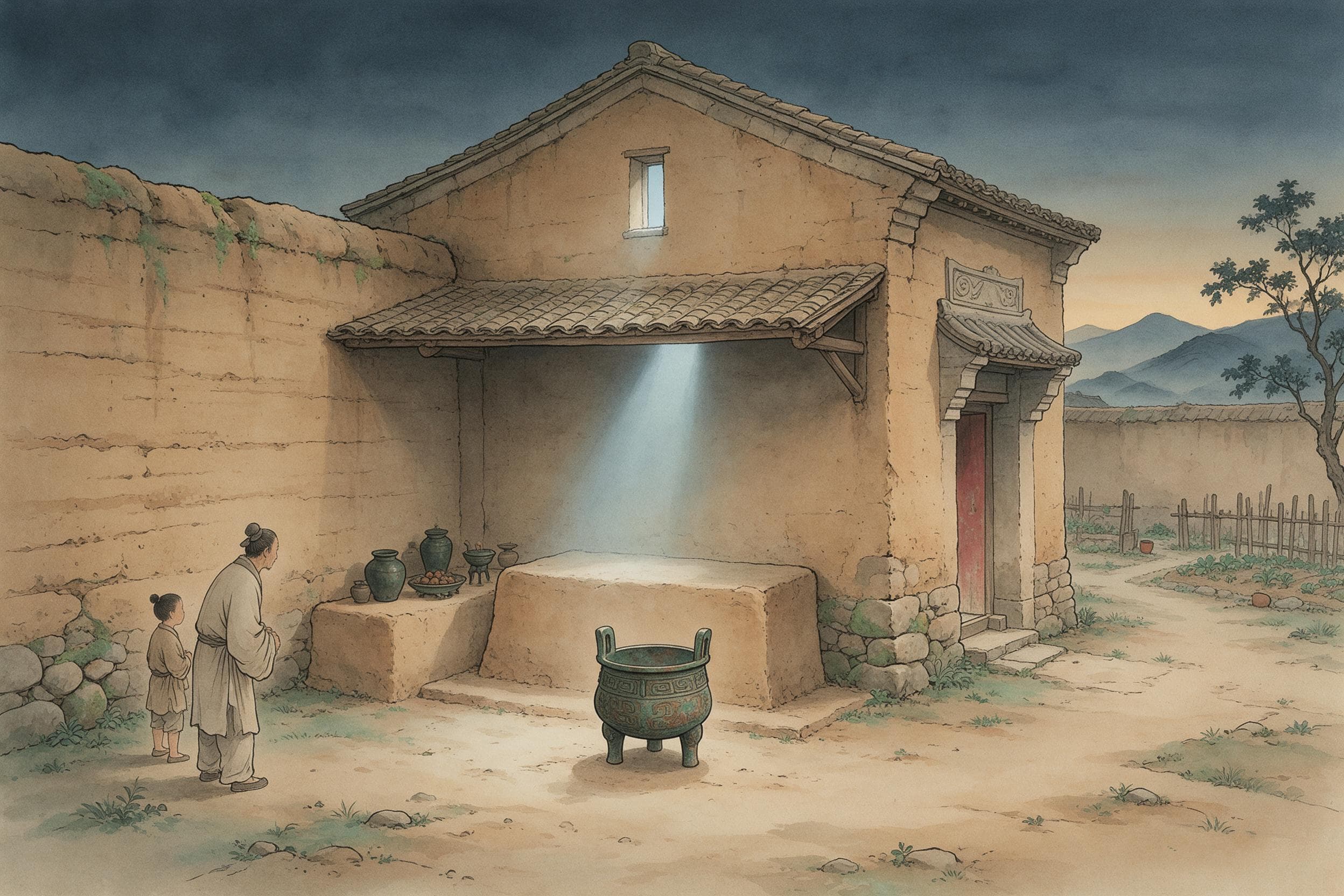
The Rites gives the rule: 天子大社,必受霜露風雨,以達天地之氣也。是故喪國之社屋之,不受天陽也。薄社北牖,使陰明也 — the Son of Heaven's great altar must receive frost, dew, wind and rain so that the qi of heaven and earth may pass; therefore the altar of a destroyed state is roofed and receives no heavenly yang, and the Bo altar has a north window so that the yin may be bright. Great altar open to the weather; dead state's altar roofed against the sky; one window, on the north. The rule is about two kinds of altar, not about one building.
The setting is what an altar is: 社祭土而主陰氣也,君南鄉於北墉下,答陰之義也 — it sacrifices to earth and governs the yin qi, and the ruler faces south at the north wall, answering the yin; hence the window is on the north. The same chapter adds 天子存二代之後,猶尊賢也。尊賢不過二代 — the Son of Heaven keeps the descendants of the two former dynasties, but for no more than two. That is about descendants, not altars; it is given as the chapter's frame, not as proof about this altar. The two sentences sit a few lines apart and answer different questions: one about light, one about descendants.
The chapter also says what an altar is for: 社,所以神地之道也。地載萬物,天垂象,取財於地,取法於天 — earth carries all things, heaven shows its signs, and men take wealth from earth and law from heaven; and 家主中霤而國主社,示本也 — the household honours the central drain, the state the altar, to show its root; 唯為社事,單出里;唯為社田,國人畢作;唯社,丘乘共粢盛。所以報本反始也. A dead state's altar is therefore not abolished, only roofed: it is still an altar, and still a place of return. That is the chapter's own reason, and it is the closest either page comes to saying why the altar of a dead state is kept.
On 使陰明也 the book gives only a direction and an effect: the window faces north so that the yin may have light. How large it was, where in the wall it sat, how the room was furnished — none of this is said. No reconstruction of the building is attempted here, and no later ritual code is brought in to supply what this page lacks.
Two Layers
The layers must not be merged. The Zuo Tradition records a fire and a presentation of captives; the Rites says how such an altar is built, lit, and what an altar is for. The ritual chapter does not mention this fire; the chronicle mentions no roof, no window, no 'returning to the root'. 亳社 and 薄社 are generally taken to be the same altar — 一般认为 — though neither page says so, and neither is used to fill the other. The chronicle's five characters and the book's rule are different kinds of statement; to join them would be to answer a question neither text asks.
What Neither Page Gives
Neither page gives the altar's position, its size, the form of its roof, the size of the north window, the order of any ceremony, what the fire destroyed, or whether it was rebuilt. Nor does either read the fire politically: no omen is drawn, no minister comments, no measure follows.
Other subjects are kept out: the seasonal sacrifices at the altar and the wax festival belong to another article, and this one is about what was done with a conquered state's altar. No general theory of the altar as a symbol of the state is offered here either — the pages give a fire, a presentation, a rule about roofs and windows, and a few sentences on why such an altar is kept at all. That is the extent of it: one fire, one presentation, one rule, and the reasons the ritual book gives.
Related reading:Paper Dear in Luoyang: How One Rhapsody Raised a Price · Praying for Rain: Dong Zhongshu's Rite and Wang Chong's Doubt · Wang Hai: The Ancestor the Youyi Killed
Sources & further reading
- 《春秋左氏传·哀公》(哀公四年经、哀公七年传;维基文库本,页面白文无注,未与中华书局点校本复核) — The chronicle's entry for the fourth year of Duke Ai, in the sixth month on the xinchou day: 亳社災, the Bo altar burned — five characters, with no explanation, and the tradition for that year says nothing about it. In the seventh year the same altar appears in use: Lu attacks Zhu, enters its palace, brings back its lord Yi, and 獻于亳社, presents him at the Bo altar, imprisoning him at Fuxia. So one page records a fire at the altar of a former dynasty and, four years later, a victory rite performed there.
- 《礼记·郊特牲》(维基文库本,页面白文无注,未与中华书局点校本复核) — The ritual rule: the altar sacrifices to earth and governs the yin qi, the ruler facing south at the north wall to answer the yin; the Son of Heaven's great altar must receive frost, dew, wind and rain so that the qi of heaven and earth may pass, and therefore 喪國之社屋之,不受天陽也。薄社北牖,使陰明也 — the altar of a destroyed state is roofed over and receives no heavenly yang, and the Bo altar has a north window so that the yin may be bright. The same chapter notes that the Son of Heaven keeps the descendants of the two former dynasties, though for no more than two.