Han officials had a leave called 洗沐 — washing — granted once every five days, nominally to go home and bathe. Three passages are used here: the life of Zheng Dangshi in the Shiji's chapter 120, the same life in the Book of Han's chapter 50 for its variants, and the Shi family in the Shiji's chapter 103. All three say only 每五日洗沐, every five days, and pass on; none explains how the leave worked. The phrase is treated as ordinary background, as if every reader knew it. Two books, three passages, one phrase; the article's subject is what lies on either side of it. This article keeps to that limit: what two men did with the day.
Five Characters and a Gap
The words mean washing the hair and the body. All three pages give 每五日洗沐 and nothing more: not which day the count began from, not whether it was suspended in emergencies, not whether pay continued, not whether one returned to the office afterwards. Those are questions of institution, and the three pages do not answer them; no later code of leave is used here to fill the gap, and the five days are not turned into a week. What can be fixed is only the frequency and the pretext: once in five days, for washing. Everything else about the leave is silence, and the silence is not filled.
Zheng Dangshi's Day
In the Shiji Zheng Dangshi is still young and junior: 孝景時,為太子舍人。每五日洗沐,常置驛馬安諸郊,存諸故人,請謝賓客,夜以繼日,至其明旦,常恐不遍 — under Emperor Jing he was a retainer of the heir apparent; on every fifth-day leave he kept post horses ready outside the city, called on old friends, thanked his guests, and went on through the night until dawn, always afraid of leaving someone out. The life adds: 年少官薄,然其游知交皆其大父行,天下有名之士也 — young and of low office, yet his friends were all of his grandfather's generation, famous men of the realm. The page gives him no sleep that night; it gives only the fear of missing someone.
The Book of Han has the same passage with small differences: 每五日洗沐,常置驛馬長安諸郊,請謝賓客,夜以繼日,至明旦,常恐不遍 — the horses at the suburbs of Chang'an, not 'the suburbs'; 存諸故人 is absent; 至明旦 for 至其明旦. One event, two ways of writing it, printed side by side and not merged. The changes are small: a place-name made precise, a phrase dropped.
The life also gives the same man at court: 每朝,候上之間,說未嘗不言天下之長者 — at every audience, when there was a gap, what he spoke of was always the good men of the world. The visits on the leave and the names at court stand in separate paragraphs, with his family, his office and his love of Huang-Lao between them; the text never joins them into one sentence. The visits and the names are two halves of the same reputation, but the page leaves them unjoined, and so does this article. Nor does it count the cost: he was 廉,又不治其產業,仰奉賜以給諸公 — honest, never building up an estate, living on his salary and gifts to entertain the elders — and what he gave away 不過算器食, no more than a measure of food in a vessel. The horses and the feast of the leave are not added up.
Shi Jian's Day
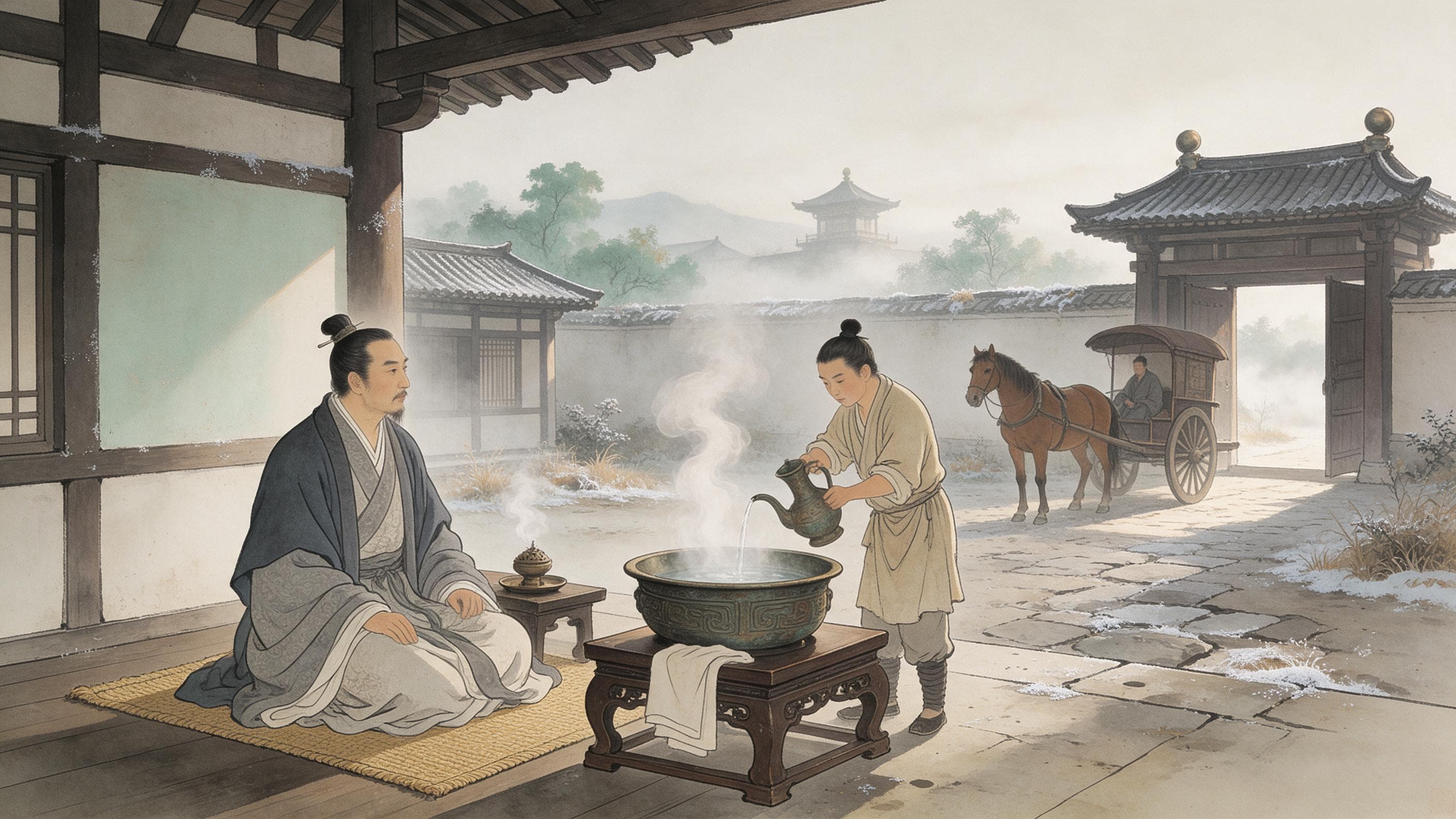
In the Shiji's life of the Shi family the day is used quite differently: 建為郎中令,毎五日洗沐歸謁親,入子舍,竊問侍者,取親中帬廁牏,身自浣滌,復與侍者,不敢令萬石君知,以為常 — Shi Jian, as chief of the palace guard, went home on every fifth-day leave to see his parents, slipped into the side rooms, asked the servants quietly, took his father's underclothes and chamber pot, washed them himself, handed them back to the servants, and never let his father, the Lord of Ten Thousand Piculs, know; it was his regular practice. The text names the items plainly — underclothes and a chamber pot — and the chief of the palace guard scrubs them himself.
The family comes first in the chapter: 萬石君家以孝謹聞乎郡國,雖齊魯諸儒質行,皆自以為不及也 — the family was known through the commanderies for filial caution, and even the plain-living scholars of Qi and Lu thought themselves behind it. The household was a small government of manners, and the leave was one of its offices. The father would not let a son's rank excuse him, and the son would not let his own rank excuse him from the basin. Sons who came home as minor officials were received 必朝服見之,不名, in court dress and without their given names; when they erred he 不譙讓,為便坐,對案不食, did not scold but sat apart and did not eat until they had bared their arms and asked pardon; the old man would get down from his carriage at the palace gate and bow to the horses on the road. Shi Jian's leave falls inside that household rule: what he did with the day was not to see people but to wash his father's personal things, and to keep it from him.
One Piece of Time, Two Uses
Both passages say 每五日洗沐: one man used it to see people, the other to serve his parents; one went 夜以繼日至明旦 through the night to dawn, the other 不敢令萬石君知 never let his father know. These are not two kinds of leave but one piece of time filled differently by two men. One is a day of callers, the other a day of laundry, and the calendar is the same. The pages do not say which use was right, and this article does not rank them.
The variants are given separately: 置驛馬安諸郊 in the Shiji against 置驛馬長安諸郊 in the Book of Han; 存諸故人 only in the former; 其慕長者如恐不見 against 其慕長者,如恐不稱; 莊為太史 against 當時為大吏; 不過算器食 against 不過具器食; 每朝,候上之間,說未嘗不言 against 每朝,候上間說,未嘗不言. Each is printed as it stands, with no 'correct' version chosen. The differences are small, and none of them changes the day.
What the Three Pages Do Not Give
None of them gives the start of the count or the rota, whether the leave stopped in an emergency, whether salary and grain continued, where the washing was done or with what, or how 洗沐 differed from 告 and 寧. Nor do they say whether anyone outside the ranks of officials had such a day, or what a household without servants did about washing. These are lives, not regulations.
Other subjects are kept out: the imperial academy, the postal stations and care for the aged each belong to other articles, and this one is only about 每五日洗沐 as it is used in three lives. No modern question of work and rest is raised, and no full picture of Han leave is drawn: three pages give two men and two bathing days: a phrase, a horse waiting at the gate, a basin, and a father who was not told.
Related reading:Guo Pu's Divinations: A Horse, Beans, and a Donkey-Rat · Ji Kang: Hammering Under a Willow, and a Tune at the Execution Ground · Sima Xiangru: Four Walls, One Lute, One Wine Shop
Sources & further reading
- 《史记》卷一百二十·汲郑列传(西汉司马迁撰;维基文库本,页面白文无注,未与中华书局点校本复核) — The life of Zheng Dangshi, styled Zhuang: while still a young and low-ranking official under Emperor Jing he 每五日洗沐,常置驛馬安諸郊,存諸故人,請謝賓客,夜以繼日,至其明旦,常恐不遍 — every fifth day, on his bathing leave, he kept post horses outside the city, called on old friends and thanked his guests, through the night until dawn, always afraid of missing someone. It adds that he loved the words of Huang-Lao, that he courts the elders as if afraid never to see them, that his friends were all of his grandfather's generation, and that at court he never failed to speak of the world's good men; the page also writes 太史 where the parallel text has 大吏.
- 《汉书》卷五十·张冯汲郑传(东汉班固撰;维基文库本,页面白文无注,未与中华书局点校本复核) — The same life, used for its variants: 每五日洗沐,常置驛馬長安諸郊,請謝賓客,夜以繼日,至明旦,常恐不遍 — post horses at the suburbs of Chang'an, no 存諸故人, 至明旦 for 至其明旦; elsewhere 其慕長者,如恐不稱 for 如恐不見; 大吏 for 太史; 具器食 for 算器食. Divergences are printed side by side in the article.
- 《史记》卷一百三·万石张叔列传(西汉司马迁撰;维基文库本,页面白文无注,未与中华书局点校本复核) — The Shi family: 建為郎中令,毎五日洗沐歸謁親,入子舍,竊問侍者,取親中帬廁牏,身自浣滌,復與侍者,不敢令萬石君知,以為常 — Shi Jian, as chief of the palace guard, went home on his fifth-day bathing leave to see his parents, slipped into the side rooms, asked the servants quietly, took his father's underclothes and chamber pot and washed them himself, gave them back to the servants, and never let his father know, as a regular practice. The same chapter describes the family's reputation for filial caution and the father's rule of dressing in court dress to receive his sons.