The phrase 'paper dear in Luoyang' comes from the Book of Jin, in the life of Zuo Si in its chapter on men of letters: 于是豪貴之家競相傳寫,洛陽為之紙貴 — the rich and noble houses competed in copying it out, and Luoyang became expensive in paper. Two pages are used here: that life, and the shorter account of the same affair in the New Account of Tales of the World. Neither gives a price for paper, and neither gives what a copy cost; this article keeps to what they say. The episode is a chain of steps, not a sudden fame.
Ten Years on a Rhapsody
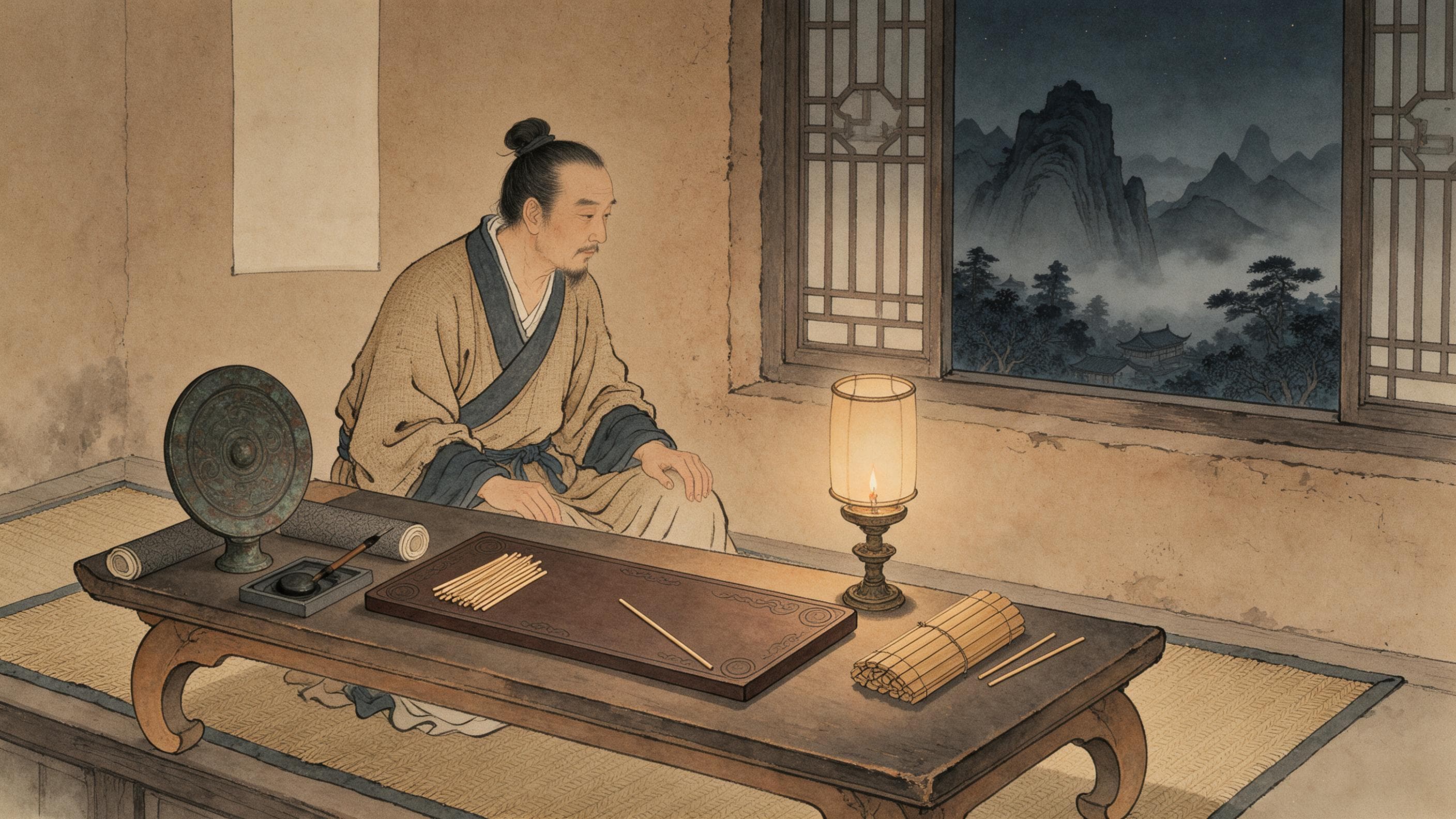
Zuo Si, styled Taichong, was of Linzi in Qi, 'a family of scholars for generations'. The life begins with his failures: 思小學鍾、胡書及鼓琴,並不成 — he studied the Zhong and Hu calligraphies and the qin, and mastered none of them. His father told a friend 思所曉解,不及我少時, what Si understands does not come up to what I had at his age; 思遂感激勤學, and he turned to study in earnest. 貌寢,口訥,而辭藻壯麗 — plain in face, slow of speech, and splendid in wording; 不好交遊,惟以閒居為事. His first rhapsody, on the Qi capital, 一年乃成, took a year. A year for that one; ten for the next.
Then the three capitals. 復欲賦三都,會妹芬入宮,移家京師,乃詣著作郎張載,訪岷邛之事 — he wished to write on the three capitals, and when his sister Fen entered the palace the family moved to the capital, where he questioned the works officer Zhang Zai about Min and Qiong. Then: 遂構思十年,門庭籓溷,皆著筆紙,遇得一句,即便疏之 — he pondered for ten years, with paper and brush set out at gate, courtyard, fence and privy, writing down any line the moment it came. 自以所見不博,求為秘書郎 — thinking his knowledge not broad enough, he asked to be made a secretary. He moved because his sister entered the palace, and the page gives no other reason for the move. That is all it gives of the writing: no list of books read, no drafts, no revisions.
After the Rhapsody Was Finished
Finished, it was not at once valued: 及賦成,時人未之重。思自以其作不謝班張,恐以人廢言 — his contemporaries did not think much of it; he held that his work did not yield to Ban Gu and Zhang Heng, and feared that the man would sink the words. So he went to Huangfu Mi, 有高譽, a man of high reputation: 思造而示之。謐稱善,為其賦序 — he showed it to him, Huangfu Mi praised it and wrote a preface. Then Zhang Zai annotated the Wei capital, Liu Kui annotated Wu and Shu with a preface of his own, and Wei Quan added a brief explanation. Liu Kui's preface has the line 世咸貴遠而賤近,莫肯用心于明物 — the world prizes what is distant and cheapens what is near, and will not apply its mind to plain things. After that Zhang Hua sighed over it: 班張之流也。使讀之者盡而有餘,久而更新. The order matters: preface and notes first, then the praise, then the copying.
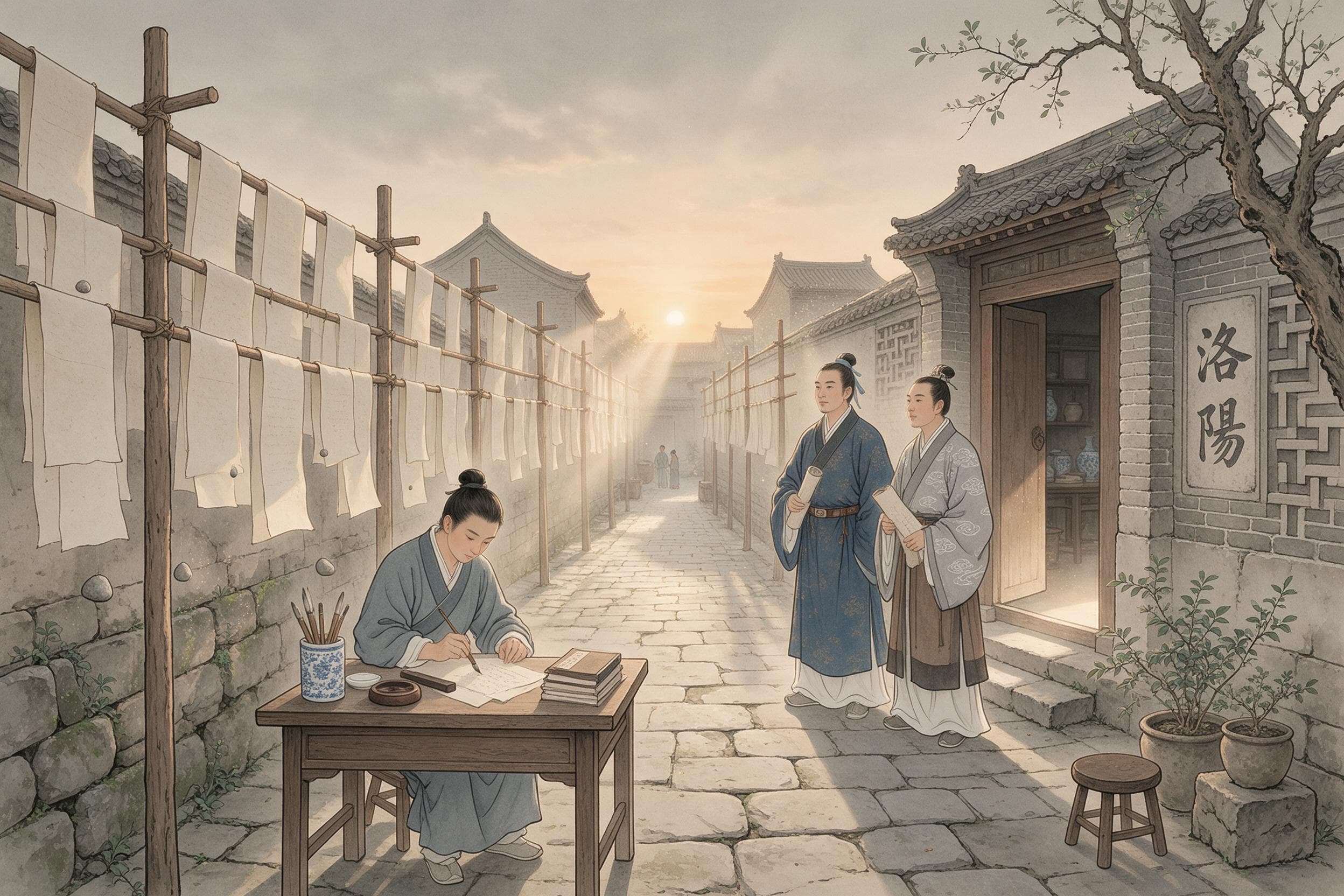
And then the sentence: 于是豪貴之家競相傳寫,洛陽為之紙貴 — the noble houses competed in copying it, and Luoyang became expensive in paper. That is the historian's narration, not Zuo Si's own words; what was copied was copied by 'the noble houses', and what became dear was the paper of Luoyang. The life turns at once to Lu Ji.
The New Account has it differently: 左太沖作《三都賦》初成,時人互有譏訾,思意不愜。後示張公。張曰:「此二《京》可三,然君文未重於世,宜以經高名之士。」思乃詢求於皇甫謐。謐見之嗟嘆,遂為作敘 — when it was first finished, contemporaries mocked and criticised it by turns, and Si was displeased; he showed it to Master Zhang, who said it could stand as a third to the two Han capitals, but that his writing was not yet weighty in the world, and should pass through a man of high name; so Si sought out Huangfu Mi, who sighed over it and wrote the preface. 于是先相非貳者,莫不斂衽讚述焉 — those who had opposed it all straightened their robes and praised it. Here Zhang Hua gives the advice and comes first; in the Book of Jin he only sighs over the finished work. The two accounts stand side by side, not merged.
Paper Dear: The Sentence, and the Missing Numbers
洛陽為之紙貴 is a judgement, not a figure. Neither page gives the price of paper, how much it rose, how many sheets a copy took, or how many households copied it — and nothing of that kind is supplied here. What the pages give is this: the rhapsody was finished, famous men wrote a preface and notes, Zhang Hua gave his verdict, and then the noble houses copied it. Why paper became dear, and how dear, the books do not say; the sentence is one clause in a long life.
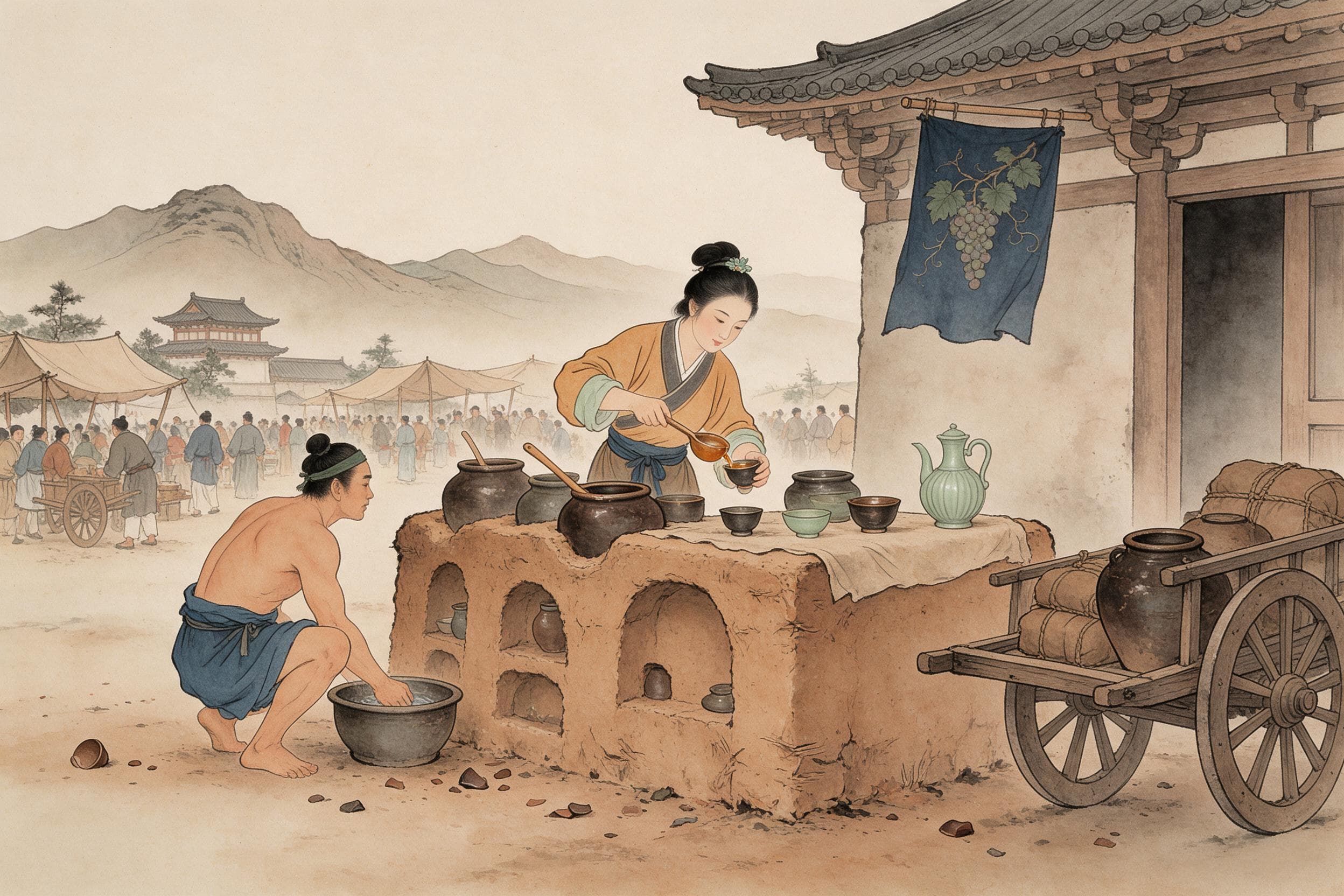
There is a counter-scene in the same life. Lu Ji, newly arrived in the capital, 欲為此賦,聞思作之,撫掌而笑 — had meant to write such a rhapsody himself, and hearing that Si was at work clapped his hands and laughed, writing to his brother Lu Yun: 此間有傖父,欲作《三都賦》,須其成,當以覆酒甕耳 — there is a bumpkin here who means to write a Rhapsody on the Three Capitals; when it is done it will serve to cover a wine jar. When he read it: 機絕歎伏,以為不能加也,遂輟筆焉 — he was utterly astonished, thought he could add nothing, and put down his brush. The change of verdict is on the page too.
Another Paper Price, in the New Account
The New Account has a second case: 庾仲初作《揚都賦》成,以呈庾亮;亮以親族之懷,大為其名價云:「可三二京,四三都。」于此人人競寫,都下紙為之貴 — Yu Chan finished his Rhapsody on the Yang Capital and showed it to Yu Liang, who, being of his kin, talked up its value as a third to the two capitals and a fourth to the three, whereupon everyone competed to copy it and the paper of the capital became expensive. Then comes Xie An: 不得爾。此是屋下架屋耳!事事擬學,而不免儉狹 — not so; this is building a house under a house, imitating everything and still narrow. Two paper prices side by side, one sponsored and one pulled down.
What Neither Page Gives
Neither page gives the text or the length of the rhapsody, the form of the copies, where the paper came from or what it cost, or who the copyists were. Nor does either give a verdict on its literary worth: there are only the words of named men — Huangfu Mi's praise, Liu Kui's preface, Zhang Hua's 'of the company of Ban and Zhang', Lu Ji's astonishment, Xie An's dismissal of the other rhapsody — and each is marked as his. What the pages supply is the steps of a reputation, not its cause.
'Paper dear in Luoyang' became a proverb later, by being taken out of this sentence; the Book of Jin has only 洛陽為之紙貴, and neither page uses it as a proverb. No general talk of literary value or cultural transmission is offered here, and the episode is not turned into a history of paper: it is one rhapsody, a few men, one sentence about paper, and the numbers the books do not give.
Related reading:Praying for Rain: Dong Zhongshu's Rite and Wang Chong's Doubt · Wang Hai: The Ancestor the Youyi Killed · Reciting the Odes: Seven Men, Seven Poems, One Verdict
Sources & further reading
- 《晋书》卷九十二·文苑·左思传(唐房玄龄等撰;维基文库本,页面白文无注,未与中华书局点校本复核) — The full life: Zuo Si of Linzi, of a family of scholars, who failed at writing and at the qin, was mocked by his father, and turned to study; 'he made the Rhapsody on the Qi Capital, which took a year'; then, wishing to write on the three capitals, he moved to the capital when his sister entered the palace, questioned the works officer Zhang Zai about Min and Qiong, and 'pondered for ten years, with paper and brush placed at his gate, courtyard, fence and privy, writing down any line as soon as it came'; thinking his knowledge not broad enough, he asked to be made a secretary; when the rhapsody was finished 'his contemporaries did not value it', so he showed it to Huangfu Mi, who praised it and wrote a preface; Zhang Zai annotated the Wei capital, Liu Kui the Wu and Shu with a preface, and Wei Quan added a brief explanation; Zhang Hua sighed that it was 'of the company of Ban Gu and Zhang Heng'; 'thereupon the rich and noble houses competed in copying it, and Luoyang became expensive in paper'. Lu Ji, who had meant to write such a rhapsody himself, laughed at the news and wrote to his brother that the man would end by covering a wine jar with it, and after reading the work 'was utterly astonished and gave up his brush'.
- 《世说新语·文学》(南朝宋刘义庆撰,刘孝标注;维基文库本,页面白文夹注,未与中华书局点校本复核) — A shorter account of the same affair: when the Rhapsody on the Three Capitals was first finished 'contemporaries mocked and criticised it in turn, and Si was displeased'; he showed it to 'Master Zhang' — Zhang Hua — who said it could stand as a third to the two Han capitals, but that 'your writing is not yet weighty in the world; you should let it pass through a man of high name'; Zuo Si then sought out Huangfu Mi, who sighed over it and wrote the preface, after which 'those who had opposed it all straightened their robes and praised it'. The same chapter has a second paper-price story: Yu Chan's Rhapsody on the Yang Capital, presented to Yu Liang, who talked up its value as 'a third to the two capitals, a fourth to the three capitals', whereupon 'everyone competed to copy it and the paper of the capital became expensive' — and Xie An's retort that it was only 'building a house under a house'.