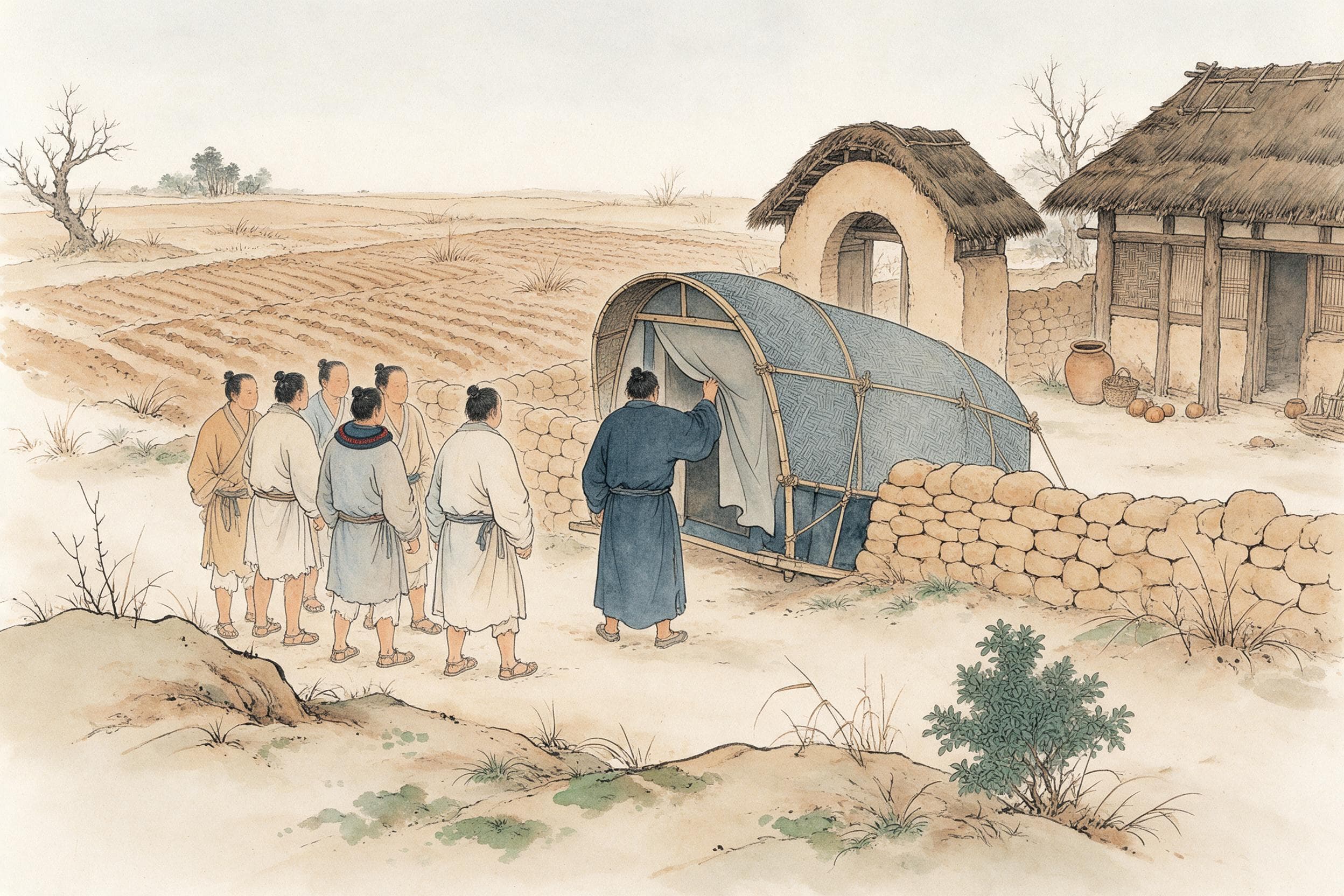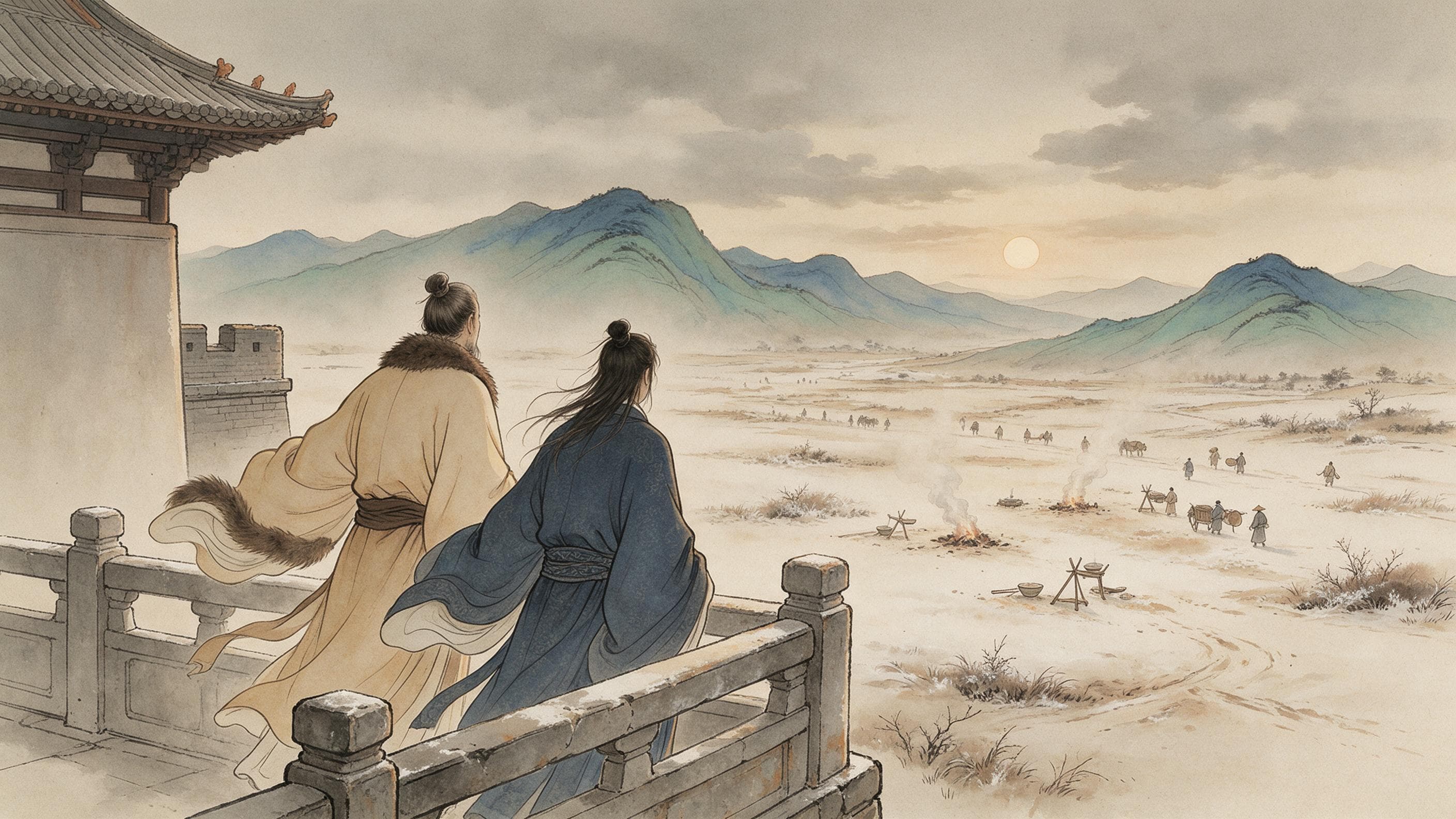
The winter sacrifice was over. Confucius had been one of its guests (蜡賓, generally read as an assistant at the rite); when it ended he went up onto the gate-tower (觀, generally read as a tower over a gate) and sighed. The page hedges even this: 仲尼之嘆,蓋嘆魯也 — "his sigh, one supposes, was for Lu." Yan Yan, at his side, asks 君子何嘆? The sacrifice itself is not described; the page opens with it already over.
The Sigh on the Tower
He answers with two ages side by side: 大道之行也,與三代之英,丘未之逮也,而有志焉 — the age when the great way was practised, and the flower of the three dynasties: he lived to see neither, and has only set his heart on them. Both descriptions that follow belong to ages outside his own. (三代之英 is generally read as the worthy rulers of the three dynasties; the page does not gloss it, and does not say how he knew of these ages.)
The First Passage: A World Without 禮
The first begins with the same four characters as that sentence: "When the great way was practised, the world was common to all; the worthy and the able were chosen, trust was kept and concord cultivated. So men did not love only their own parents, nor treat only their own children as children: the old had their end, the strong their use, the young their nurture, and widowers, widows, orphans, the childless and the disabled were all provided for; men had their portion, women their home. Goods were hated to be thrown on the ground, but need not be kept for oneself; strength was hated not to come from oneself, but need not be used for oneself. So plots were shut and did not rise, robbers and rebels did not act, and the outer door was not closed. This was the Great Unity (大同)."
Two details are easy to miss. The four 有所 clauses end by gathering 矜、寡、孤、獨、廢疾者 into one — names the page leaves unglossed — and 男有分,女有歸 gets six characters and no explanation. Each half of the goods-and-strength pair is also two statements: goods hated to be wasted, yet not to be hoarded; strength hated to go unused, yet not to be spent on oneself. Above all: in the whole passage the character 禮 does not occur once — no walls and moats, no ruler and subject, no institution of any kind.
One Character: 今
Not a transition but a character: 今大道既隱,天下爲家 — "now the great way is hidden, and the world is a family." After that 今, the whole second passage: "Each loves his own parents, each treats his own children as children; goods and strength are for oneself. The succession of rulers is made into ritual; walls and moats into security; ritual and rightness into the net and line — to set ruler and subject right, father and son close, brothers concordant, husband and wife in harmony; to establish measures, settle fields and dwellings, honour the brave and the knowing, and count achievement as one's own. So plots are used and rise, and weapons rise from this. Yu, Tang, Wen, Wu, King Cheng and the Duke of Zhou were the pick of them. These six gentlemen: not one was careless in ritual. By it they made their rightness visible, tested their trust, set down their faults, took benevolence as model and spoke of yielding, and showed the people a constant. If any would not go by it, the man in place was removed, and the many counted it a calamity. This was the Lesser Peace (小康)."
Side by side: 各親其親 answers 人不獨親其親; 貨力爲己 answers 不必爲己; 謀用是作,而兵由此起 answers 謀閉而不興. And 禮, absent before, occurs three times here — 大人世及以爲禮, 禮義以爲紀, 未有不謹於禮者也. The 六君子 are six named men, counted by the page: Yu, Tang, Wen, Wu, King Cheng, the Duke of Zhou. The last line, 在埶者去 — 埶 read as 勢, power (generally) — says even the man in power goes. That is the shape of the page: ritual is what the second world has and the first lacks.
Why the Lesser Peace Comes Second
Why go on to it? The disciple asks in the next line: 如此乎禮之急也? "Is ritual that urgent?" That is why the passage exists. The answer: 夫禮,先王以承天之道,以治人之情,故失之者死,得之者生 — lose it and you die, keep it and you live. Then the Odes, bluntly: 相鼠有體,人而無禮。人而無禮,胡不遄死! Then ritual laid across a life: 達於喪、祭、射、御、冠、昏、朝、聘 — eight occasions running from mourning to a diplomatic mission.
So: a sigh; a world he did not see; another he did not see; then ritual taking hold of the present. It is not ideal-then-decline. The page says 大道之行 and 大道既隱 only; it does not rank them, and "ideal" and "decline" would be our words. Nor is this a record of institutions: the Great Unity passage can offer no institutions, because it has none: it describes a way of holding goods and strength, not an administration. A ritual book is putting a speech into Confucius's mouth, and there is no ceremony in it to watch.
The Same Speech, Asked Out by a Ruler
In another chapter the words are drawn out by a ruler. 哀公問於孔子曰:大禮何如?君子之言禮,何其尊也? Confucius declines: 丘也小人,不足以知禮. Then: 民之所由生,禮爲大. Three clauses on one frame, 非禮無以: to serve the spirits of heaven and earth; to distinguish ruler and subject, high and low, elder and younger (the page's 辯 carries a variant 辨); to separate man and woman, father and son, brothers, and marriage ties. Together they answer the duke's first question — ritual is what keeps the spirits served, ranks distinct, and kin in order. Asked why the gentlemen of today do none of it, he lists six failings; these words sit in editorial brackets on the page — (怠)荒(怠)敖慢 — so they are not quoted as text. Cleanly quotable: 好實無厭,淫德不倦 and 固民是盡,午其衆以伐有道.
Sitting in attendance, asked what is greatest in the human way, he 愀然作色 and answers 人道政爲大. Government: 政者,正也 — rectification. Then 夫婦别,父子親,君臣嚴,三者正,則庶物從之矣. Then four steps: 愛人爲大 → 禮爲大 → 敬爲大 → 大昏爲大. The duke objects that 冕而親迎 is too heavy; he changes countenance again: 合二姓之好,以繼先聖之後,以爲天地、宗廟、社稷之主,君何謂已重乎? And 天地不合,萬物不生。大昏,萬世之嗣也. So 爲政先禮,禮其政之本與. The change of countenance happens twice, and both times it marks a point he will not soften. 大昏 is generally read as the ruler's own marriage.
Last, reverencing oneself, by a tree: 身也者,親之枝也 — the body is the branch of one's parents; 傷其本,枝從而亡. The ladder runs backwards: cannot love others, cannot keep one's body; cannot keep it, cannot be at peace on the land; cannot be at peace, cannot take joy in heaven; cannot take joy in heaven, cannot complete one's body. What is completing it? 不過乎物 — not overstepping the thing, as it is generally read; the page does not explain it. One of the four sentences on the way of heaven is kept: 貴其不已,如日月東西相從而不已也,是天道也. And the close: 仁人之事親也如事天,事天如事親.
Together: ritual is not dropped from heaven; it is what people made after the great way was hidden, and with it government has a root. The two chapters also arrive differently: one speech sighed out before a disciple, one drawn out by a duke; one asking where ritual came from, one where it stands. Both are words placed in Confucius's mouth by a ritual book. Neither gives the Great Unity's institutions, the Lesser Peace's dates, or anyone's age. Other rite articles here describe a ceremony; this one is how Confucius talks about ritual.
Related reading:Vessels and the Book of Rites: Twenty-Six Dishes and a Single Tassel · The Duke Entertains: One Meal Under the Rites · Cutting the Net and Spinning Hemp: Two Small Things Stopped on the Spot
Sources & further reading
- 《禮記·禮運》(維基文庫本,白文無注,頁面標 textquality 75%;頁頭「禮運大同篇/大同與小康」為頁面編者說明,非原文;未與中華書局點校本複核) — Only the first third of the chapter is used. Once, Confucius took part as a guest at the winter sacrifice; when it was over he went up on the gate-tower and sighed — the page says 蓋嘆魯也, a guess. Yan Yan asks why. He answers that the age when the great way was practised, and the flower of the three dynasties, were both beyond his reach (丘未之逮也,而有志焉). Then the whole Great Unity passage, unbroken: 天下爲公; men do not love only their own; the old, the strong, the young and the unfortunate are provided for; goods are hated to be thrown on the ground but need not be kept, strength is hated not to come from oneself but need not be used for oneself; plots do not rise and the outer door is not closed — 是謂大同, and not one 禮 in it. Then the single turning word: 今大道既隱,天下爲家 — each for his own, succession made into ritual, walls and moats into security, 禮義以爲紀; six things set right by the six 以; plots rise and weapons follow; the 六君子, Yu, Tang, Wen, Wu, King Cheng and the Duke of Zhou, 未有不謹於禮者也; 在埶者去; 是謂小康. And immediately the disciple's question, 如此乎禮之急也, with the answer 失之者死,得之者生, the line from the Odes (相鼠), and ritual reaching to 喪、祭、射、御、冠、昏、朝、聘.
- 《禮記·哀公問》(維基文庫本,白文無注,頁面標 textquality 75%,頁內有「辯一作辨」一處異文標記,未與中華書局點校本複核) — The same kind of talk, drawn out by a ruler instead of sighed out by Confucius himself. Duke Ai asks 大禮何如 and why gentlemen speak of ritual so reverently; Confucius first says 丘也小人,不足以知禮, then answers 民之所由生,禮爲大, with three 非禮無以 clauses. Asked why the gentlemen of today do none of it, he lists six failings — four characters in that list carry editorial brackets on the page, (怠)荒(怠)敖慢, and are not quoted as received text. Sitting in attendance he gives 人道政爲大 and 政者,正也, then the three things (夫婦别,父子親,君臣嚴) and the four steps (愛人爲大 → 禮爲大 → 敬爲大 → 大昏爲大). The duke objects to 冕而親迎; Confucius changes countenance, answers 合二姓之好…君何謂已重乎, adds 大昏,萬世之嗣也, and concludes 爲政先禮,禮其政之本與. On reverencing oneself: 身也者,親之枝也, 傷其本,枝從而亡, the reverse ladder ending 不能樂天,不能成其身, 不過乎物, one of the four 天道 sentences, and the close 仁人之事親也如事天,事天如事親.