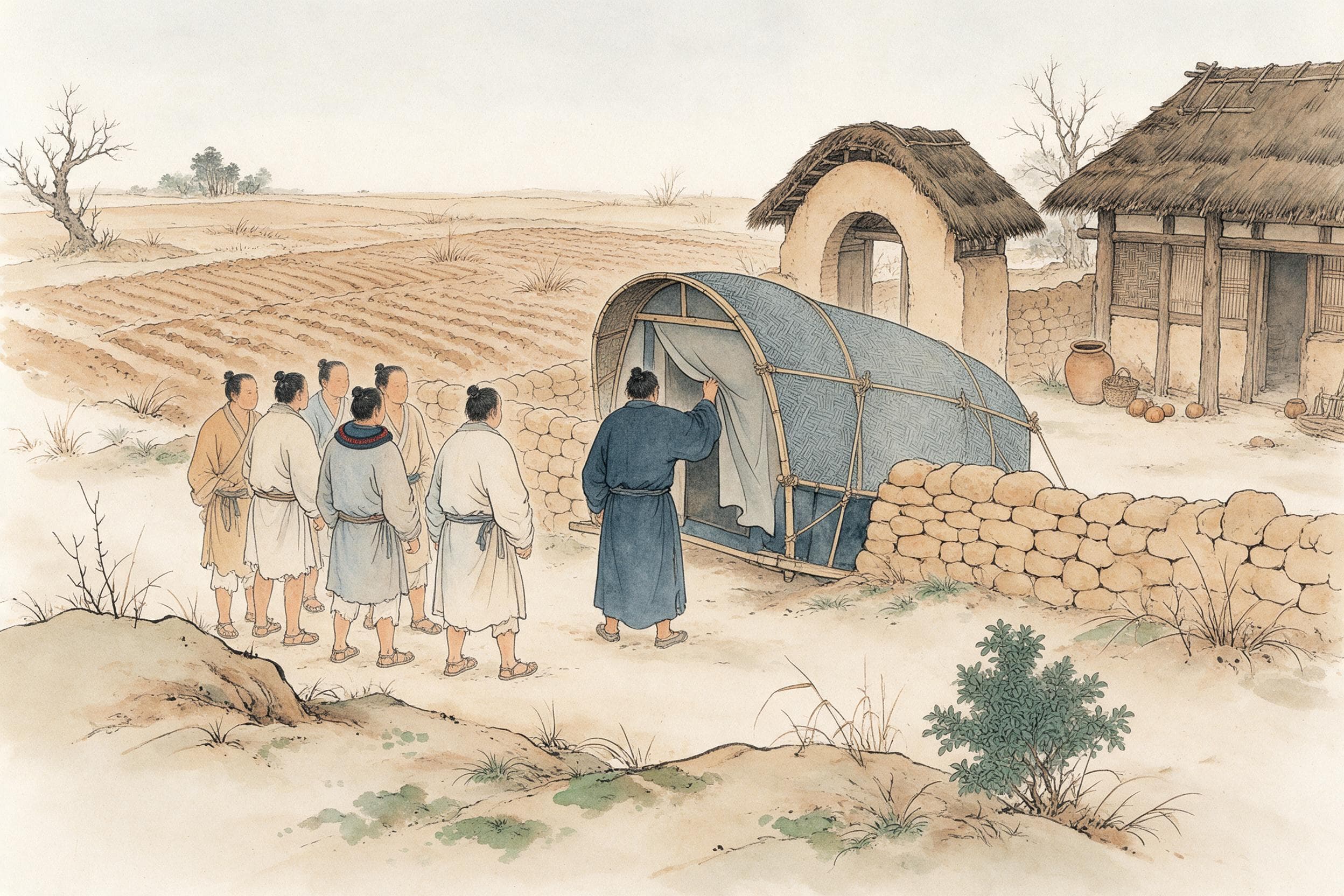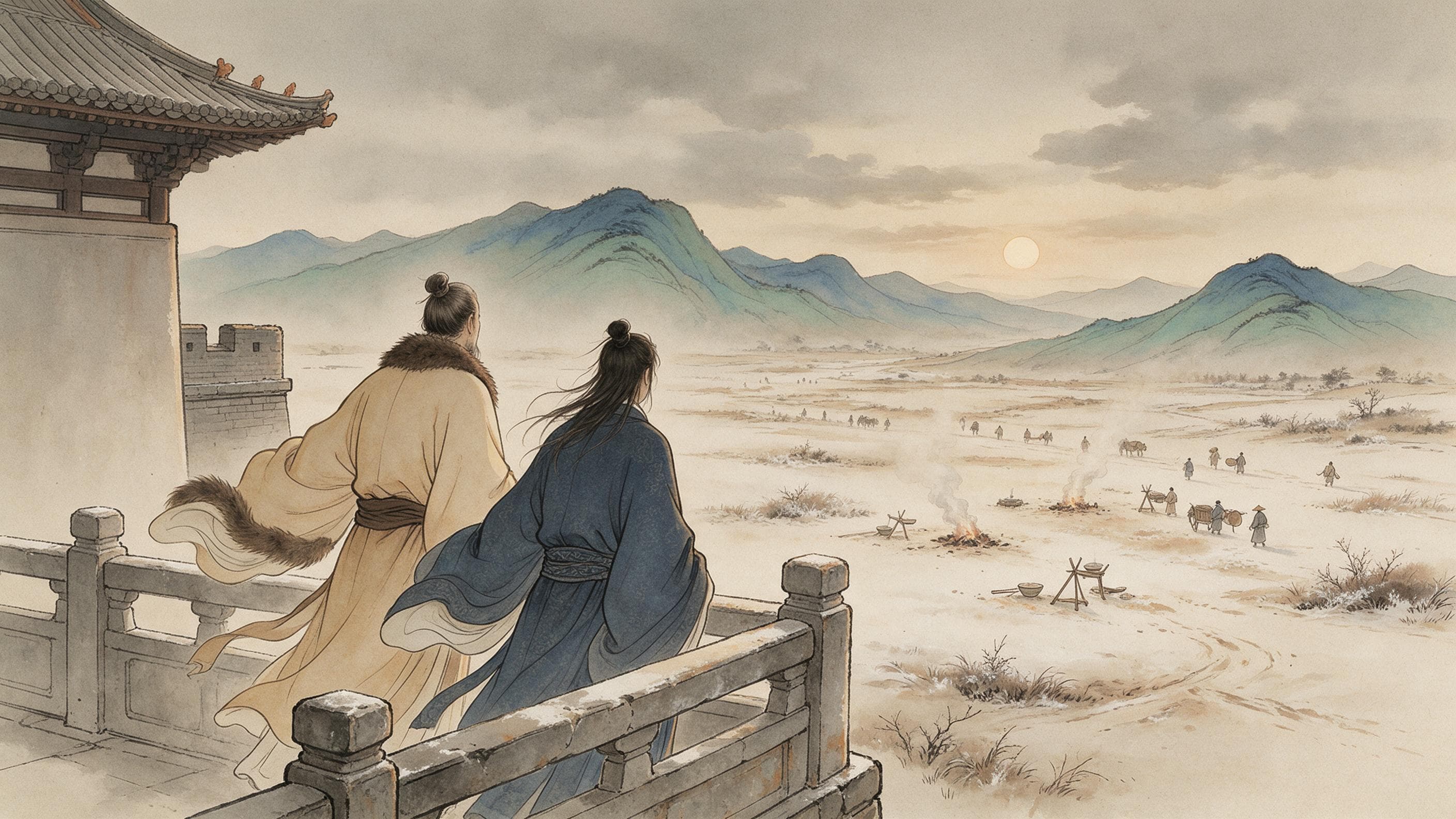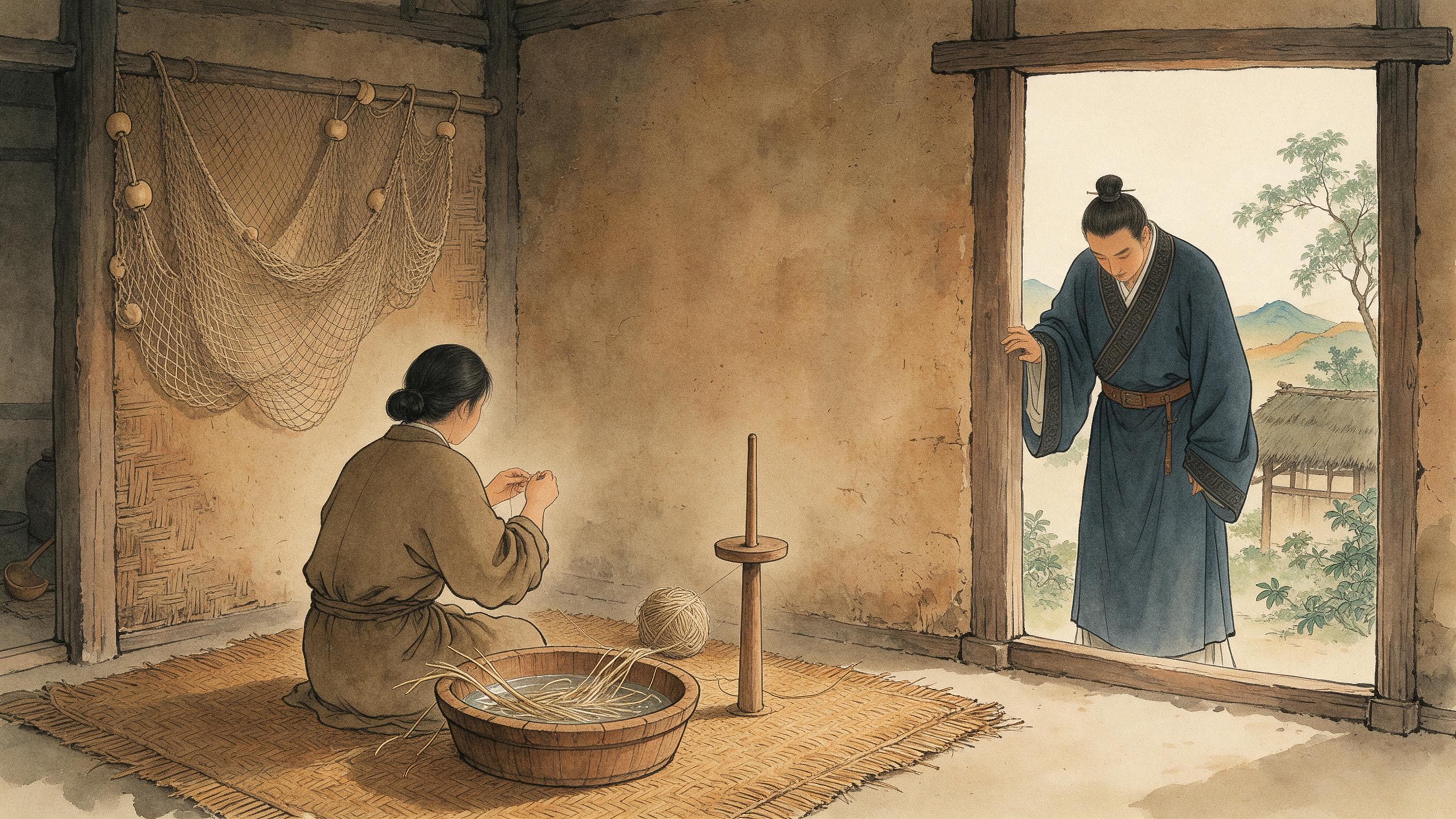
Two scenes from the two Lu chapters of the Guoyu, with a whole juan between them and no order of events. In the first, Lord Xuan of Lu soaks a net in the deep of the Si in summer to take fish, and the grandee Li Ge walks up and cuts the net and throws it away. In the second, Gongfu Wenbo comes home from court and finds his mother spinning hemp, and says that in a house like theirs the mistress should not still be doing it. The two scenes do one thing in common: stop a small everyday act, then cite an old rule. And they end the same way — on one short sentence from a third man.
First Scene: The Net
The page opens with seven characters: 宣公夏濫於泗淵. 濫 is not flooding; the note says 濫,漬也。漬罟於泗水之淵以取魚也 — soaking a net in the deep of the Si to take fish — and adds 泗在魯城北也, the Si is north of the Lu capital. The next five characters are the whole action: 里革斷其罟而棄之, Li Ge cut his net and threw it away; the note explains one word, 罟,網也, a net. No argument, no request for permission: the net is cut and gone.
Then he speaks, and he starts with a calendar. First: 古者大寒降,土蟄發,水虞於是乎講罛罶,取名魚,登川禽,而嘗之寢廟,行諸國,助宣氣也 — in old times, when the great cold came down and the hibernating creatures stirred, the warden of the waters practised the various nets, took the great fish, brought up the river creatures, had them tasted in the ancestral chamber first and spread the practice through the state, to help the yang breath rise. The note glosses 水虞 as 漁師也,掌川澤之禁令, the fisher-officer who holds the prohibitions of rivers and marshes, and 名魚 as 大魚, big fish. Second: 鳥獸孕,水蟲成,獸虞於是乎禁罝羅,矠魚鼈以為夏犒,助生阜也 — when the birds and beasts are breeding and the water creatures are grown, the warden of beasts forbids the rabbit and bird nets, and fish and turtles are speared to make dried stores for summer, to help living things increase. Third: 鳥獸成,水蟲孕,水虞於是禁罝罜䍡,設穽鄂,以實廟庖,畜功用也 — when the birds and beasts are grown and the water creatures are breeding, the small nets are forbidden, pits and palisades are set, to fill the temple kitchen and store up use. Each stage ends on a reason: 助宣氣, 助生阜, 畜功用.
Then six prohibitions, one per clause: 山不槎蘖,澤不伐夭,魚禁鯤鮞,獸長麑䴠,鳥翼鷇卵,蟲舍蚳蝝 — on the hill do not cut the sprouting stumps; in the marsh do not fell the young trees; among fish forbid the fry; among beasts let the fawns grow; for birds shelter the nestlings and eggs; for insects leave the ant eggs and the locust grubs. And the close: 蕃庶物也,古之訓也, this is to multiply the creatures; it is the old instruction. The verdict is three characters: 今魚方別孕,不敎魚長,又行網罟,貪無藝也 — the fish are carrying eggs, you do not let the fish grow, and out come the nets again: your greed has no limit. The note on 藝 is one word: 極也, a limit.
The lord accepts it: 吾過而里革匡我,不亦善乎!是良罟也,為我得法。使有司藏之,使吾無忘諗 — I was wrong and Li Ge corrected me, is that not good? This is a fine net; it has got me the rule. Let the officers keep it, so that I do not forget the admonition. And the music-master Cun, who was in attendance, says the line the scene is built to: 藏罟不如寘里革於側之不忘也 — keeping the net will not do as much as keeping Li Ge at your side. The notes: 師,樂師,存名也, the 師 is the music-master and Cun is his name; 寘,置也, to set or place.
The Thread Between Them
In the second scene the same move appears again. Jing Jiang says 愆則有辟,古之制也, for a fault there is a penalty, that was the old rule, and then 君子勞心,小人勞力,先王之訓也, the gentleman labours with his mind and the small man with his strength, that was the former kings' instruction. Li Ge's sentence was 蕃庶物也,古之訓也. What the two of them stop is different — one stops taking fish, the other stops taking ease — but what they bring out is the same kind of thing: an old name for a rule. This is the only place where the two chapters are joined; below they are kept apart.
Second Scene: The Hemp
The second scene opens with nine characters: 公父文伯退朝,朝其母,其母方績 — Gongfu Wenbo came back from court, paid his respects to his mother, and his mother was spinning hemp. Her son says 以歜之家而主猶績, in a house like ours the mistress still spins; what he fears is the anger of the Ji clan (the note: 季孫,康子也, Ji Sun is Kangzi) and being thought unable to look after his household. Whether his mother is tired he does not mention. She sighs: 魯其亡乎!使僮子備官而未之聞耶?居,吾語女 — is Lu about to fall, that a boy should hold office and never have heard of this? Sit down, I will tell you.
Her argument starts from soil: 昔聖王之處民也,擇瘠土而處之,勞其民而用之,故長王天下 — the sage kings put the people on poor ground and worked them hard, and so ruled the world long. Then the sentence everything hangs on: 夫民勞則思,思則善心生;逸則淫,淫則忘善,忘善則惡心生 — when people labour they think, and thinking gives rise to a good heart; when they are at ease they grow wanton, wantonness forgets goodness, and forgetting goodness gives rise to an evil heart. Then the pair: 沃土之民不材,逸也;瘠土之民莫不嚮義,勞也 — the people of rich soil are good for nothing, from ease; the people of poor soil all turn toward what is right, from labour. This is her claim, not a census of soils.
Two Tables
The first table is the day of five ranks in four parts, each ending 而後即安, and only then did he rest. The lords: 朝修天子之業命,晝考其國職,夕省其典刑,夜儆百工,使無慆淫,而後即安 — in the morning they carry out the Son of Heaven's business, by day examine the duties of their state, at dusk review the statutes, at night warn the hundred officers against slackness. The ministers: 朝考其職,晝講其庶政,夕序其業,夜庀其家事,而後即安. The officers: 朝受業,晝而講貫,夕而習復,夜而計過無憾,而後即安 — in the morning they receive their tasks, by day rehearse them, at dusk go over them again, at night count their errors so as to have no regret. The Son of Heaven's day is the longest, from 大采朝日 to 日入監九御,使潔奉禘、郊之粢盛,而後即安. And at the bottom, two clauses only: 明而動,晦而休,無日以怠 — they move at dawn and rest at dusk, with no day of idleness.
The second table is the work of women in six grades, one thing each: 王后親織玄紞;公侯之夫人加之以紘、綖;卿之內子為大帶;命婦成祭服;列士之妻加之以朝服;自庶士以下,皆衣其夫 — the queen weaves the dark cap-cords herself; the wives of dukes and lords add the cap-strings and the covering; the wives of ministers make the great sash; the named wives complete the sacrificial robe; the wives of officers add the court robe; from the lower officers down, they simply clothe their husbands. Then the old rule: 社而賦事,蒸而獻功,男女效績,愆則有辟 — at the spring sacrifice the work is assigned, at the winter sacrifice the achievement is presented; men and women both render service, and for failure there is a penalty. Then the former kings' instruction: 君子勞心,小人勞力. And the verdict: 自上以下,誰敢淫心舍力 — from the top down, who dares to indulge his heart and spare his strength? It answers Li Ge's 貪無藝 across a whole juan.
Two Closing Lines
Both scenes end in the same position. The first: the music-master Cun says 藏罟不如寘里革於側之不忘也, and the attention moves from the object to the man. The second: Jing Jiang finishes with 以是承君之官,余懼穆伯之絕嗣也 — to take the ruler's office with a heart like this, I fear the line of Mu Bo will end; the page never records what her son answered; it closes on Confucius, who heard of it and said 弟子志之,季氏之婦不淫矣 — remember this, disciples: the wife of the Ji family is not wanton. Five characters, and a household matter becomes a verdict.
Both pages are the Guoyu, old-attributed to Zuo Qiuming, with Wei Zhao's interlinear notes; inside those notes are Qing collation remarks of the form 案…公序本作…, and none of those is quoted here. The notes themselves are quoted where they explain a word, and marked as notes. One note rejects Tang Gu's reading of 孟春 with 唐云『孟春』,誤矣 — a commentator's opinion, not a settled fact. Neither page gives a year, a place beyond 泗 in one note, or any detail of the net; and 古之訓 is a name the speaker brings out for the occasion, not a record of an actual statute. This site has written about the field ritual and about the schools of the ritual books; this piece is two scenes, and no institutions.
Related reading:Spring Sou, Summer Miao, Autumn Xian, Winter Shou: Four Hunts a Year · At the First Crow: One Day in a Gentleman's Household, According to the Rites · Three Winds and Ten Faults: A New Dynasty's First List of Prohibitions
Sources & further reading
- 《國語》卷四·魯語上·里革斷宣公罟而棄之(舊題左丘明撰,三國吳韋昭注;維基文庫本,正文+注,注中另夾清人校語,未與中華書局點校本複核) — One scene and one verb. 宣公夏濫於泗淵,里革斷其罟而棄之 — in summer Lord Xuan of Lu soaked a net in the deep of the Si, and the grandee Li Ge cut the net and threw it away. Then the old order: 古者大寒降,土蟄發,水虞於是乎講罛罶,取名魚,登川禽,而嘗之寢廟,行諸國,助宣氣也; 鳥獸孕,水蟲成,獸虞於是乎禁罝羅,矠魚鼈以為夏犒,助生阜也; 鳥獸成,水蟲孕,水虞於是禁罝罜䍡,設穽鄂,以實廟庖,畜功用也. Then six prohibitions: 山不槎蘖,澤不伐夭,魚禁鯤鮞,獸長麑䴠,鳥翼鷇卵,蟲舍蚳蝝,蕃庶物也,古之訓也. The verdict: 今魚方別孕,不敎魚長,又行網罟,貪無藝也. The lord: 吾過而里革匡我,不亦善乎!是良罟也,為我得法。使有司藏之,使吾無忘諗. And 師存侍,曰:藏罟不如寘里革於側之不忘也. The page carries Wei Zhao's interlinear notes (濫,漬也; 罟,網也; 水虞,漁師也; 名魚,大魚也; 藝,極也; 寘,置也) and, inside them, Qing collation notes which this article does not quote; a note also rejects Tang Gu's reading 孟春 as 誤矣, cited only as a commentator's opinion.
- 《國語》卷五·魯語下·公父文伯之母論勞逸(舊題左丘明撰,三國吳韋昭注;維基文庫本,正文+注,注中另夾清人校語,未與中華書局點校本複核) — Gongfu Wenbo returns from court and finds his mother spinning hemp (公父文伯退朝,朝其母,其母方績); he objects that in a house like theirs the mistress should not still be spinning (以歜之家而主猶績). She sighs: 魯其亡乎!使僮子備官而未之聞耶?居,吾語女 — and argues from soil: 擇瘠土而處之,勞其民而用之; 夫民勞則思,思則善心生;逸則淫,淫則忘善,忘善則惡心生; 沃土之民不材,逸也;瘠土之民莫不嚮義,勞也. Then the day of each rank in four parts, each ending 而後即安 (天子: 大采朝日…日入監九御…; 諸侯: 朝修天子之業命,晝考其國職,夕省其典刑,夜儆百工; 卿大夫: 朝考其職,晝講其庶政,夕序其業,夜庀其家事; 士: 朝受業,晝而講貫,夕而習復,夜而計過無憾; 自庶人以下: 明而動,晦而休,無日以怠). Then the six grades of women's work: 王后親織玄紞;公侯之夫人加之以紘、綖;卿之內子為大帶;命婦成祭服;列士之妻加之以朝服;自庶士以下,皆衣其夫. Then 社而賦事,蒸而獻功,男女效績,愆則有辟,古之制也; 君子勞心,小人勞力,先王之訓也; 自上以下,誰敢淫心舍力. Her last words: 吾冀而朝夕修我曰:必無廢先人。爾今曰:胡不自安。以是承君之官,余懼穆伯之絕嗣也. The chapter closes on Confucius: 仲尼聞之曰:弟子志之,季氏之婦不淫矣. Notes are Wei Zhao's; Qing collation notes inside them are not quoted.