The last stanza of a poem in the Book of Songs has a few lines about ice: 二之日鑿冰沖沖,三之日納于凌陰,四之日其蚤,獻羔祭韭. Ice is cut, the ice is brought into the 凌陰, and at 四之日 a lamb is offered with leeks. Three ancient pages survive that deal with ice, and each deals with it in its own way: a song about the work of a year, a chronicle answer that is really about ritual and about who was allowed to receive ice, and an office manual that lists the men who handled it. Not one of the three describes the place the ice went into.
A Stanza in the Book of Songs
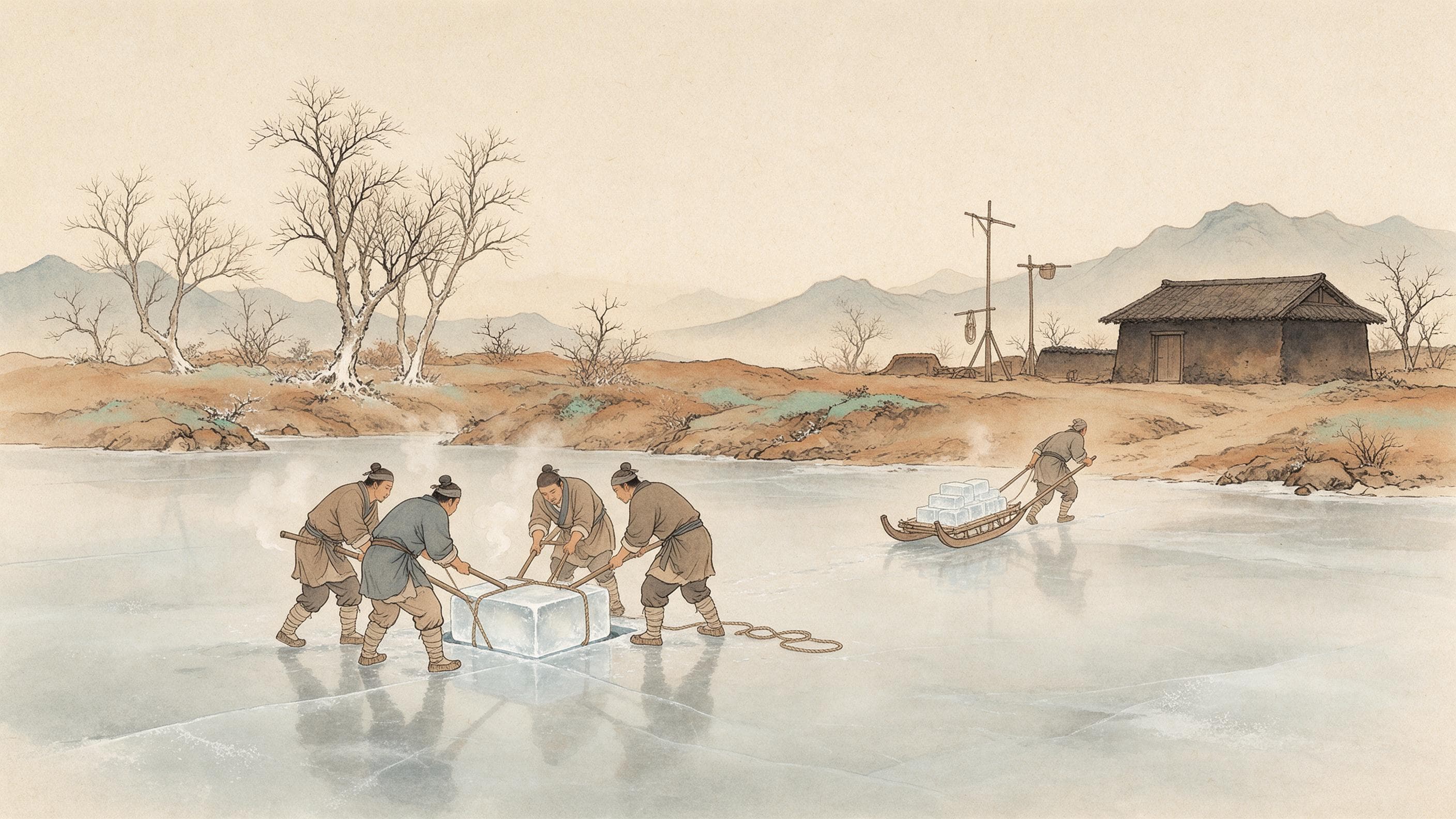
The page that carries 七月, 'Seventh Month', gives the poem's shape in one line, 八章,章十一句 — eight stanzas, eleven lines each — and no commentary. It does not gloss 凌陰, and it does not gloss the month words 二之日, 三之日, 四之日 that the stanza uses. The lines are a sequence of tasks: cut the ice, bring it in, make the offering. Who did the cutting the poem does not say. Nor does the page give the poem a date; this article calls it traditional and does not choose between the Western Zhou and the Spring and Autumn period.
A Hailstorm and a Question, 昭公四年
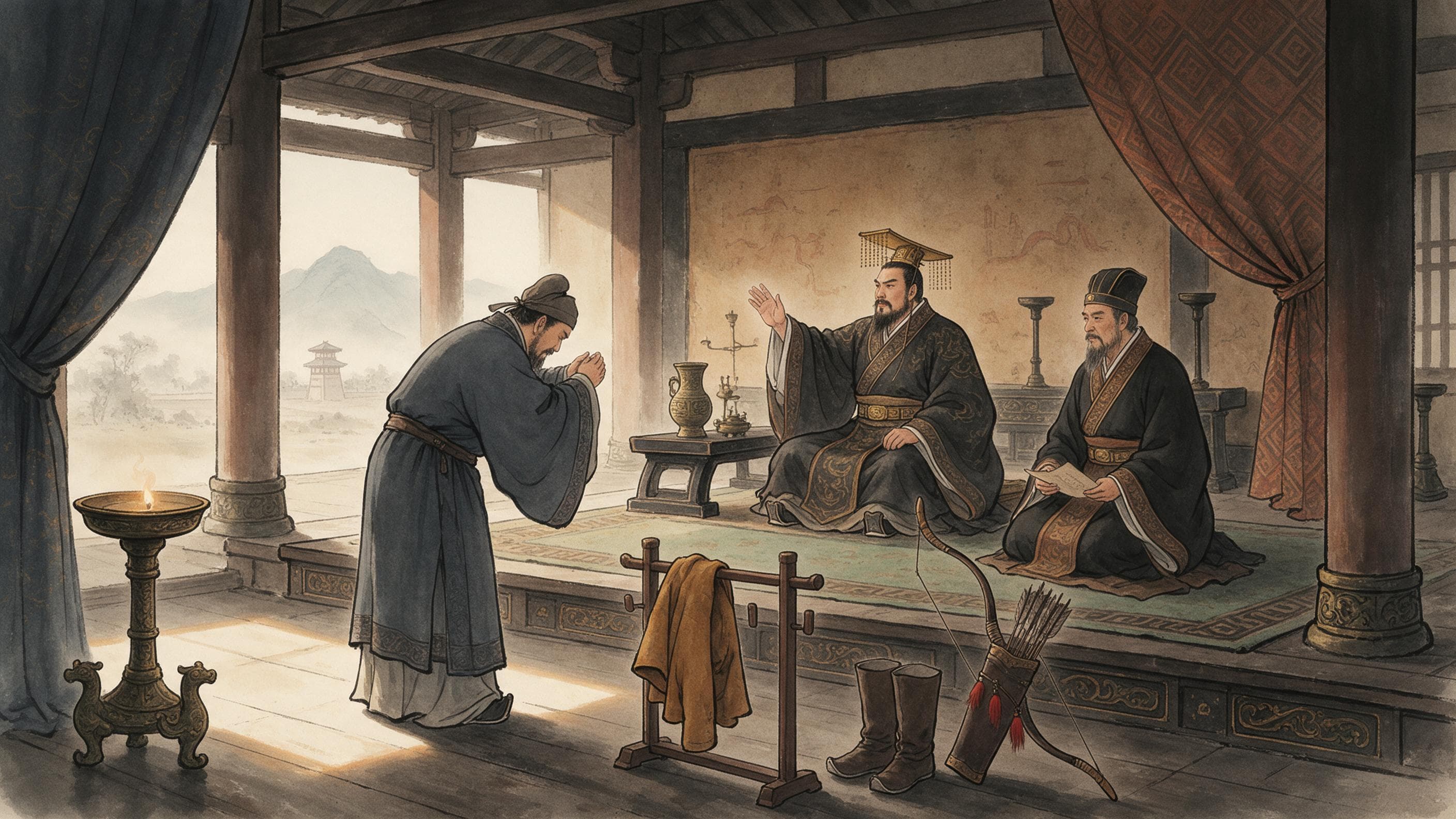
In the fourth year of Duke Zhao of Lu, the chronicle's entry under the king's first month of spring reads in three characters: 大雨雹, great rain and hail. The narrative for the same year has the same three characters and then a conversation: 大雨雹。季武子問於申豐曰:雹可禦乎 — Ji Wuzi asked Shen Feng whether hail could be warded off. Shen Feng opens with a general claim, 聖人在上,無雹;雖有不為災, and then turns to ice. (The same juan has another 大雨雹 in the winter of the third year, a different entry; this article does not use it.)
What he describes is a calendar of ice: 古者日在北陸而藏冰,西陸朝覿而出之 — in ancient times ice was stored when the sun was 在北陸, and brought out when 西陸 appeared at dawn. The page glosses 北陸, 西陸 and 朝覿 no further. The ice was taken 深山窮谷,固陰沍寒, from deep mountains and poor valleys where the shade is solid and the cold holds. It was stored with 黑牡秬黍,以享司寒, black victims and black millet offered to Si Han, and brought out with 桃弧棘矢,以除其災, a peach-wood bow and thorn-wood arrows to remove its harm. Then: 祭寒而藏之,獻羔而啟之,公始用之,火出而畢賦 — stored at the cold sacrifice, opened with the lamb, used first by the duke, and given out to all when 火 comes out. The page glosses neither 火出 nor 畢賦.
Who received it, in his words: 朝之祿位,賓食喪祭,於是乎用之 — at the court's ranks, at guests, food, mourning and sacrifice; 食肉之祿,冰皆與焉 — all who held meat-eating stipends shared the ice; 大大命婦,喪浴用冰 — for great officers and the wives of titled men, ice was used when the dead were bathed; and 自命夫命婦,至於老疾,無不受冰 — from titled men and their wives down to the old and sick, none went without. (The page prints 大大命婦 where the text calls for 大夫命婦; the quotation above keeps the page's characters.) Four kinds of men handled the ice, and the page says nothing about what the four names covered: 山人取之,縣人傳之,輿人納之,隸人藏之.
He ends by comparing a store kept well with one neglected. 其藏之也周,其用之也遍 — stored thoroughly, used everywhere — and then 冬無愆陽,夏無伏陰,春無凄風,秋無苦雨,雷出不震,無菑霜雹癘疾不降,民不夭札. Against that, the practice of his own day: 今藏川池之冰,棄而不用, ice from streams and ponds stored and left unused, and so 雹之為菑,誰能禦之 — who can ward off the harm of hail? His last sentence names the poem: 七月之卒章,藏冰之道也, 'the last stanza of 七月 is the way of storing ice.' That is the one place where two of these pages meet, and it is Shen Feng's sentence, not the poem's.
The Office Manual: 凌人
The third page is the 周禮, Rites of Zhou, in the section 天官冢宰. It begins with an administration being set up: 惟王建國,辨方正位,體國經野,設官分職,以為民極 — the king establishes the state, sets positions, lays out the capital and the fields, divides offices and assigns duties. In the list of offices under the heaven office there is one entry for staff and one for duties. The staff: 凌人:下士二人;府二人,史二人,胥八人,徒八十人 — two junior officers, two storekeepers, two scribes, eight overseers, eighty labourers. The manual is a design for an administration; nothing on the page says the office ran in this form in Zhou times, and this article does not assume that it did.
The duties: 凌人:掌冰政。歲十有二月,令斬冰,三其凌。春始治監,凡外內饔之膳羞,監焉。凡酒、漿之酒醴亦如之。祭祀,共冰監。賓客,共冰。大喪,共夷盤冰。夏,頒冰掌事。秋,刷. In order: he has charge of ice administration; in the twelfth month he orders the ice cut, 三其凌, three times its ice, a phrase the page leaves unexplained; in spring he first prepares the 監; the 監 serves the kitchens inside and out, and the wines and drinks; for sacrifices he supplies the ice vessel, for guests ice, for a great mourning 夷盤 ice; in summer he hands out ice; in autumn he scrubs. 三其凌 is quoted as written and not turned into a volume.
What the manual has that the other two pages lack is a year's round and a staff list: a month for cutting, a season for preparing vessels, a summer hand-out, an autumn cleaning, and a graded body of men — officers, storekeepers, scribes, overseers, labourers. What it lacks is everything a reader wants next: the size or shape of the store, how much ice was kept, who was on the list at the summer hand-out, how much each received, where the ice came from, what it cost. The page says none of this, and this article does not fill it in.
Reading the Three Pages Together
Each page answers a different question. The poem answers what the year's work was: cut, bring in, offer. The chronicle answers who was entitled to ice and what a well-kept store was supposed to do for the seasons and the sick; its frame is a hail disaster and a nobleman's question, and its speaker is describing the past — of his own day he says 今藏川池之冰,棄而不用. The manual answers what staff and duties an ice office would have. The three cannot be fitted into one picture: the poem names no officer, the chronicle gives no numbers, the manual names no recipient and no month for the hand-out. The only link the pages themselves make is Shen Feng quoting the last stanza of 七月. A reader who wants the store, the amounts and the list of recipients will not find them on any of the three pages, and one page's silence is not another page's answer.
What the Pages Do Not Give
Three notes to close. First, the quotations are given as the pages print them: 大大命婦 is kept although 大夫命婦 is meant, and 監 is kept as printed. Second, the numbers stand as written — 徒八十人, 三其凌, 歲十有二月, and the stanza's 二之日, 三之日, 四之日 — with no conversion into modern measures and no arithmetic performed on them. Third, these three pages are not a history of refrigeration, and this article does not write one; the Song trade in iced drinks is another subject and another article. What they give is a stanza, an argument and an office: ice cut in winter, handed out in summer, and, in one line of the chronicle, used to bathe the dead.
Related reading:Tao Qian's Resignation: Five Dou of Rice, a Field of Millet, and One Piece of Prose · Twelve Scrolls, 118 Chapters: How an Acupuncture Classic Was Assembled · Caps of the Yin: Xu, Zhangfu, and the Names of Three Dynasties
Sources & further reading
- 《詩經·七月》(維基文庫本,頁面白文;篇末只標「《七月》,八章,章十一句」,無注) — The last stanza reads 二之日鑿冰沖沖,三之日納于凌陰,四之日其蚤,獻羔祭韭. The page gives no gloss for 凌陰 or for the month words 二之日, 三之日, 四之日, and no date for the poem.
- 《春秋左氏傳·昭公四年》(維基文庫本,頁面白文;經作「四年春.王正月.大雨雹」) — The narrative for the same year gives 大雨雹 and the exchange 季武子問於申豐曰.雹可禦乎, then Shen Feng's long answer on ice: 古者日在北陸而藏冰…食肉之祿,冰皆與焉…自命夫命婦,至於老疾,無不受冰, and his closing 七月之卒章,藏冰之道也. The page prints 大大命婦 where 大夫命婦 is meant; it also has a separate 大雨雹 in the winter of the third year.
- 《周禮·天官冢宰》(維基文庫本,頁面白文;凌人一職分見序官與職文) — The staff entry: 凌人:下士二人;府二人,史二人,胥八人,徒八十人. The duties entry: 凌人:掌冰政。歲十有二月,令斬冰,三其凌。春始治監…祭祀,共冰監。賓客,共冰。大喪,共夷盤冰。夏,頒冰掌事。秋,刷. The page carries no commentary and no date for the office.