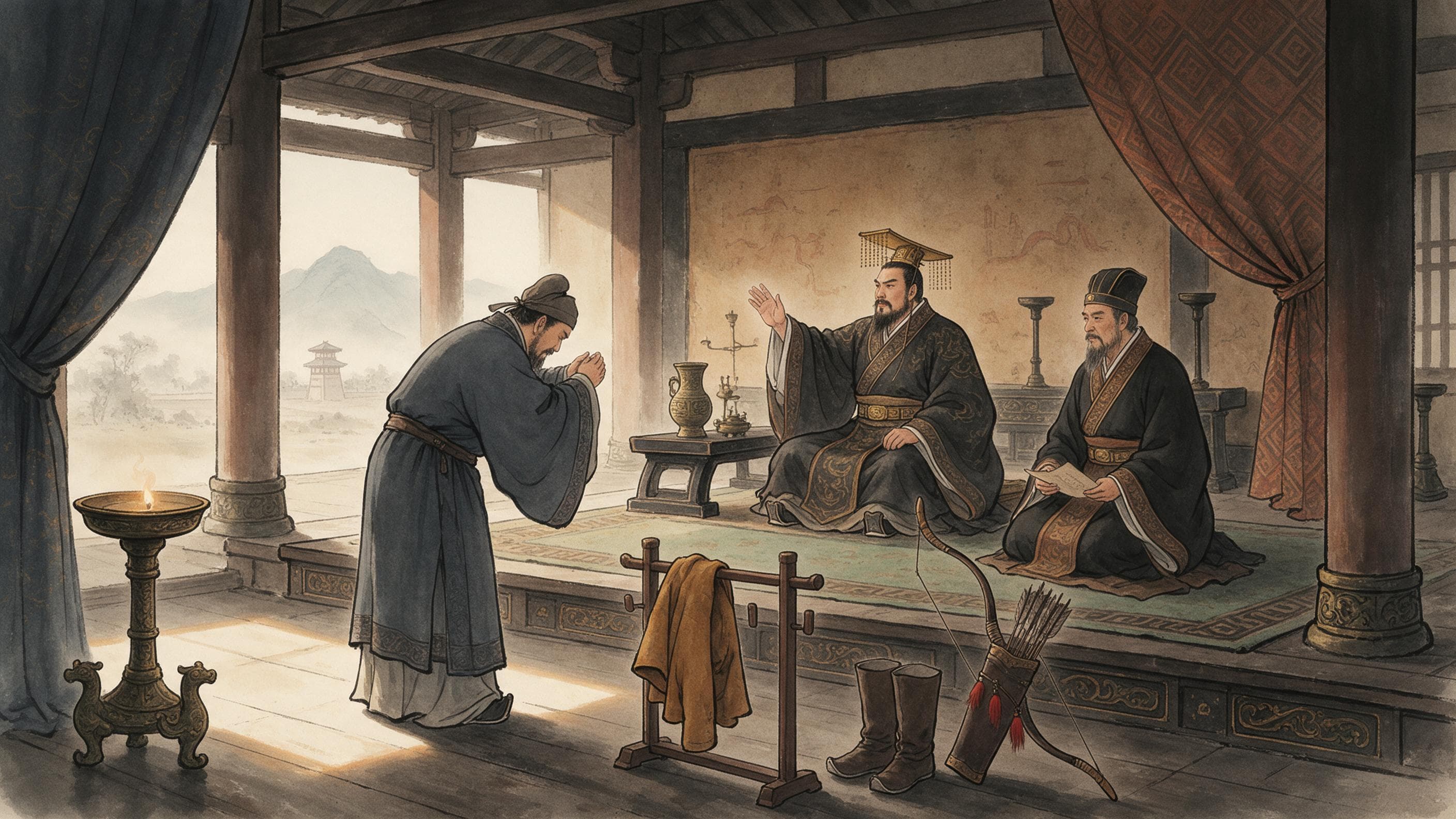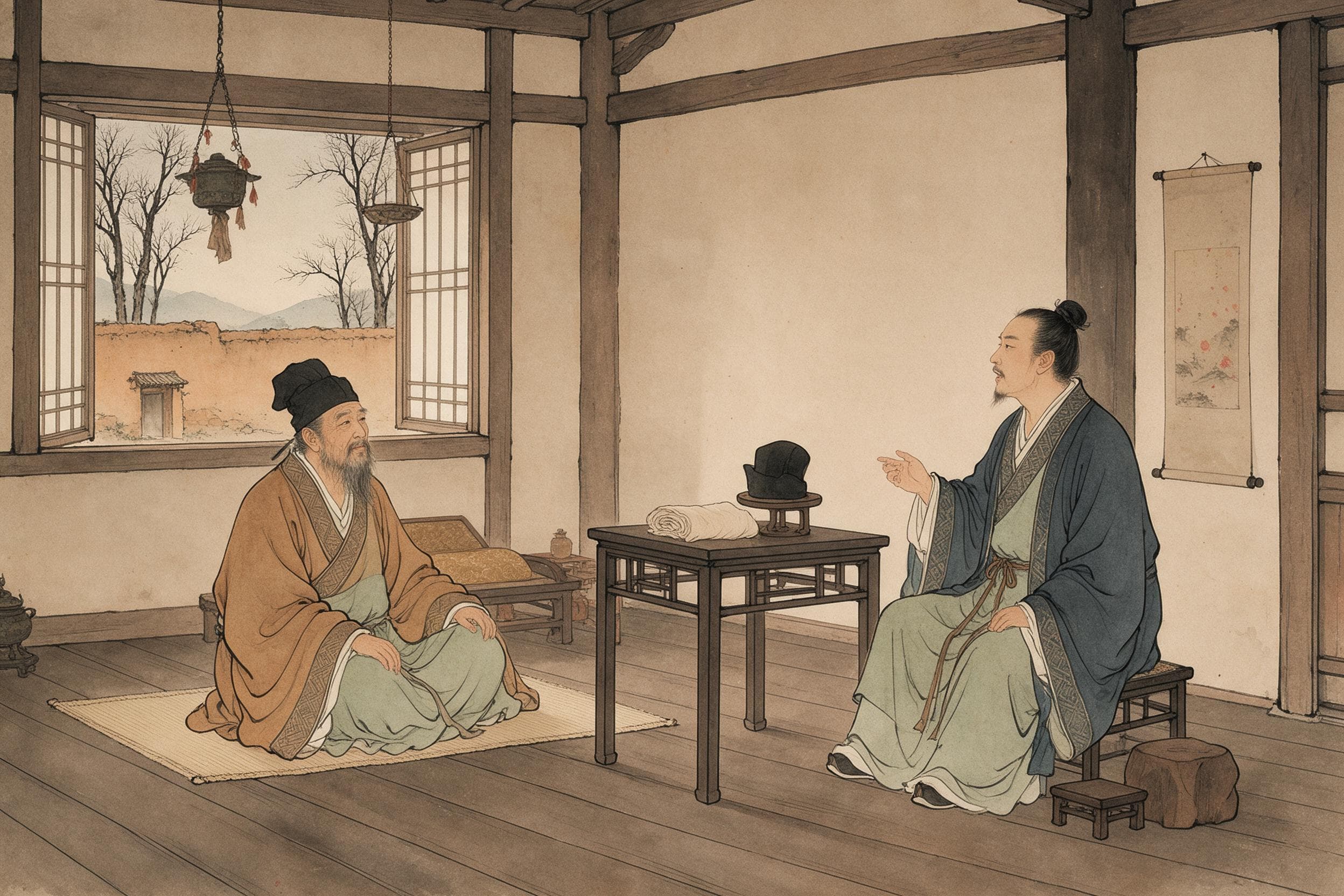
A man is asked a question about his clothes. The text is the opening of the Liji chapter called Ruxing: 魯哀公問於孔子曰:「夫子之服,其儒服與?」 Duke Ai of Lu asks Confucius whether what he is wearing is the scholar's dress. The answer starts with where he has lived: 丘少居魯,衣逢掖之衣;長居宋,冠章甫之冠 — when young he lived in Lu and wore the fengye robe, generally understood to be a robe with a wide sleeve; grown, he lived in Song and wore the cap of Zhangfu. Then a principle: 君子之學也博,其服也鄉 — a gentleman's learning is broad, his dress belongs to his district. And then the sentence the answer turns on: 丘不知儒服 — I do not know any scholar's dress.
One person, two halves: a robe from Lu, a cap from Song. The cap is the only object in the reply with a name of its own, 章甫, and the reply never describes it. Nor does the question get a yes or a no: the duke asks whether there is such a thing as a scholar's dress, and the answer is that a man's clothes follow where he has lived. The chapter then runs through a series of answers beginning 儒有, and ends with Duke Ai lodging him and saying 終没吾世,不敢以儒爲戲, as long as I live I will not make a joke of the scholars. Somewhere in the middle of that series is one more remark about dress: 儒有衣冠中,動作慎 — the scholar's cap and dress are moderate, his movements careful. The chapter that opens by denying a scholar's uniform still describes one, in a word: moderate.
One: a cap with a name and no shape
That is all the first page gives: a question, a cap's name, the district it came from, a denial. Not the height, not the material, not the shape. The word 冠 appears again only in the 衣冠中 line. A reader who wants to know what Zhangfu looked like must go elsewhere. The gloss of 逢掖 as a wide sleeve is an old explanation, not a line of the page.
Two: three names, three dynasties, one sentence
The second page, the Jiaotesheng, gives three: 委貌,周道也;章甫,殷道也;毋追,夏后氏之道也 — weimao is the way of Zhou, zhangfu the way of Yin, wuzhui the way of the house of Xia. Three words, three dynasties, one sentence. Each is given the word 道, way, which the page does not define. What it is: a list of names hung on dynasties, with no shape, no measurement, no material and no statement of who wore them. It stands a few lines after the capping passage, where the three investitures grow more honoured and the cap is followed by a courtesy name — that passage belongs to the article on the capping rite; here only the adjacency matters.
The list has its own order — Zhou, Yin, Xia, newest first — and it overlaps with the first page at exactly one word: Zhangfu. In the Ruxing, Zhangfu is the cap Confucius wore because he had lived long in Song. In the Jiaotesheng, Zhangfu is the way of Yin. Put the two together and a sentence comes out ready-made: Zhangfu is the Yin cap. But that sentence is a joining of two statements; neither page writes it. Whether the cap worn in Song was the cap of the Yin is a link the reader supplies, and should know he is supplying. One step further: nothing on these pages dates the name to the Shang. The book that calls it the way of Yin is generally dated to the Han. Whether anyone while the Shang stood called a cap Zhangfu is not a question these pages answer, and this article does not answer it either.
Three: the two lists that do not match
The third page, the Wangzhi, gives four: 有虞氏皇而祭,深衣而養老;夏后氏收而祭,燕衣而養老;殷人冔而祭,縞衣而養老;周人冕而祭,玄衣而養老. Four dynasties, four names; each name is followed by 而祭 — and then by a different garment and 而養老. The sentence is built in two halves: the cap belongs to sacrifice, the robe to the care of the aged. It reads easily as one outfit — a Yin man sacrificing in a xu cap and a white-hemmed robe — which is not what it says. The cap is what he wore at the sacrifice; the robe is what he wore when the old were cared for.
Set the other list beside it: 周弁,殷𠳲,夏收,三王共皮弁、素積 — the Zhou bian, the Yin 𠳲, the Xia shou, and what the three kings shared, a leather cap and a plain-hemmed robe. Now compare. Xia: 收 in both lists, the same word. Yin: 冔 in the Wangzhi, 𠳲 in the Jiaotesheng — different characters, neither page mentioning the other; the usual view is that they name one cap, and that is a view, not a line of either text. Zhou: 冕 in the Wangzhi, 弁 in the Jiaotesheng — two different caps, and the pages do not say which is right or whether the two sentences describe the same occasion. The Wangzhi has a fourth dynasty, 有虞氏, that the Jiaotesheng's second list lacks; the Jiaotesheng has 三王共皮弁素積, a shared item, that the Wangzhi lacks. Of four caps, the two lists agree on one. That is the real result: four dynasties on one page, three on the other, one name in common — and a combined table would be an invention. The pages are set side by side here, and the question of which list is right stays where they leave it.
Four: who wore them
The Wangzhi passage that carries the four caps also carries the places and the meals. Just before it: 有虞氏養國老於上庠,養庶老於下庠;夏后氏養國老於東序,養庶老於西序;殷人養國老於右學,養庶老於左學;周人養國老於東膠,養庶老於虞庠 — two schools per dynasty, one for the state's old men and one for commoners'; Yin's pair is 右學 and 左學. Elsewhere on the same page: 凡養老:有虞氏以燕禮,夏后氏以饗禮,殷人以食禮,周人脩而兼用之 — four dynasties, four ways of feasting the aged, and Yin's is 食禮, the food rite. These are the only places on the three pages that put anyone in the room: old men, in schools, at a meal. The caps themselves are never tied to an age or an office.
The passage that does divide people by headwear is not about dynasties. In the Jiaotesheng's account of the winter sacrifice: 黄衣黄冠而祭,息田夫也。野夫黄冠。黄冠,草服也 — yellow robes and yellow caps for the sacrifice, to rest the field labourers; the field man's cap is yellow; the yellow cap is a straw garment. A few lines on, when the officer of birds and beasts receives the envoys: 草笠而至,尊野服也 — they come in straw hats, honouring the rustic dress. So the only material named anywhere in the three pages is straw, and it is named for the lowest of the wearers. The caps with dynasty names remain names.
Five: what the three pages leave out
- No shapes. The height, form, material and colour of 委貌, 章甫, 毋追, 皇, 收, 冔, 冕 and 弁 are nowhere on these pages. The one material given, 草服, belongs to the field man's cap.
- No commentary. All three pages are plain text: no Zheng Xuan commentary, no Kong Yingda sub-commentary. Whatever a commentator settled about these words lies outside this article.
- No Shang-period evidence. The book that calls the cap the way of Yin is generally dated to the Han. Whether the name Zhangfu was used while the Shang stood is not answered here, and this article does not answer it.
- No verdict on 冔 and 𠳲. Two characters in the same slot of two parallel lists; the usual view that they name one cap is reported as a view, not adopted.
- No cap-rite detail. The three investitures, the toasts, the courtesy name belong to the article on the capping rite; one line here, no ritual quoted.
- No colour scheme. The article on colour and mourning in the Yin covers 尚白; nothing is inferred from it here, and no claim is made that a dynasty fond of white wore white caps.
What is left is a vocabulary: three names in one sentence, 委貌, 章甫, 毋追; four in another, 皇, 收, 冔, 冕; three in a third, 弁, 𠳲, 收, plus the leather cap the three kings shared. At the bottom of the list, a straw cap for a man in a field. The pages name nine caps and describe none. A cap can be a dynasty's label and have no shape at the same time; the two facts stand on one page, unreconciled.
Related reading:Tao Qian's Resignation: Five Dou of Rice, a Field of Millet, and One Piece of Prose · Twelve Scrolls, 118 Chapters: How an Acupuncture Classic Was Assembled · Ice: Cut in Winter, Given Out in Summer, and Used to Bathe the Dead
Sources & further reading
- 《礼记·儒行》(维基文库本,白文无注,页面标 Textquality 75%,未与中华书局点校本复核) — The chapter opens with the question about dress: 魯哀公問於孔子曰:「夫子之服,其儒服與?」孔子對曰:「丘少居魯,衣逢掖之衣;長居宋,冠章甫之冠。丘聞之也:君子之學也博,其服也鄉。丘不知儒服。」The rest is the long series of answers beginning 儒有, among them 儒有衣冠中,動作慎; it ends 孔子至舍,哀公館之,聞此言也,言加信,行加義:「終没吾世,不敢以儒爲戲。」Nothing in the chapter describes the cap or names its material; 逢掖 as a wide sleeve is a gloss, not a line of the page.
- 《礼记·郊特牲》(维基文库本,白文无注,页面标 Textquality 75%,未与中华书局点校本复核) — The two lists. First: 委貌,周道也;章甫,殷道也;毋追,夏后氏之道也。Then: 周弁,殷𠳲,夏收,三王共皮弁、素積。They stand a few lines after the capping passage (三加彌尊,喻其志也。冠而字之,敬其名也) and before the lines on marriage. The character 𠳲 is U+20CF2, once only on the page, and it is not the same character as the 冔 of the Wangzhi. Later in the same chapter, on the winter sacrifice: 黄衣黄冠而祭,息田夫也。野夫黄冠。黄冠,草服也; a few lines on, 草笠而至,尊野服也.
- 《礼记·王制》(维基文库本,白文无注,页面标 Textquality 75%,未与中华书局点校本复核) — From the section on the aged: 有虞氏養國老於上庠,養庶老於下庠;夏后氏養國老於東序,養庶老於西序;殷人養國老於右學,養庶老於左學;周人養國老於東膠,養庶老於虞庠。虞庠在國之西郊。有虞氏皇而祭,深衣而養老;夏后氏收而祭,燕衣而養老;殷人冔而祭,縞衣而養老;周人冕而祭,玄衣而養老。凡三王養老,皆引年。Elsewhere on the page: 凡養老:有虞氏以燕禮,夏后氏以饗禮,殷人以食禮,周人脩而兼用之。The sentence names the four items without using the word 冠.