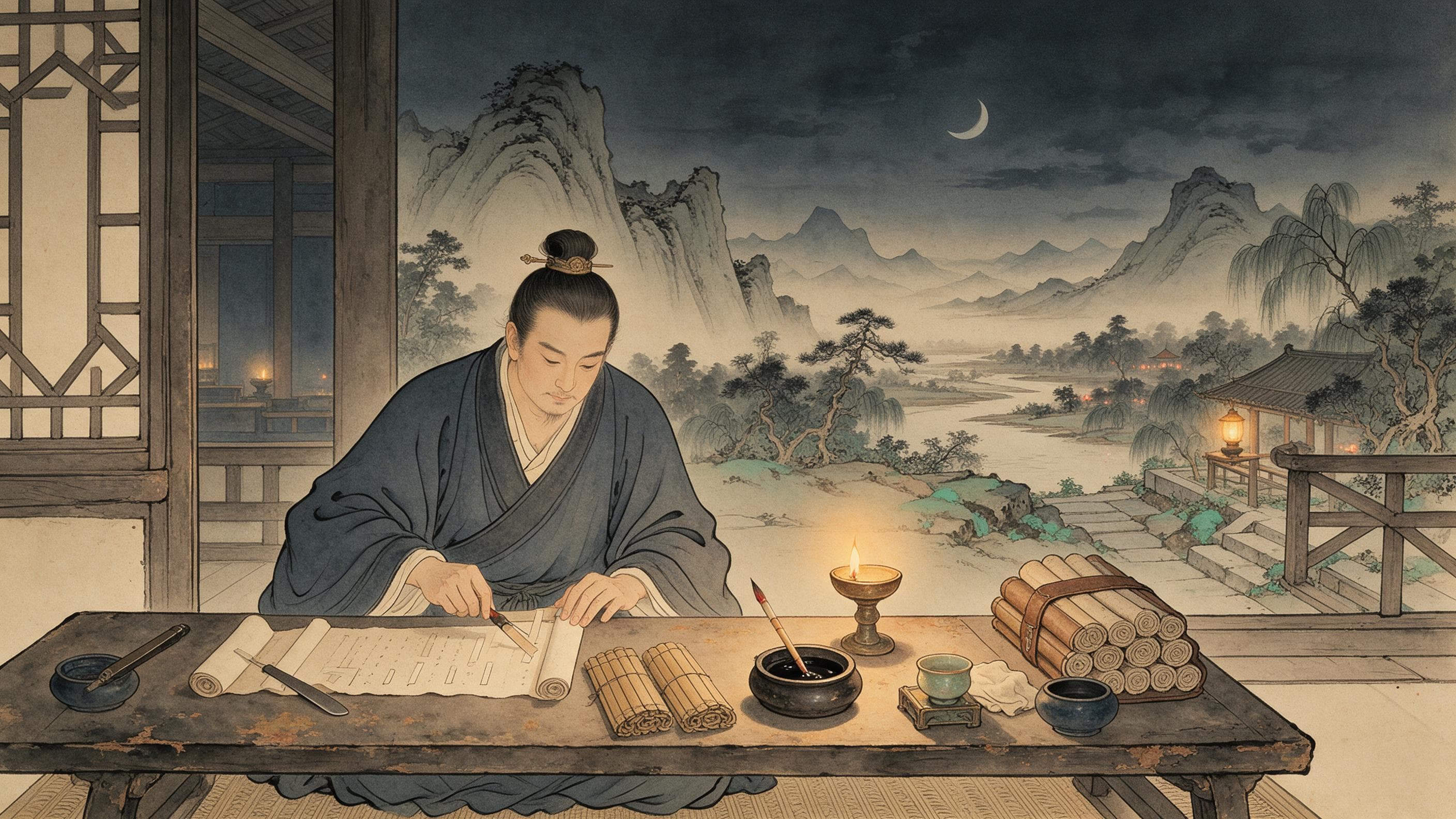
To compile a book you first need books to compile. Huangfu Mi's preface says it plainly: 'the three works come to one end, their text much repeated, and their confusions are not of one kind… so I compiled the three, making like matters follow one another, cutting their floating words, removing their repetitions, discussing their essentials, until it came to twelve scrolls' (三部同歸,文多重複,錯互非一……至為十二卷). This piece writes three things: how he says he compiled it, how the Song editors say they collated it, and the account of scroll-counts that the Siku editors left.
One: three books and one illness
Which three books the preface makes clear: 'according to the Seven Summaries and the Arts and Letters treatise, the Yellow Emperor's Inner Classic was eighteen scrolls. Now there are the Needle Classic in nine scrolls and the Questions in nine scrolls — twice nine, eighteen — which is the Inner Classic; some of it is also lost… There is also the Mingtang: Acupoints, Needles and Moxa, Essential Cures, all remnants of the Yellow Emperor and Qibo' (《針經》九卷,《素問》九卷,二九十八卷,即《內經》也). That one sentence is all the two pages say about how the Questions and the Needle Classic stand to the Inner Classic, so this piece writes that one sentence and adds no history of medicine.
Why he began, the preface also says: 'in the Ganlu period I fell ill with wind and added a hundred days of bitter deafness; the essentials of treatment were all shallow and near' (甘露中,吾病風加苦聾百日,方治要皆淺近). Then came the step above. After it he sets his own limit: 'the root text's arguments have principle; though they do not fit near matters, I did not cut much. If a true essential is wanted, when I have leisure I shall collate it into a teaching classic' (其本論其文有理……當撰核以為教經云爾). That is his own account, copied here; the Ganlu reign period is not converted into a Western date.
Two: rules for the edition
The front matter also has a set of 'rules of the preface', which are rules of editing, not of medicine: 'in all questions, the Yellow Emperor and Lei Gong are both said to ask; in the answers, the Yellow Emperor is said to answer and Qibo and the rest to reply. Where a former chapter has already given the names in a question and answer, the next chapter says only ask and reply and does not repeat the names. Where the person differs, the names are repeated. This is the rule' (序例). And a rule for terms: 'where it says preside over it, both moxa and needle may be used; where it says needle it, moxa may not; where it says moxa it, the needle may not — this too is the rule'. These are the acts of compiling: uniform titles, uniform terms.
Three: the Song collation
The copy we read is a Song edition, and its front matter is Song work. Lin Yi's memorial: 'Huangfu Mi of Jin, widely read in the classics and the hundred schools… took the three books of the Yellow Emperor, the Questions, the Needle Classic and the Mingtang, and compiled the Needle and Moxa Classic in twelve scrolls'. It also says how the collation was done: 'the state ordered its scholars to collate medical books, and to take the Questions, the Jiuxu, the Lingshu, the Great Simplicity, the Thousand Ducats, its Wing, and the Arcane Essentials and other good books to compare, and to make a fair copy for the emperor's own reading' (國家詔儒臣校正醫書……校對). It is signed by Gao Baoheng, Sun Qi and Lin Yi.
One more layer must be marked: the interlinear notes are not Huangfu Mi's. The Siku editors: 'the notes in the text often quote Yang Shangda's Great Simplicity, Sun Simiao's Thousand Ducats, Wang Bing's commentary to the Questions, and Wang Weide's Bronze Man figures, comparing their differences. All these books are later than Mi; they were added by Gao Baoheng, Sun Qi, Lin Yi and the rest when they collated, and are not Mi's original' (非謐之舊也). So the book has at least two hands: a Western Jin compilation and a Northern Song collation.
Four: the account of scrolls
The scroll-count differs between catalogues, and the Siku note lays the account out: 'the Sui treatise calls it the Yellow Emperor's Jiayi Classic in ten scrolls, noting one scroll of sounds; the Liang catalogue says twelve scrolls and gives no author's name'. Then: 'the Old Tang catalogue calls it the Yellow Emperor's Three-Part Needle Classic in thirteen scrolls, and first gives Mi's name — one scroll more than the Liang copy, perhaps counting the scroll of sounds' (其並音一卷計之歟). And: 'the New Tang catalogue has both the Yellow Emperor's Jiayi Classic in twelve scrolls and Huangfu Mi's Yellow Emperor's Three-Part Needle Classic in thirteen, following both earlier catalogues, and so is more confused still' (則更舛誤矣). The note itself opens by calling it 'the Acupuncture Jiayi Classic in eight scrolls, by Huangfu Mi of Jin'. Four counts — ten, twelve, thirteen, eight — are set side by side and not decided here.
The chapter count also comes in two numbers, in the same note: it first says 'the book is in all one hundred and eighteen chapters', then lists which chapters are divided into upper and lower, and which into upper, middle and lower, and ends 'in fact one hundred and twenty-eight chapters' (實一百二十八篇). Both are copied; this piece neither adds nor subtracts, and computes no average per scroll. Of the division into scrolls the page gives only the first two: scroll one lists sixteen chapter titles, scroll two eight entries (the first split into upper and lower, then the Eight Extraordinary Vessels, the Measure of the Vessels, and so on); scrolls three to twelve are bare headings with no chapters listed.
Five: beyond these two pages
Note that the official biography does not mention the book. The Jinshu's life of Huangfu Mi says 'his family being poor, he worked the fields himself, carrying books to the farm' (居貧,躬自稼穡,帶經而農); that 'later he fell ill with wind paralysis, yet his hand never left the scrolls'; that he was so absorbed 'that people of the time called him a book-addict'; that he called himself Master Xuanyan and refused every summons. Its list of his writings names the Century of Emperors, the Chronology, lives of the High-Minded, the Recluses and the Women, and the Annals of Xuanyan — and no Jiayi Classic. So the story of the compilation comes from the book's own preface and the Song memorials, not from the dynastic history.
A boundary: the piece on the Bencao gangmu is about Li Shizhen's thirty years, the piece on the Seven Summaries is about Liu Xiang and his son collating books; this one is the textual account of Huangfu Mi joining three books and the Song editors collating them again. Nor does it argue that this was the foundation of acupuncture, and it writes no general theory of meridians: the two pages give prefaces, rules, a table of contents and catalogue entries.
What the pages do not give: only the front matter is here, the twelve scrolls of text were not read, so no passages and no acupoints are quoted; a full chapter list beyond scroll one, the exact year of compilation, and the variants between the Song edition and the Tang copies are all absent. What is left is one sentence, 'compiled the three into twelve scrolls', a few rules of editing, a list of Song collators, four scroll-counts and two chapter counts.
Related reading:Tao Qian's Resignation: Five Dou of Rice, a Field of Millet, and One Piece of Prose · Ice: Cut in Winter, Given Out in Summer, and Used to Bathe the Dead · Caps of the Yin: Xu, Zhangfu, and the Names of Three Dynasties
Sources & further reading
- 《针灸甲乙经》宋校本卷首(维基文库本,未与点校本复核) — The front matter of the Song edition: the Siku editors' note, Lin Yi's memorial, Huangfu Mi's own preface and the editorial rules, and the table of contents. Huangfu Mi: 'according to the Seven Summaries and the Arts and Letters treatise, the Yellow Emperor's Inner Classic was eighteen scrolls. Now there are the Needle Classic in nine scrolls and the Questions in nine scrolls — twice nine, eighteen — which is the Inner Classic… There is also the Mingtang: Acupoints, Needles and Moxa, Essential Cures, all remnants of the Yellow Emperor and Qibo. The three works come to one end, their text much repeated, and their confusions are not of one kind. In the Ganlu period I fell ill with wind and added bitter deafness for a hundred days… so I compiled the three, making like matters follow one another, cutting their floating words, removing their repetitions, discussing their essentials, until it came to twelve scrolls' (乃撰集三部,使事類相從,刪其浮辭,除其重複,論其精要,至為十二卷). The rules: 'in all questions, the Yellow Emperor and Lei Gong are both said to ask; in the answers, the Yellow Emperor is said to answer and Qibo and the rest to reply… where the person differs the names are repeated. This is the rule. Where it says 'preside over it', both moxa and needle may be used; where it says 'needle it', moxa may not; where it says 'moxa it', the needle may not — this too is the rule' (序例). Lin Yi's memorial: 'he took the three books of the Yellow Emperor — the Questions, the Needle Classic and the Mingtang — and compiled the Needle and Moxa Classic in twelve scrolls'; and 'the state ordered its scholars to collate medical books, and to take the Questions, the Jiuxu, the Lingshu, the Great Simplicity, the Thousand Ducats, its Wing, and the Arcane Essentials and other good books to compare' (國家詔儒臣校正醫書……校對), signed by Gao Baoheng, Sun Qi and Lin Yi. The Siku note carries the numbers: 'the Sui treatise calls it the Yellow Emperor's Jiayi Classic in ten scrolls, with one scroll of sounds; the Liang catalogue, twelve scrolls, without an author's name'; the Old Tang catalogue, thirteen scrolls 'and first gives Mi's name'; the New Tang catalogue has both twelve and thirteen; and the note says 'the book is in all one hundred and eighteen chapters', then counts the divisions and says 'in fact one hundred and twenty-eight chapters' (實一百二十八篇). The page's table of contents lists the chapter titles of scrolls one and two only, and the bare headings of scrolls three to twelve.
- 《晋书》卷五十一〈皇甫谧传〉(维基文库本,未与点校本复核) — The biography, which never mentions the acupuncture book. It gives his origins and habits: 'Huangfu Mi, style Shi'an, childhood name Jing, of Chaona in Anding, great-grandson of the Han grand commandant Song'; at twenty still unstudious, then moved by his aunt's tears to study with Xi Tan of the same district; 'his family being poor, he worked the fields himself, carrying books to the farm' (居貧,躬自稼穡,帶經而農); 'quiet and of few desires, he first set his mind on high things, took writing as his task, and called himself Master Xuanyan'; 'later he fell ill with wind paralysis, yet his hand never left the scrolls' (後得風痹疾,猶手不輟卷); 'he was so absorbed in books that he forgot sleep and food, and people of the time called him a book-addict' (時人謂之書淫); he refused all office. The list of his writings names the Century of Emperors, the Chronology, lives of the High-Minded, the Recluses, the Women, and the Annals of Xuanyan — no Jiayi Classic. He died in the third year of Taikang, aged sixty-eight.