Tao Qian's resignation is told twice on these two pages. The Book of Jin's chapter on recluses is a biography: it follows him from 親老家貧, poor with aged parents, to the day he returned the seal, and it quotes the whole of the Guiqulai. The Wenxuan, the Liang anthology, prints the same piece with a short preface and with Li Shan's notes between the lines. This article keeps three layers apart: the biography's narrative, the text of the piece, and the anthology's short preface. The five dou of rice and the millet are the biography's words; the piece is his own; the preface is the author's own short preface. The two texts overlap almost word for word; what differs is what each is for.
Why He Went
The life begins with the reason: 以親老家貧,起為州祭酒,不堪吏職,少日自解歸。州召主簿,不就,躬耕自資,遂抱羸疾 — poor with aged parents, he took office as a state libationer, could not bear the clerical work, and resigned within days; summoned as registrar he declined, farmed for himself, and fell ill. Later 復為鎮軍、建威參軍, he served on the staff of two generals, and told friends: 聊欲弦歌,以為三徑之資可乎 — I should like a small office to pay for the path home. The officials heard it and made him magistrate of Pengze. Two departures, two returns: the libationership ended 少日自解歸 within days, the registrarship he 不就 declined; only after the staff posts did he ask for a county. The three earlier attempts are all undone within days or declined outright.
The anthology's preface is much shorter: 序曰:余家貧,又心憚遠役,彭澤縣去家百里,故便求之。及少日,眷然有歸與之情,自免去職。因事順心,命篇曰歸去來 — my family was poor and I feared distant service; Pengze was a hundred li from home, so I asked for it; within days I felt the wish to return and resigned of my own accord; the matter being as my heart wished, I named the piece Guiqulai. Poverty, fear of distance, a hundred li, the wish to return, the resignation, the naming: that is all, and it is the shortest telling of the whole affair. Neither page has a long autobiographical preface, and none is supplied.
Two Kinds of Grain
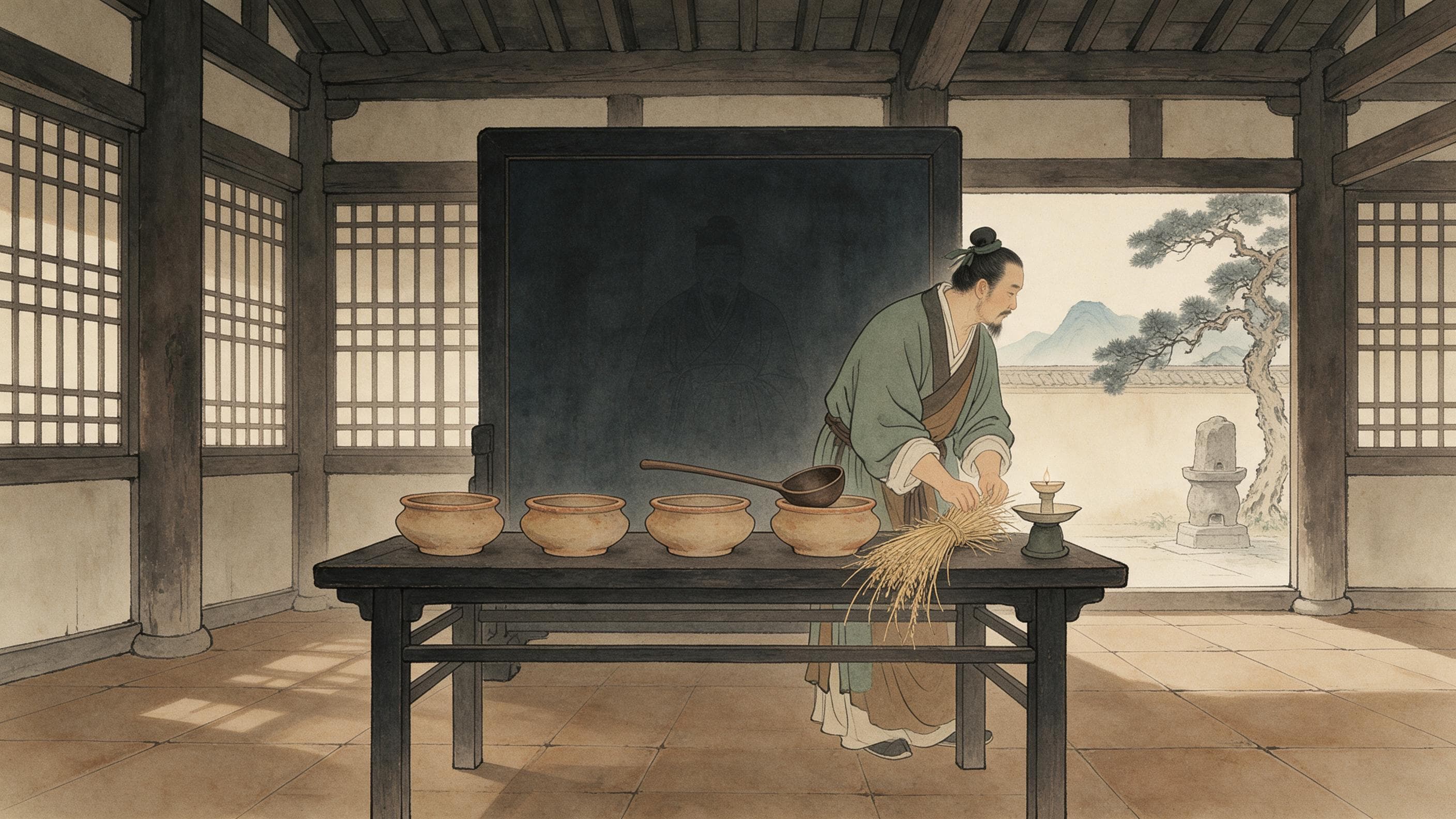
The biography gives one concrete act in the county: 在縣,公田悉令種秫穀,曰:「令吾常醉於酒足矣。」妻子固請種粳。乃使一頃五十畝種秫,五十畝種粳 — in the county he ordered the public fields all planted with glutinous millet, saying that as long as he was always drunk on wine it was enough; his wife insisted on ordinary rice, so one qing and fifty mu went to millet and fifty mu to rice. Qing and mu are printed as given, not converted; 秫 and 粳 are kept as the page has them. It is the only place in the life where a quantity is divided, and the division is between wine and food.
The anthology's preface has no public fields and no millet; its one reason is 彭澤縣去家百里,故便求之, a hundred li from home, and so he asked for it. For the same office the biography gives field sizes and the anthology gives distance — each page gives one end, and this article does not join them into one account.
Five Dou of Rice
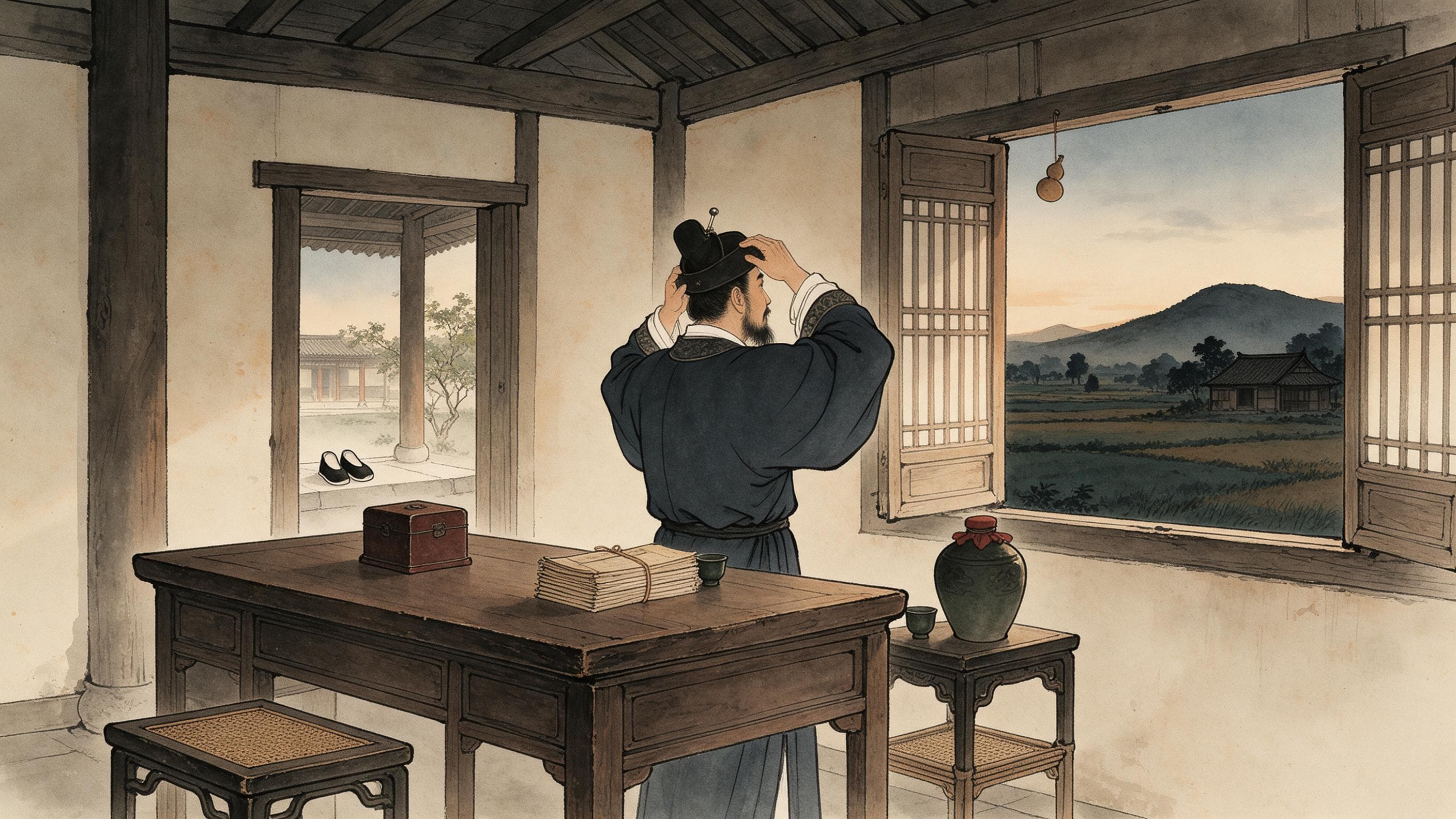
The life goes on: 素簡貴,不私事上官。郡遣督郵至縣,吏白應束帶見之,潛歎曰:「吾不能為五斗米折腰,拳拳事鄉里小人邪!」義熙二年,解印去縣,乃賦《歸去來》 — he was plain and proud, and did not privately serve his superiors; when the commandery sent an inspector and the clerk said he should tie his sash and see him, he sighed that he could not bow for five dou of rice and wait on a petty man from his own district; in the second year of Yixi he returned the seal, left the county, and wrote the Guiqulai. The words are quoted as they stand, 拳拳 included. Three things arrive together: the inspector, the sash, and the refusal.
What the five dou were, neither page explains: not whether daily, monthly or yearly pay, not what it was worth or in what grain. No estimate is offered, no modern value, no annual salary is calculated; 束帶, tying the sash, is not explained either. 'Not bowing for five dou of rice' became a proverb later; neither page uses it as one.
The Piece Itself
Both pages carry the full text, with small differences. It opens: 歸去來兮,田園將蕪胡不歸?既自以心為形役,奚惆悵而獨悲?悟已往之不諫,知來者之可追。實迷途其未遠,覺今是而昨非 — the anthology has 寔迷途 for 實迷途. Elsewhere the life has 僮僕來迎,稚子侯門 where the anthology has 僮僕歡迎,稚子候門; 恨晨光之希微 against 熹微; 園日涉而成趣 against 園日涉以成趣; 農人告余以春暮 against 春兮. Both close alike but for one character: the life has 聊乘化而歸盡, the anthology 聊乘化以歸盡; the next line, 樂夫天命復奚疑, is the same. Six variants in one short piece, none of them changing its sense.
The anthology is an anthology: Li Shan's notes stand under the lines, citing the Mao Songs, the Huainanzi, the Analects and Zhuangzi for the allusions. Those notes are a commentator's words, one by one, and are not folded into this article's narrative; the biography quotes the piece without notes. Neither page says on what day or month it was written.
After the Resignation
The life follows him home: summoned as court writer, he declined; 既絕州郡覲謁, he stopped paying calls on the provincial authorities. When Wang Hong came to the province 以元熙中, he wished to see him and Tao Qian 稱疾不見, pleading illness, telling people 我性不狎世,因疾守閑 — my nature does not suit the world, and I keep to my leisure by reason of illness. Wang Hong had wine set out on the road where he would pass, and 潛既遇酒,便引酌野亭, meeting wine he drank in a roadside pavilion; when he had no shoes, Wang Hong had a pair made, and when the servants asked for his size 潛便於坐申腳令度焉, he stretched out his foot from his seat to be measured. The man who had refused a sash for an inspector let a friend make him shoes.
Two more sentences the life keeps: 性不解音,而畜素琴一張,弦徽不具 — he did not understand music, yet kept a plain lute without strings or studs, and at drinking parties 撫而和之,曰:「但識琴中趣,何勞弦上聲!」 He died 以宋元嘉中,時年六十三, in the Yuanjia period at sixty-three. The life also quotes his own 五柳先生傳: 環堵蕭然,不蔽風日,短褐穿結,箪瓢屢空,晏如也 — four bare walls that kept out neither wind nor sun, a short coat patched and knotted, baskets and gourds often empty, and he was at ease — adding 其自序如此,時人謂之實錄, that is how he described himself, and his contemporaries called it a true record. A lute without strings closes the picture.
What neither page gives: what the five dou were, the salary and term of the Pengze post, the business of the county, how the public fields were collected, how much millet and rice came in, or the day the piece was written. The years are left as written — the second year of Yixi, the Yuanjia period — and not converted. No talk of 'reclusion' or of literary history is offered, and the episode is not turned into the story of a proverb: the two pages give a biography, a piece and a preface, three things: a life, a piece of prose, and the author's own short preface.
Related reading:Twelve Scrolls, 118 Chapters: How an Acupuncture Classic Was Assembled · Ice: Cut in Winter, Given Out in Summer, and Used to Bathe the Dead · Caps of the Yin: Xu, Zhangfu, and the Names of Three Dynasties
Sources & further reading
- 《晋书》卷九十四·隐逸·陶潜传(唐房玄龄等撰;维基文库本,页面白文无注,未与中华书局点校本复核) — The biography: Tao Qian, poor with aged parents, takes office as a state libationer, finds he cannot bear the clerical work and resigns within days; declines the post of registrar; farms for himself and falls ill; serves as staff officer to two generals, and asks his friends 聊欲弦歌,以為三徑之資可乎 — that he would like a small office to pay for his path home — whereupon he is made magistrate of Pengze. In the county 公田悉令種秫穀,曰:「令吾常醉於酒足矣。」妻子固請種粳。乃使一頃五十畝種秫,五十畝種粳 — the public fields were all to be planted with glutinous millet for wine, until his wife asked for ordinary rice, so one qing fifty mu went to millet and fifty mu to rice. When the commandery sent an inspector and the clerk said he must tie his sash to receive him, he sighed 吾不能為五斗米折腰,拳拳事鄉里小人邪, and in the second year of Yixi he returned the seal, left the county and wrote the Guiqulai. The biography quotes the whole piece, then follows him after retirement — declining the post of court writer, the visits of Wang Hong, the shoes made to his outstretched foot, the unstrung lute — and ends with his death in the Yuanjia period at sixty-three.
- 《昭明文选》卷四十五·辞·归去来(并序)(南朝梁萧统编,李善注;维基文库本,页面正文与注混排,未与中华书局点校本复核) — The anthology's text of the same piece, with a short preface: 序曰:余家貧,又心憚遠役,彭澤縣去家百里,故便求之。及少日,眷然有歸與之情,自免去職。因事順心,命篇曰歸去來 — poverty, fear of distant service, Pengze a hundred li from home, the wish to return soon after arriving, the resignation, the naming of the piece. The poem follows with Li Shan's notes between the lines, citing the Mao Songs, Huainanzi, the Analects and Zhuangzi; the anthology's wording differs from the Jinshu in places — 寔迷途 for 實迷途, 僮僕歡迎,稚子候門 for 僮僕來迎,稚子侯門, 熹微 for 希微, 園日涉以成趣 for 園日涉而成趣, 農人告余以春兮 for 春暮.