A sentence and a half: 'In Shu the governor Bing cut the Li Dui, warded off the harm of the Mo river, and led two rivers through the middle of Chengdu. This canal could all be used by boats, and when there was surplus the water was used for irrigation and soaking, and the common people enjoyed its benefit' (於蜀,蜀守冰鑿離碓,辟沫水之害,穿二江成都之中……百姓饗其利) — from the Shiji's treatise on canals. The source layer first: this is a Western Han retrospect on a work of the late Warring States in Shu, not a Qin archive; the Book of Han's treatise on ditches and channels has another version of the same passage. Only this one work is treated here, with the Zhengguo canal and the Bian canal fenced off, and no later engineering account is taken as original text.
Three Things in One Sentence
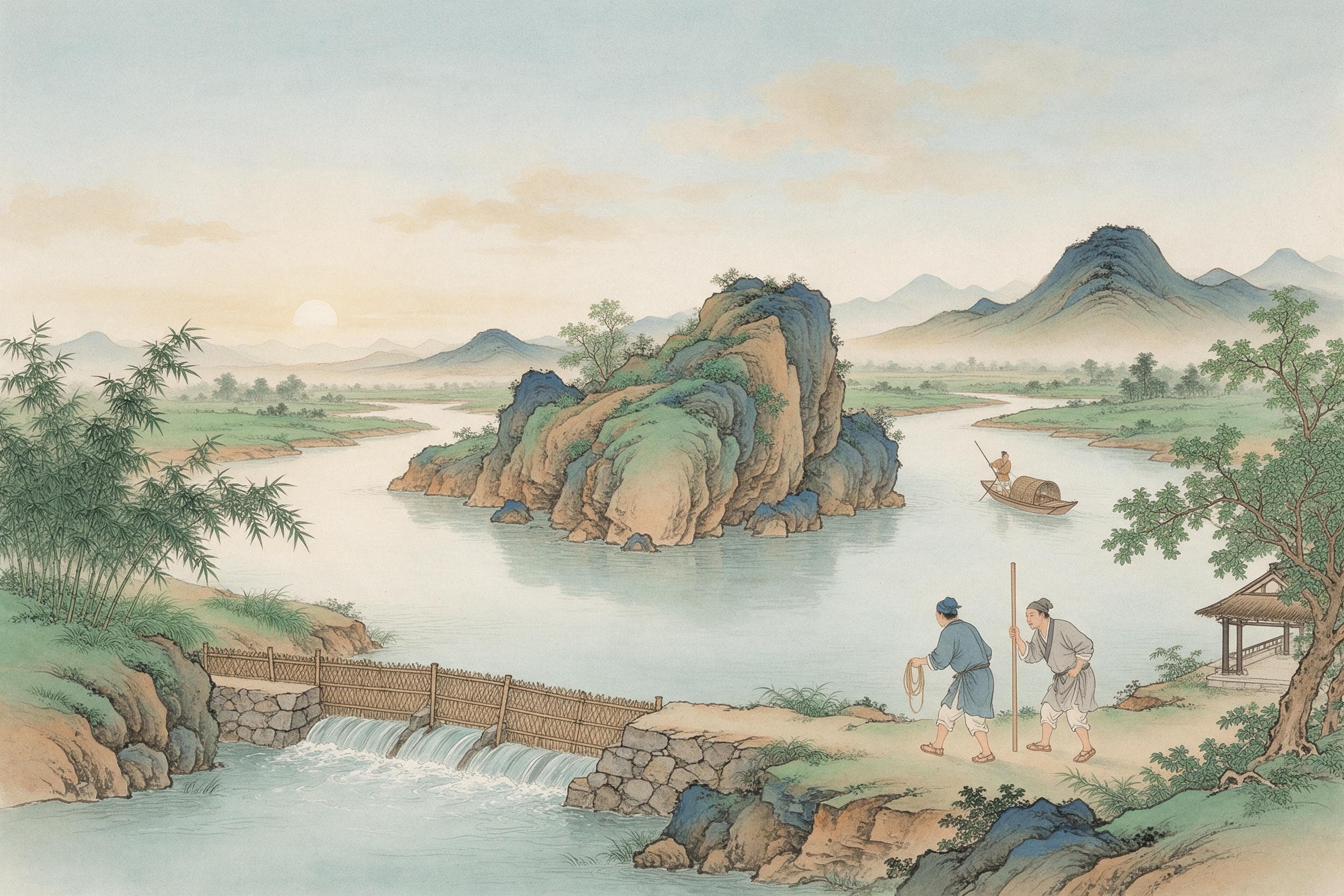
Taken apart, three actions: 'cut the Li Dui' — what Li Dui was, the page does not gloss; it is generally taken as a great rock in the water or a place name, marked here as the usual reading and not identified with any modern site. 'Warded off the harm of the Mo river.' 'Led two rivers through the middle of Chengdu.' Cutting and leading are two actions, not one phrase of 'building a canal'. The man is only 'the governor Bing': no full name, no date.
The uses are as plain: 'this canal could all be used by boats, and when there was surplus the water was used for irrigation and soaking, and the common people enjoyed its benefit.' The order is worth noticing: boats first, and only 'when there was surplus' irrigation. Then a description of the effect: 'where it passed, people everywhere drew off its water to irrigate the fields, and the channels of the fields were counted in ten-thousands of ten-thousands, too many to number' (至於所過……以萬億計,然莫足數也). That is a way of saying 'very many', not a statistic; it is printed as it stands and not converted.
The treatise that holds this sentence does not begin with Shu. It begins with Yu: 'The Xia Shu says: Yu checked the flood for thirteen years and did not enter his own door' (禹抑洪水十三年,過家不入門) — then the nine provinces, the nine rivers, the nine marshes; only after that the canals of the states, one by one, with Shu last. The Shu work is a line and a half in a book that opens with a flood hero and ends with a Han emperor's breach.
The Hanshu Version
The Book of Han's treatise has the same passage: 'In Shu the governor Li Bing cut the Li kui, avoided the harm of the Mo river, and led two rivers through Chengdu. This canal could all be used by boats, and when there was surplus it was used for irrigation, and the common people enjoyed its benefit. Where it went, people everywhere drew off its water to irrigate the fields; the ditches and channels were very many, too many to number' (於蜀,則蜀守李冰鑿離馈,避沫水之害,穿二江成都中……溝渠甚多,然莫足數也). The variants, one by one: the full name Li Bing for the Shiji's 'Bing'; a different character for Li Dui, printed as each page has it; 避 for 辟; 成都中 for 成都之中; 溉 for 溉浸; 至于它 for 至于所过; 沟渠甚多 for 益用溉田畴之渠; and the Book of Han has no 'ten-thousands of ten-thousands' at all. Both are printed; neither is corrected.
Their placing is also the same: both put the Shu work last in a geographical list — the Hong canal drawn from the river at Xingyang, then Chu, then Wu, then Qi, then Shu. It is not a separate memoir but one item in a list of regional waterworks, and in both books it is the same short item.
The Limit of the Engineering
The fish-mouth, the flying-sand weir, the precious-bottle mouth, the ratios of division — of all this the two pages contain not a word. The text gives two actions (cutting the Li Dui, leading two rivers) and two uses (boats, irrigation); it gives no intake, no weir, no ratio, no length, no gradient. Those details are commonly later additions, and they are not used here as Qin or Han text, nor to reconstruct the works.
Also absent: irrigated acreage, construction time, labour, the office in charge. A comparison shows the difference in the material: in the same treatise the Zhengguo canal is given 'forty thousand-odd qing of saline land irrigated, a harvest of one zhong a mu', while the Shu work gets no acreage at all, only 'the people enjoyed its benefit' and 'ten-thousands of ten-thousands'. The first is a figure, the second a manner of speech; the second is not used here as a number.
Drawing the Line with the Other Canals
The treatise on canals is a general ledger of water: Yu's channeling of the river, the Hong canal from Xingyang, the waterways of Chu, Wu and Qi, the two rivers of Shu, Lord Bai of Wei on the Zhang, the Zhengguo canal, the Han transport canal and the Huazi breach. Only the Shu item is taken here. The Zhengguo canal belongs to another article, and the transport canal and the breach are not in this one. The division is needed for one point only: in the same treatise the entries differ greatly in fullness, and the Shu entry is among the shortest.
What Neither Page Gives
Neither page gives the form or data of the works — intake, weir body, lengths, gradients, water gauges — nor irrigated acreage, construction time, labour or the directing office; nor the later history of repairs and additions, nor the origin of the weir's name, nor any story of Li Bing and his son. No modern phrase such as 'cradle of the world's water culture' is used; 'ten-thousands of ten-thousands' is printed, not converted into a figure; and no date is supplied — the pages say only 'in Shu', inside a sequence of Qin events, and no BC date is assigned here. None of this appears on either page.
What can be written is this: the governor Bing cut the Li Dui, warded off the harm of the Mo river, and led two rivers through Chengdu; the canal carried boats, and surplus water was used for irrigation, and the people enjoyed the benefit; and the channels that drew off its water were so many that they were 'counted in ten-thousands of ten-thousands' and could not be numbered. The Book of Han adds a full name, Li Bing, and differs in several characters. How the water was divided, how a weir was built, how much land was watered — neither page says. Each page gives one line and a half of it, and no more.
Related reading:Following the Ground: How the Qin Wall Was Built · The Dukang Map: How a Warring States Map Was Used · Building Luoyi: Divination First, Then the Lines, Then Two Oxen
Sources & further reading
- 《史记》卷二十九·河渠书(西汉司马迁撰;维基文库本,页面白文无注,未与中华书局点校本复核) — The passage in the list of waterworks by region, last after the canals of Chu, Wu and Qi: 'In Shu the governor Bing cut the Li Dui, warded off the harm of the Mo river, and led two rivers through the middle of Chengdu. This canal could all be used by boats, and when there was surplus the water was used for irrigation and soaking, and the common people enjoyed its benefit. Where it passed, people everywhere drew off its water to irrigate the fields, and the channels of the fields were counted in ten-thousands of ten-thousands, too many to number.' The same chapter has Lord Bai of Wei's Zhang canal, the Zhengguo canal with its 40,000-odd qing and a harvest of one zhong a mu, and the Han transport canal; none of that is used here beyond a comparison of what the pages do and do not give.
- 《汉书》卷二十九·沟洫志(东汉班固撰;维基文库本,页面白文无注,未与中华书局点校本复核) — The same passage in the Han treatise, worded differently: 'In Shu the governor Li Bing cut the Li kui, avoided the harm of the Mo river, and led two rivers through Chengdu. This canal could all be used by boats, and when there was surplus it was used for irrigation, and the common people enjoyed its benefit. Where it went, people everywhere drew off its water to irrigate the fields; the ditches and channels were very many, too many to number.' The variants matter: Li Bing's full name for the Shiji's 'Bing', a different character for Li Dui, 避 for 辟, 成都中 for 成都之中, 溉 for 溉浸, 至于它 for 至于所过, and no 'ten-thousands of ten-thousands' at all.