The material here has two layers: a piece of archaeological reporting, and the Book of Han's geographical treatise. The report ran in People's Daily on 1 August 2026, page 7, by Yang Wenming and Cai Shujing, and was reposted by the Institute of Archaeology's news page on 5 August; its content is the account of the project leader Yang Yong and of the researcher Ding Changfen. It is a newspaper piece, not an excavation report: every archaeological statement below is written as 'according to the report'. The classical text is background only and is not used as archaeological evidence.
What the Report Says, and What It Does Not
What it does not give should be marked first: no plan of the town, no length, width or height of the walls, no stratigraphic phasing, no transcription of the clay seals and no find-spots for them. None of that is supplied in this article. The report gives an outline, gates, pillar bases, a workshop, four characters on seals and categories of objects; only those are written here.
The site, according to the report: the Zhuti old town in Zhaotong, Yunnan, first found in the second national survey in the 1980s, confirmed in 2017 by systematic survey and trial excavation as the seat of Han-Jin Zhuti county and commandery, listed in 2019 as a national protected site, and excavated systematically from 2022 by the Institute of Archaeology of the Chinese Academy of Social Sciences with the Yunnan institute. The report says that 'an outline of a Han-Jin local administrative town of about forty thousand square metres has slowly emerged', and that it is the best-preserved Han-Jin town site yet found in Yunnan. 'Forty thousand square metres' must be read with care: the report says the outline that has emerged is that size, not that the walled interior is that size, and not that this is the whole extent. Nothing here multiplies it by a density or estimates how many people lived inside; the report itself gives no population.
Defences: Walls, Moat, Two Gates
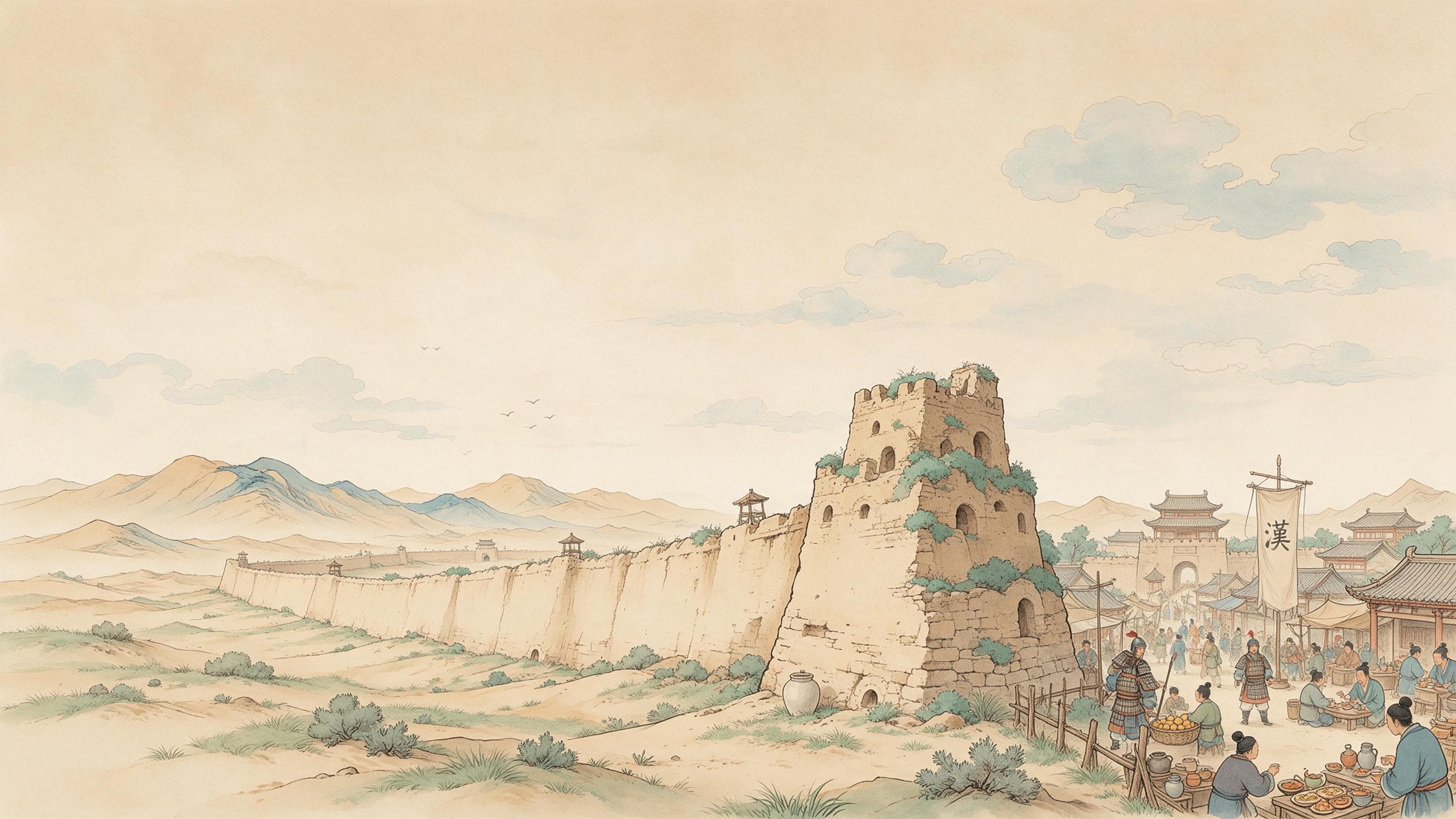
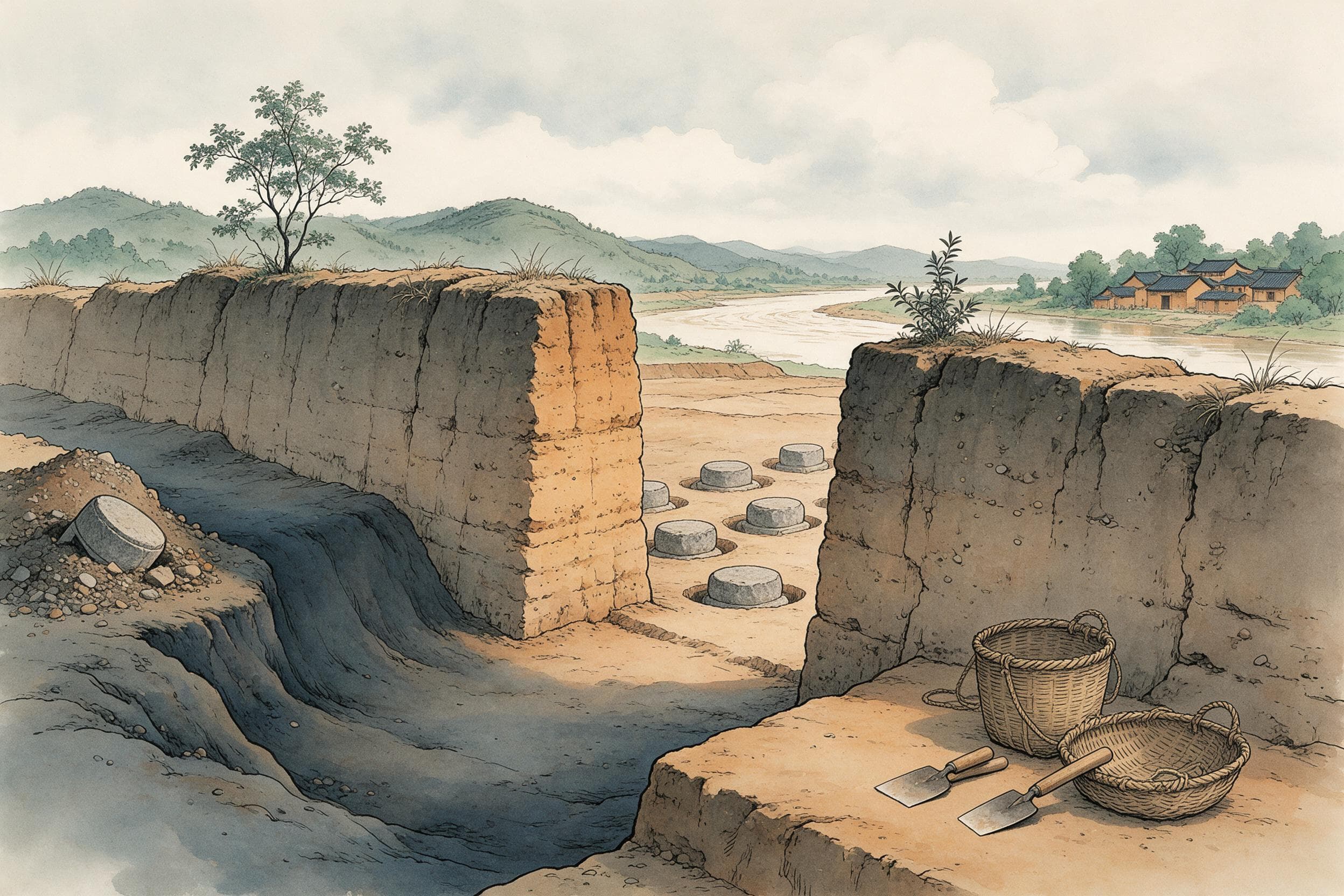
According to the report, the excavations 'cleared the remains of the city wall and moat' and 'fully exposed the west gate and the south gate'; both gates 'were provided with gate towers of a uniform three-bay design'; the report calls this an important discovery for the archaeology of Han-Jin commandery and county seats. Three bays is the concrete form the report gives; the width of the passage, the depth of the tower, the thickness of the walls and the width of the moat are not given and are not supplied here.
In the south-western part of the town, according to the report, 'rows of pillar bases' were found, showing that a fairly large building once stood there; the bases are 'densely arranged, less than two metres apart', and the report says it is 'very likely a granary-type building, similar in structure to a pile dwelling', adding that pile dwellings suit damp ground and resist insects. 'Very likely' is the report's phrasing and is carried over as such, not as a conclusion; the number of bases and the size of the building are not given.
The Clay Seals: Four Characters and a Characterisation
According to the report, the site 'yielded several clay seals bearing the characters Zhuti and Qianwei'. The report first explains what such seals are — clay pressed over the cord knots of bundled documents and stamped with an official seal, at once tamper-proof and a kind of official signature — and then says that these seals 'further prove the date and character of the site'. Both layers are carried over: the object is explained by the report, and the judgement on date and character is the report's. Note the limit: the report names the four characters 朱提 and 犍为, and gives no transcription, no count of characters, no dimensions, no find-spot and no number beyond 'several'. So this article can say 'clay seals bearing the characters Zhuti and Qianwei' and no more; it does not expand four characters into a document, nor reconstruct an office from them.
The Workshop and the Objects
According to the report, near the Qian river in the south-east the excavators found 'a large-scale iron-working quarter': furnace bodies, sloping deposits of burnt earth and slag, and production fittings such as blowpipes and fragments of furnace wall. The report says that, given the region's mineral wealth, this 'should be an important handicraft base of metal smelting and casting for the south-west at that time' — a judgement of the report, marked here as the report's words and not as a published research conclusion. The size of the furnaces, the area of the workshop and its output are not given.
According to the report, the site also yielded 'large quantities of building materials and objects of daily life': roof-tile ends with cloud scrolls and with the inscription 'auspicious sheep'; coins of the wu zhu, da quan wu shi and huo quan types; pottery, bronze, iron and lacquer-wood vessels; and glass beads. The report says their forms and workmanship are 'highly convergent with the Central Plains', and uses the glass beads for exchange along the southern routes. Only the categories and the report's judgements are recorded here: dimensions, counts and find-spots for any object are not given, and the degree of contact is not developed in this article.
The Classical Layer as Background Only
The Qianwei commandery entry in the Book of Han's geographical treatise: 'households 109,419, persons 489,486; twelve counties: Bodao, Jiangyang, Wuyang, Nan'an, Zizhong, Fu, Niupi, Nanguang, Hanyang, [one name defective in the transcription], Zhuti, Tanglang.' All it establishes is one thing: the Han listed Zhuti among the twelve counties of Qianwei.
What it cannot do should also be said: the 489,486 persons are the whole commandery's, not Zhuti's; the treatise gives no size for a county, no seat, no form of any town, and no separate population for any single county. The classical text therefore cannot be used to estimate this town's population or to measure its walls. The relation of the two layers: the report's Han-Jin dating and the treatise's county list can stand side by side, but neither proves the other — the treatise does not identify which earthen town was the seat of Zhuti, and the report does not explain the Han county system. Each layer holds on its own, and no bridge is built between them here.
What can be established is this: a circuit of wall and moat, two gates with three-bay towers, rows of pillar bases, an iron-working quarter, clay seals bearing Zhuti and Qianwei, and several kinds of coin and tile, all according to the report; and, from the treatise, that Zhuti was one of the twelve counties of Qianwei, with the commandery's households and population as given. The town's plan, its measurements, its phasing, the reading of the seals and the number of people who lived inside it — neither page says. The walls of Chang'an, the Weiyang palace and the north-western frontier are other subjects; only this south-western commandery town is treated here, and no general history of a south-western silk road is written.
Related reading:A White Wall and an Awl's Inch: The City of Tongwan · Following the Ground: How the Qin Wall Was Built · Two Rivers Through Chengdu: The Works of the Governor of Shu
Sources & further reading
- 《汉晋城址见证古代西南边疆治理》(杨文明、蔡树菁;《人民日报》2026年8月1日第7版,中国社会科学院考古研究所网站「考古动态」2026-08-05转载) — A newspaper report, not an excavation report: the site at Zhuti in Zhaotong, Yunnan, confirmed in 2017 as the seat of Han-Jin Zhuti county and commandery, listed as a national protected site in 2019, systematically excavated from 2022 by the Institute of Archaeology and the Yunnan institute; the team leader Yang Yong describes a roughly 40,000-square-metre outline of a Han-Jin local administrative town; city walls and a moat cleared, the west and south gates fully exposed, each with a gate tower of three bays; rows of pillar bases in the south-west, less than two metres apart, 'very likely a granary-type building, similar in structure to a pile dwelling'; clay seals bearing the characters Zhuti and Qianwei; a large-scale iron-working quarter near the Qian river in the south-east with furnace bodies, burnt-earth and slag deposits, blowpipes and furnace-wall fragments; roof tiles with cloud scrolls and the inscription 'auspicious sheep', coins of the wu zhu, da quan wu shi and huo quan types, pottery, bronze, iron and lacquer ware, and glass beads. The report gives no plan, no wall measurements, no stratigraphy, and no transcription of the seals.
- 《汉书》卷二十八上·地理志上(东汉班固撰;维基文库本,页面白文无注,未与中华书局点校本复核) — The Qianwei commandery entry, used only as background: 'households 109,419, persons 489,486; twelve counties: Bodao, Jiangyang, Wuyang, Nan'an, Zizhong, Fu, Niupi, Nanguang, Hanyang, [one name illegible in the transcription], Zhuti, Tanglang.' It shows that the Han listed Zhuti among the counties of Qianwei; the household and population figures are for the whole commandery and say nothing about Zhuti alone, its seat, or its walls.