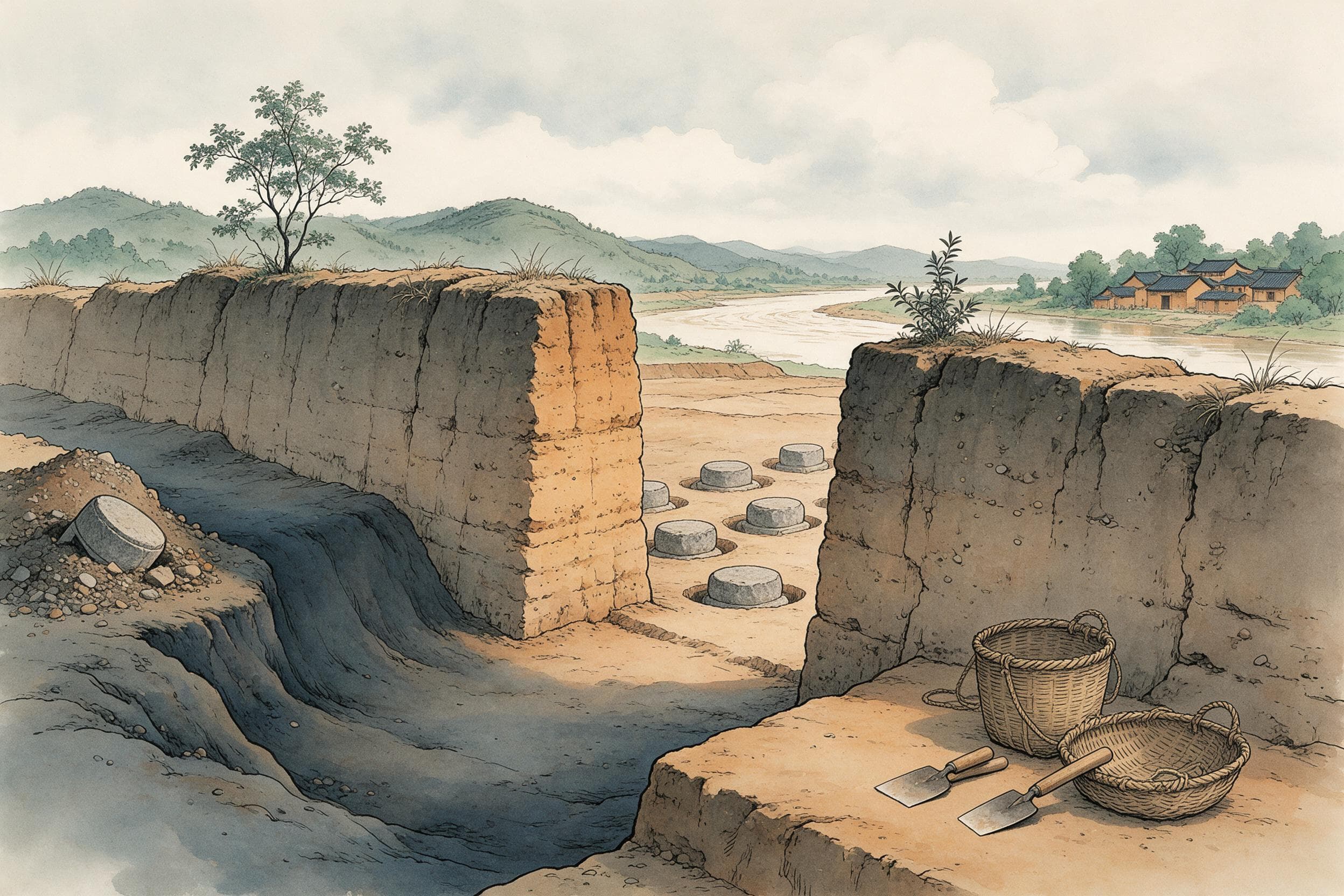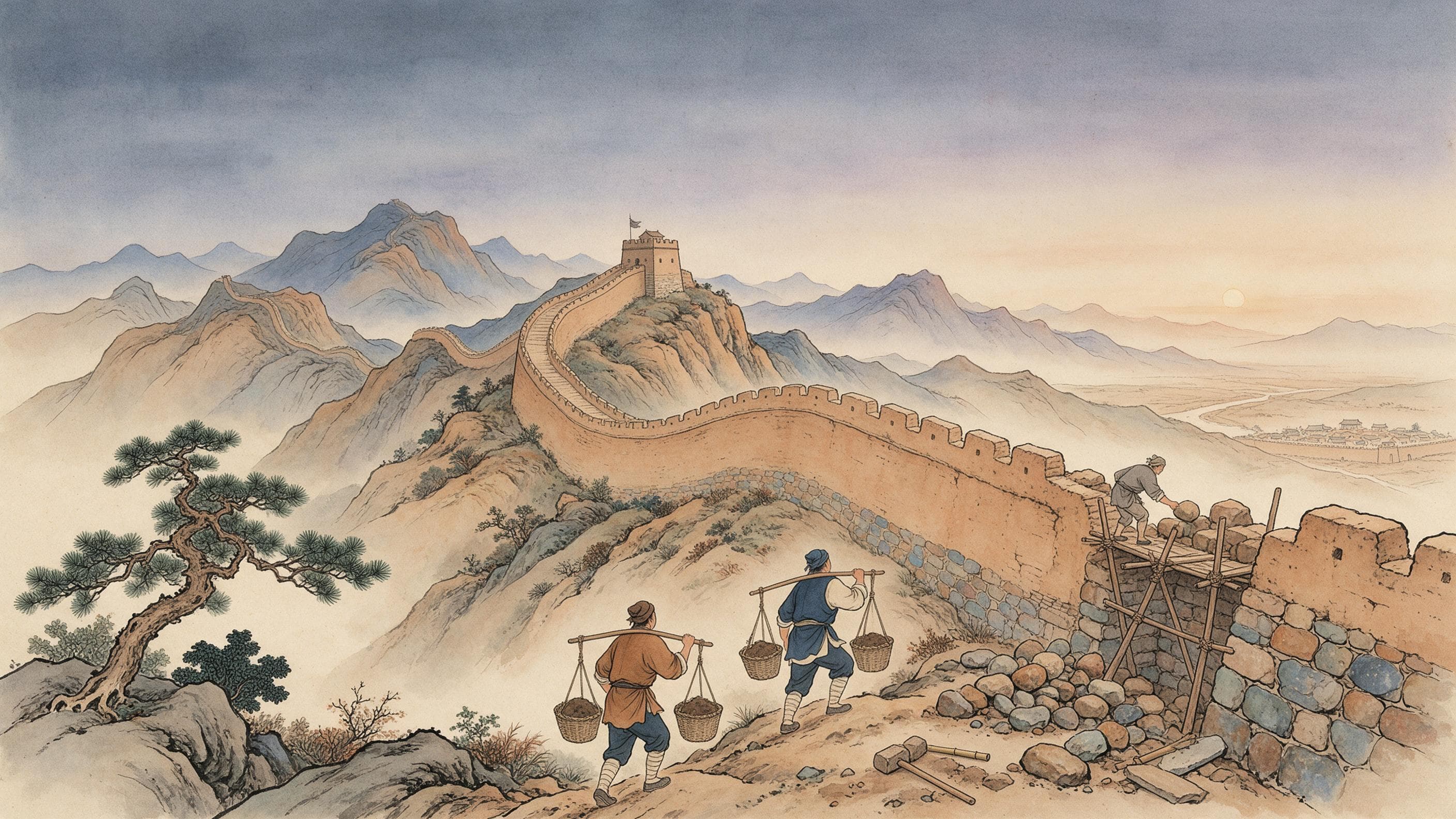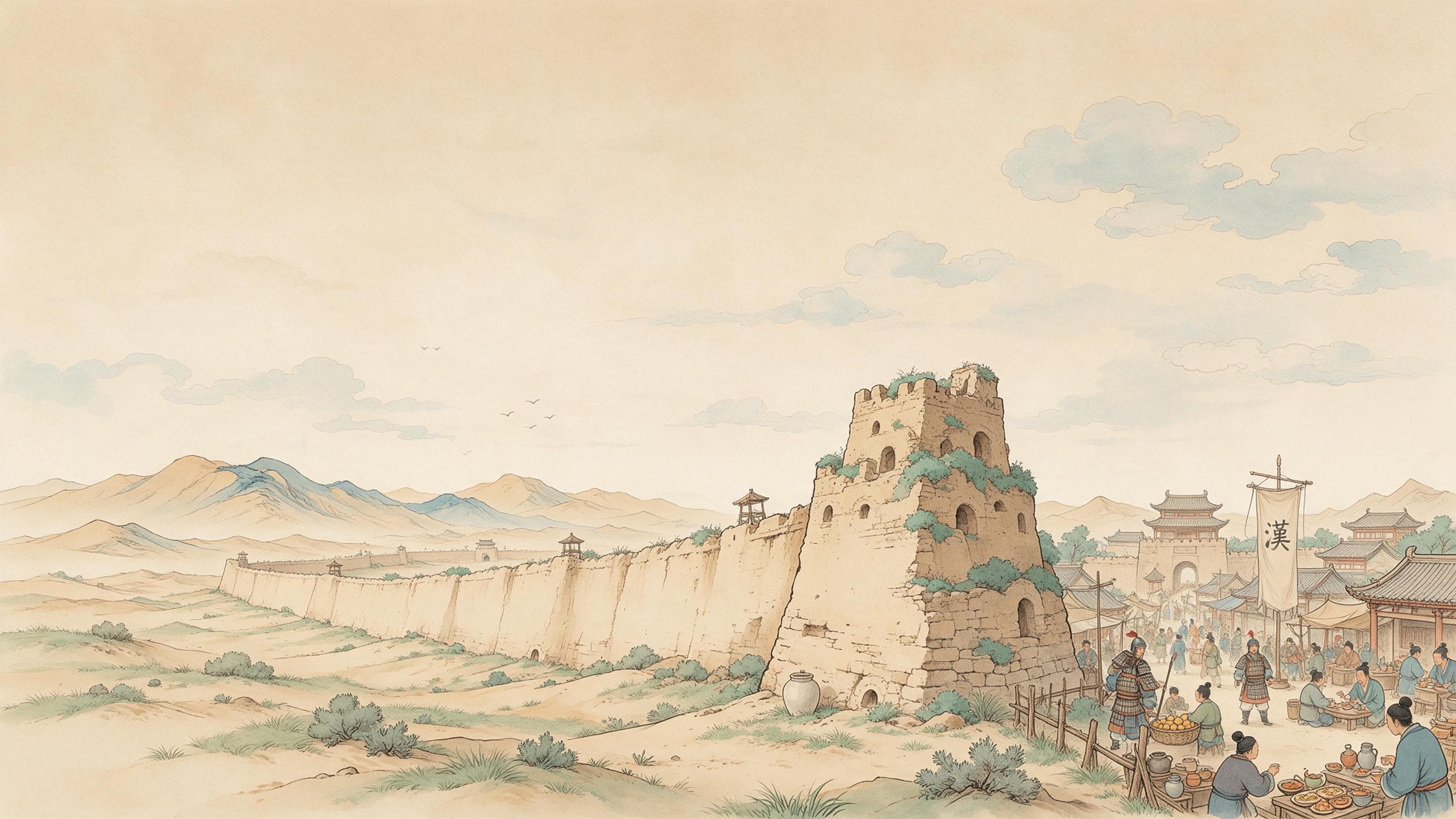
What a visitor sees first at the Tongwan site in Jingbian, Shaanxi, is a series of broken walls. They are white — pale enough to shine under the desert light, which is why the place has long been called White City. According to the Book of Jin, this is how the wall was built: the master builder was brilliant and cruel, and "steamed the earth for the rammed wall; if an awl could be driven in one cun, the workman was killed and rammed in with it".
A city named as a boast
The builder was Helian Bobo, leader of the Tiefu branch of the Xiongnu and founder of the Xia state. The history records that in the Fengxiang years he "appointed Chigan Ali as master of works, levied a hundred thousand people, Chinese and non-Chinese, from north of the mountains, and began a capital north of the Shuofang river and south of the Black Water". The name came from his own sentence: "I am about to unify the world and rule the ten thousand states; let it be called Tongwan — 'ten thousand unified'." The hundred thousand are described only as coming from north of the mountains, without distinction of people; the Guangming report dates the work to 413 and gives it six years, and the Commentary on the Waterways places it in the seventh year of the Longsheng era, which agrees with 413.
The early book and the late book
Begin with the earlier one. Li Daoyuan's Commentary on the Waterways, written in the early sixth century, follows the Sheyan river and comes to the city: in the seventh year of Longsheng, north of that water and south of the Black Water, the master of works Chigan Ali was sent to rebuild the great city and called it Tongwan. "Earth was steamed for the work. The battlements stand long, the high wall looks new." Then the weapons: the five arms, "sharp and excellent, all hundred-times refined", the inscription on the great Dragon Sparrow ring, and the bronze drums, winged dragons, tomb figures, bronze camels and dragon-tigers, "all gilt, set before the palace". Craft, objects and reputation are all there, and not one word about killing. The Commentary was compiled in the early sixth century, more than a hundred years before the Book of Jin.
Now the later one. The Book of Jin, completed under the Tang in 648, describes the same city and the same steaming, and adds a sentence: "if an awl could be driven in one cun, the workman was killed and rammed in with it." Then bow-makers and armourers executed according to whether an arrow pierced the armour, closing with "several thousand craftsmen killed, and therefore the vessels were all exquisite". The killing is not an isolated record of cruelty here; it is the device that explains why the work was exquisite. Two things have to be said together. The phrase "rammed in with it" is not explained in the original, so this article does not elaborate what it involved. And the Commentary's silence cannot be turned round into proof that nothing happened: a geography of rivers does not record executions on building sites. What can be said is: the same event, with the early book writing craft and the late book writing cruelty.
Why the wall is white
The Guangming report offers another line. In the site museum there is a display called "the secret of the wall": the soil is described as coarse sand, clay and lime — what builders call three-in-one earth. Staff demonstrate the "steamed earth" method: quicklime, when water is added and it slakes into slaked lime, gives off quantities of steam, so that from a distance the site seems to smoke, as if the city had been steamed. Lime in the earth is also why the wall is pale.
That explanation needs a label. It is a museum demonstration and a guide's account, not a finding from a formal excavation report; the report says "research has established", but gives no test data or report citation. So this article calls it the museum's explanation. The white wall is real, and the slaking-lime chemistry is sound; whether that is what the old phrase "steamed earth" meant is more than this evidence can settle.
What else was built
The report gives two more concrete things. One is the Yong'an terrace, a high building with a rammed-earth core and timber galleries around it and on top, reconstructed as a model in the museum — the same technique as the wall, earth for structure and wood for circulation. The other is status and population: the report says the city held more than eighty thousand people at its height, calls the site the only certainly identified Xiongnu city in China, and notes its place on the country's World Heritage tentative list since 2011. These are the report's figures, not excavation data.
Where each of the three pages stops
Lay the three pages side by side. A sixth-century geography gives craft and objects; a Tang history gives people, numbers and the awl's cun; a 2023 report gives the colour of the wall, the composition of the soil and the city's later standing. The first two are not archaeology, and the third is not an excavation report: there are no measured heights or thicknesses, no section drawing of the rammed layers, no site plan, and no record of a bone in relation to the wall.
So this article does not say that workmen certainly lie inside the wall, and does not convert "steamed earth" into a quality-control system: that would turn a literary sentence in a later history into an engineering code. The Book of Jin is cited as the Book of Jin, the Commentary's silence as its silence, and neither is made to vouch for the other.
That is what makes the place interesting. A wall that is white because lime was mixed into it was later described as "steamed"; and the word steamed makes the killing sound more real. Physical and textual evidence meet in the same wall without either one vouching for the other.
Related reading:Following the Ground: How the Qin Wall Was Built · Two Rivers Through Chengdu: The Works of the Governor of Shu · The Dukang Map: How a Warring States Map Was Used
Sources & further reading
- 房玄齡等《晉書》卷一百三十·載記第三十(Fang Xuanling et al., Book of Jin, juan 130, "Record of Helian Bobo") — The Tang compilation's account: Helian Bobo sends a hundred thousand people from north of the mountains to build a capital between the Shuofang river and the Black Water, names it Tongwan because he will 'unify the ten thousand states', and his master builder Chigan Ali, 'cruel and harsh', builds the wall by steaming the earth, killing the workman and ramming him in whenever an awl could be driven in an inch; also the arms workshops where bow-makers and armourers were executed according to whether an arrow pierced the armour, and the figure of several thousand craftsmen killed.
- 〈城墙会冒烟?探秘「匈奴故都」统万城〉,光明網 2023-07-16(Guangming Online report on the Tongwan site) — A site visit report: the walls are white, hence the local name White City; the material is described as sand, clay and lime, a 'three-in-one earth'; museum staff demonstrate the 'steamed earth' method as quicklime slaking and giving off steam; the city was begun in 413, took six years and some hundred thousand labourers, and is described as the only certainly identified Xiongnu city site, with a population given as over eighty thousand at its height.
- 酈道元《水經注》卷三·河水(Li Daoyuan, Commentary on the Waterways, juan 3, on the Sheyan river) — The earlier account, compiled in the early sixth century: Chigan Ali is sent to rebuild the great city and name it Tongwan, 'earth was steamed for the work', the battlements stand and the high wall looks new, and the weapons and gilt bronzes are described — but no killing is mentioned.