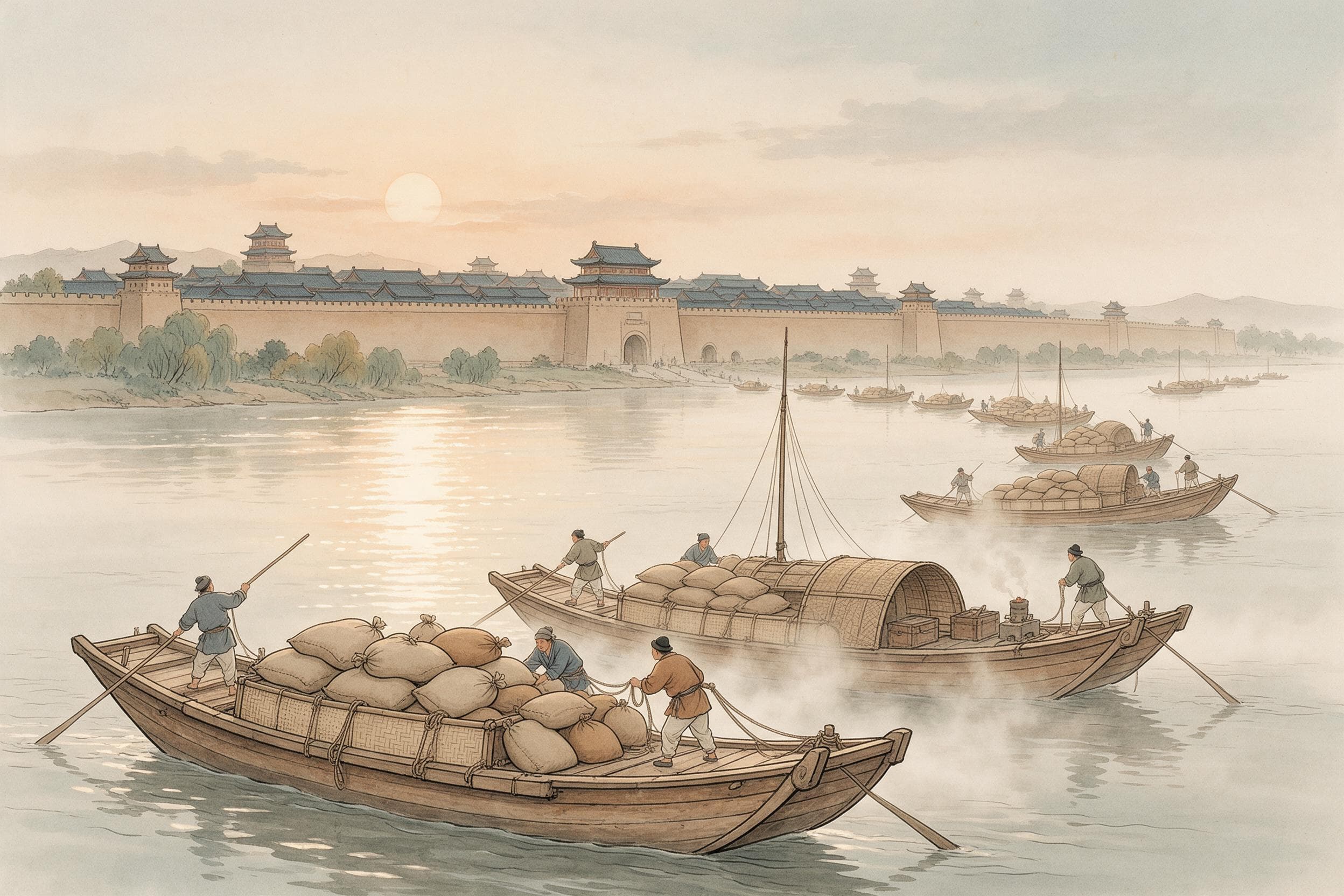
The granaries of Chang'an ate grain from the east. In the first decades of the Han, the Shi Ji's 'Treatise on the Balanced Standard' gives only a round figure for what came up that line in a year: 'grain was shipped and transferred from east of the mountains to supply the officials at the capital, no more than several hundred thousand shi' (漕轉山東粟,以給中都官,歲不過數十萬石). What that meant in practice the page does not say. It gives a starting point: over the next century the same figure climbs, reaching six million at its highest.
Early Han: No More Than a Few Hundred Thousand
The Shi Ji places the sentence after the reigns of Hui and the Empress Lü; the Tong Dian, in the grain-transport chapter of its tenth juan, assigns it to 'the time of the first emperor' and adds a note: 'this means the offices at the capital' (謂京師之官府). Zhongduguan was not every office, only the capital's. The two books arrange the date differently but agree on the scale: a few hundred thousand shi. The setting: officials' salaries were measured and government needs reckoned, and the tax levied accordingly (量吏祿,度官用,以賦於民); grain transport was one item in that budget.
The two ends are worth naming. One is 'east of the mountains', a term the page does not gloss; the usual reading is the land east of the Hua mountains, the Guandong. The other is zhongduguan, the offices at the capital. Between them the text mentions no granary, boat or man, only 'shipped and transferred'. The few hundred thousand shi is the net result of a working line, not the load of one journey.
From the East, by Water
Grain came from the east mainly by water. In the yuan-guang era Zheng Dangshi gave Emperor Wu an estimate: formerly eastern grain went up the Wei river, and a run was reckoned to take six months (度六月而罷), with the Wei's course over nine hundred li and difficult stretches; if the new straight channel were used, a run was reckoned at three months, which would 'cut the transport and save troops' (損漕省卒). Six months, then three — both are estimates, marked by the word du, not measurements. The Tong Dian adds only that it was 'greatly convenient' and gives no actual annual volume.
Jia Yi put the cost more bluntly in the reign of Wen: 'the transport sets out from the sea coast; on a cash of one coin in tax, tens of coins go on carriage' (一錢之賦,數十錢之費), so that 'what the ruler gets is very little, and what the people suffer is very much'. This is political argument, not statistics, and Emperor Wen did not adopt it; but it states the problem: the farther the grain travels, the more of it is eaten on the way. The Tong Dian opens its chapter with Guanzi's line that when grain travels five hundred li the people show hunger (粟行五百里,則眾有饑色) — the same idea, and equally an argument, not a Han institution.
Thirty Zhong for One Shi
Qin's arithmetic survives in the Tong Dian: to attack the Xiongnu, 'grain was moved, and the world was made to fly fodder and haul millet … thirty zhong delivered one shi' (率三十鍾而致一石). The note continues: 'six hu four dou make one zhong; reckoning what the road consumed, one hundred and ninety-two hu were used to obtain one shi' (六斛四斗為鍾……凡用百九十二斛乃得一石). Thirty zhong sent, one shi delivered; six hu four dou to the zhong; the note itself works out the hundred and ninety-two. That line was not toward Chang'an: it started in the coastal commanderies of Huang, Zhui and Langya and ran north to the Bei river, so it cannot serve as a rate for Han transport to the capital.
The same formula of dozens of zhong to a shi appears more than once. The Shi Ji, describing the road to the southwest, says that 'the workers numbered tens of thousands, carrying grain a thousand li on their backs, and more than ten zhong delivered one shi' (率十餘鐘致一石). The Tong Dian dates this to the jianyuan era; the Shi Ji puts it after Wei Qing's capture of the Ordos. The years disagree; the figure is the same. The Shi Ji also has a plainer sentence: 'those who travel carry their own; those who stay send it out' (行者齎,居者送).
Under Emperor Wu: From a Million to Six
Under Emperor Wu the numbers change shape. After Shuofang was walled, 'the transport was very distant, all east of the mountains bore the labour, the spending ran to tens and hundreds of millions, and the treasury grew empty' (轉漕甚遼遠……費數十百巨萬,府庫益虛). Fan Xi, arguing about the route, gives the volume of the day: 'grain came from east and west of the mountains, more than a million shi a year, past the hazard of Dizhu, and much was lost, at no small cost' (漕從山東西,歲百餘萬石,更底柱之險,敗亡甚多而亦頗費). Later the Shi Ji has: 'the grain shipped down the river was reckoned at four million shi, and only with the government's own purchases was there enough' (而下河漕度四百萬石,及官自糴乃足). That four million belongs to Emperor Wu's reign, and is not the four million hu of Emperor Xuan.
By the first year of yuanfeng, with Sang Hongyang over the granary office and the equal-supply policies in place, 'the eastern transport increased to six million shi a year; within one year the Tai Cang and Gan Quan granaries were full' (山東漕益歲六百萬石。一歲之中,太倉、甘泉倉滿). The word 'increased' marks a figure after the rise; the Shi Ji says neither how many years it held nor how many boats or men. One detail on the same page shows where transport sat in official assessment: Bu Shi, as magistrate of Chenggao, 'was best at transport' (將漕最) and was made tutor to the king of Qi.
Emperor Xuan: Four Million Hu, Sixty Thousand Men
In the wufeng era, Geng Shouchang began his memorial with an old rule: 'by precedent, four million hu of eastern grain were shipped each year to supply the capital, using sixty thousand men' (故事,歲漕關東谷四百萬斛以給京師,用卒六萬人). He proposed instead buying grain nearby, in the metropolitan commanderies and in Hongnong, Hedong, Shangdang and Taiyuan, which would 'save more than half the eastern transport troops'. Xiao Wangzhi objected, partly on money: 'building granaries and fitting out boats would cost more than two hundred million' (費直二萬萬餘), and it would be 'a labour that moves the masses'; Geng Shouchang, he said, was practised in 'reckoning work and splitting grains' (習於商功分銖之事) but not to be entrusted with deep plans, and things should 'for the present stay as they are'. The emperor did not listen, and 'the transport indeed went conveniently' (漕事果便). These are the only pair of volume and manpower given together on either page.
Set the numbers side by side and they form a line in time: early Han, 'no more than several hundred thousand shi'; under Emperor Wu, Fan Xi's 'more than a million a year', the treatise's 'reckoned at four million', and by yuanfeng 'six million a year'; under Emperor Xuan, the precedent of 'four million hu with sixty thousand men', with an attempt to halve the men. Each figure has its page and its reign, and they cannot be merged into one 'Han transport volume'. What the two pages lack is equally clear: no boat design or capacity, no canal labour or length, no total cost of a run, no conversion into modern tonnage. What is certain is the direction: eastern grain, moving to Chang'an.
Related reading:A County Before a Tomb: The Western Han's Tomb Towns · Ditches with Names: Draining a Field by the Zhouli · A Square Enclosure and a Name: The Qin Tomb at Shangzhaoyao
Sources & further reading
- 《史记》卷三十·平准书(西汉;维基文库本,未与点校本复核) — The Shi Ji's figures and the line itself. Early Han: 'grain was shipped and transferred from east of the mountains to supply the officials at the capital, no more than several hundred thousand shi a year' (漕轉山東粟,以給中都官,歲不過數十萬石), in a passage that also says officials' salaries were measured and government needs reckoned before the tax was levied (量吏祿,度官用,以賦於民). After Shuofang: 'the transport was very distant, all east of the mountains bore the labour, the spending ran to tens and hundreds of millions, and the treasury grew empty' (轉漕甚遼遠,自山東咸被其勞,費數十百巨萬,府庫益虛). On the southwest road: 'the workers numbered tens of thousands, carrying grain a thousand li on their backs, and more than ten zhong delivered one shi' (作者數萬人,千里負擔饋糧,率十餘鐘致一石); and 'those who travel carry their own, those who stay send it out' (行者齎,居者送). Under Wu: 'the grain shipped down the river was reckoned at four million shi, and only with the government's own purchases was there enough' (而下河漕度四百萬石,及官自糴乃足); then 'the eastern transport increased to six million shi a year; within one year the Tai Cang and Gan Quan granaries were full' (山東漕益歲六百萬石。一歲之中,太倉、甘泉倉滿). Bu Shi as magistrate of Chenggao 'was best at transport' (將漕最). The treatise ends before Emperor Xuan, so its four-million figure belongs to Emperor Wu and is not the four million hu of the Tong Dian's Xuan Di passage; nor does it contain Qin's thirty-zhong ratio.
- 《通典》卷十·食货十·漕运(唐杜佑;维基文库本,未与点校本复核) — A Tang compilation that preserves the Qin ratio and the Xuan Di figures. Qin: 'to attack the Xiongnu, grain was moved, and the world was made to fly fodder and haul millet … thirty zhong delivered one shi' (率三十鍾而致一石), with the note 'six hu four dou make one zhong; reckoning what the road consumed, one hundred and ninety-two hu were used to obtain one shi' (六斛四斗為鍾……凡用百九十二斛乃得一石); the route ran from the coastal commanderies of Huang, Zhui and Langya north to the Bei river, not to Chang'an. Early Han: the same 'no more than several hundred thousand shi' sentence, here assigned to 'the time of the first emperor', with the note 'this means the offices at the capital' (謂京師之官府). Jia Yi's memorial under Wen: 'on a cash of one coin in tax, tens of coins go on carriage' (一錢之賦,數十錢之費). The southwest road's 'more than ten zhong for one shi' is dated here to the jianyuan era. Zheng Dangshi in the yuan-guang era: a Wei-river run reckoned at six months, three by the new channel (度六月而罷……度可三月罷). Fan Xi: 'grain came from east and west of the mountains, more than a million shi a year, past the hazard of Dizhu, and much was lost' (漕從山東西,歲百餘萬石,更底柱之險,敗亡甚多). Xuan Di, wufeng: 'by precedent, four million hu of eastern grain were shipped each year to supply the capital, using sixty thousand men' (故事,歲漕關東谷四百萬斛以給京師,用卒六萬人), Geng Shouchang's proposal to buy nearby and halve the troops, Xiao Wangzhi's objection that granaries and boats would cost 'more than twenty million' (費直二萬萬餘), and the emperor's refusal, after which 'the transport indeed went conveniently' (漕事果便). The Tong Dian is a later compilation and not an independent witness to the Han text, but the Xuan Di passage is the only one of these two pages that carries that reign's figures.