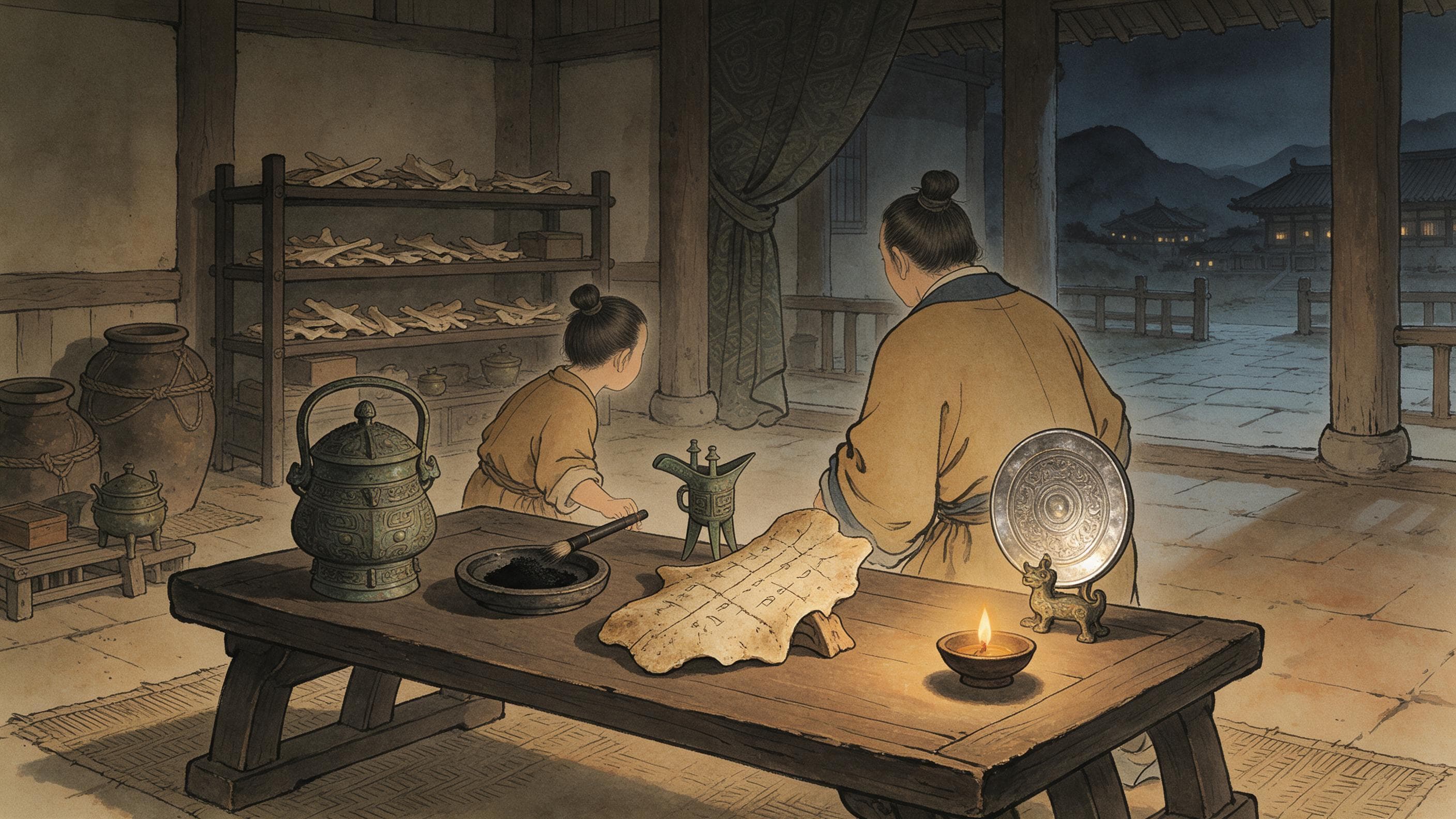
The room is the 適室, the chamber proper to the dead man. The body is covered with the shroud-quilt (幠用斂衾). In the Liji the last breath is waited for first: a thread of silk lies at the nostrils (屬纊以俟絶氣), and 'a man does not die in a woman's hands, a woman not in a man's' (男子不死於婦人之手,婦人不死於男子之手).
Two ritual books set it out. The Yili (儀禮) has a chapter for a knight's death, the shi sang li (士喪禮), following one death from the deathbed to the day chosen for burial; it is written as directions for those who must carry it out, and is the backbone used here. The Liji (禮記) chapter sang da ji (喪大記) covers the same ground but records what changes with rank — ruler, great officer, knight — used here for that only. Neither book reports a funeral that happened. Both are prescriptions, and their figures are rules, not measurements.
The Call from the Roof
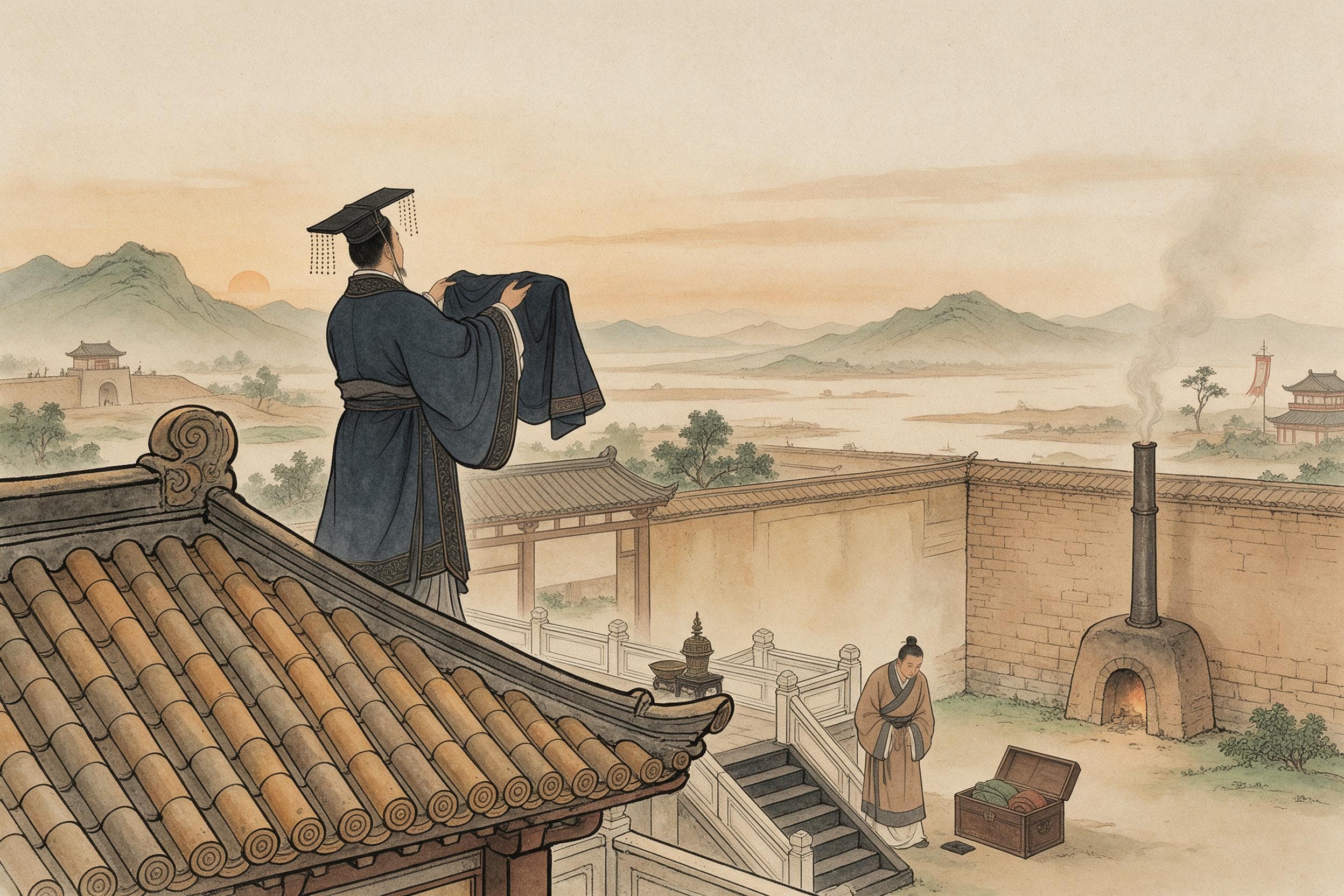
The first act is not burial but a call. One man — a 復者 in the 爵弁 cap and costume — takes the dead man's garment, tucks the skirt into the jacket, carries it over the left shoulder with the collar in his belt, and climbs to the roof. He goes up by the east wing to the ridge, stands facing north, waves the garment, and calls three times: 'O so-and-so, return!' (皋某復). Then he lowers the garment at the front; it is received in a box (篋), carried up the 阼階, and laid on the corpse (以衣尸). Then a horn spoon holds the mouth open (楔齒用角柶) and a stand ties the feet (綴足用燕几).
The Liji says what that call is. 'Only wailing comes before the recall; only after the recall are the affairs of death carried out' (唯哭先復,復而後行死事), and it gives the form: men are called by name, women by their courtesy name (男子稱名,婦人稱字). It is a summons, not a revival — nothing in either chapter has the dead answer. The Liji grades the garment by rank — the ruler's 卷 robe, his wife's 屈狄, the great officer's 玄赬, the knight's 爵弁 costume, their wives' 襢衣 and 税衣 — while the climb, the stance and the three calls stay the same. Then the books part: the Yili lays the garment on the corpse; the Liji says 'the recall garment is not used to dress the corpse, nor in the encoffining' (復衣不以衣尸,不以斂). Both stand as written.
Washing, Rice, and Clothes
Washing comes next. Water is drawn; rice is rinsed on the hall and the rinse-water heated. The household stands outside the door facing north while the body is washed, combed and dried; the used water goes into a pit between the steps (渜濯棄於坎). The Liji grades the water — 粱 millet for the ruler and the knight, 稷 for the great officer — and the ice: a great basin for the ruler, a 夷盤 for the great officer, two earthenware basins and none for the knight (士併瓦盤無冰). Then rice and shells: the master bares his left arm, washes the shells and goes in; rice goes into the mouth on the right three times, one shell with each, the same left and middle, then rice until the mouth is full (實於右,三,實一貝。左、中亦如之。又實米,唯盈). For a knight the Yili lists three shells and a dou of rice (貝三…稻米一豆).
Then the dressing, 襲. A silk mask (掩) covers the face; white floss plugs the ears; a black square with red lining (幎目) is laid over it; the shoes are tied on; the body is dressed in three sets (乃襲,三稱), belted, the hands fitted with covers and cords; a hood (冒) is drawn over head and body and tied, then the quilt again. Clothes arrive from the ruler, kin and friends (襚) — some put on the body, some laid on the bed east of the corpse — and a name banner (銘) has been made and hung at the west of the eaves: 'the coffin of Such-and-such of such a clan' (某氏某之柩).
Two Encoffinings
The next morning is the small encoffining, 小斂. Nineteen sets of clothes are laid out in the room (凡十有九稱); reeds and a bamboo mat are spread; the body is lifted on and wrapped in ties and coverlets; the curtain comes down; master and mistress fall on the body and wail without count (踊無算); the master binds his hair, the women bind theirs; and the body is carried into the hall (侇於堂).
At nightfall torches are lit; next morning they are put out and the great encoffining, 大斂, begins. Thirty sets are laid out for a knight (凡三十稱); a pit for the coffin has been dug so that the coffin's sides (衽) show (掘肂見衽), and the coffin is brought in on rollers. The body is lifted, wrapped in ties, coverlets and clothes, laid in the coffin; the master wails as before; the lid goes on. Baskets of roasted millet and panicum are set beside it (熬黍稷各二筐), the pit is plastered (乃涂), and the name banner is put in place. From now on the dead man lies in 殯, in state, while the household keeps up the days of wailing.
The Liji's rank table now does work the Yili does not: clothes for the great encoffining, a hundred sets for the ruler, fifty for the great officer, thirty for the knight (君陳衣于庭,百稱…大夫…五十稱…士…三十稱) — the knight's thirty agreeing with the Yili. The coffin thickens with rank: the ruler's outer coffin eight cun, the lower great officer's six, the knight's six (君大棺八寸…士棺六寸). The 殯 itself changes shape: the ruler's is stacked and plastered into a hut over a funeral carriage (君殯用輴,欑至于上,畢塗屋), the great officer's built at the west side, plaster kept off the coffin, the knight's with the coffin's side left showing and plaster on top (士殯見衽,塗上). The baskets beside the coffin are graded too: four kinds and eight baskets for the ruler, three and six for the great officer, two and four for the knight (熬,君四種八筐…士二種四筐) — again the knight's four agreeing with the Yili's two kinds of two baskets.
Wailing, and the Choosing of the Day
On the third day, after the great encoffining, the household puts on mourning dress and takes up the staff (三日,成服,杖). They wail morning and evening at the coffin (朝夕哭), and on the first of each month a pig with fish and dried meat is offered (朔月,奠用特豚、鱼腊). Then the grave is chosen: the 冢人 marks and digs it; the master's charge is 'the anxious son So-and-so, divining a dwelling for his father So-and-so: will this dark dwelling bring no later trouble?' (哀子某,為其父某甫筮宅…兆基無有後艰). The coffin frame is inspected (既井椁), and the day is divined in the same way: 'on the coming day So-and-so, divining the burial of his father So-and-so' (卜葬其父某甫), and the answer comes back, 'the day is approved' (占曰某日從).
What the Two Pages Do Not Record
Neither chapter gives a funeral. There is no account of a body handled this way, no household that carried it out, no grave, no cost. The Liji's table runs through ruler, great officer and knight; the Son of Heaven does not appear in it. And the two accounts disagree at the very first step: whether the garment waved on the roof ends up on the corpse. What the two books leave is a procedure — washing, rice, cloth, coffin, plaster, and a date asked of a shell — and, between the death room and the grave, the order in which hands were to move, plus one sentence said three times on a roof.
Related reading:Dried Meat: How a Cut Was Cured, and What It Ate With · A Grave With No Mound: Cao Pi's Final Ordinance · How People Lived in Chang'an: Wards, Walled Yards and a Rented House with Peonies
Sources & further reading
- 《仪礼》卷十二·士丧礼(战国至汉初成书;维基文库本,未与点校本复核) — The procedure from death to the divination of the burial day: death in the proper chamber, the call from the roof ('O so-and-so, return', three times), the wedged mouth and tied feet, washing and the pit for the used water, rice and three shells in the mouth, the three sets of grave clothes, the small encoffining with nineteen sets, the great encoffining with thirty sets, plastering, the days of wailing, the divination of the dwelling and of the day. It ends at the divination; the burial itself is the next chapter.
- 《礼记》·丧大记(战国至汉初成书;维基文库本,未与点校本复核) — The same ground with rank differences: the silk at the nostrils, the garments used for the recall by ruler, wife, great officer, knight; 'the recall garment is not used to dress the corpse, nor in the encoffining'; the graded water for washing hair and the graded ice; the clothes for the great encoffining (a hundred, fifty, thirty sets); the thickness of coffins; the forms of lying in state; the graded baskets of grain. This page carries ruler, great officer and knight; the Son of Heaven is not in it.