The Shang hymn 'Xuan Niao' opens with two lines: 'Heaven commanded the dark bird; it came down and gave birth to Shang. It dwelt on the broad lands of Yin' (天命玄鳥,降而生商。宅殷土芒芒). Those lines are often taken as a record of Shang origins. But the page itself notes 'one stanza, twenty-two lines', and reading on, the dark bird appears only there; the mother of the Shang and the egg never appear at all.
Heaven Commanded the Dark Bird
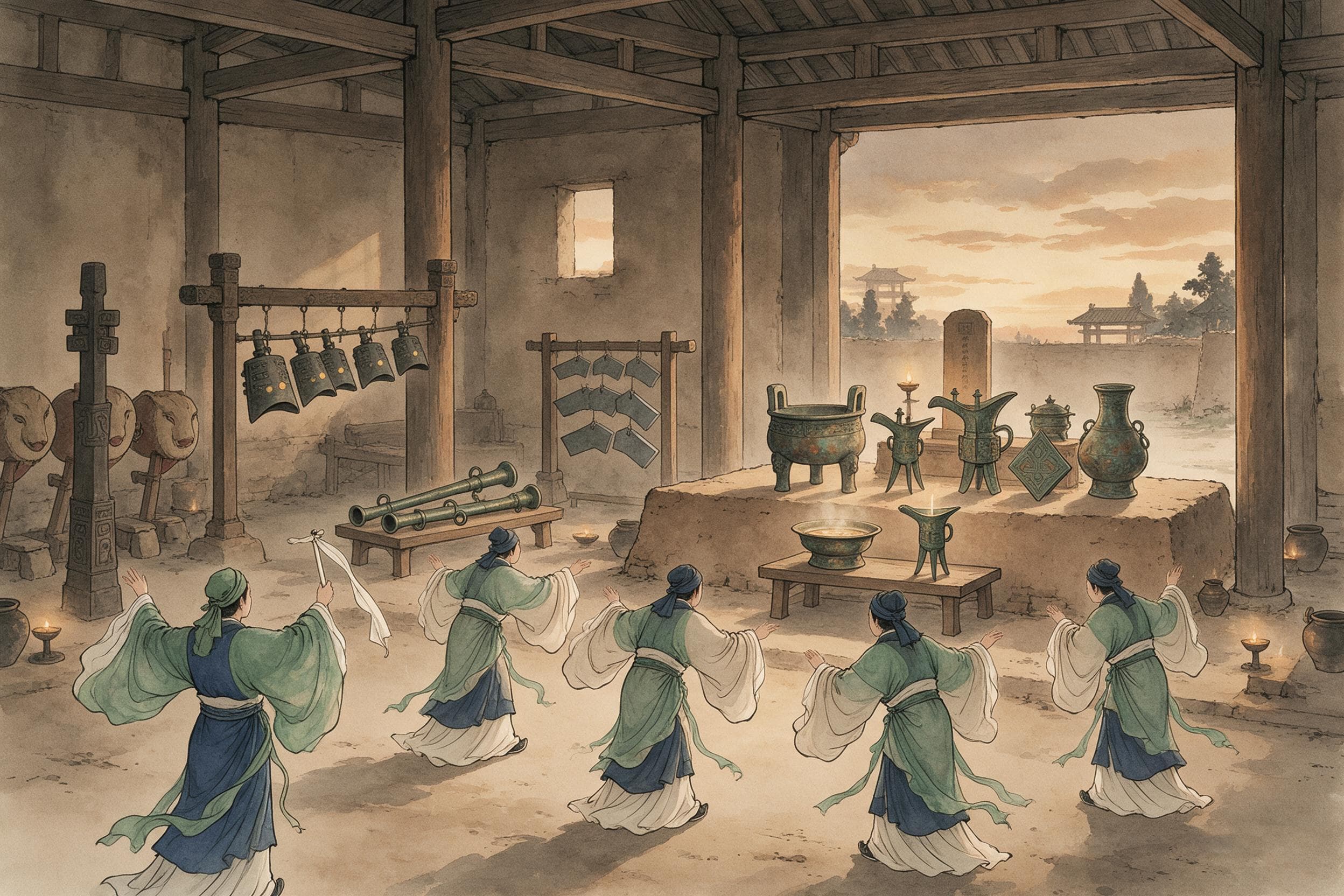
The poem moves fast. After those two lines comes 'the ancient god commanded Wu Tang to set the four quarters in order' (古帝命武湯,正域彼四方); then 'he gave charge to the lords, and possessed the nine regions', 'the former kings of Shang received the mandate without fail — it is in the descendants of Wu Ding'; then 'the descendants of Wu Ding: the martial king overcomes all; ten chariots with dragon banners, great sacrificial millet presented'; then 'the royal domain a thousand li, where the people stay; the borders reached the four seas'; and it closes with 'the four seas come to pay court, crowding in; Yin received the mandate fittingly, a hundred blessings are on it'. The poem's body is Tang, Wu Ding and the royal domain; the origin takes two lines. It is a song for ancestral sacrifice, not a chronicle of origins. The bird appears only here; after that the stage belongs to Tang and to Wu Ding's line.
No Jian Di in the Poem
In twenty-two lines there is no mother's name, no egg, no swallowing; there is not even the name Xie (契) — the poem says Shang was born, not that Xie was. That is the plainest gap in the piece: for a sacrificial song, 'Heaven commanded the dark bird' is enough to state an origin; who the mother was, and where the egg came from, need not be told.
At the head of the page stands a line of the Mao preface: 'Xuan Niao was sung in sacrifice to Gao Zong' (《玄鳥》,祀高宗也). That is a Han preface, not the poem; Gao Zong is generally taken to be Wu Ding, and the page gives no note. The preface fits the poem's 'descendants of Wu Ding' and 'the martial king overcomes all', but the date of the Shang hymn is disputed — traditionally late Shang, by others attributed to the state of Song in the Spring and Autumn period — and neither page settles it, nor does this article. What bird the 'dark bird' was is generally taken to be the swallow; the page gives no note, so it can only be marked 'generally'. The page's 'annotations' section is empty: there is no Mao commentary or Zheng commentary to lean on. Of the poem's form it says only 'one stanza, twenty-two lines'; apart from the preface it says nothing of tune or occasion.
The Shiji Supplies the Story
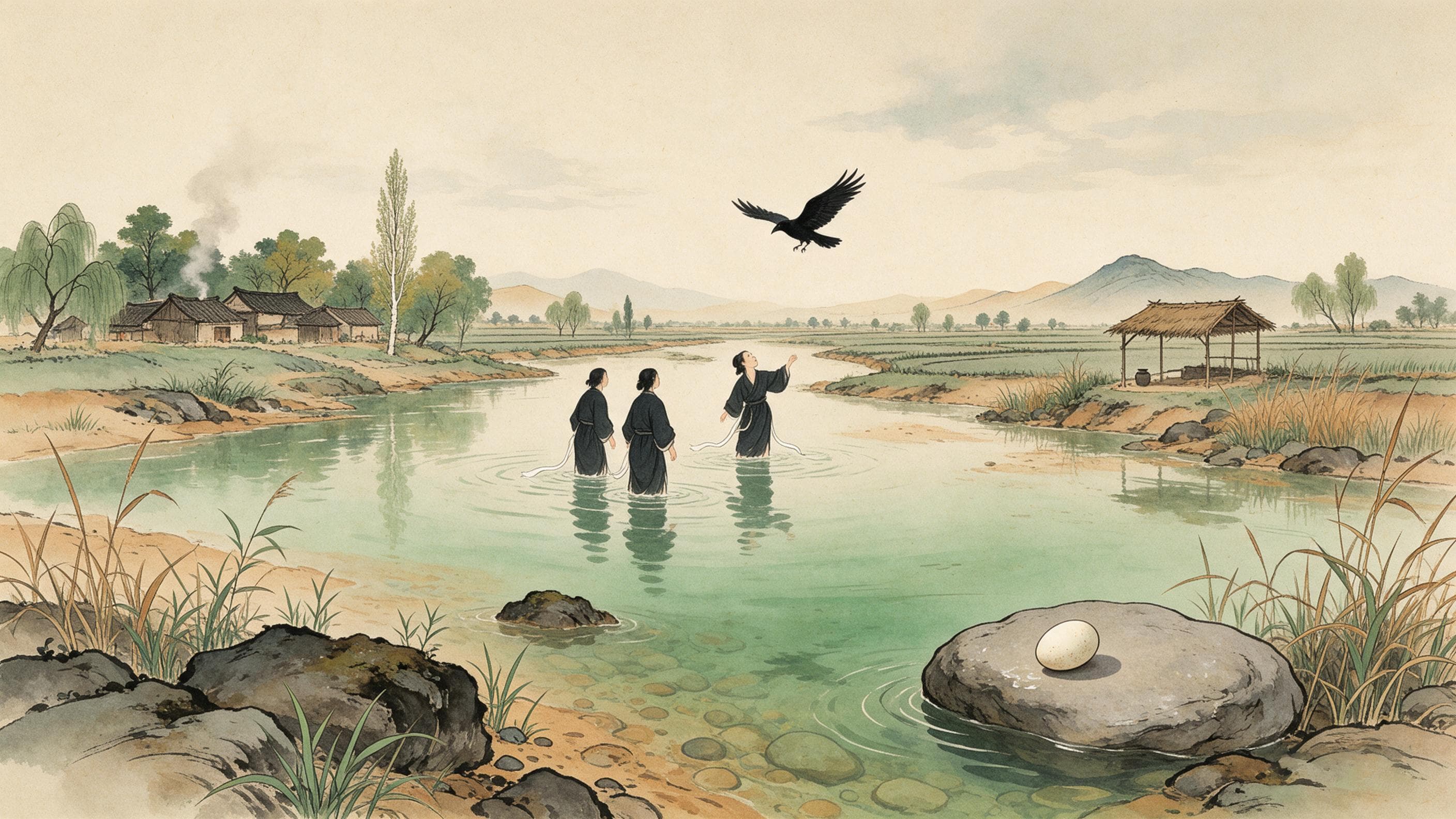
In the Shiji's 'Annals of Yin' the opening is a full paragraph: 'Xie of Yin: his mother was Jian Di, a woman of the You Song clan, and a secondary wife of Di Ku. Three women were bathing when they saw the dark bird drop its egg; Jian Di took it and swallowed it, and conceived Xie' (殷契,母曰簡狄……因孕生契). What the poem states as a conclusion becomes, in the Shiji, a scene with a place (the water), people (three women) and actions (dropping, taking, swallowing). This is a Western Han account: cite the Shiji, and call it legend.
The scene is followed at once by deeds and status: 'when Xie grew up he helped Yu control the waters and had merit. Emperor Shun charged him: ‘The people are not close, the five relations are not taught; be minister of education and respectfully spread the five teachings, and the five teachings will lie in leniency.’ He was enfeoffed at Shang and given the clan name Zi' (封于商,賜姓子氏). Then comes a run of generations: Xie died, his son Zhao Ming ruled; Zhao Ming died, his son Xiang Tu ruled … down to 'Zhu Gui died, his son Tian Yi ruled, and he was Tang the Completer'. A further line says 'Tang, from Xie to Tang, moved eight times' (自契至湯八遷). The generations run 'died, his son ruled', as flat as a ledger. The myth is fitted into a frame of offices, a surname, a fief and a genealogy. Those are the historian's arrangements, not reliable history.
Between the Two Pages
Read side by side, the difference is clean: the poem gives the conclusion — Heaven commanded the dark bird, and Shang was born; the history gives the plot — three women bathing, the bird dropping its egg, Jian Di swallowing it and conceiving Xie. The poem has no Jian Di; the history even names her clan (You Song) and her husband (Di Ku). The poem has no Xie; the history follows him from birth to Tang. One layer is a sung line, the other a written tradition. Neither page names the water: the Shiji says only that they were bathing.
One more thing can be pointed out: each page has one key line that lands the word 'Shang' on something different — the poem says Shang was born, the history says Xie was enfeoffed at Shang. The poem ties Shang to the dark bird, the history ties it to a fief and a clan name; one is mandate, the other institution, and neither page joins the two.
Boundaries and Gaps
The important thing is not to read either layer as reliable history. The poem is a sacrificial song (on the Mao preface and its form, generally so); the history is a Han-dynasty annals. Neither page is a record of Shang origins, so the article can only say 'the legend goes'. The dark bird as swallow, Gao Zong as Wu Ding, can only be marked 'generally'. Later explanations of a totem kind are not on these pages, and are not developed here; nor is 'the Shang all believed this', for which there is no material. The pages give no dates for Jian Di, Di Ku or Xie, so no chronology is drawn.
What remains, then, is two lines of verse and one story: 'Heaven commanded the dark bird; it came down and gave birth to Shang' finishes the origin in a sentence; 'three women bathing … and she conceived Xie' turns it into a scene. They are separated by an unknown span, one sung and one written; set the two lines beside the paragraph and the reader sees which layer is verse and which is history. The poem calls it only 'the dark bird'; 'swallow' is a commentator's gloss, not the poem's word. What it was, and how the Shang themselves told this, neither page answers.
Related reading:Records and Statutes: What the Shang Had, and What Survives · Dried Meat: How a Cut Was Cured, and What It Ate With · A Grave With No Mound: Cao Pi's Final Ordinance
Sources & further reading
- 《诗经·商颂·玄鸟》(维基文库本,未与点校本复核) — One stanza, twenty-two lines, with a Han Mao preface at the head: 'Xuan Niao was sung in sacrifice to Gao Zong' (《玄鳥》,祀高宗也). The origin is two lines only: 'Heaven commanded the dark bird; it came down and gave birth to Shang. It dwelt on the broad lands of Yin' (天命玄鳥,降而生商。宅殷土芒芒). The rest goes at once to 'the ancient god commanded Wu Tang to set the four quarters in order' (古帝命武湯,正域彼四方), then to the descendants of Wu Ding (在武丁孫子; 武丁孫子,武王靡不勝), the thousand-li domain and the four seas (邦畿千里……肇域彼四海), and closes 'Yin received the mandate fittingly, a hundred blessings are on it' (殷受命咸宜,百祿是何). There is no Jian Di, no egg and no swallowing in the poem, and not even the name Xie. The page has no Mao or Zheng commentary and the 'annotations' section is empty; the poem's lines sit inside a <poem> block, so text-only extraction can return an empty page.
- 《史记》卷三·殷本纪(西汉司马迁;维基文库本,未与点校本复核) — The Han-dynasty narrative that fills out the poem. Opening: 'Xie of Yin: his mother was Jian Di, a woman of the You Song clan and a secondary wife of Di Ku. Three women were bathing when they saw the dark bird drop its egg; Jian Di took it and swallowed it, and conceived Xie' (殷契,母曰簡狄,有娀氏之女,為帝嚳次妃。三人行浴,見玄鳥墮其卵,簡狄取吞之,因孕生契). Then the deeds: Xie helped Yu control the waters; Emperor Shun made him minister of education with the charge to spread the five teachings; 'he was enfeoffed at Shang and given the clan name Zi' (封于商,賜姓子氏); 'Xie rose in the time of Tang, Yu and the great Yu' (契興於唐、虞、大禹之際). Then the genealogy from Xie through Zhao Ming, Xiang Tu and the rest to 'Tian Yi, who was Tang the Completer' (主癸卒,子天乙立,是為成湯), and 'from Xie to Tang, moved eight times' (自契至湯八遷). The page is the whole Yin annals, a Western Han text, not a contemporary Shang record.