One sentence in the Shang Shu's 'Duo Shi' is often quoted as proof that the Shang had books: 'you know that the Yin ancestors had records and statutes, and that Yin overthrew Xia' (惟爾知,惟殷先人有冊有典,殷革夏命). The speaker is the Duke of Zhou, in a proclamation; what those volumes and statutes looked like, the page never says. Not one physical example survives.
What the Duke of Zhou Said at Luoyi
The chapter opens by naming the occasion: 'in the third month the Duke of Zhou, for the first time at the new city of Luo, spoke to the former officers of the Shang king' (惟三月,周公初于新邑洛,用告商王士). The whole piece is the duke speaking on the king's behalf ('the king said'), to Yin survivors moved to Luoyi. He begins with heaven's mandate: Xia lost virtue, heaven punished it, and ordered the Yin ancestor Tang to overthrow Xia; later Yin too lost virtue and heaven sent down mourning; so Zhou's replacement of Yin is likewise the mandate. Halfway through comes 'you know that the Yin ancestors had volumes and statutes, and that Yin overthrew Xia', followed at once by their counter-argument — 'now you say that the men of Xia were promoted into the royal court and served among the hundred offices' — and his answer: 'I employ only the virtuous' (予一人惟聽用德).
In that passage the words do one job: they remind the audience that their own past was recorded and that they know the precedent of Yin overthrowing Xia; if the precedent exists, Zhou's overthrow of Yin is no isolated act. This is persuasion, not an inventory. In the same passage he does not say how many documents, what a statute was, where they were kept or who kept them, and the chapter never mentions them again. To treat the line as a 'catalogue of Shang documents' is to lift it out of its argument.
Neither Object Survives
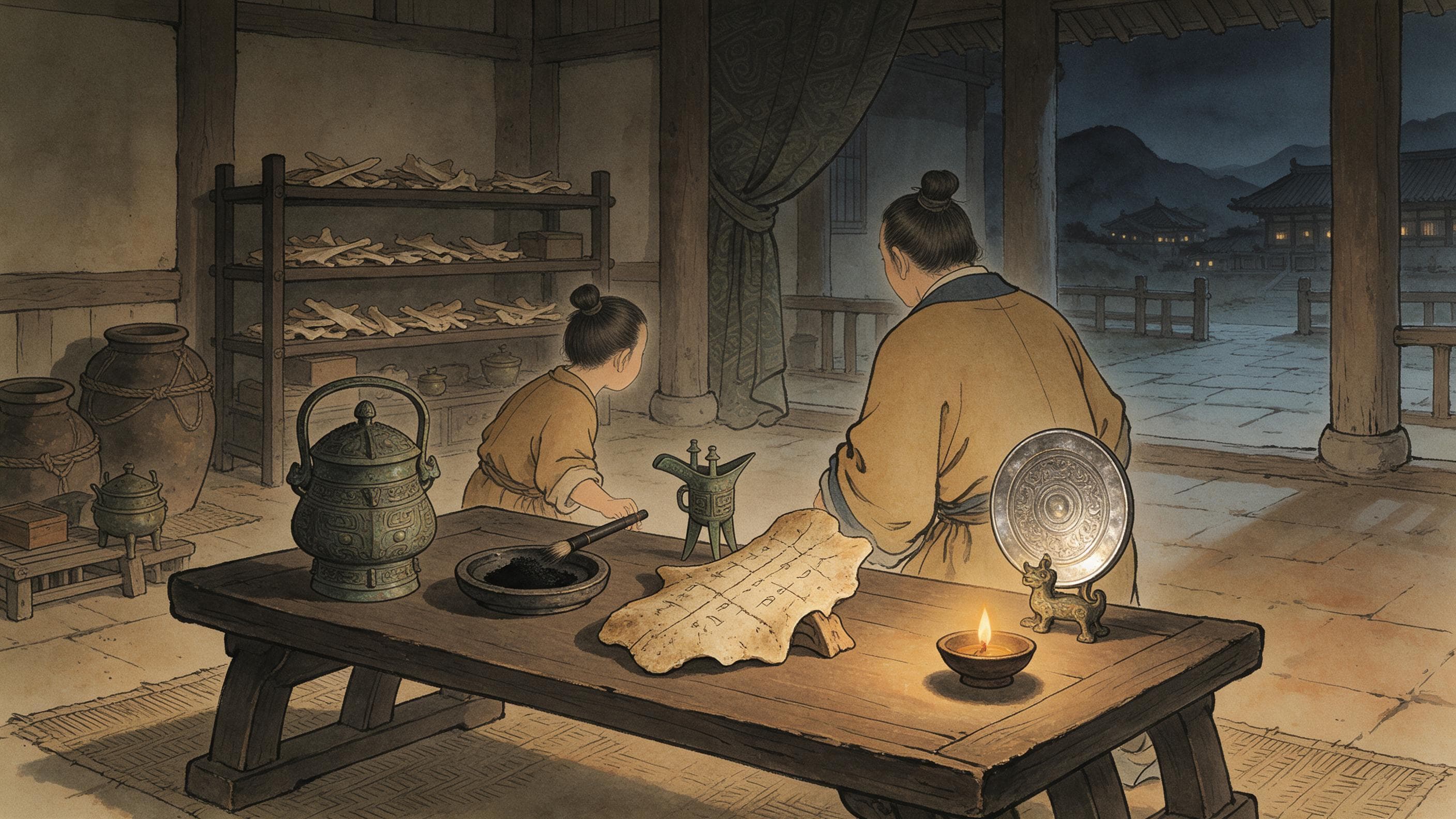
The texts say the Shang had volumes and statutes; archaeology has produced none — that is the present state of things, not proof that none existed. The Shang writing that survives today comes in two main kinds: divination inscriptions on bone, and cast inscriptions on bronze. Neither is a 'volume' or a 'statute'; each had its own use and form. Filling the gap with them is answering a different question.
Xu Shen, writing in the Eastern Han, never claimed to have seen a Shang volume, but he had seen 'the ancient script of former ages'. The fifteenth chapter of the Shuowen's preface says: 'in the provinces they often dig from mountains and rivers bronze vessels, and their inscriptions are the ancient script of former ages, all resembling one another' (郡國亦往往於山川得鼎彝,其銘即前代之古文,皆自相似). Two things follow: Eastern Han scholars knew the older script from bronze inscriptions, and they did not say they had seen Shang records. The same preface records the books found in the wall of Confucius's house (the Li Ji, Shang Shu, Chun Qiu, Lun Yu, Xiao Jing) and the Zuo Zhuan presented by Zhang Cang — bamboo-and-silk texts generally dated to the Warring States and early Han, far later than the Shang.
Xu Shen Wrote a History of Forms
The Shuowen preface is a short history of writing, and its spine is letter-forms: Shennong ruled by knotted cords, 'the hundred trades grew complex and falsehood sprouted'; the Yellow Emperor's scribe Cang Jie 'saw the tracks of birds and beasts' and first made writing; 'forms copied by kind are called wen; when forms and sounds were added to each other they were called zi'; 'written on bamboo and silk it is called shu'. Then the six scripts, the fifteen chapters of great seal under King Xuan's scribe Shi Zhou, the 'ancient script' of Confucius's six classics and Zuo's commentary; the seven states with 'characters of different shapes'; Qin's unification, when Li Si memorialised that they be 'made the same', 'abolishing whatever did not match the Qin script', and the Cang Jie, Yuan Li and Bo Xue chapters were made 'taking Shi Zhou's great seal and somewhat reducing or altering it — the so-called small seal'; Qin's burning of the classics and 'clearing away the old statutes', the rise of clerkly script, 'and from this the ancient script died out'; Han's cursive; the statute testing youths of seventeen on nine thousand characters and the eight scripts; and Wang Mang's six scripts under Zhen Feng.
Two Statutes, One Record
In that run the word dian, 'statute', appears twice: 'they all discarded their records' (皆去其典籍), of the seven states, and 'cleared away the old statutes' (滌除舊典), of Qin. Both are about later books being abandoned or destroyed, not about Shang archives. The word ce, 'record', appears in these two pages only once, in the Duo Shi line. Xu Shen's question is not who kept archives but how forms changed, how the ancient script died out and how Han scholars learned to read again; the Shuowen's own method is 'now arranging the seal forms, joined with the ancient and the Zhou script', 'divided by radicals', and the postface counts 'fourteen chapters, five hundred and forty radicals, nine thousand three hundred and fifty-three characters'. In that story the Shang belongs to the stretch called 'the ancient script of former ages'; it has no archival history of its own.
Between the Two Pages
Put the two pages together and each gives a little, but not enough: one is an early Zhou proclamation using two ready-made words to remind Yin survivors of what they already knew; the other is an Eastern Han dictionary preface on letter-forms, bamboo and silk, Qin's unification and the Han statute, mentioning in passing that bronze inscriptions are the ancient script. Neither says how many slips made a volume, what form a statute took, where Shang volumes were kept, or which office kept them. Those gaps cannot be closed with oracle bone or bronze inscriptions, and should not be closed by reading later 'bamboo books' backwards.
One more caution: 'writing made the same' is Qin's work. Xu Shen is explicit — 'when the First Emperor of Qin first united the world, Li Si memorialised to make them the same', after the seven states had 'characters of different shapes'; moving that back to the Shang flattens a thousand years into a phrase. Likewise 'written on bamboo and silk it is called shu' is an Eastern Han definition of writing, not evidence that Shang books were on bamboo and silk. In these two pages bamboo and silk are a material named in a definition and the stuff of later copies, not a Shang find.
So this article can say exactly this much: one line in an early Zhou proclamation, a history of letter-forms in an Eastern Han dictionary preface, and a clear blank between them. The texts say the Shang had volumes and statutes; no object survives; what those words meant in practice, neither page says. It does not claim 'the earliest books in China', and it does not infer an archival system from oracle bones — that is a question for another kind of evidence.
Related reading:A Grave With No Mound: Cao Pi's Final Ordinance · How People Lived in Chang'an: Wards, Walled Yards and a Rented House with Peonies · The Jade That Had to Sound Right
Sources & further reading
- 《尚书·多士》(维基文库本,未与点校本复核) — The only place on these two pages where the word ce, 'record', occurs. The chapter's opening: 'in the third month the Duke of Zhou, for the first time at the new city of Luo, spoke to the former officers of the Shang king' (惟三月,周公初于新邑洛,用告商王士); the speeches are put in the king's mouth ('the king said', 王若曰) and address the Yin survivors moved west to Luoyi (予惟時其遷居西爾). The line: 'you know that the Yin ancestors had volumes and statutes, and that Yin overthrew Xia' (惟爾知,惟殷先人有冊有典,殷革夏命), immediately followed by the audience's counter-argument 'now you say that the men of Xia were promoted into the royal court and served among the hundred offices' (夏迪簡在王庭,有服在百僚) and the answer 'I employ only the virtuous' (予一人惟聽用德). The passage is about the mandate and the precedent of dynastic change; it gives no number, form, place or officer for the volumes, and the chapter never mentions them again. The page carries the text only, no commentary.
- 《说文解字》卷十五·叙(东汉许慎;维基文库本,未与点校本复核) — An Eastern Han history of writing, with letter-forms as its spine. Knotted cords under Shennong, then Cang Jie making writing (初造書契); 'forms copied by kind are called wen; when forms and sounds were added, they are called zi' (依類象形,故謂之文;其後形聲相益,即謂之字); 'written on bamboo and silk it is called shu' (著於竹帛謂之書). Then the six scripts, Shi Zhou's fifteen chapters of great seal, the ancient script of the classics; the seven states with 'characters of different shapes' (文字異形); Qin's unification, Li Si's memorial to make them the same, 'abolishing whatever did not match the Qin script' (罷其不與秦文合者), the three character primers and the small seal; Qin's 'burning of the classics and clearing away of the old statutes' (燒滅經書,滌除舊典), the rise of clerkly script, 'and from this the ancient script died out' (而古文由此絕矣); the eight Qin scripts, Han cursive, the statute testing youths on nine thousand characters, and Wang Mang's six scripts. On older writing: 'in the provinces they often dig from mountains and rivers bronze vessels, whose inscriptions are the ancient script of former ages, all resembling one another' (郡國亦往往於山川得鼎彝,其銘即前代之古文,皆自相似), alongside the books found in Confucius's wall and the Zuo Zhuan presented by Zhang Cang. The word dian appears only of later losses — the seven states 'discarding their records' (皆去其典籍) and Qin 'clearing away the old statutes' (滌除舊典) — never of Shang archives; the word ce does not appear in the preface at all. The page gives the preface text without commentary.