A Tang poet wrote about the peonies in his rented house. The compound came with them; there were so many that when they first opened he suspected something uncanny, and later he worried about the sun scorching them and gathered the fallen petals to burn as incense. The word he uses for the place is zhai — a house — and the verb is lin, to rent. What he rented was not a bed in a dormitory but a walled home with a garden. The poem names neither the city nor a price.
One hundred and eight wards, four gates each
According to Xu Song's Qing compilation Tang liangjing chengfang kao, drawing on Tang histories, the Chang'an zhi, Tang anecdotes and tomb inscriptions, the outer city measured eighteen li and 115 paces east to west, fifteen li and 175 paces north to south, sixty-seven li around, with walls eighteen feet high. Inside, fourteen streets ran north-south and eleven east-west, and between them were laid out the wards — 108 of them. Each ward had four gates, with cross streets running out to meet them. The Zhuque street, due south of the imperial city, was a hundred paces wide. Wards differed in size: the first east of Zhuque street was 350 paces across, the second 450, and the next three 650 each.
Xu Song was a Qing scholar, and these lines are his compilation, not a Tang voice speaking directly; they should be cited as what his book gathers. Nor can the size of a ward or the width of a street tell us how many households lived in one, or how many rooms a family had. The sources do not reach that far.
The cross street and the lane, dug up
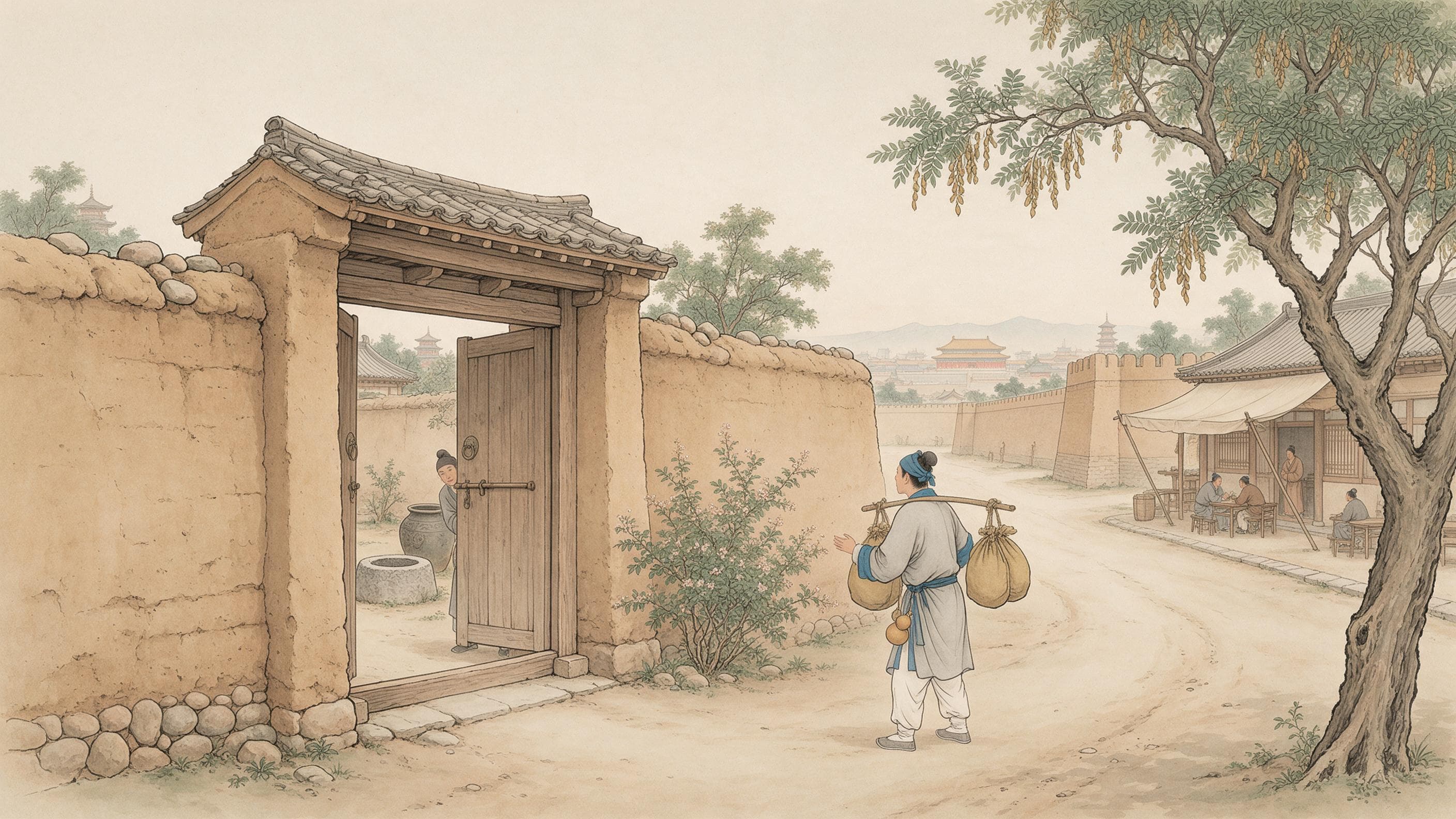
Recent excavation in the Buzheng ward turned the diagram into measurements. In the eastern part of the dig a north-south street, labelled L1, was found: its early road surface was up to 10.8 metres wide, the later one up to 11.1, which matches the standard width of a ward's main cross street. About 67 metres west of L1 was a second north-south road, L2, read as a lane within the ward. Between the two lay two compounds enclosed by rammed-earth walls, joined east to west, the second better preserved. The dig also produced wells, water vats, a brick storage pit and ceramic drainage pipes. Buzheng ward had originally been called Longzheng, and was renamed to avoid the personal name of Emperor Xuanzong.
The report gives no area for the compounds, no dimensions for the rooms, and no identity for the people who lived in them; none of that is supplied here. What it does establish is modest and concrete: the ward's main street was an earthen road a little over ten metres wide, lanes ran behind it, and between them stood courtyards walled in rammed earth, with a well, a water vat and drains inside the wall. Water and waste were handled within the compound.
Who rented, and where
The compilation has one very practical sentence under the provincial office in Wenben ward: the representatives sent up to the capital by the provinces had no residence there, and mostly rented quarters, living mixed in with merchants. Only in 643, in the seventeenth year of Zhenguan, did the court order offices built for them. That single line describes a rental market: the tenants included officials in town on business, and their neighbours were traders.
Wards also held inns and lodging houses: "inns" are noted in Xingdao and Changxing wards, "lodging houses" in Wenben and Jing'an. Under the Wenben entry a visitor from Shu is said to have taken rented lodging in the ward. These were mostly private guest houses inside residential blocks, so the English word should be inn or lodging house, not hotel. South of the city the picture changed: the four wards south of the Shanxi monastery had almost no mansions, and where anyone lived at all, the households were scattered, with fields under cultivation and footpaths between them. In one city, some wards were packed with lodgings and others were still farmland.
The most quoted line is not about rent
The saying that "living in Chang'an is not easy" is regularly produced as evidence that Tang rents were high. It is not. There are two versions. One Tang collection has the young Bai Juyi presenting his poems to the critic Gu Kuang, who tells him that grain is expensive just now, so living will not be easy either. Another has it as "everything in Chang'an is dear, so living is not easy". And according to the study cited here, the anecdote is very probably a late-Tang invention; but a fabricated story can carry real information, and the experience it reflects — scholars struggling to get by in the capital — was real. Bai's own letter recalls arriving for the examinations with no relative at court and no acquaintance among the great, and his poem has him riding into the city in a worn coat on a thin horse, reaching Chang'an at dusk with no one to receive him.
So the saying is evidence about grain prices and about the price of everything, and about a stranger's isolation in the capital. It is not evidence about rent. For rent in Chang'an, the citable sources give nothing at all.
The half the sources do not price
That is the boundary of this piece. There are no rental figures and no sale prices — only stray numbers in Tang fiction, which cannot be treated as market rates. There are no lease terms, guarantors or penalty clauses, and no household counts per ward. Dunhuang rental contracts cannot simply be moved to Chang'an: different period, different administration, and no citable transcription was opened for this article, so they are left out.
What can be said is this: a grid of 108 walled wards, each with four gates and cross streets; streets a little over ten metres wide, lanes behind them, and courtyards of rammed earth with wells and water vats inside; a rented house that came with a bed of peonies; officials and merchants living side by side in the same ward; and a famous complaint that turns out to be about rice. The figure one wants — a month's rent — is exactly what the sources leave out. The gap is part of the answer.
Related reading:Jade, Silk and Horses: What an Envoy Carried · Lowering the Coffin: The Day of the Burial · The Dark Bird and the Birth of Shang: Two Lines of Verse and a Story
Sources & further reading
- 徐松《唐兩京城坊考》卷二·西京外郭城(Qing compilation of Tang materials, juan 2, "The Outer City of the Western Capital") — Dimensions of the outer city, 108 wards with four gates and cross streets, the hundred-pace Zhuque street, ward sizes of 350, 450 and 650 paces, named inns and lodging houses, and provincial representatives who rented quarters among merchants until an official residence was built for them in 643.
- 魏景波〈再议「长安居,大不易」〉,《中国社会科学报》2023-12-08(Guangming reprint) — Two versions of the famous phrase: one source has the patron say grain was expensive, so living would not be easy, the other has 'everything in Chang'an is dear'; the author argues the Bai Juyi anecdote was invented in the late Tang, while the experience of struggling to live in the capital was real.
- 〈隋唐长安城布政坊遗址考古成果公布〉,央视新闻 2026-03-21(Guangming reprint) — Excavation in the Buzheng ward: a north-south ward street 10.8 to 11.1 metres wide, a lane about 67 metres west of it, two compounds enclosed by rammed-earth walls, plus a well, water vats, a brick storage pit and ceramic drains.
- 王建〈題所賃宅牡丹花〉,《全唐詩》卷二百九十九(Wang Jian, poem on peonies in a rented house, Quan Tangshi juan 299) — Literary evidence that Tang people used the word 'rented house' for a home with a garden: the rented compound already had peonies, and the poet worries about the sun and gathers the fallen petals to burn as incense. The poem names neither city nor price.