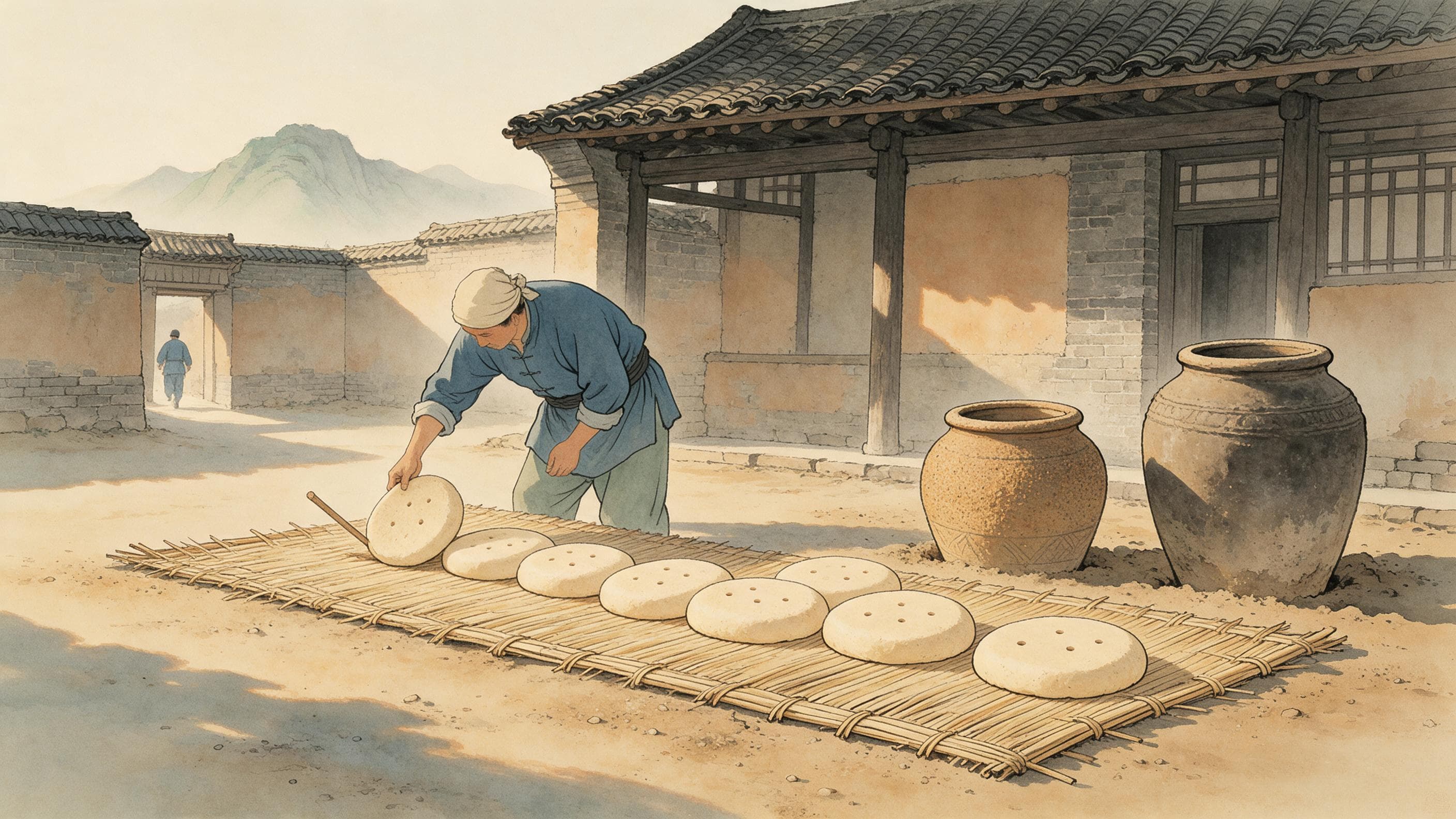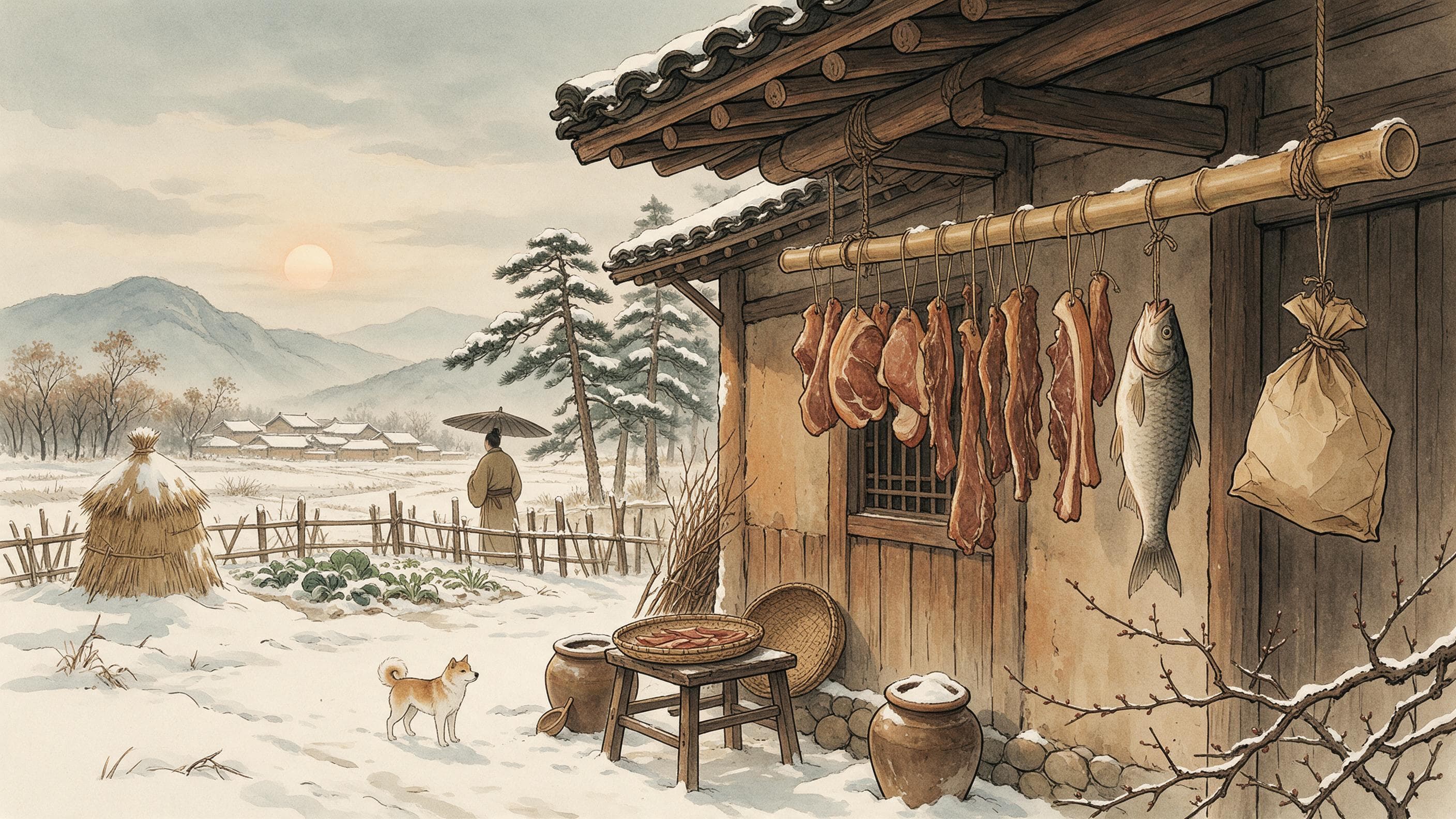
The Li Ji's 'Nei Ze' has a run of names that reads like a menu: 'beef strips, dried deer, dried wild boar, dried mi, dried jun' (牛脩、鹿脯、田豕脯、麋脯、麕脯). The next line gives four of them a xuan and the pheasant and hare a mao, then moves on: it never says how these meats were cut, cured or salted. The Qi Min Yao Shu's chapter on dried meat and cured meat reverses it: seasons, days and hand-feel are precise, while quantities are 'to taste' and 'as much as needed'. Read together, one gives the menu, the other the method, with no common table between them.
Beef Strips, Dried Deer, Dried Boar
The section lists rice, viands, drinks, wine, relishes and foods in order; dried meat belongs among the foods. This is a book of rules, not a kitchen ledger: commonly dated to the Warring States and early Han, it sets separate rules for grand officers, shi and commoners' elders. Of the five names, only 'dried deer' has the same shape as our 'dried meat'; the rest keep their own names. The xuan-and-mao line carries no note on the page, and this article does not supply what xiu, xuan and mao meant. What is certain is the list: wild boar, mi, jun, deer and beef made the menu.
Wheat Food, Dried-Meat Soup, Rabbit Paste
Dried meat never appears alone. 'For foods: snail paste with rice gruel and pheasant soup; wheat food with dried-meat soup and chicken soup; broken rice with dog and hare soup, mixed with grain, no smartweed' (食:蝸醢而苽食、雉羹,麥食、脯羹、雞羹,折稌、犬羹、兔羹). Then a table of pairings: 'sliced dried meat with ant-egg paste; dried-meat soup with rabbit paste; mi skin with fish paste; fish slices with mustard sauce; raw elk with meat paste; pickled peaches and plums with egg salt' (腶脩,蚳醢;脯羹,兔醢;麋膚,魚醢……). Every item has its paste. Hai is usually glossed as meat paste; the page gives no note.
There is also a rule of rank: 'a grand officer at an ordinary meal has either minced meat or dried meat, not both' (大夫燕食,有膾無脯,有脯無膾); below, 'a shi does not have two soups and two cuts' and 'commoners' elders do not eat bare'. Another line puts dried meat in the seasonal menu: 'in summer, dried meat and dried fish are fitting' (夏宜腒鱐); ju and su are usually glossed as dried meat and fish, with no note on the page. So far the ritual book governs what goes with what and who may eat it together — not one word on cutting, salt or days.
Three Nights for Slices, Taste for Strips
The Northern Wei farm manual's seventy-fifth chapter begins with a calendar for five-flavour dried meat: 'the first, second, ninth and tenth months are best' (正月、二月、九月、十月為佳). Meats: 'beef, mutton, zhang, deer, wild boar and domestic pig, cut into strips or slices' (或作條,或作片), always with the grain. Then: pound beef and sheep bones, boil, skim, let settle; cook fermented beans in the broth till 'full colour and balanced taste', strain; when cold add salt, pounded scallion, powdered pepper, ginger and orange peel; steep and 'knead through with the hand' (手揉令徹). The test depends on shape: 'slices after three nights; strips only when you taste the flavour has gone through' (片脯三宿則出,條脯須嘗看味徹乃出).
Hang them in the shade; while strips are still damp, 'press them firm with the hand again and again' (數以手搦令堅實). When done, keep them 'in a quiet store-room' — 'smoke makes the taste bitter' — and 'hang them in paper bags', since 'in a jar they sweat' and unbagged they take flies and dust (紙袋籠而懸之). Twelfth-month strips get their own name, 'chill-cured' (瘃脯), and keep through summer. When taking them out, 'take the fat ones first' — fat is greasy and does not keep.
Other methods have their own dates. White dried meat for summer: 'best in the twelfth month; the first, second and third will also do' (作度夏白脯法). Sweet fat dried meat: twelfth-month zhang and deer, sliced 'as thick as a palm', dried in shade 'with no salt', 'crisp as snow'. Snakehead fish dried meat: 'from the beginning of the eleventh month to the end of the twelfth'. Five-flavour cured meat: 'made at the start of the twelfth month', steeped 'four or five days'. Crisp cured meat: also the twelfth month. Salted damp fish: 'any season will do'. Why those months, the book does not say; what can be seen is the arrangement: what must keep through summer is made in the twelfth month.
Ten to a String
The snakehead is the most technical. 'Do not scale it and do not open it; thrust a stick in at the mouth and out at the tail' (不鱗不破,直以杖刺口中,令到尾), the stick's tip shaped like a gaming die. 'Make the brine extremely salty with plenty of powdered ginger and pepper, and pour it into the mouth until full' (灌魚口,以滿為度). 'Bore the eyes with bamboo, ten to a string, mouths up, and hang them under the north eave through winter to freeze-cure; by the second or third month the fish is done' (十箇一貫……經冬令瘃). Two ways to eat it: split it raw, gut it and steep it in sour vinegar; or 'wrap it in grass and mud, roast it in embers', then strip the mud, wrap in cloth and pound it — 'white as snow' (白如珂雪).
Two methods are all hand-feel. White dried meat for summer: lean flesh, 'cut into slices, soak in cold water, wring out the blood until the water runs clear' (搦去血,水清乃止); steep in clear white brine with pepper powder, 'take it out after two nights and dry it in shade'; while half-dry, 'tap it lightly with a wooden stick to make it firm — firm only, and be careful not to let shreds of meat come out' (僅使堅實而已,慎勿令碎肉出). Sweet fat dried meat is simpler still: slices 'as thick as a palm', shade-dried 'with no salt', 'crisp as snow'. Damp, firm, crisp: words for hands and mouth, not for a scale.
To Taste, That Is All
There really are no proportions. Salt is 'to taste only; do not let it be too salty' (適口而已,勿使過鹹); pepper, ginger and orange peel are 'all powdered', with a note 'as much as needed' (量多少); the bean broth only has to reach 'full colour and balanced taste'. The meat-paste method in the same juan is far more exact: 'one dou of meat, five sheng of koji powder, two and a half sheng of white salt, one sheng of yellow steamed wheat' (肉一斗,麴末五升,白鹽兩升半,黃蒸一升). But that is paste, not dried meat; those figures do not carry across, and the book does not explain the silence. What can be followed is sequence and hand-feel: boil the broth, salt, knead through, take out, string, dry in shade, press firm, bag and hang.
Together the two pages give half each. The ritual book gives names and pairings: five dried meats, soup with rabbit paste, no minced and dried meat at one meal. The farm book gives seasons and handling: first month to tenth, three nights for slices, ten fish a string, bags and hanging. Between them there is no common table: the ritual book never says how to make the meat, the farm book never says what it goes with. One more line: the adjacent seventy-fourth chapter on fish pickle is about wet salting and mash; this seventy-fifth is the dry method. Neither page gives price, weight or origin; this article converts no weights and calls this no 'wisdom of preservation'.
Related reading:A Grave With No Mound: Cao Pi's Final Ordinance · How People Lived in Chang'an: Wards, Walled Yards and a Rented House with Peonies · The Jade That Had to Sound Right
Sources & further reading
- 《齐民要术》卷第八·脯腊第七十五(北魏贾思勰;维基文库本,未与点校本复核) — The whole dry-curing chapter. Five-flavour dried meat: 'the first, second, ninth and tenth months are best' (正月、二月、九月、十月為佳); meats 'beef, mutton, zhang, deer, wild boar and domestic pig, cut into strips or slices' (或作條,或作片), always with the grain; bone broth, fermented beans, then 'salt — to taste only, do not let it be too salty' (鹽,適口而已,勿使過鹹), scallion white pounded, 'pepper, ginger and orange peel all powdered, as much as needed' (椒、薑、橘皮,皆末之,量多少); steep and 'knead through with the hand' (手揉令徹); 'slices come out after three nights, strips when you taste the flavour has gone through' (片脯三宿則出,條脯須嘗看味徹乃出); string them and dry in shade under the north eave; press strips firm while damp; keep in a quiet store, 'smoke makes the taste bitter', 'paper bag and hang — in a jar it sweats, unbagged it takes flies and dust' (紙袋籠而懸之); twelfth-month strips are 'chill-cured' (瘃脯) and keep through summer; 'take the fat first, fat is greasy and does not keep' (先取其肥者). White dried meat for summer: twelfth month best, first to third also possible; lean flesh, cold-water soak and wring until clear, clear white brine with pepper, two nights, shade-dry, 'tap lightly with a stick to firm it, firm only, do not let shreds come out' (僅使堅實而已,慎勿令碎肉出). Sweet fat dried meat: twelfth month, zhang and deer, slices as thick as a palm, shade-dried 'with no salt', 'crisp as snow'. Snakehead dried meat: eleventh month to end of twelfth, unscaled and unopened, a stick thrust mouth to tail, extremely salty brine with ginger and pepper poured into the mouth, bamboo through the eyes, 'ten to a string' (十箇一貫), hung under the north eave through winter, done by the second or third month, eaten raw with sour vinegar or roasted in mud and embers until 'white as snow'. Five-flavour cured meat: twelfth month, birds and fish, steeped 'four or five days'; crisp cured meat: twelfth month, boiled then shade-dried; damp-salted fish: any season. The same juan's meat-paste recipe is exact by contrast (one dou meat, five sheng koji powder, two and a half sheng white salt, one sheng yellow steamed wheat), which is why the absence of figures in the dried-meat methods is a fact about this chapter, not about the book.
- 《礼记·内则》(维基文库本,未与点校本复核) — The ritual menu. The list of dried meats: 'beef strips, dried deer, dried wild boar, dried mi, dried jun; mi, jun, deer and wild boar each had their xuan, pheasant and hare their mao' (牛脩、鹿脯、田豕脯、麋脯、麕脯……雉、兔皆有芼). The pairings: 'wheat food with dried-meat soup and chicken soup' (麥食、脯羹、雞羹); 'sliced dried meat with ant-egg paste; dried-meat soup with rabbit paste; elk skin with fish paste; fish slices with mustard sauce' (腶脩,蚳醢;脯羹,兔醢……). The rank rule: 'a grand officer at an ordinary meal has either minced meat or dried meat, not both' (大夫燕食,有膾無脯,有脯無膾), followed by 'a shi does not have two soups and two cuts' and 'commoners' elders do not eat bare'. The seasonal line: 'in summer, dried meat and dried fish are fitting, with rank-smelling fat' (夏宜腒鱐,膳膏臊). The page is text without commentary: it does not gloss xiu, xuan, mao, hai, ju or su, and gives no method, salt quantity or day count anywhere.