He wanted his grave to be unfindable. 'I am building this tomb on waste ground that will not feed anyone, so that after the dynasty changes no one will know where it is' (故吾營此丘墟不食之地,欲使易代之後不知其處). The speaker is Cao Pi, Emperor Wen of Wei. In the tenth month of huangchu 3 (222) he marked out Shouyang mountain's eastern slope as his mausoleum and wrote a final ordinance.
The Tomb Takes the Mountain for Its Body
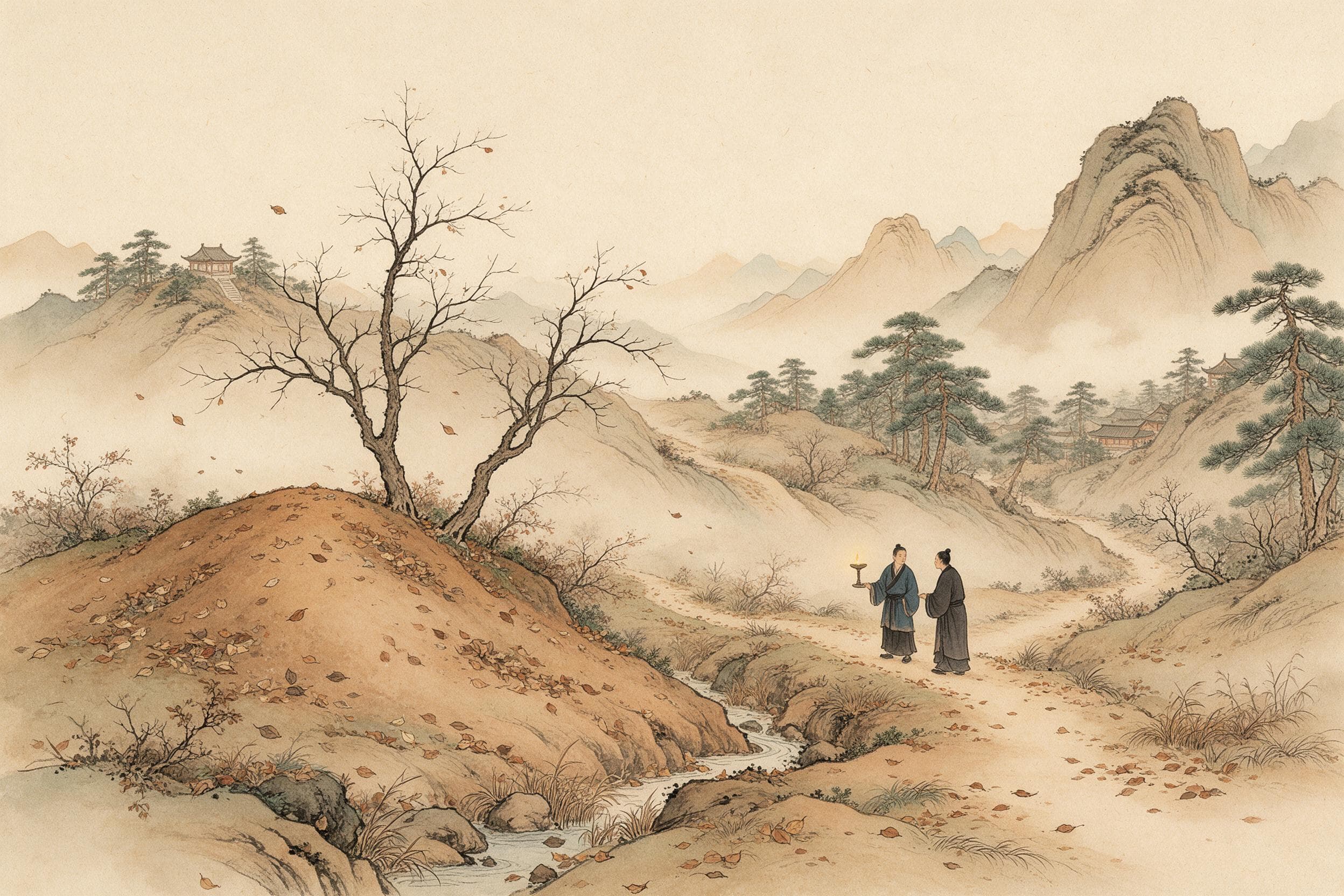
The ordinance begins with form, and it is all negative: 'the mausoleum takes the mountain for its body; no mound, no trees, no resting hall, no garden town, no spirit road' (壽陵因山爲體,無爲封樹,無立寑殿,造園邑,通神道). He cites two ancient burials — Yao at Gulin, where trees were left growing, and Yu at Kuaiji, where fields were not disturbed — concluding that 'mounds and groves are not of high antiquity; I do not take them up' (封樹之制,非上古也,吾無取焉). This is a claim about form, not a plan: neither page gives dimensions, boundaries, or a word about the interior.
Half his reasoning is form; the other half hiding: 'burial is storage, and the point is that men cannot see it. Bone has no knowledge of pain or itch, and the mound is no dwelling for a spirit; the rites do not sacrifice at the grave, lest living and dead be defiled; a coffin and an outer coffin suffice to rot the bones, and clothes and coverlet suffice to rot the flesh' (夫葬也者,藏也……衣衾足以朽肉而已). This is his own argument, not a ritual quotation; the clause on not sacrificing at the grave is stated once and never developed.
No Gold, No Jade
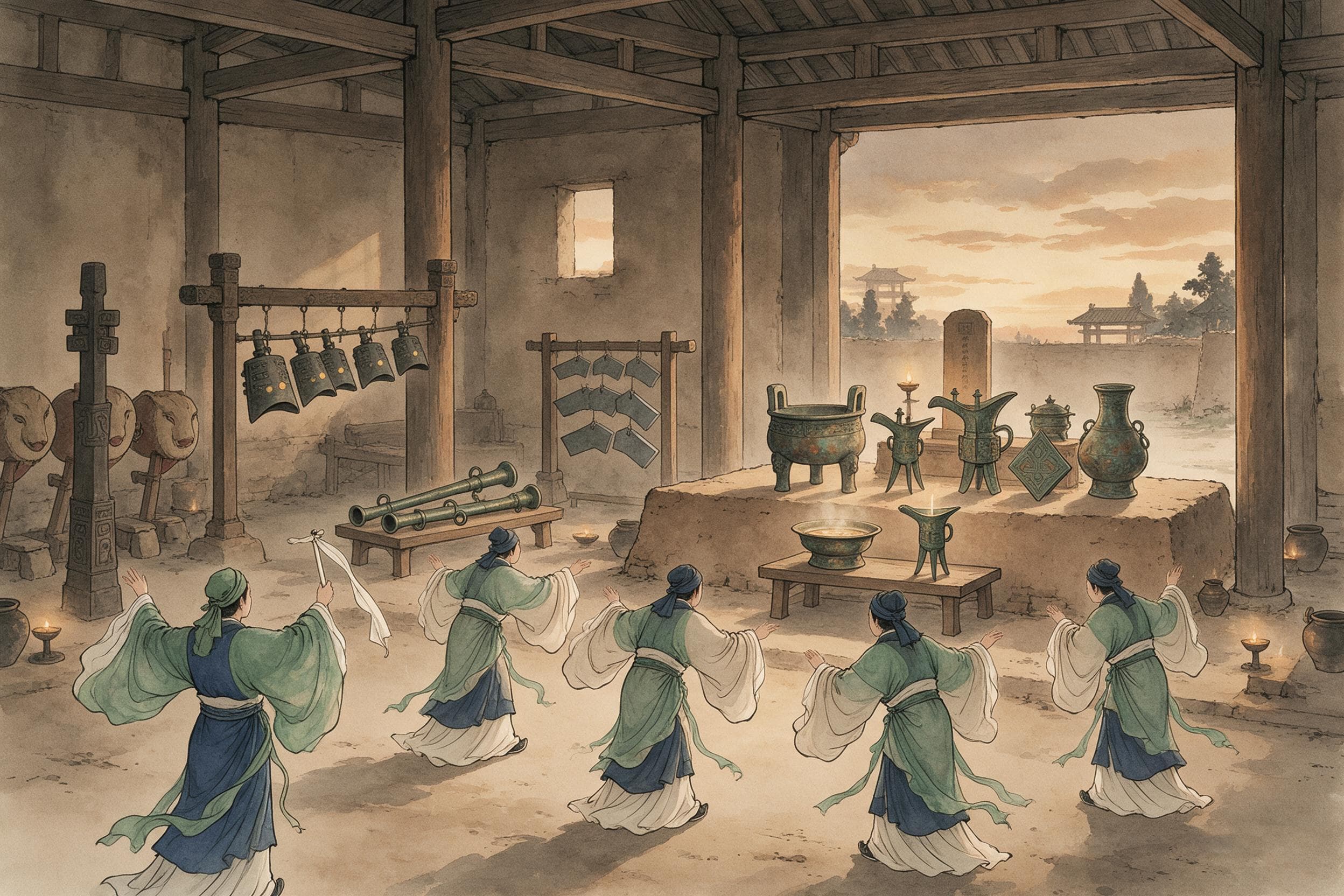
The grave goods are listed: 'no reed charcoal, no gold, silver, copper or iron; nothing but pottery, in keeping with the old idea of the clay cart and straw figures. The coffin is to be lacquered three times at the joins only; the mouth-filling is not to use pearls or jade; no pearl-sewn shroud, no jade case — the doings of foolish custom' (無施葦炭,無藏金銀銅鐵,一以瓦器……無施珠襦玉匣,諸愚俗所爲也). Neither page glosses the reed charcoal or the clay cart and straw figures; this article does not fill in their shapes.
His father had made the same kind of arrangement. The Tong Dian records that Cao Cao, 'had four cases of final garments made ahead, each labelled, for the four seasons, saying that if the unforeseen came they were to be used by season; of gold, earrings, pearls, jade, copper and iron, not one thing was to be sent with him' (先自製送終衣服四篋……一不得送). Cao Pi's ordinance also names two old Spring and Autumn cases — Ji Sun buried with a jade, Confucius crossing the steps to stop it; the Duke of Song's lavish burial blamed on Hua Yuan and Yue Ju — without explaining them, and neither page annotates them. Those are the only Wei rules of the kind on the pages; no third man, no sign of a fashion, so 'Wei buried cheaply' is more than they carry.
No State Lasts, No Tomb Is Unrobbed
Then the sentence everyone quotes: 'from antiquity to now there has been no state that did not perish, and no tomb that was not opened. Since the troubles began, every Han imperial tomb has been dug, until the jade cases and gold threads were burned out and the bones with them — the punishment of burning, and is it not bitter? The calamity comes from lavish burial and from mounds and groves' (自古及今……禍由乎厚葬封樹). Read it as argument: he is persuading ministers to accept his arrangement, not compiling a survey; the pages give no list of opened tombs, no dates or counts.
He offers two cases: 'Han Wen was not robbed because Ba ling had nothing to seek; Guang Wu was robbed because Yuan ling had a mound and trees. The safety of Ba ling was Zhang Shizhi's doing; the digging of Yuan ling was Emperor Ming's crime' (漢文帝之不發……罪在明帝). The Tong Dian's text of Han Wen's own last decree orders that 'the mountains and rivers at Ba ling stay as they are' (霸陵山川因其故,無有所改), and Ying Shao notes 'taking the mountain for the burial, raising no mound' (因山爲藏,不復起墳). So 'taking the mountain as the body' was not Cao Pi's invention; Ba ling already did it. The 'Emperor Ming' here is the Han emperor Ming, Guang Wu's son; the Pei Songzhi note later on the same page names another, Cao Rui of Wei. Two emperors, one title, not to be merged.
Break This Ordinance, and I Am Mutilated Below Ground
He knew paper could not bind the living, so he made it heavy: 'if this ordinance is disobeyed and anything is altered or added, may I be mutilated below the ground, mutilated again and again, die and die again. Let the minister who does it be one who treats his dead lord with contempt, disloyal and unfilial; if the dead know anything, may they not bless you' (若違今詔……將不福汝). He also fixed the filing: 'this ordinance is to be kept in the ancestral temple, with copies in the master of writing's office, the secretariat, and the three excellencies' (藏之宗廟,副在尚書、祕書、三府).
Even the consorts were provided for: 'the empress and the honoured ladies below her who do not go to the king's fief — when they die, all are to be buried west of the stream, and the place has already been marked out' (其皇后及貴人以下……皆葬澗西). His reason is the old story of Shun at Cangwu, his two wives not following, and Yanling burying his son far off at Ying and Bo: 'if the soul has awareness, there is nowhere it does not go; one stream's width is not distance' (魂而有靈……不足爲遠). It keeps the consorts from raising great tombs.
Afterwards
In the fifth month of huangchu 7 (226) Cao Pi died at Jiafu hall, aged forty; in the sixth month he was buried at Shouyang. The Records adds one line: 'from the laying out to the burial, everything was done according to the final ordinance' (自殯及葬,皆以終制從事). That is a single sentence of report, not a survey of the tomb: nothing on what became of Shouyang, no dimensions, no mound, no chamber. The Wei shi chunqiu adds one more item: the new emperor Ming wished to attend the funeral, and Cao Zhen, Chen Qun and Wang Lang 'urged him against it on account of the heat, and he stayed' (以暑熱固諫,乃止).
The same juan records the other side. In huangchu 2 'he built Lingyun terrace'; in 3 'he dug Lingzhi pond'; in 4 'he built the Southern Tour terrace at Wan'; in 5 'he dug Tianyuan pond'; in 7 'he built the Jiuhua terrace' — the man writing himself a cheap burial was raising terraces and digging ponds. Those are palace and garden works, not tombs, and the page says so. Pei Songzhi's note adds that 'only under Emperor Ming were the Taiji and Zhaoyang halls begun on the Han southern palace site' — the son's building is another matter. And in 635 Yu Shinan, arguing against lavish burial, quoted the ordinance at length and judged that 'this ordinance of Wen of Wei may be said to understand the matter' (魏文此制,可謂達於事矣) — the text was cited as an argument, not proof it was carried out. Neither page gives the tomb's size, interior or later fate; this article cites no archaeology. Mourning dress is a separate article; this one is only about how one emperor told his own burial to be handled. Related reading: The Grades of Mourning Dress · The Wei Capital at Ye
Sources & further reading
- 《三国志》卷二·魏书·文帝纪(西晋陈寿;维基文库本,未与点校本复核) — The final ordinance in full, given under the tenth month of huangchu 3 (222): 'the mausoleum takes the mountain for its body; no mound, no trees, no resting hall, no garden town, no spirit road' (壽陵因山爲體,無爲封樹,無立寑殿,造園邑,通神道); 'burial is storage, and the point is that men cannot see it' (夫葬也者,藏也,欲人之不得見也); 'I am building this tomb on waste ground that will not feed anyone, so that after the dynasty changes no one will know where it is' (故吾營此丘墟不食之地,欲使易代之後不知其處); 'no reed charcoal, no gold, silver, copper or iron; nothing but pottery' (無施葦炭,無藏金銀銅鐵,一以瓦器), 'the coffin lacquered three times at the joins only, no pearls or jade in the mouth-filling, no pearl-sewn shroud or jade case' (棺但漆際會三過,飯含無以珠玉,無施珠襦玉匣); the two Spring and Autumn cases (Ji Sun's jade, the Duke of Song's burial); the comparison with Han Wen's Ba ling and Guang Wu's Yuan ling, and 'the digging of Yuan ling was Emperor Ming's crime' (原陵之掘,罪在明帝) — here the Han emperor Ming, not Cao Rui; the argument itself, 'no state that did not perish, no tomb that was not opened … the calamity comes from lavish burial and from mounds and groves' (自古及今,未有不亡之國,亦無不掘之墓也……禍由乎厚葬封樹); the curse on anyone who alters it (若違今詔……將不福汝) and the filing of copies in the ancestral temple, the master of writing's office, the secretariat and the three excellencies; the consorts to be buried west of the stream (皆葬澗西). The chapter also records his death in huangchu 7, aged forty, burial at Shouyang, and the single line 'from the laying out to the burial, everything was done according to the final ordinance' (自殯及葬,皆以終制從事) — a report, not an inspection. The same juan lists his terraces and ponds (Lingyun terrace, Lingzhi pond, Southern Tour terrace, Tianyuan pond, Jiuhua terrace), and Pei Songzhi's note records that under Emperor Ming the Taiji and Zhaoyang halls were begun.
- 《通典》卷七十九·礼三十九·凶礼一(唐杜佑;维基文库本,未与点校本复核) — The Tang compilation's chapter on imperial death and tombs, which carries the Wei material in a different text. Cao Cao's own arrangement: 'he had four cases of final garments made in advance, each labelled, for spring, summer, autumn and winter … of gold, earrings, pearls, jade, copper and iron, not one thing was to be sent with him' (先自製送終衣服四篋……金珥珠玉銅鐵之物,一不得送). The final ordinance in abridged form: 'the mausoleum takes the mountain for its body; no mound, no trees, no resting hall, no garden town; this ordinance is kept in the ancestral temple' (壽陵因山為體,無封樹,無立寢殿,無造園邑。此詔藏之宗廟) — note that this text lacks the Shi Ji's 'no spirit road' clause and reads slightly differently. It also preserves Han Wen's last decree ('the mountains and rivers at Ba ling stay as they are, with nothing changed', 霸陵山川因其故,無有所改) with Ying Shao's note 'taking the mountain for the burial, raising no mound' (因山為藏,不復起墳), which is the precedent for Cao Pi's phrase. Du You's own verdict: 'this ordinance of Wen of Wei may be said to understand the matter' (魏文此制,可謂達於事矣). And in 635 Yu Shinan, opposing lavish burial, copied the ordinance into his memorial and quoted Zhang Shizhi's words about 'if there is something to desire inside, even walling in the southern mountain leaves a crack' — evidence of the text's later use as an argument, not of its execution.