A wine office, in the Zhouli's account, is a place where nothing leaves without being written down: what was issued, when, and in what quantity. The entries are closed at the end of the day, summarised at the end of the month and reckoned at the year's end, and the men in charge are judged by the standard of the wine (以酒式誅賞). The one item the books do not carry is the king's and queen's own drinking.
An Office for Wine
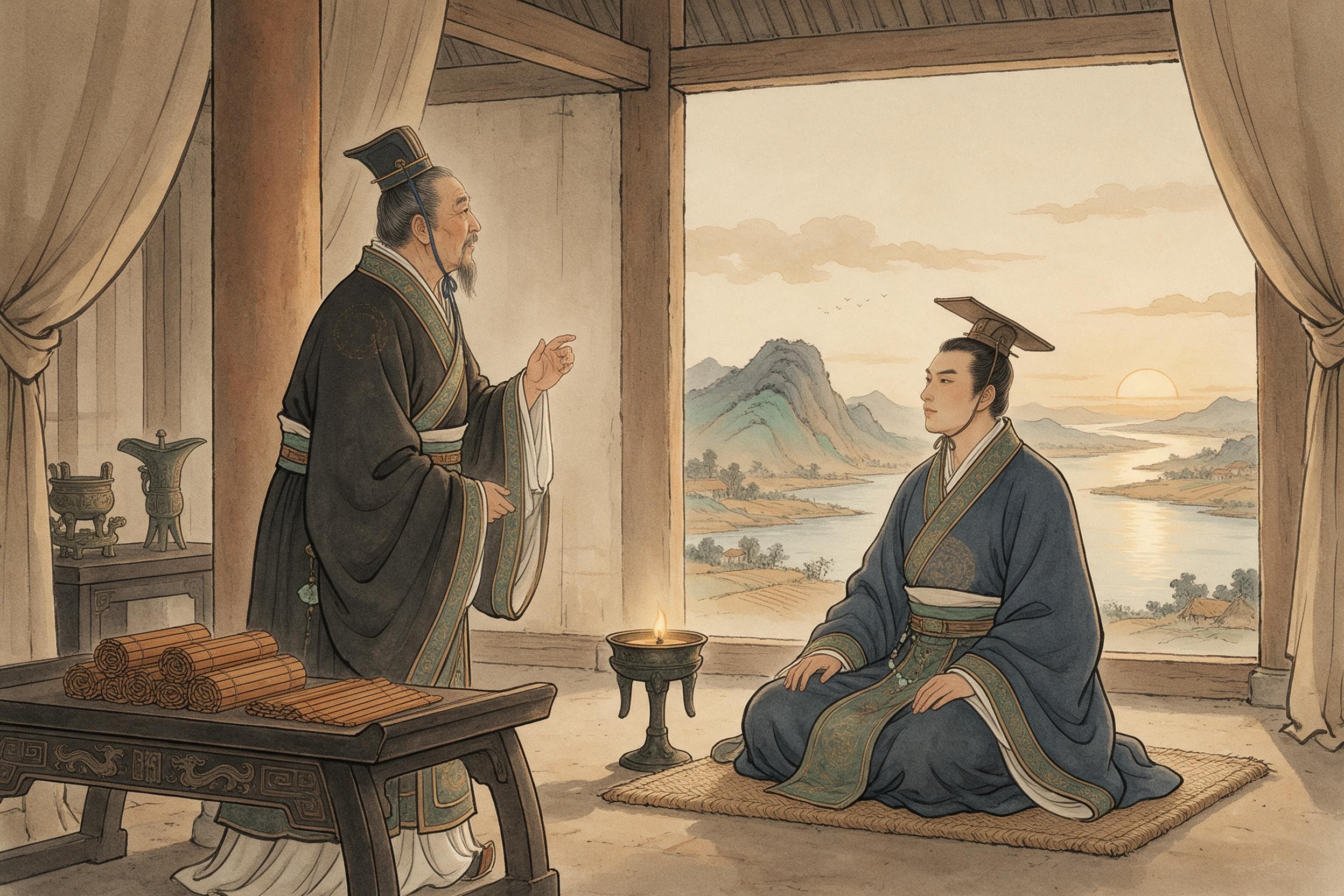
The establishment comes first. The wine director (酒正): four middle knights, eight junior knights, two keepers of stores, eight scribes, eight couriers, eighty menials (中士四人,下士八人;府二人,史八人,胥八人,徒八十人). The wine men (酒人): ten eunuchs, thirty women of wine, three hundred attendants (奄十人,女酒三十人,奚三百人); it is they who make the five ferments and three wines and serve them at sacrifices (掌為五齊三酒,祭祀則共奉之), and who bring in the wine for guests (共賓客之禮酒、飲酒而奉之). The beverage men (漿人): five eunuchs, fifteen women of beverages, a hundred and fifty attendants (奄五人,女漿十有五人,奚百有五十人). These are establishments, not a census: the text says how many posts the office was meant to have.
What the director does is issue the materials and sort the produce. He 'holds the government of wine, and by rule and method issues the wine materials' (掌酒之政令,以式法授酒材). Then the sorts. Five ferments (五齊): 泛齊, 醴齊, 盎齊, 緹齊, 沈齊. Three wines (三酒): 事酒, 昔酒, 清酒. Four drinks (四飲): 清, 醫, 漿, 酏. The page prints the names and no gloss. The beverage men's entry, however, lists six drinks — water, 漿, 醴, 涼, 醫, 酏 (六飲水、漿、醴、涼、醫、酏) — which is not the same set as the director's four; the two entries do not line up, and no note on the page reconciles them.
Eight Vessels and a Ledger
For sacrifice the director supplies the five ferments and the three wines 'to fill eight vessels' (以實八尊). A great sacrifice receives three extra sets, a middle one two, a small one one (大祭三貳,中祭再貳,小祭壹貳), and there is a count of cups for each; the ferment wines alone are not doubled (唯齊酒不貳). The word 貳 means a second, or subsidiary, vessel — generally so taken. The director also supplies the queen's and the heir's drinks and wine (及後、世子之飲與其酒). For the king's own banquets the wine is supplied 'according to the count' (共其計); for feasts of knights, elders and orphans there is 'no count of cups' (無酌數).
Issuing is by warrant: 'whoever holds a rank-allotment of wine receives it on a written tally' (凡有秩酒者,以書契授之), and grants and rewards are given 'by rule and method' (皆有法以行之). Then the ledger: 'What the wine director issues is entered as completed at the end of the day and summarised at the end of the month; the junior steward hears it. At the year's end there is a reckoning — except the drinking of the king and queen is not reckoned — and men are rewarded or punished by the standard of the wine' (酒正之出,日入其成,月入其要,小宰聽之。歲終則會,唯王及後之飲酒不會,以酒式誅賞). An office measured by its wine, with two drinkers struck from the measure.
A Farm Manual
The second book is not an office manual but a farm manual, and not the same world. The Qimin yaoshu (齊民要術) is a sixth-century northern Chinese agricultural compendium by Jia Sixie (賈思勰); its seventh juan tells a household how to make starter and how to brew. It has no officers, no sacrifices, no ledger. Between the Zhouli's ideal bureaucracy and this courtyard lie several centuries, and the two cannot be used to prove each other; they are read here as two kinds of text.
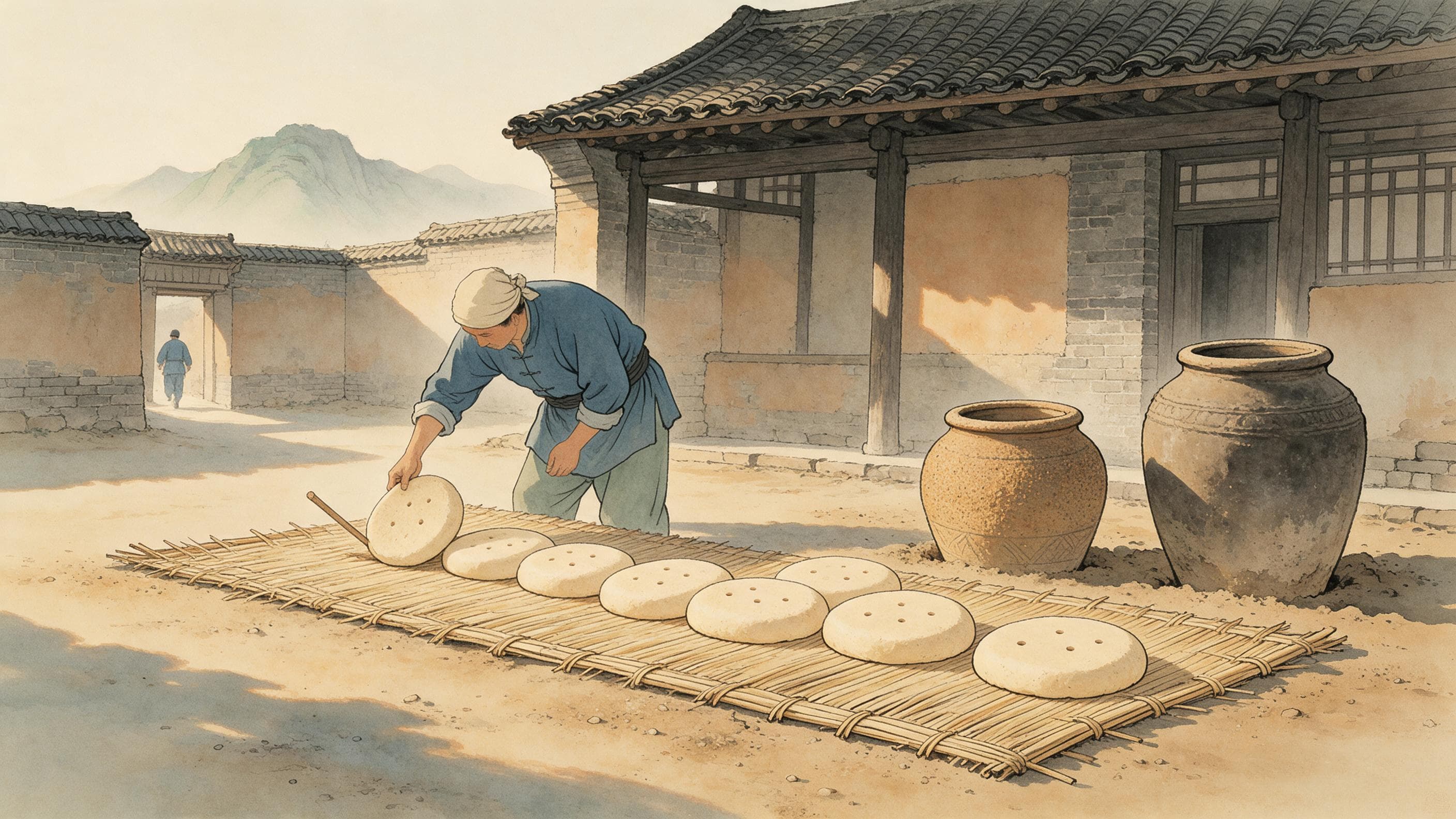
The starter is made from wheat in three states: 'for three hu of wheat starter, steam, roast and leave raw one hu each' (凡作三斛麥麴法:蒸、炒、生,各一斛). The roasted wheat is taken to yellow but not scorched; the raw is picked over and cleaned; each is ground separately, fine, and the three are mixed. Of the two starter recipes on the page, the shorter is the more precise: the cakes are made in a round iron mould 'five cun across and one and a half cun thick' (徑五寸,厚一寸五分), trodden hard by strong men on a flat board, and pierced with a wooden peg (以杙刺作孔). They lie in a clean room with an east-facing door, windows and seams sealed with mud against any draught; turned in place at seven days, gathered at fourteen, taken out at twenty-one and dried in the sun — 'the starter is done' (麴成矣).
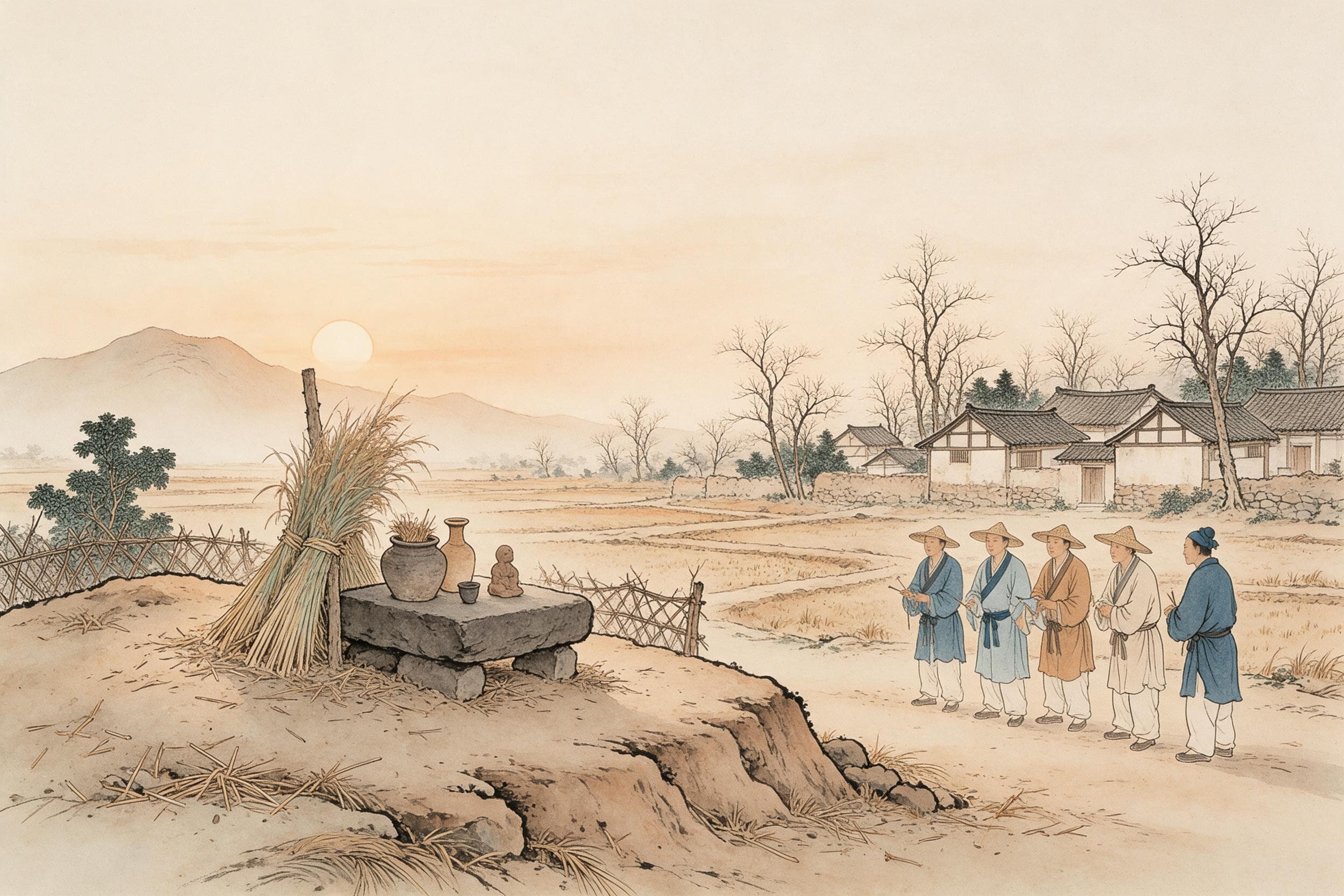
The fuller recipe is the same grain and a different occasion. It begins with a chosen day — 'in the seventh month, on a middle yin day' (七月取中寅日) — and with boys in blue robes fetching water before sunrise, twenty hu of it, facing the direction of death (面向殺地). The mixing and rolling are done by boys and small children, all facing the same way. The ground is marked into paths and lanes, a 'starter man' (麴人) is set in each lane and five 'starter kings' (麴王) among them; wine, dried meat and boiled cakes are offered, and the master reads a text three times and bows twice. The page then marks the difference itself: the shorter recipe, it says, is the same as the first 'except that there is no longer any marking of paths, no wine and meat, no boiled cakes, no sacrifice to the starter king and no boys rolling cakes by hand' (無復阡陌、酒脯、湯餅、祭麴王及童子手團之事矣). Rite and workshop stand side by side on the same sheet, labelled.
Fish-Eye Water
Brewing begins with the dry cake. It is dried in the sun for about five days, brushed clean with a broom three times a day, broken up, and a dou of it is pounded in a mortar. 'If you steep one dou of starter, use five sheng of water. Steep for three days, until it seethes like fish-eye water; then feed in the rice' (若浸麴一斗,與五升水。浸麴三日,如魚眼湯沸,酘米). The rice is cleaned fine and washed twenty times; the wine rice is cooked soft, then 'spread out and cooled thoroughly' (舒使極冷,然後納之) before it goes into the jar.
Then the feedings. For a wine of glutinous or panicled millet, 'one dou of starter carries two shi one dou of grain' (一斗麴,殺米二石一斗), fed in four times: three dou first, five dou after one night, one shi after two more nights, three dou after three more (第一酘,米三斗;停一宿,酘米五斗…又停三宿,酘米三斗). A glutinous-rice wine differs: one dou of starter carries one shi eight dou, and the grain goes in three times and no more (唯三過酘米畢).
What the Two Books Do Not Give
Neither book gives a strength, a yield, a cost or a drinker. The Zhouli's numbers are posts, not people; its five ferments and three wines are names with no gloss on the page, so what they tasted like cannot be recovered from it. The farm manual's measures are for a household whose size, equipment and success the text never reports: it says how, not how much, and never whether the brew turned out. Put side by side, the two books show two ways of speaking about one liquid — one counts men and vessels and closes a ledger, the other counts dou and days and waits for the surface to look like fish eyes. They are not evidence for each other.
Related reading:The Swallow and the Birth of Shang: Two Lines of Verse and a Story · The Call from the Roof: A Death, Step by Step · Records and Statutes: What the Shang Had, and What Survives
Sources & further reading
- 《周礼·天官冢宰》(酒正、酒人、浆人;战国至汉初成书;维基文库本,未与点校本复核) — The wine officers of the Zhouli with their establishments counted to the last menial; the director issues the raw materials, distinguishes five ferments, three wines and four drinks, supplies eight sacrificial vessels with three, two or one extra sets, and keeps the accounts daily, monthly and yearly — except that the king's and queen's own drinking is never audited. The beverage men's entry lists six drinks, not four; the page reconciles nothing.
- 贾思勰《齐民要术》卷第七(造神麴饼酒第六十四等;六世纪北朝;维基文库本,未与点校本复核) — A sixth-century northern farm manual. Three hu of wheat starter, one hu each steamed, roasted and raw; two recipes on the page, the fuller with a chosen day, boys in blue fetching water facing the direction of death, and five starter kings, the shorter with an iron mould five inches by one and a half and no rite at all; then brewing — a dou of starter in five sheng of water for three days, until it seethes like fish-eye water, then rice fed in four times, one dou of starter carrying two shi one dou of grain.