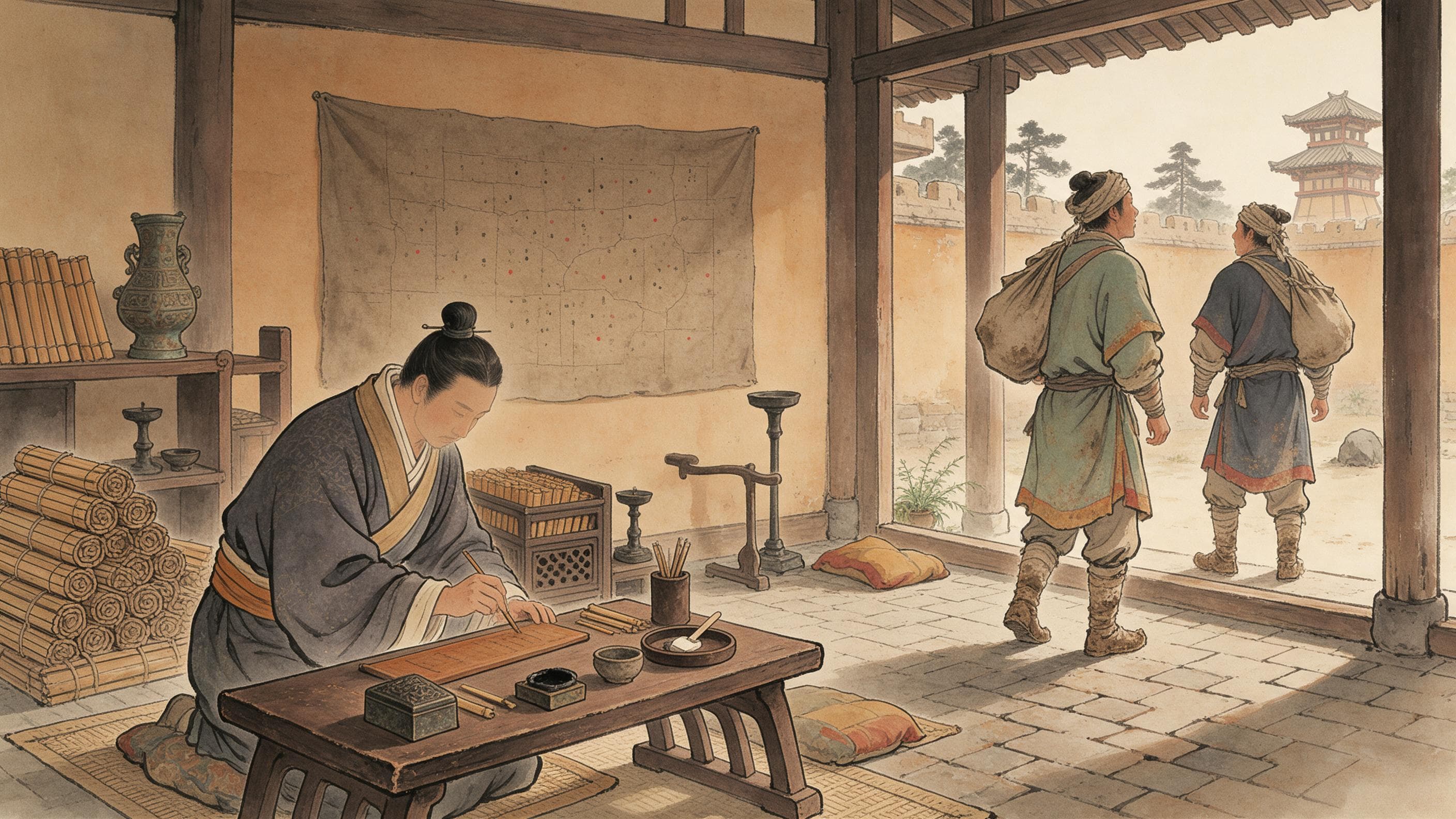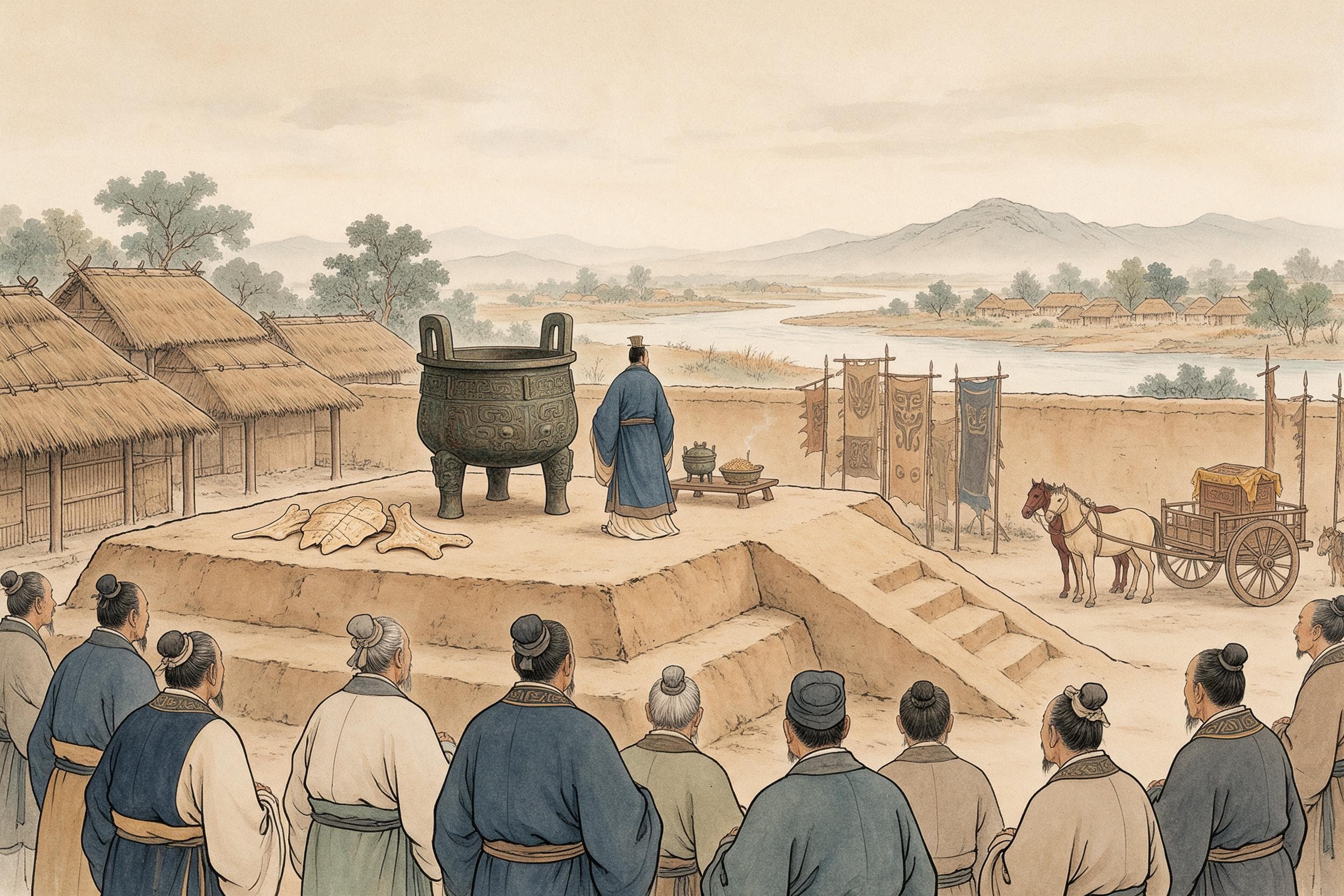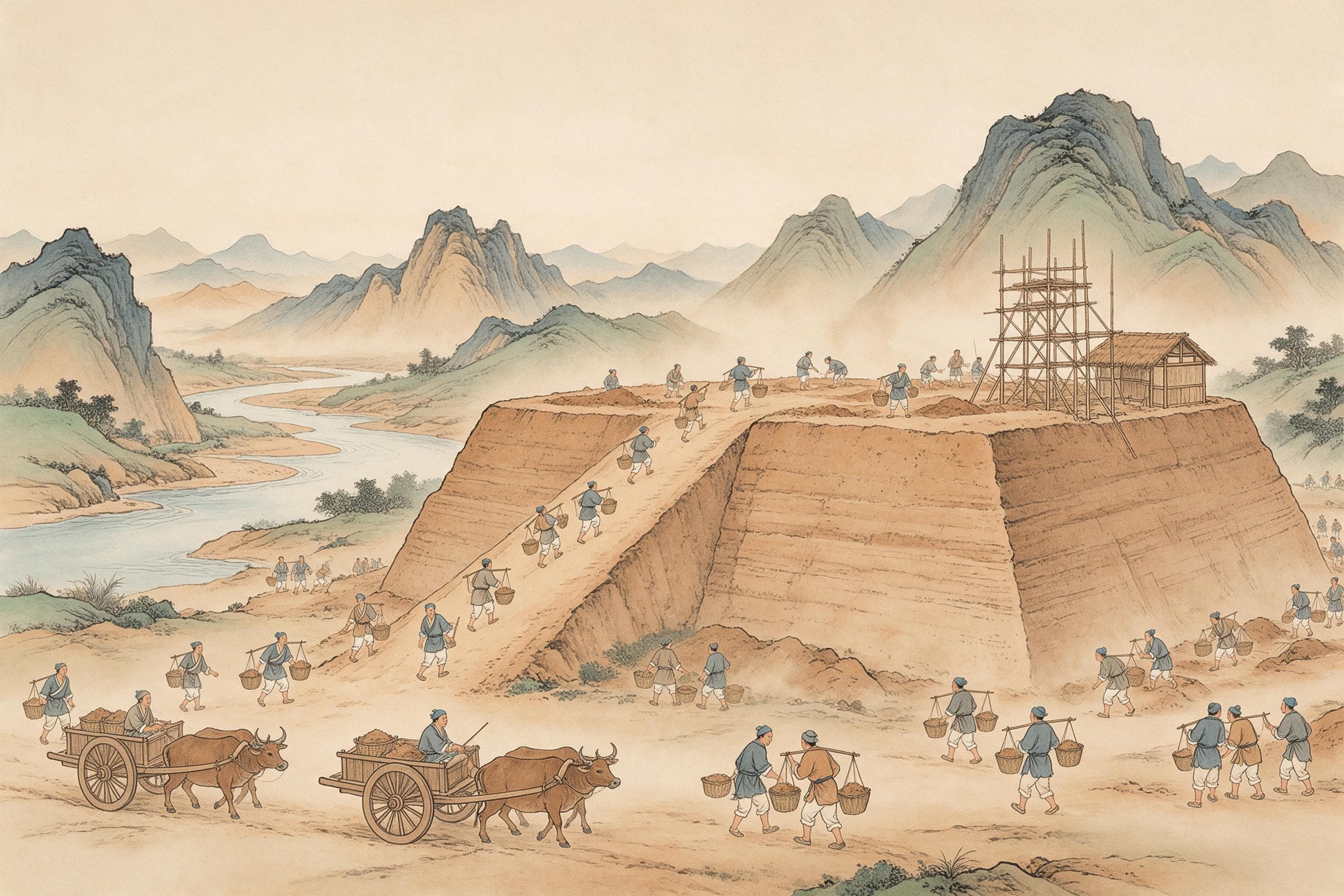
One sentence holds two things: more than seven hundred thousand men, and a river of mercury. The Shiji's chronicle of the First Emperor describes the burial: 'From the beginning of his reign he had cut and governed Lishan, and when he had united the world, convicts were sent there from all under heaven, more than seven hundred thousand of them. They cut through three springs, poured bronze and set the coffin; palace halls, offices and wonders of every kind were moved in until they filled it. Artisans were ordered to make crossbow triggers, so that any who came near would be shot. Rivers, the Yangtze, the Yellow River and the great seas were made of quicksilver and mechanically circulated; above were set the heavens, below the earth; fish-oil was used for candles, meant to burn without going out.'
Lishan in the Chronicle
Two more sentences follow. The Second Emperor said that the childless women of the palace should not be sent away, and 'all were made to follow the dead, and many died'; and when the burial was done, for fear the artisans would reveal the machinery, 'the artisans and the store-keepers were all shut in, and none came out again'. Then trees and grass were planted, 'to make it look like a mountain'. All of this stands in the chronicle, beside the year-lists, the progresses and the inscribed stones. The passage gives no height, no circuit, no depth for the three springs.
The figure of seven hundred thousand appears twice, and the two belong together. In the thirty-fifth year: 'more than seven hundred thousand convicts were set to work on the Afang Palace, or at Lishan' — one body of men split between two sites. At the burial: 'convicts were sent there from all under heaven, more than seven hundred thousand of them.' So the number is both cumulative — the work began when he took the throne — and shared, at least in the thirty-fifth year, with a palace. It cannot be read as seven hundred thousand men at one tomb at one time.
Liu Xiang's Quotation
In the Han shu's life of Liu Xiang, the court was building the Changling tomb under Emperor Cheng; Liu Xiang sent up a remonstrance against its extravagance and held up Qin as the warning: 'The First Emperor of Qin was buried in the fold of Lishan: below he sealed the three springs, above he raised a mountain mound more than fifty zhang high and more than five li around; stone coffins made a travelling palace, human fat the lamps, quicksilver the rivers and seas, gold the wild ducks and geese. Of the treasures hidden, the ingenuity of the machinery, the beauty of coffin and shell, the splendour of palaces and halls, one cannot finish the account. He also killed many palace women and buried artisans alive, reckoned by the ten thousand. All under heaven suffered his corvée and turned against him; the work at Lishan was not finished when Zhou Zhang's army of a million reached its foot.' Before Qin the passage has already set Confucius and the modest graves of antiquity against lavish burial. He goes on to the desecrations: Xiang Yu burning the buildings, a shepherd's strayed sheep setting fire to the buried coffins.
The use of the passage matters. Liu Xiang is not reporting a discovery; he is arguing. His conclusion is that 'the thicker the virtue, the thinner the burial; the deeper the knowledge, the humbler the grave', and that where virtue is thin the mound is high and 'the digging up will be swift' — and he turns at once to the emperor's own Changling. The more splendid he makes Qin's tomb, the better his case that lavish burial invites desecration. Quoting these lines means carrying that purpose with them: Liu Xiang is speaking to Emperor Cheng.
Numbers and Descriptions
The two figures are not on the same level. 'More than seven hundred thousand' is the chronicle's number of labourers, cumulative and split between two sites; 'reckoned by the ten thousand' is Liu Xiang's estimate of the palace women killed and artisans buried alive — a death toll. They cannot be added, and the smaller cannot be used to scale the larger, still less to compute how many stood on the site at once: neither page gives a schedule or a muster.
The mercury belongs to the same problem. 'Rivers and seas of quicksilver, mechanically circulated' is the chronicle's description; Liu Xiang writes 'quicksilver for rivers and seas'. Both are words, not finds. Whether such a river lies in the tomb, neither page shows; this article does not write 'proved'. 'Fifty zhang high and five li around' is likewise Liu Xiang's estimate, not a measurement.
Two Kinds of Page
One is a chronicle, year by year; the other is a memorial, built to persuade. The chronicle carries legendary detail — candles of fish-oil, crossbow triggers to shoot intruders. The memorial carries comparison and conclusion — lavish burial will be robbed. Every quotation needs its speaker and its purpose: one is a historian recording, the other is Liu Xiang addressing an emperor. Read together without that distinction, the rhetoric of a memorial becomes the dimensions of a building.
What can be written is how these two books describe Lishan. What cannot: that archaeology has proved the rivers of mercury; that seven hundred thousand men worked at once; that the tomb is as the chronicle says. The first turns words into evidence, the other two turn a total into a shift roster. It is also why the same sentences can serve as description in one book and as evidence in another.
What Is Not Here
No plan of the tomb precinct, no dimensions of the chamber, no register of artisans, no death count, no duration of the works. No physical trace of the mercury, the fish-oil candles or the crossbow triggers. No exact number for the women made to follow the dead, and no statement of whether the work stopped when the emperor died. These pages describe and they argue; they do not survey. What this article writes, then, is how two books tell of one tomb, not an archaeological report on it.
In these pages Lishan is two different things. In the chronicle it is an underground world with 'the heavens above and the earth below', made to house a man who had just united the world. In the memorial it is a ready-made lesson that lavish burial is dug up again, used to stop another emperor from copying it. One mound, two ways of writing it — and the first question to ask of either is who is speaking, and to whom.
Related reading:Six Chi Six Cun: A War Chariot's Measurements and Two Ways of Counting a Sheng · Thirty-Six Commanderies: A Number Without a List · The Market North of the Palace: Liao's Southern Capital
Sources & further reading
- 司马迁《史记》卷六·秦始皇本纪(西汉;维基文库本,未与点校本复核) — The chronicle's account of the tomb. In the thirty-fifth year it says that 'more than seven hundred thousand convicts were set to work on the Afang Palace or at Lishan' (隱宮徒刑者七十餘萬人,乃分作阿房宮,或作麗山); at the burial it says that 'from the beginning of his reign the First Emperor had cut and governed Lishan, and when he had united the world, convicts were sent there from all under heaven, more than seven hundred thousand of them' (天下徒送詣七十餘萬人), who 'cut through three springs, poured bronze and set the coffin', filled the palace halls and offices with wonders, set crossbow triggers to shoot at anyone who approached, 'made rivers, the Yangtze, the Yellow River and the great seas out of quicksilver, mechanically circulated', 'above they set the heavens, below the earth', and used 'fish-oil for candles'. It adds that the Second Emperor had the childless women of the palace follow the dead, 'and many died', and that the artisans who knew the machinery were shut inside the tomb 'and none came out again', the mound then planted to look like a hill. It gives no plan, no dimensions and no duration of the work.
- 班固《汉书》卷三十六·楚元王传(刘向传,东汉;维基文库本,未与点校本复核) — A memorial, not a survey. Under Emperor Cheng the court was building the Changling tomb, and Liu Xiang submitted a remonstrance against the extravagance; to argue it he holds up Qin: 'the First Emperor of Qin was buried in the fold of Lishan: below he sealed the three springs, above he raised a mountain mound more than fifty zhang high and more than five li around; stone coffins made a travelling palace, human fat the lamps, quicksilver the rivers and seas, gold the wild ducks and geese. Of the treasures hidden, the machinery's ingenuity, the beauty of coffin and outer coffin, the splendour of palaces and halls, one cannot finish the account. He also killed many palace women and buried artisans alive, reckoned by the ten thousand. All under heaven suffered his corvée and turned against him; the work at Lishan was not finished when Zhou Zhang's army of a million reached its foot' (驪山之作未成,而周章百萬之師至其下矣). Liu Xiang then traces the desecrations — Xiang Yu burning the buildings, a shepherd's fire in the tomb — and draws the moral that 'the thicker the virtue, the thinner the burial', using Qin to argue that Emperor Cheng should stop building Changling. The figures are his, given in the course of an argument.