North of the palace in the Liao southern capital there was a market. What gathered there was written down a century after the city fell, by a Southern Song compiler, in four words: 'the hundred wares of land and sea'. The city itself had been taken over whole. In 938 the Later Jin ceded the sixteen prefectures, the Liao emperor raised the old Tang frontier town of Youzhou to Nanjing, and its walls, gates and lanes were left standing as they were. Two books describe the place, and neither was written by anyone who lived in it.
A city received whole
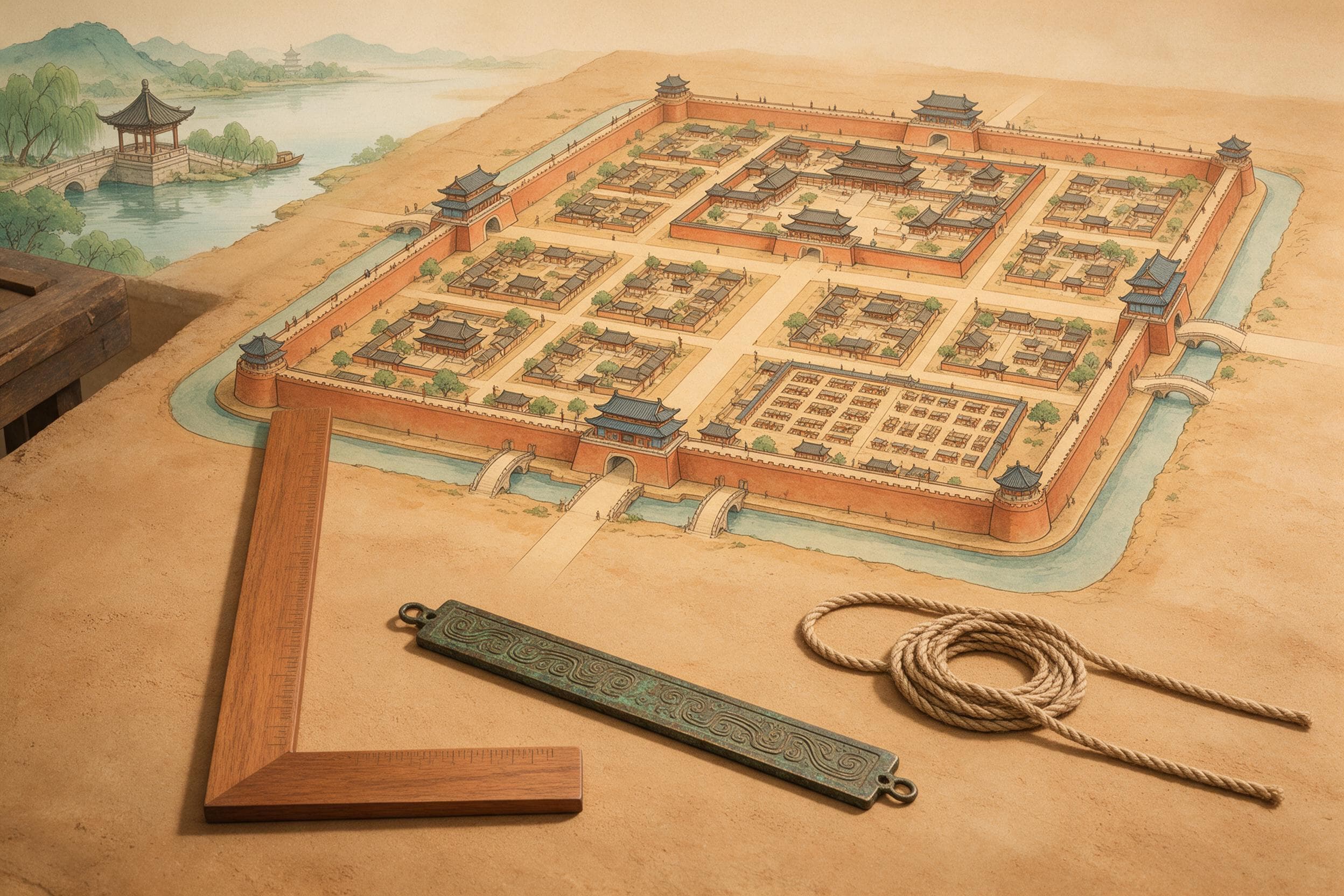
The Liaoshi's geography supplies the frame. 'The city was thirty-six li square, three zhang high, one zhang five chi broad; its embrasures and fighting galleries were complete. It had eight gates: in the east Andong and Yingchun, in the south Kaiyang and Danfeng, in the west Xianxi and Qingjin, in the north Tongtian and Gongchen.' The palace lay in the south-west corner, with portrait halls for Emperors Jingzong and Shengzong; the gate had towers, the ball court was south of it, the Yongping hostel to its east; the palace's west gate, Xianxi, was 'built and never opened'; a cool hall stood on the height of the western wall, the Yanjiao tower at the north-east corner. Then the entry stops listing: 'the wards and markets, the offices, the monasteries and shrines, are too many to write down.'
Households are given by county, not by city. Xijin, the county that held part of the capital, had twenty thousand households; Wanping had twenty-two thousand. The circuit's six prefectures and eleven counties each carry a figure, and one shows how a county was born: Xianghe was carved out of three neighbouring counties because 'the Liao set a salt monopoly office at Xincang, and residents gathered there' — a salt office pulled a new county into being. The Southern Song book gives one round number instead: 'households and mouths, three hundred thousand'. That is a retrospective estimate, not a register, and must not be added to the two counties' figures.
The market in the north
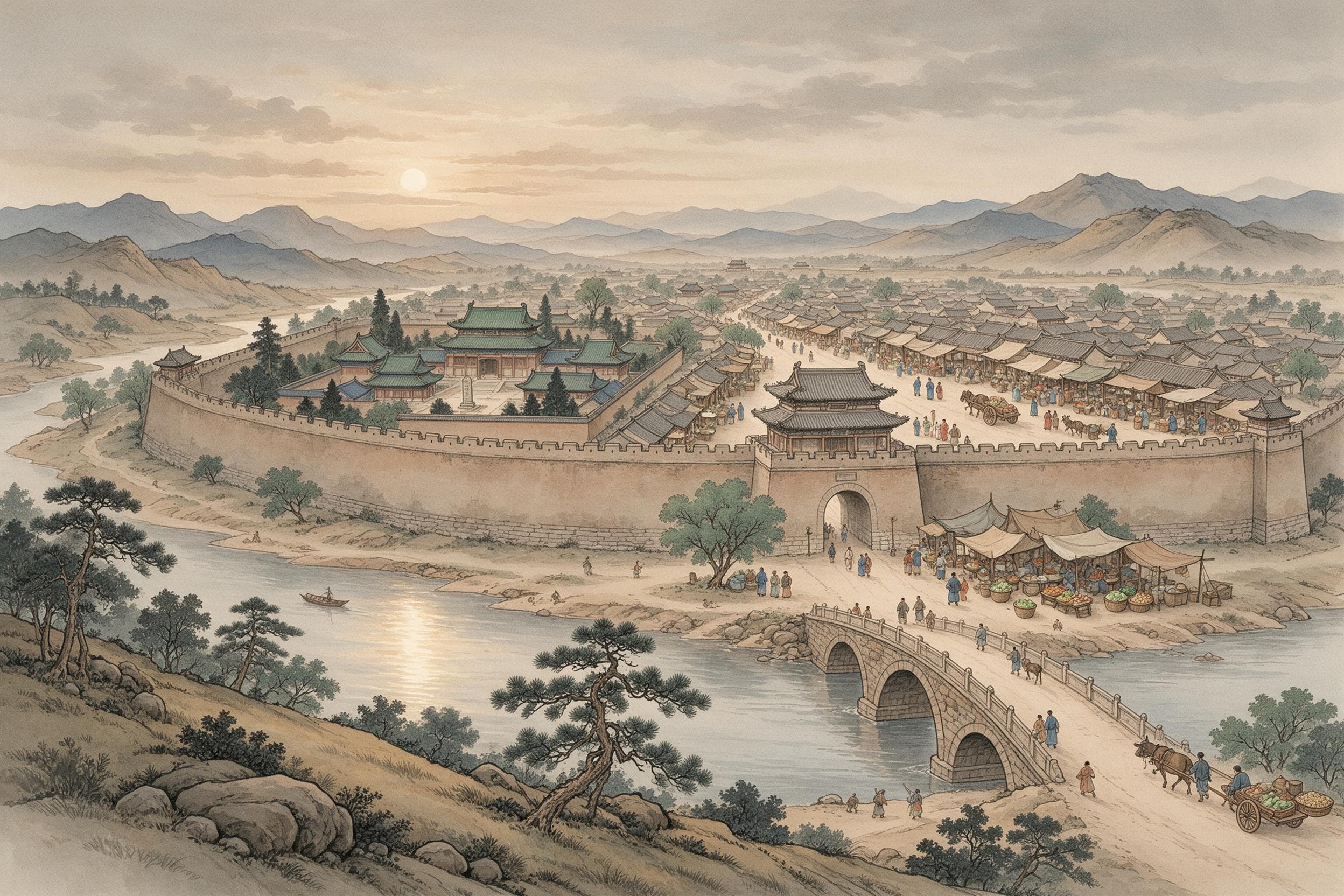
The market itself comes mainly from the Qidan guozhi: 'The great palace was magnificent; in the north of the city there was a market, and the hundred wares of land and sea gathered in it. Monasteries and Buddhist temples led the north. Brocades, silks and fine figured weaves were the finest under heaven. The vegetables, fruits and rice of the fat soil all came out, and mulberry, hemp, wheat, sheep, pigs, pheasants and hares need not be mentioned. The water is sweet and the soil deep; many are skilled, the best study books, the next practise archery, and they endure hardship.' Ye Longli presented it in 1180 from older records and Song reports; he never entered the city.
The nearest eyewitness inside the Liaoshi is a Song envoy. Wang Zeng's itinerary was copied into the geography: from Xiongzhou he crossed the river, went forty li to Xincheng, seventy to Zhuozhou, sixty to Liangxiang, crossed the Lugou — the Sanggan — and sixty li further came to Youzhou, 'called Yanjing'. 'The sub-city was built against the south-west of the outer wall. Due south was the Qixia gate, with the Yuanhe hall inside; the east gate was Xuanhe. The wards and lanes of the city all had towers.' He names two monasteries shown to envoys, Minzhong, founded by Tang Taizong for soldiers killed in the Liaodong campaign, and Kaitai, built by the Khitan prince Yelü Hanning; 'court envoys were sent to view them both'. Outside the south gate stood the Yue king's residence, used for banquets; beyond it the Yongping hostel, 'formerly the Jieshi hostel, renamed after the peace'. South of it was the Sanggan.
What the palace was for
For most of the year the palace at Nanjing was not where the emperor lived. It was the ceremonial and administrative plant of the south: portrait halls for two dead emperors, a ball court, a hostel for envoys, a princely residence for banquets. Money was handled here too — the Qidan guozhi, listing the five capitals' finance offices, puts first 'the Three Bureaus at Yanjing'. And this was the headquarters for the Song frontier: under the Yanjing route it lists a chief commander's office, a controlled horse-and-foot command, a military commission, the Niulan army-watch camp, the Shimen command, the northern and southern bodyguard offices and the Mengzhuaila office.
The southern capital's year also kept a piece of the steppe. Ninety li south-east of the city lay Yanyang marsh, 'several hundred li across; in spring geese and ducks gather there, in summer and autumn many water chestnuts'. Every spring the emperor hunted it: guards in dark green, each with a club, hawk food and a goose-spear, stood along the water five or seven paces apart; drums were beaten upwind to drive the geese off the water, and the emperor released a gyrfalcon. When a goose fell, the line stabbed it with their spears lest the hawk be overmatched, and fed it the fat. 'Whoever took the first goose was rewarded, as a rule, with silver and silk.' City and marsh were two halves of one season.
Roads, rivers and what the walls held
Wang Zeng's stages also describe the approach: forty, seventy, sixty, sixty li, with the Lugou crossed at the end — the Liaoshi's Sanggan, which lay 'to the south' of the city. The geography then lists the passes that made the place a gate: Juyong, Songting and Yulin, and the Gubei mouth; the rivers Sanggan, Gaoliang and Shizi; Mount Da'an and the Yan range, with the Yaoyu island among them. A capital in that position was a fortress before it was a market, and the Qidan guozhi says so: from afar the walls wound 'like a belt, coiling and circling', and the place was 'truly a state for the use of arms'.
Inside that frame the market is almost blank. 'Too many to write down' is all the Liaoshi says; neither book gives Nanjing a market regulation, a list of trades or a toll figure. What the city's economy rested on must be inferred from small entries — a salt office that pulled settlers into a county, three bureaus handling the south's revenue, brocades a Southern Song writer thought the finest under heaven. None of these is a price.
Three witnesses, not one
The two books are not the same kind of evidence. The Liaoshi was compiled in 1344 by a Yuan commission under Tuotuo from Liao records; its geography states institutions — walls, gates, counties, households — a Yuan reconstruction of Liao order. The Qidan guozhi is a retrospective, written after the Liao had fallen, and its praise of the city's goods is praise of a lost northern capital. Wang Zeng's itinerary sits inside the first book but belongs to a third voice: a Song envoy who walked the road in the early eleventh century and saw the wards himself. Three witnesses, not to be melted into one sentence.
So the city can be described but not audited. Thirty-six li of wall, eight gates, a palace in the south-west corner, towers over the lanes, a market in the north, two counties of twenty and twenty-two thousand households, and a round three hundred thousand in a later book: that is the frame. What is missing is everything a market is made of — the stalls, the guilds, the tolls, the prices, the people who bought and sold. The one scene with living persons is not in the market at all: the spring hunt, where the guard who took the first goose was paid in silver and silk.
Sources & further reading
- 《辽史》卷四十·地理志四·南京道(元脱脱等修;维基文库本,未与中华书局点校本复核) — Yuan compilation of Liao institutions, presented in 1344 with Tuotuo at the head of the commission. The Nanjing entry gives the wall (thirty-six li square, three zhang high), the eight gates, the palace in the south-west corner with its portrait halls, ball court, Yongping hostel and Yanjiao tower, the phrase that the wards, markets, offices and monasteries are 'too many to write down', and county households (Xijin 20,000, Wanping 22,000; Xianghe created after a salt monopoly office drew settlers). The same entry quotes the Song envoy Wang Zeng's itinerary through Xincheng, Zhuozhou and Liangxiang to Yanjing, describing the sub-city against the south-west corner, the Qixia gate, towers over the wards, the Minzhong and Kaitai monasteries and the Yongping hostel. It also records Yanyang marsh and the spring goose hunt. The history is a Yuan reconstruction of Liao order, not a Liao document.
- 叶隆礼《契丹国志》卷二十二·四京本末·南京(南宋,1180 年进书;维基文库本) — Southern Song retrospective, presented in 1180, compiled from earlier records and from Song envoys' reports; it is not a Liao self-description. Its Nanjing section gives the city as the old Youzhou raised to Nanjing, 'households and mouths three hundred thousand', the magnificent palace, 'in the north of the city there was a market, and the hundred wares of land and sea gathered in it', monasteries 'leading the north', brocades and fine silks 'the finest under heaven', the produce of the soil, and the people's skills. The same juan lists the Three Bureaus at Yanjing among the five capitals' finance offices and the Yanjing route's military commands facing Song. Its figures are round and retrospective, and are treated here as such.