In the second stanza of Changfa the names begin to line up: 玄王桓撥,受小國是達,受大國是達。率履不越,遂視既發。相土烈烈,海外有截. Xuan Wang and Xiangtu — two names, one line of action each, no explanation of who they are. This article reads the half of Changfa that no other piece has used: Xuan Wang, Xiangtu, the defeat of Wei and Gu, Kunwu and Jie, and the minister Aheng. The other hymn, Liezu, keeps only its preface line, because its offering table has already been read out line by line elsewhere. The material first: both pages are plain text of the Shang song, one Mao preface at the head, one stanza count at the foot, and the 註解 section empty.
One: two preface lines, two uses
Both pages print the Mao preface before the text, one line each: 毛詩序:「《長發》,大禘也。」 and 毛詩序:「《烈祖》,祀中宗也。」 What the great di sacrifice was and which Shang king Zhongzong was, the pages do not explain; a preface gives a label for use, not a rite and not an occasion. It is a later hand assigning each poem a place — and in the case of Liezu the word 中宗 does not occur in the poem at all. The poems have sacrificial language of their own: 以假以享, 來假來饗, 顧予烝嘗. That language is in the text; 大禘 and 祀中宗 are only in the prefaces. One is a use, the other is the text.
The pages also show where the two sit: Changfa between Xuan niao and Yin wu, Liezu between Na and Xuan niao. Each ends with its stanza count — Changfa in seven stanzas (one of eight lines, four of seven, one of nine, one of six), Liezu one stanza of twenty-two lines — and nothing else: no commentary at all, the 註解 section empty. The names that follow can only be written as the poem gives them.
Two: Xuan Wang, Xiangtu, and the war
The first two stanzas are a run of names: 濬哲維商,長發其祥。洪水芒芒,禹敷下土方。外大國是疆,幅隕既長。有娀方將,帝立子生商。玄王桓撥,受小國是達,受大國是達。率履不越,遂視既發。相土烈烈,海外有截。 Flood, Yu, Yousong, the Lord, Xuan Wang, Xiangtu — the poem gives names and actions and explains no one. Two of its lines, 有娀方將,帝立子生商 and, further down, 帝命式于九圍, are quoted in the article on the Shang high god, where the subject is who sends fortune and calamity; here they are read only for the names beneath them, and that is the whole of the overlap. 玄王 and 相土 carry no gloss: which ancestor Xuan Wang is, and what 相土 did beyond 海外有截, the page does not say. Commentators usually make 玄王 out to be Xie; that is their work, and this article does not allot the name.
The middle stanzas turn to Tang: 帝命不違,至于湯齊。湯降不遲,聖敬日躋。昭假遲遲,上帝是祗,帝命式于九圍. The last line is the second of those the high-god article uses; it is quoted here for the sequence of Tang's rise, not for the Lord. Two stanzas then speak of 受小球大球 and 受小共大共, of being 為下國綴旒 and 為下國駿厖 — what was received, and for which states, the poem leaves general.
The sixth stanza is the fighting: 武王載旆,有虔秉鉞。如火烈烈,則莫我敢曷。苞有三蘖,莫遂莫達。九有有截,韋顧既伐,昆吾夏桀. A banner raised, an axe held, fire, and four names in a row — Wei, Gu, Kunwu, Jie. No dates, no course of the campaign, no account of how any of the four were beaten; 武王 here is generally taken to be Tang, though the page says nothing. The last stanza changes tone: 昔在中葉,有震且業。允也天子,降予卿士。實維阿衡,實左右商王 — in the middle years there was shaking and there was work; true indeed is the Son of Heaven, who sent down a minister; this is Aheng, who stood at the Shang king's left and right. Aheng is the only minister named in the poem, generally understood to be Yi Yin, again with no note. The poem ends there: origins, Tang, war, one minister, and not a year or a city in the whole piece.
Three: Liezu, one preface line
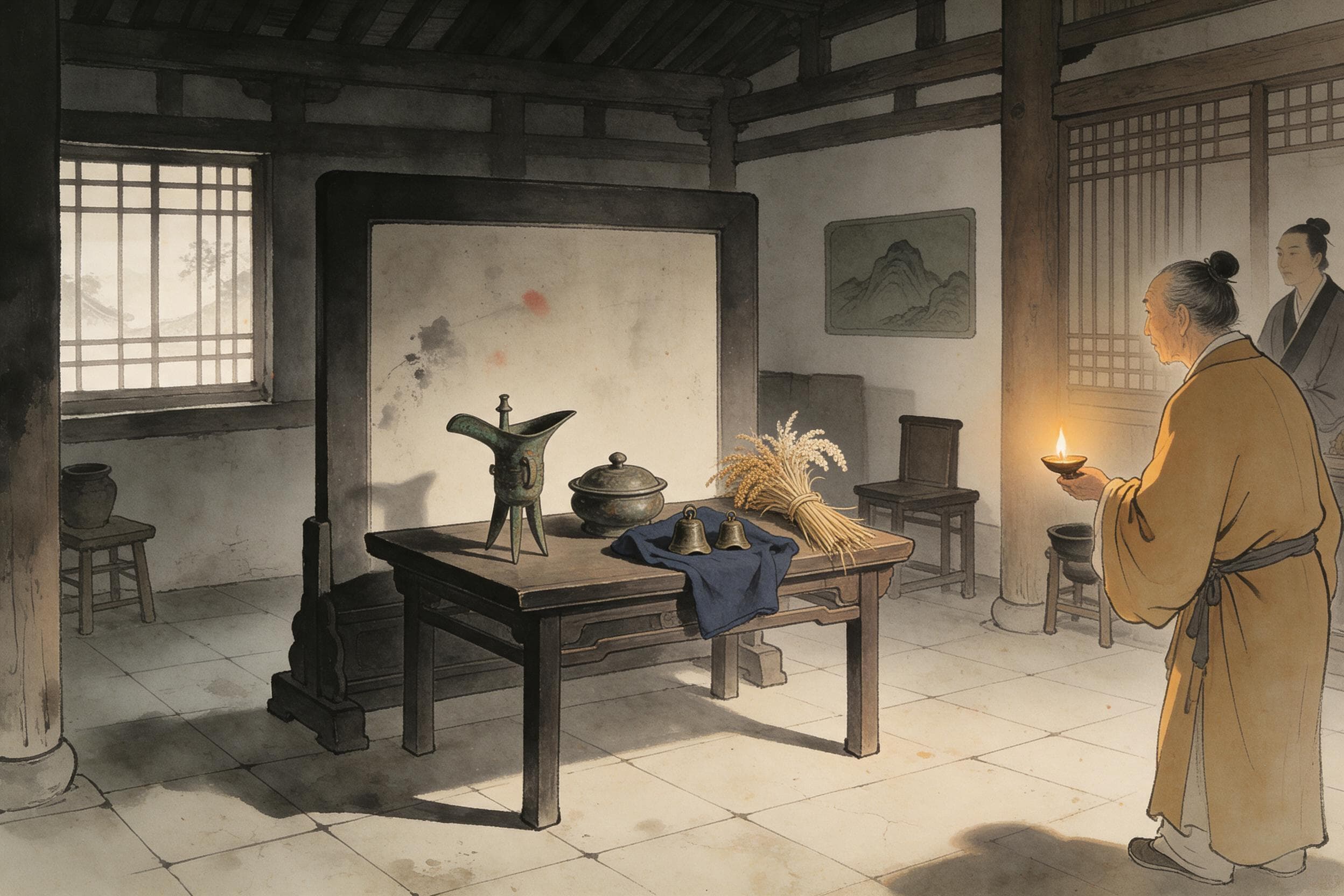
Liezu is one stanza of twenty-two lines, and its table — the wine 清酤, the broth 和羹, the carriage 約軝錯衡, the eight bells 八鸞, the voice of 湯孫 — has already been read line by line in At the Ancestral Sacrifice; this article does not repeat it. What is left here is the preface: 毛詩序:「《烈祖》,祀中宗也。」 A use assigned by a later hand. 中宗 is not named in the poem, and the page does not say which king he was.
So for Liezu the preface does all the work, and there is nothing else to add: a label, a use, a stanza count already counted elsewhere. The distinction is the hard part of both pages — a preface says where a poem was used, a poem says what it says, and these are not the same kind of statement. For the second hymn the page gives only the first.
Four: what the poems can say themselves
Changfa can be read as three runs. First the names of the beginnings — flood, Yu, Yousong, the Lord who establishes a son, Xuan Wang, Xiangtu. Then Tang and the mandate that does not depart. Then four defeated names and one minister. Liezu, with its table left to the other article, says little of its own that is not a blessing: 申錫無疆, 綏我眉壽, 降福無疆, and 顧予烝嘗,湯孫之將 — the only statement of identity inside either poem. Both hymns use 帝 and 上帝; both ask for 無疆; neither gives a year, a place, or an order of rites. The prefaces' two uses stand beside the poems, and cannot be read as their content.
Five: what the pages give, and do not
- The overlap is stated, not hidden: Liezu in full — 清酤, 和羹, 約軝錯衡, eight bells, 湯孫, even the count of one stanza and twenty-two lines — has been used line by line in the article on the ancestral sacrifice, and the lines 有娀方將,帝立子生商 and 帝命式于九圍 in the one on the Shang high god. This article takes only the remaining half of Changfa and draws a line under those two quotations.
- Both sources are one section of one book, the Shang song of the Book of Songs, not two independent documents; the texts come to a little over three hundred characters plus two preface lines, and nothing has been padded with object lore.
- The prefaces are marked as prefaces: the great di and the sacrifice to Zhongzong are uses assigned by a later hand, not the poems' own words; neither 大禘 nor 中宗 is explained on the pages.
- The poems give only their own text: 玄王, 相土, 韋, 顧, 昆吾, 夏桀 and 阿衡 are copied as written; names are not assigned — 玄王 gets no gloss, 武王 is Tang and 阿衡 is Yi Yin only as the usual understanding.
- No dating judgement: the article writes of the Shang song in the Book of Songs and does not claim these are Shang-period poems (the question is disputed, and the pages do not take a side).
- Lines kept apart: the swallow lines, Yin wu's southern campaign and the music and dance of the ancestral sacrifice are other articles; no general talk of Shang religion or of poetry and politics.
What remains, once the duplicated half is set aside, is a poem of names: a Lord who establishes a son, Xuan Wang and Xiangtu, Tang, four defeated enemies, and a minister called Aheng. The prefaces supply two uses, one of which now belongs to another article. The poem supplies names, and the page supplies no note to settle any of them.
Related reading:The Case Book: Cang Gong's Register of Patients · At the First Crow: One Day in a Gentleman's Household, According to the Rites · The Yin Honoured the Spirits: Three Dynasties Judged by a Later Hand
Sources & further reading
- 《诗经·商颂·长发》(维基文库本,白文,页首列毛诗序,页末列章句,未与中华书局点校本复核) — The page gives the Mao preface first — 毛詩序:「《長發》,大禘也。」 — and then the poem in seven stanzas: 濬哲維商,長發其祥。洪水芒芒,禹敷下土方。外大國是疆,幅隕既長。有娀方將,帝立子生商。/ 玄王桓撥,受小國是達,受大國是達。率履不越,遂視既發。相土烈烈,海外有截。/ 帝命不違,至于湯齊。湯降不遲,聖敬日躋。昭假遲遲,上帝是祗,帝命式于九圍。/ 受小球大球,為下國綴旒,何天之休。不競不絿,不剛不柔。敷政優優,百祿是遒。/ 受小共大共,為下國駿厖,何天之龍。敷奏其勇,不震不動。不戁不竦,百祿是總。/ 武王載旆,有虔秉鉞。如火烈烈,則莫我敢曷。苞有三蘖,莫遂莫達。九有有截,韋顧既伐,昆吾夏桀。/ 昔在中葉,有震且業。允也天子,降予卿士。實維阿衡,實左右商王。 The page ends with the stanza count — 《長發》七章:一章,八句;四章,章七句;一章,九句;一章,六句 — and the header places it between 玄鳥 and 殷武. The page carries no commentary: 註解 is empty.
- 《诗经·商颂·烈祖》(维基文库本,白文,页首列毛诗序,页末列章句,未与中华书局点校本复核) — The preface: 毛詩序:「《烈祖》,祀中宗也。」 — with 中宗 underlined and linked on the page. The poem, one stanza of twenty-two lines: 嗟嗟烈祖,有秩斯祜。申錫無疆,及爾斯所。既載清酤。/ 賚我思成,亦有和羹。既戒既平,鬷假無言。時靡有爭。/ 綏我眉壽,黃耇無疆。約軝錯衡,八鸞鶬鶬。/ 以假以享,我受命溥將。自天降康,豐年穰穰。/ 來假來饗,降福無疆。顧予烝嘗,湯孫之將。 The page ends 一章,二十二句, and its header places it between 那 and 玄鳥. No commentary on the page. This article keeps only the preface line from this page: the poem's vessels and bells are treated in the article shang-sacrifice-songs, and the stanza count has already been given there.