The Shang hymn Na opens 'how lovely, how fine! We set out our hand-drums' (猗與那與,置我鞉鼓) — the praise begins with the drums set out. The next line, 'we beat the drums, tang-tang, to gladden our forefather Tang' (奏鼓簡簡,衎我烈祖), says what the drumming is for. The other hymn, Lie Zu, opens with the wine: 'the clear wine is already set out' (既載清酤). Both are one-stanza, twenty-two-line songs for ancestral sacrifice. The Mao preface says Na honoured Tang and Lie Zu honoured Zhong Zong — a Han preface, not the poems.
We Set Out Our Hand-Drums
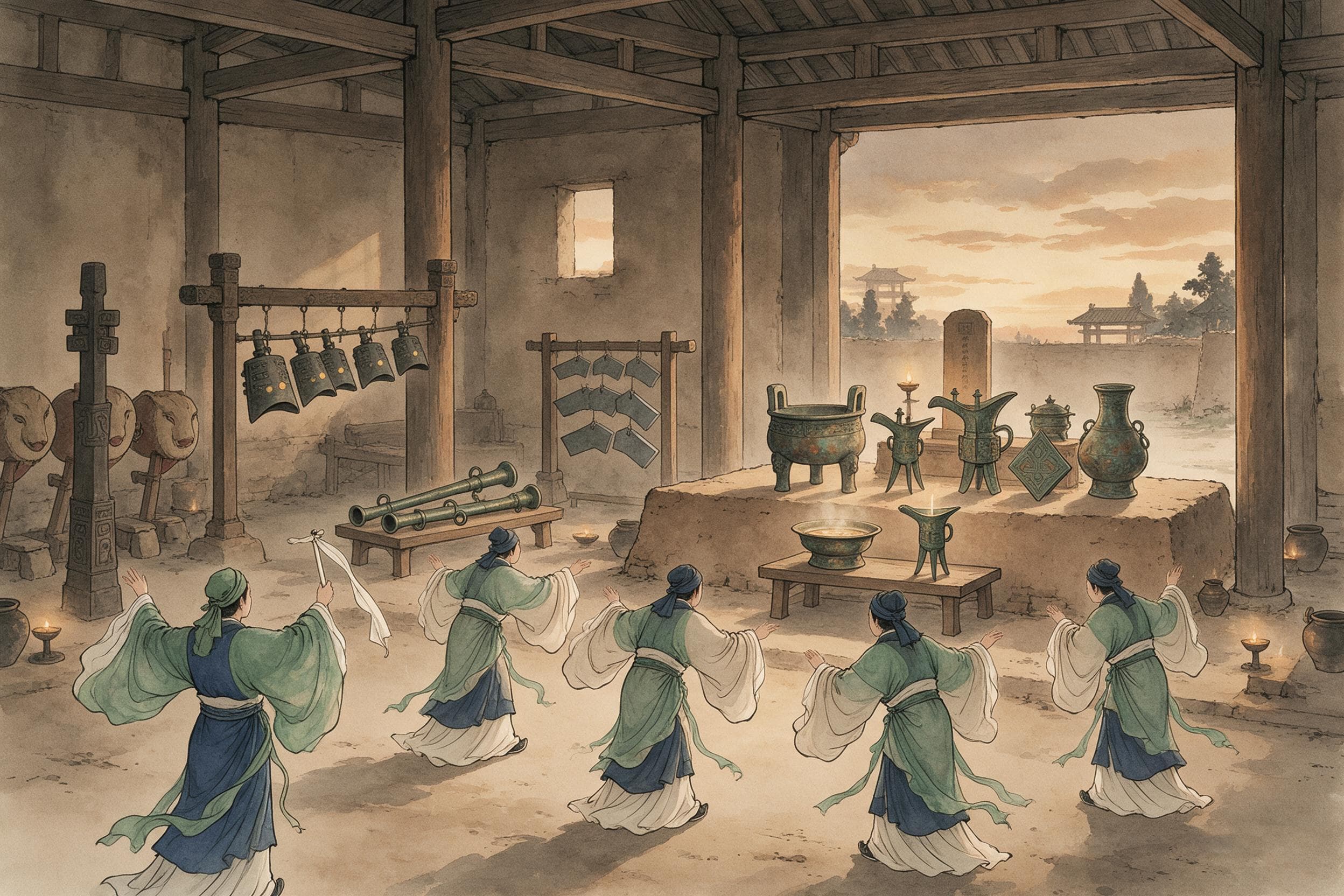
The instruments in Na come one at a time: the hand-drums set out; 'the drums beaten, tang-tang'; 'hand-drums boom, the pipes go hui-hui' (鞉鼓淵淵,嘒嘒管聲); 'all in tune and level, resting on our chime-stones' (既和且平,依我磬聲); 'the great drums are full, the wan dance has its order' (庸鼓有斁,萬舞有奕). Drums, pipes, chime-stones, the yong drum, and a wan dance, all in one stanza. The two characters yong-gu carry no note at the page's end, so no name is fixed for them here; the page's notes gloss only five words: yi-yu is an exclamation of praise; kan means joy; sui means peace; yi means full; yi (of the dance) means order.
The instruments have an order: drums set out, drums beaten, then 'the descendant of Tang plays the music' (湯孫奏假), then drums and pipes, then chime-stones, then the great drums and the wan dance. It reads like the order of a performance; but this is a song, and the order is the song's order, not a service manual. The poem never says how many of each instrument, who played them, or for how long. Nor does it use a word for ensemble or conductor: one sound follows another in the line.
The Descendant of Tang
The sacrificer is called 'the descendant of Tang' (湯孫). In Na the phrase occurs three times — 'the descendant of Tang plays the music', 'how glorious is the descendant of Tang', and the closing 'look on our winter and autumn sacrifice, brought by the descendant of Tang' (顧予烝嘗,湯孫之將); Lie Zu closes with the same line. The phrase is generally taken to mean Tang's descendant; the page gives no note. Lie Zu opens with 'ah, ah, our forefather, ordered blessings are his; blessings without limit extended to this place' (嗟嗟烈祖,有秩斯祜。申錫無疆,及爾斯所). Na adds 'we have good guests, and they are not displeased' (我有嘉客,亦不夷懌), and 'from ancient times the former people made this; warm and respectful morning and evening, those who serve are reverent' (自古在昔……執事有恪).
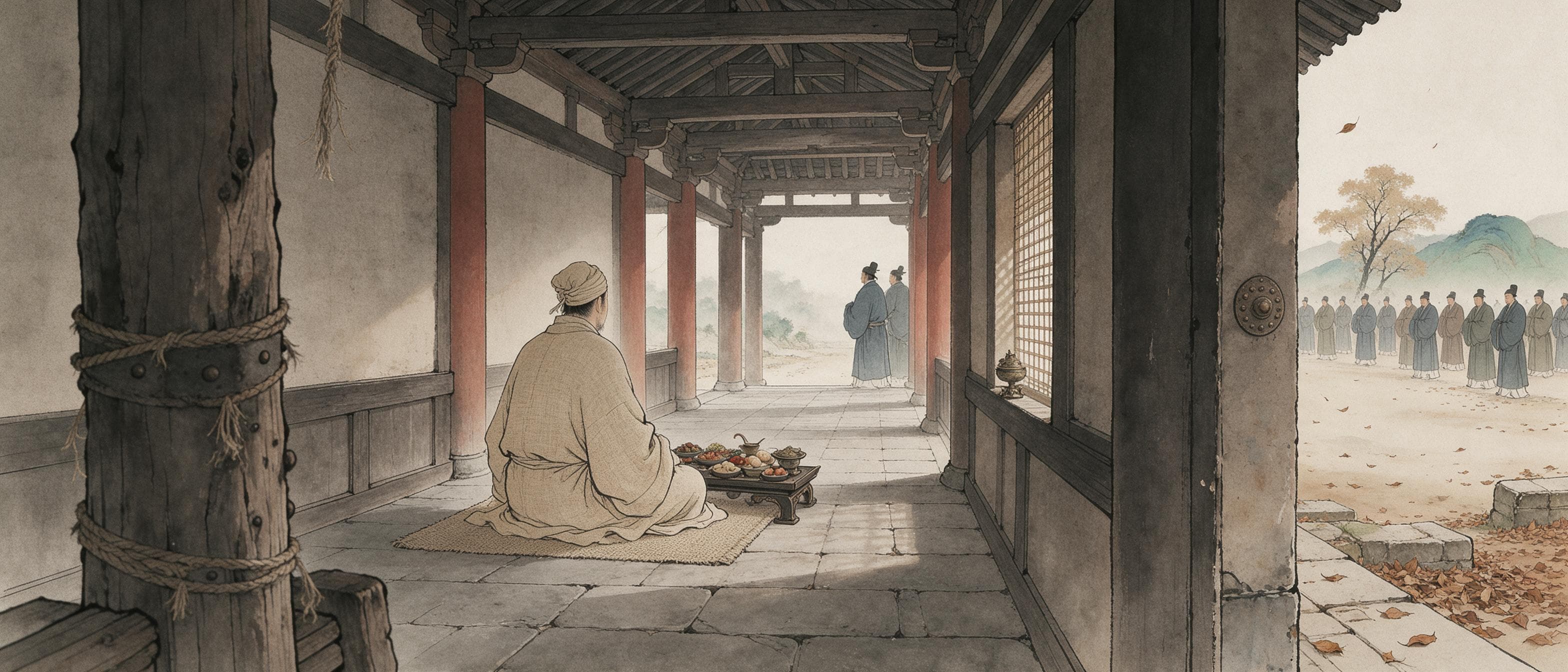
The offerings appear in Lie Zu: 'the clear wine is already set out' (既載清酤); 'reward us with our completed thoughts; there is also the blended broth, prepared and level' (賚我思成,亦有和羹。既戒既平); 'the great gathering is without words, and there is no strife' (鬷假無言,時靡有爭). Then the carriage and the blessings: 'the yoke-ends and cross-bar are inlaid, eight bells chiming' (約軝錯衡,八鸞鶬鶬); 'we come and present, and we receive the mandate broadly' (以假以享,我受命溥將); 'heaven sends down well-being, a year of abundance, grain on grain' (自天降康,豐年穰穰); 'come, come and enjoy; send down blessings without limit' (來假來饗,降福無疆). Qing-gu is generally glossed as clear wine and he-geng as blended broth; the page gives no note, so these are marked as the usual reading.
For Tang, For Zhong Zong
Each page opens with a line of the Mao preface. For Na: 'Na was sung in sacrifice to Tang. From Wei Zi to Duke Dai the rites and music fell into ruin; there was Zheng Kao Fu, who obtained the twelve pieces of the Shang hymn from the Grand Master of Zhou, and Na was the first' (《那》,祀成湯也……以《那》為首). For Lie Zu: 'Lie Zu was sung in sacrifice to Zhong Zong' (《烈祖》,祀中宗也). One honours Tang, one Zhong Zong; Zhong Zong is generally taken to be Tai Wu, though the page gives no note. The preface is Han; it records a Han understanding of the recipients and of where the Shang hymns came from, and is not the poem itself — 'Zheng Kao Fu obtained the twelve pieces from the Grand Master of Zhou' is the preface speaking.
The date of the Shang hymns is disputed: traditionally late Shang, by others attributed to the state of Song in the Spring and Autumn period. The Mao preface's story about Zheng Kao Fu is itself part of that dating question; neither page settles it, and this article does not either. The objects and scenes in the poems can be read as the poems' contents; they cannot be turned round to date them. The preface's Zheng Kao Fu is a Han story about where the songs came from, not a date inside the poems.
What the Poems Show
Set out the two lists. Instruments: four — hand-drums, pipes, chime-stones, yong drums — plus a wan dance. Offerings: two — clear wine and blended broth. Carriage: one set — inlaid yoke-ends and cross-bar, eight bells chiming. The sacrificer is 'the descendant of Tang'; there are also 'good guests' and 'those who serve'. The sacrifice is called zheng-chang, generally glossed as the autumn and winter sacrifices, with no note on the page. The poems give no place, no temple hall, no number of instruments, no number of musicians, no duration and no pitches; none is supplied. The wan dance too is named without description.
Compare the two. They agree in closing with 'look on our winter and autumn sacrifice, brought by the descendant of Tang', and both have music, wine and praise of the forefather. They differ in emphasis: Na begins with drums and culminates in the wan dance, its weight on sound and the dance's order; Lie Zu sets out clear wine, blended broth, the carriage, the abundant year and blessings, its weight on offerings and petitions. Both are songs for ancestral sacrifice — on the Mao preface and their form, generally so — and neither is a service manual.
Between the Two Pages
This article asks one thing: what a sacrifice looks like in these two poems. What can be seen is objects and order — drums, pipes, chime-stones, yong drums, the wan dance, clear wine, blended broth, the carriage, the descendant of Tang, the guests. What cannot be seen is how the service was arranged, who stood where, what pitches were used, how long it lasted. No origin story and no oracle-bone sacrifice are brought in: the site has separate pieces on Shang sacrifice and ancestors and on the origin myth, and this one keeps to these two poems. The sounds in the poems are adjectives — tang-tang, hui-hui, yuan-yuan, jingling — not a score. Object names are quoted as they stand, and no general verdict about 'the musical brilliance of the Shang' is offered.
Related reading:Two Books About Wine: An Office Manual and a Recipe · Seven Names and Five Kings: The Shang Ministers the Zhou Remembered · The Zha and the She: Two Sacrifices, Not One
Sources & further reading
- 《诗经·商颂·那》(维基文库本,未与点校本复核) — One stanza, twenty-two lines, with a Han Mao preface at the head: 'Na was sung in sacrifice to Tang. From Wei Zi to Duke Dai the rites and music fell into ruin; there was Zheng Kao Fu, who obtained the twelve pieces of the Shang hymn from the Grand Master of Zhou, and Na was the first' (《那》,祀成湯也……以《那》為首). The poem: 'how lovely, how fine! We set out our hand-drums; we beat the drums, tang-tang, to gladden our forefather Tang; the descendant of Tang plays the music … hand-drums boom, the pipes go hui-hui; all in tune and level, resting on our chime-stones; how glorious is the descendant of Tang, solemn is his sound; the great drums are full, the wan dance has its order; we have good guests, and they are not displeased; from ancient times the former people made this; warm and respectful morning and evening, those who serve are reverent; look on our winter and autumn sacrifice, brought by the descendant of Tang' (置我鞉鼓……顧予烝嘗,湯孫之將). The page's notes gloss five words only — yi-yu as praise, kan joy, sui peace, yi fullness, yi (dance) order — and the page dates the poem 'one stanza, twenty-two lines'.
- 《诗经·商颂·烈祖》(维基文库本,未与点校本复核) — One stanza, twenty-two lines, with the Han Mao preface: 'Lie Zu was sung in sacrifice to Zhong Zong' (《烈祖》,祀中宗也). The poem: 'ah, ah, our forefather, ordered blessings are his; blessings without limit extended to this place; the clear wine is already set out; reward us with our completed thoughts; there is also the blended broth, prepared and level; the great gathering is without words, and there is no strife; give us long life, yellow and grey without limit; the yoke-ends and cross-bar are inlaid, eight bells chiming; we come and present, and we receive the mandate broadly; heaven sends down well-being, a year of abundance; come, come and enjoy; send down blessings without limit; look on our winter and autumn sacrifice, brought by the descendant of Tang' (嗟嗟烈祖……顧予烝嘗,湯孫之將). The page gives no commentary and no glosses; the lines sit inside a poem block, and the page dates the poem 'one stanza, twenty-two lines'.