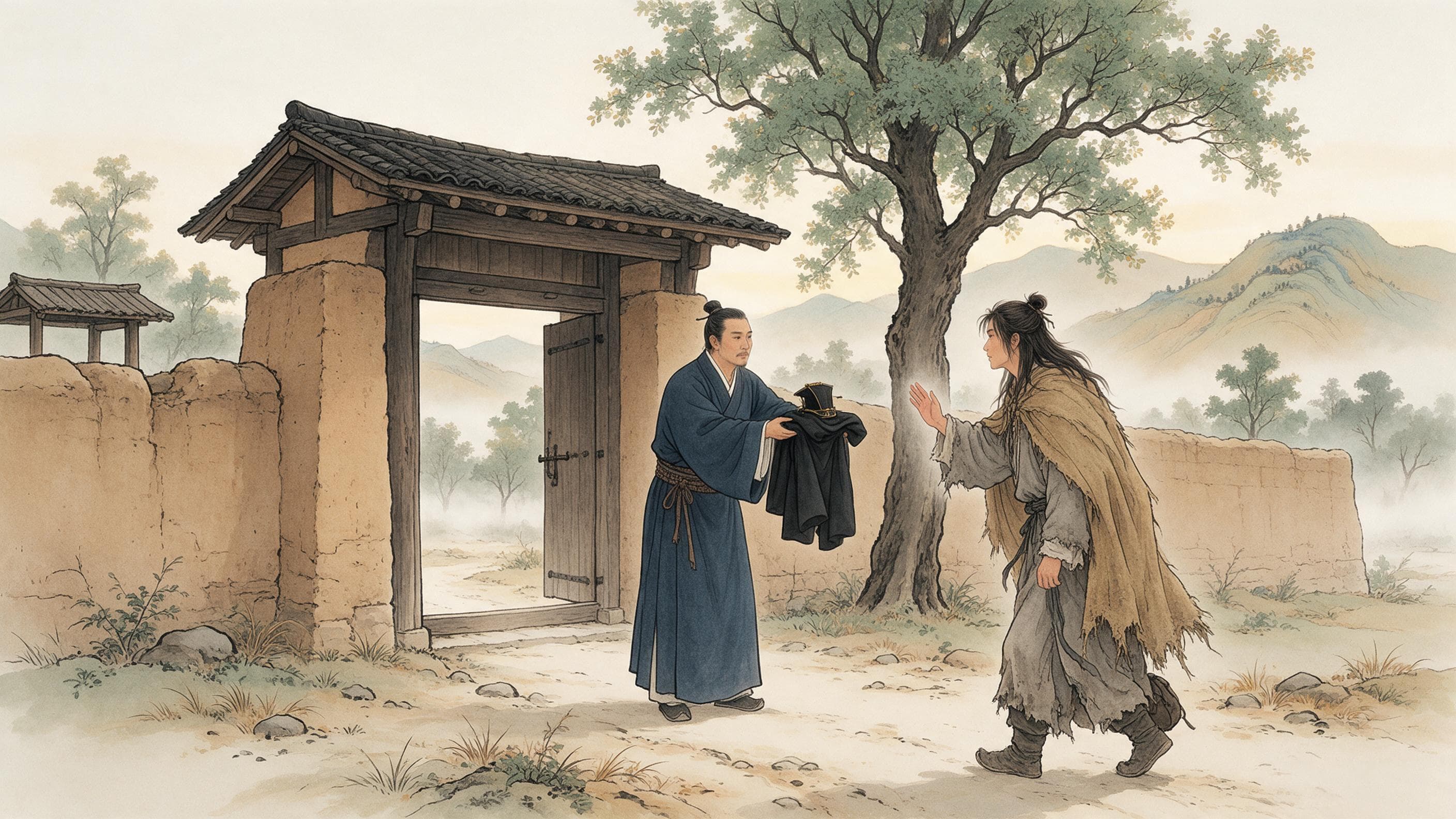
Begin with the day. The rule is not to choose it: 不诹日 — do not consult about the day. Instead, on the day of divination the master of the house stands outside the gate in dark cap and dark robe facing west, his kinsmen behind him in the same dress, the officers east; the diviner fetches the stalks; the steward speaks the charge: 孝孙某,筮来日某,诹此某事,适其皇祖某子。尚飨. The name in that formula is 某 — so-and-so — holding the place where a name would go. This is the opening of the 特牲饋食禮, the sacrifice in which one man of the shi rank brings a single victim to his ancestors. Three days before it, they divine something stranger: which living man shall be the ancestor.
One Page of Actions, One of Reasons
Two pages are used here, doing two kinds of work. The Yili is a script: who stands where, what is lifted, what is poured, in what order. It never says why. The Liji chapter 祭統 gives reasons and almost no steps: 夫祭者,非物自外至者也,自中出,生於心也 — sacrifice is not a thing that comes from outside; it comes out from within, born in the heart. It also counts, ten relations shown by sacrifice (夫祭有十倫焉) and three things of weight in it, and it grades who eats the remains: four with the ruler, six with his great officers, eight with the shi. Those numbers belong to the ruler's sacrifice, not to this one. The two books are not text and commentary. Where this article quotes 祭統, it says so, and does not use it to explain a step.
First the Day, Then the Man
There are two divinations. The day: 不诹日, then 及筮日 — the master at the gate in cap and dark robe, the kin in the same dress, the officers east, the diviner taking the stalks from the western school. No person is named: 孝孙某,筮来日某 — the filial grandson, so-and-so, divines such a day for such a service, approaching his august ancestor, so-and-so. Three days before the sacrifice: 前期三日之朝,筮尸,如求日之仪, and this charge does name a man, in the same placeholder way: 筮某之某为尸 — divine whether this man of that house may be the substitute.
He then has to be told. 乃宿尸 — the master goes to the substitute's gate, the substitute comes out dressed as the master, the steward says 筮子为某尸,占曰吉,敢宿 — we divined you should be substitute for such a one, the omen was good, we presume to inform you. The substitute agrees; the master bows with his head to the ground. Guests are informed in the same form. Which man may be chosen is settled in the other book: 孫爲王父尸 — a grandson is the substitute for his grandfather; 所使爲尸者,於祭者子行也;父北面而事之 — he stands in the son's generation to the sacrificer, and the father faces north and serves him. A rule about kinship, stated as one, not a step in this manual.
The Eve: Tripods and a Stew
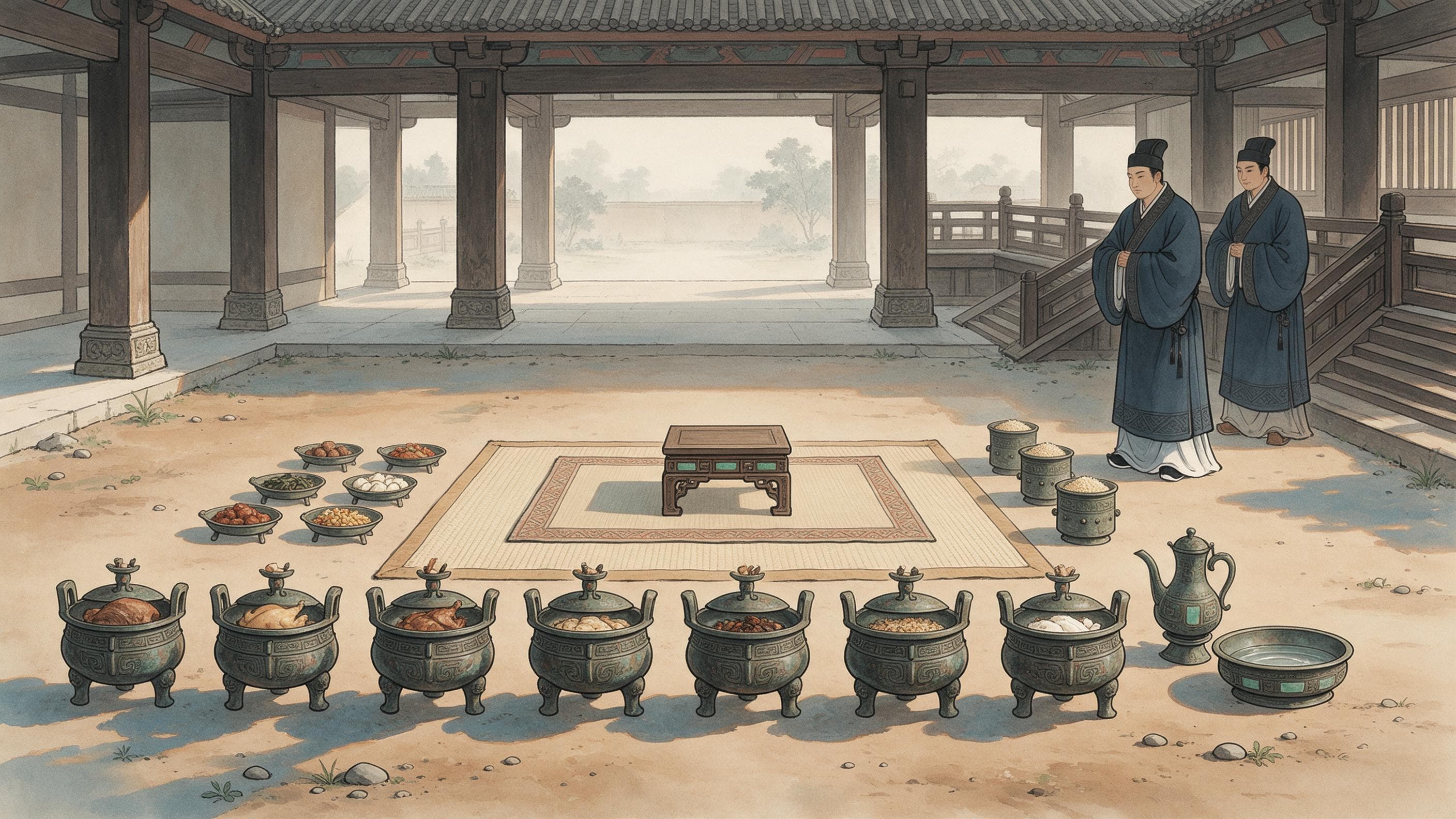
The evening before, the courtyard is set. 厥明夕,陈鼎于门外,北面北上,有鼏 — tripods outside the gate facing north, each with its lid; a stand south of them; the victim west of that, head north, feet east; the washing basin southeast of the descending steps; wine vessels and stands at the eastern wall; dishes and baskets in the eastern room; mats and two grain vessels in the western hall. The officers inspect and report 濯、具, washed and complete, then 视牲,告充, the victim inspected and passed; 雍正作豕, the officer of the victim handles the pig.
Then they ask the hour, and the answer is a condition: 请期,曰『羹饪』 — when the stew is cooked. At dawn the master watches the killing at the side of the gate (视侧杀), his wife watches the hearth below the western hall, the cooking is outside the gate on the east, and 羹饪,实鼎 — stew ready, tripods filled. Inside, 尊于户东,玄酒在西 — wine east of the door, and west of it water, called dark wine, given the place of honour. For the substitute a basin is set inside the gate: 尸盥匜水,实于槃中,箪巾,在门内之右. His mat is laid in the chamber.
The Ancestor at the Gate
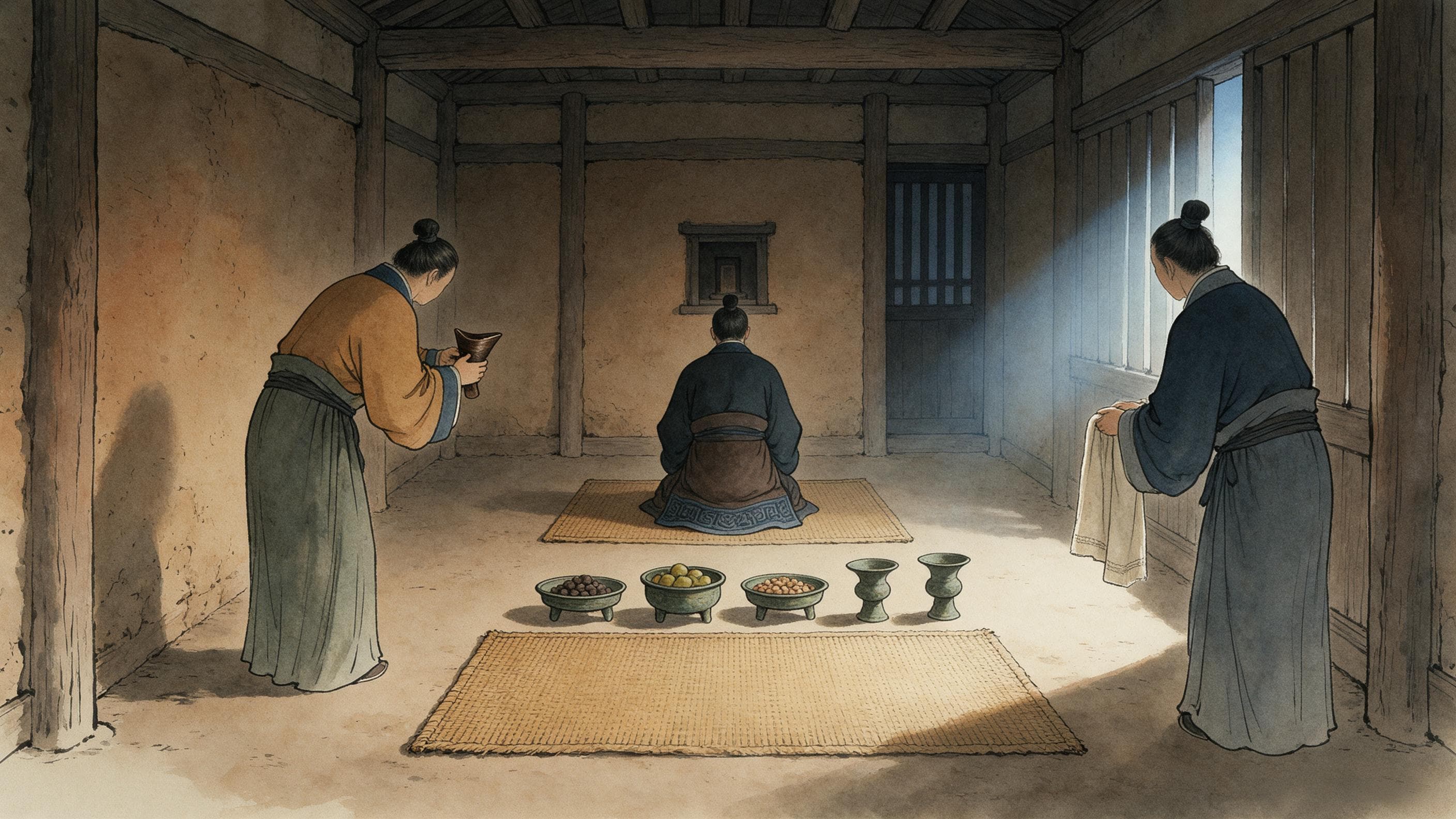
The wife goes in first with two dishes, pickles and snail sauce (荐两豆,葵菹、蜗醢); then the tripods are lifted, the master and the assistant for the victim, the senior guest and officers for fish and dried meat; the meat goes onto the stands. Then 祝迎尸于门外 — the invocator welcomes the substitute outside the gate. 尸入门左,北面盥 — he enters left of the gate and washes facing north; 宗人授巾, the officer hands him the towel; at the steps 祝延尸, the invocator leads him up. 尸即席坐,主人拜妥尸 — he sits on his mat, and the master bows to settle him. Here the other book has a rule about the doorway: 君迎牲而不迎尸,别嫌也。尸在廟門外則疑於臣,在廟中則全於君 — the ruler welcomes the victim but not the substitute, to avoid confusion; outside the gate he is still doubtful as a subject, inside he is wholly the ruler.
He eats. 祝命挼祭 — the invocator orders the first offering; the substitute holds the cup in his left hand and offers a pickle between the dishes; he tastes the wine and reports it good (祭酒,啐酒,告旨), tastes the stew and reports the same. Then the mouthfuls: 尸三饭,告饱 — three, and he announces he is full; 祝侑, the invocator urges him, and the master bows; three more and full again, urged again, three more: 尸又三饭,告饱. Nine mouthfuls, three announcements, three urgings. The page counts them; it does not explain.
The Cup, the Blessing, the Remains
The master pours: 主人洗角,升酌,酳尸 — a horn cup washed, filled, offered; the substitute tastes, the senior guest follows with liver, and the invocator takes the cup and announces 送爵!皇尸卒爵. Then the substitute pours back: 祝酌授尸,尸以醋主人. Then the blessing, which is what the day is for: 佐食抟黍授祝,祝授尸 — the assistant rolls millet and gives it to the invocator, who gives it to the substitute; 尸受以菹豆,执以亲嘏主人 — the substitute takes it in a dish of pickles and blesses the master with his own hand. Not the invocator, not a priest: the man playing the grandfather gives the fortune himself, and the master receives it with his head to the ground.
Then the mistress: 主妇洗爵于房,酌,亚献尸. Then the guest: 宾三献,如初。燔従如初。爵止. The cups run outward, to the master and mistress, to the eldest brother and the younger brothers, to the women's kin in the inner room (献内兄弟于房中), until 众宾及众兄弟交错以辩 — guests and kinsmen crossing cups until everyone has had one. Then the fiction ends: 祝东面告利成, the invocator announces the benefit is complete; 尸谡, the substitute rises, the invocator going before him.
Two men then eat what is left. 筵对席,佐食分簋铏 — mats laid opposite each other, the assistant dividing grain and stew; 祝命尝食 — the invocator orders the eating. The two are the heir who lifted the cup and the eldest brother; each gets one piece of skin (各一肤); the invocator says 馂,有以也, this eating has its reason; and when the master pours for them both, 酳,有与也, this cup has its sharing. The reason is in the other book: 餕者祭之末也, the eating of remains is the end of the sacrifice; and 尸亦餕鬼神之餘也,惠術也,可以觀政矣 — even the substitute eats what the ghosts and spirits have left; it is the art of giving, and by it government may be observed. There the eaters come four, six and eight by rank; here there are two.
The page's last section, marked 记, supplies what the script assumed: everyone in court dress, dark cap, black belt and apron, except 唯尸、祝、佐食玄端, the substitute, invocator and assistant in dark upper garments with a rank apron; what the basket holds (二爵、二觚、四觯、一角、一散); and what is set on the substitute's stand — five cuts of the pig (左肩、臂、臑、肫、胳), the spine and ribs, 肤三,离肺一,刌肺三,鱼十有五, fifteen fish. Then 佐食阖牖户 — the assistant shuts the windows and door — and 宗人告事毕, the officer announces the business finished; the guests leave. There is no weight for the pig, no price, no count of hours, no family: 孝孙某 is as specific as the page gets. Two limits follow: this is a rule, not a record of one rite; and 祭統's ranks are not to be pushed back onto this shi's two eaters. This site has written about Shang divination and sacrifice, Shang sacrificial music and dance, the altar of soil and the winter wax, and a fallen state's altar; this piece is one shi's offering to his own dead.
Related reading:The Duke Entertains: One Meal Under the Rites · Jesters: The Men Who Talked Back to Kings · Worthy Women: A Few Women, A Few Sentences
Sources & further reading
- 《儀禮·特牲饋食禮》第十五(維基文庫本,白文,頁面用簡體錄文,未與中華書局點校本複核) — The script for one shi's ancestral offering, with no year, place or named family: 不诹日; 筮尸; 乃宿尸; the eve's tripods and the victim (雍正作豕); 请期,曰羹饪; 夙兴,视侧杀; 尸盥匜水 in the gate; 祝迎尸于门外; 主人拜妥尸; 祝命挼祭; 尸三饭告饱, urged three times, nine mouthfuls; 主人洗角,升酌,酳尸; 尸以醋主人; 尸受以菹豆,执以亲嘏主人; 主妇亚献, 宾三献; 众宾及众兄弟交错以辩; 祝东面告利成, 尸谡; 馂 with 祝曰馂,有以也 and 酳,有与也; 佐食阖牖户; 宗人告事毕. Ends with a 记 on dress, vessels and the cuts of meat. The page's text has damaged spots (e.g. the divination result line) and a split character 扌耎 for 擩; neither is quoted.
- 《禮記·祭統》(維基文庫本,繁體白文,頁頭標 textquality 75%,未與中華書局點校本複核) — Argument, not ritual steps: 夫祭者,非物自外至者也,自中出,生於心也; 福者,備也; 祭者,所以追養繼孝也; 生則養,没則喪,喪畢則祭; 外則盡物,内則盡志; 十倫; 三重; 散齊七日,致齊三日; 孫爲王父尸…父北面而事之; 君迎牲而不迎尸,别嫌也; 尸飲五/七/九; 餕者祭之末也; 尸亦餕鬼神之餘也,惠術也,可以觀政矣; the remains eaten by 君與卿四人, 大夫六人, 士八人; 春祭曰礿,夏祭曰禘,秋祭曰嘗,冬祭曰烝.