The sentence is twenty characters long and holds one day: 惟三祀十有二月朔,伊尹以冕服奉嗣王歸于亳. On the first day of the twelfth month of the third year, Yi Yin brought a cap and a robe of ceremony and escorted the heir king back to Bo. The page supplies a day, a month, a year count, one minister, one king, one set of ceremonial clothes and one place name; not what the clothes looked like, who put them on, or how anyone walked in. All of it comes from that sentence and the two short chapters either side of it.
One: three short chapters, one line
All three pages belong to the Book of Documents (尚書, Shangshu), and all three are short. The headers read 尚書太甲上梅賾 and so on: the author column names Mei Ze (梅賾), to whom this group of chapters is attributed, and that name is the only provenance the pages offer. These are the chapters scholarship calls the 偽古文尚書, the forged old-text Documents — presented in the fourth century as the recovered ancient book, treated since the Qing as later composition. The pages say none of this themselves and carry not one gloss, so nothing here is a Shang archive. The order is 伊訓, 太甲上, 太甲中, 太甲下, 咸有一德, 盤庚上; this article uses 上, 中 and 咸有一德, and 太甲下 appears only in the navigation strip.
Two: two characters, not bright
The chapter opens with a verdict seven characters long: 太甲既立,不明 — Tai Jia was set up, and was not bright. It says the same thing three more times: 惟嗣王不惠于阿衡, the heir king would not follow A-heng; 王惟庸罔念聞, the king took no notice; 王未克變, the king could not be changed. Between them Yi Yin speaks three times, each speech introduced differently: 伊尹作書曰, he composed a document and said; 伊尹乃言曰, then he spoke; 伊尹曰, he said. The first argues from precedent: 先王顧諟天之明命,以承上下神祇。社稷宗廟,罔不祗肅 — the former king looked to Heaven's bright mandate and served the spirits above and below, and the altars and the ancestral temple were kept in awe. It ends on the person: 祗爾厥辟,辟不辟,忝厥祖 — revere your sovereign; if the sovereign is no sovereign, he shames his ancestors.
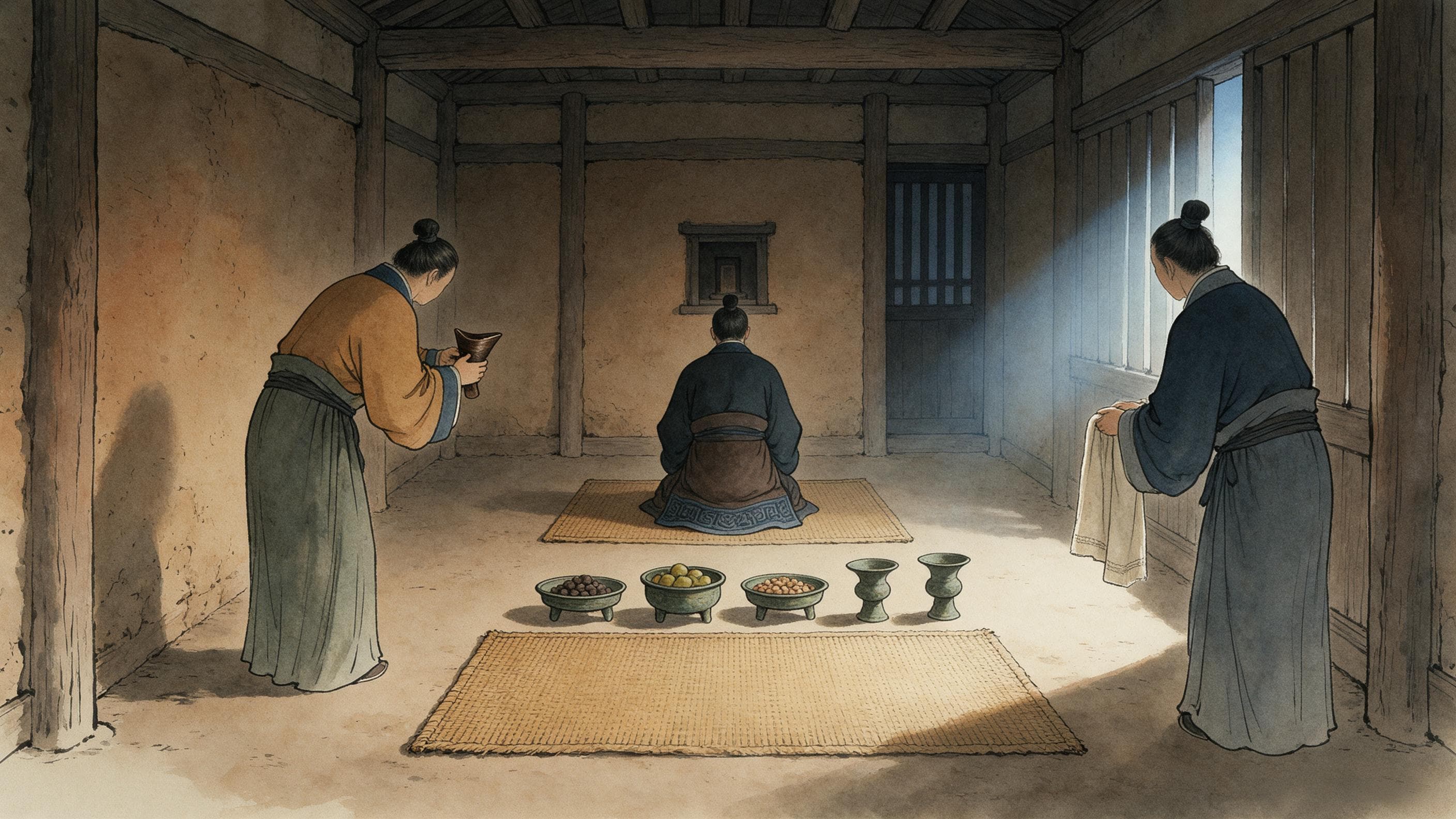
The second speech gives the dead king's working day: 先王昧爽丕顯,坐以待旦 — before daylight he was already clear-headed, sitting and waiting for dawn; and 旁求俊彥,啟迪後人, he sought fine men everywhere. Then two images: 慎乃儉德,惟懷永圖, be careful with the virtue of frugality; and 若虞機張,往省括于度則釋, like a crossbow already drawn — look to the arrow and the mark, then release. The third speech names the fault: 茲乃不義,習與性成 — this is not right, and habit has become nature. Then it acts: 予弗狎于弗順,營于桐宮,密邇先王其訓,無俾世迷 — I will not grow familiar with what is not compliant; I will build at Tong Palace, close to the teaching of the former kings, so the world is not led astray. And: 王徂桐宮居憂,克終允德 — the king went to Tong Palace to dwell in mourning, and completed his sincere virtue.
Three: one word, 放
The word every retelling uses is not in the chapter. It is in the 序, the small preface line at the head of the first page: 太甲既立,不明,伊尹放諸桐 — Yi Yin 放 him at Tong. 放 can mean to set down, to let go, to banish; the line does not say which. The chapter's own version is the three sentences above: a place is built at Tong, the king goes there, and he 居憂, dwells in mourning. Both stand on the page in different layers; this article keeps them side by side, unmerged, unruled. Three things then stay unknown: who watched the king at Tong, where Tong was, what he did in the three years. 密邇先王 says only that the place was close to the former kings — temple or tombs, the page does not say; and 居憂 does not say for whom he mourned.
Four: the first day of the twelfth month
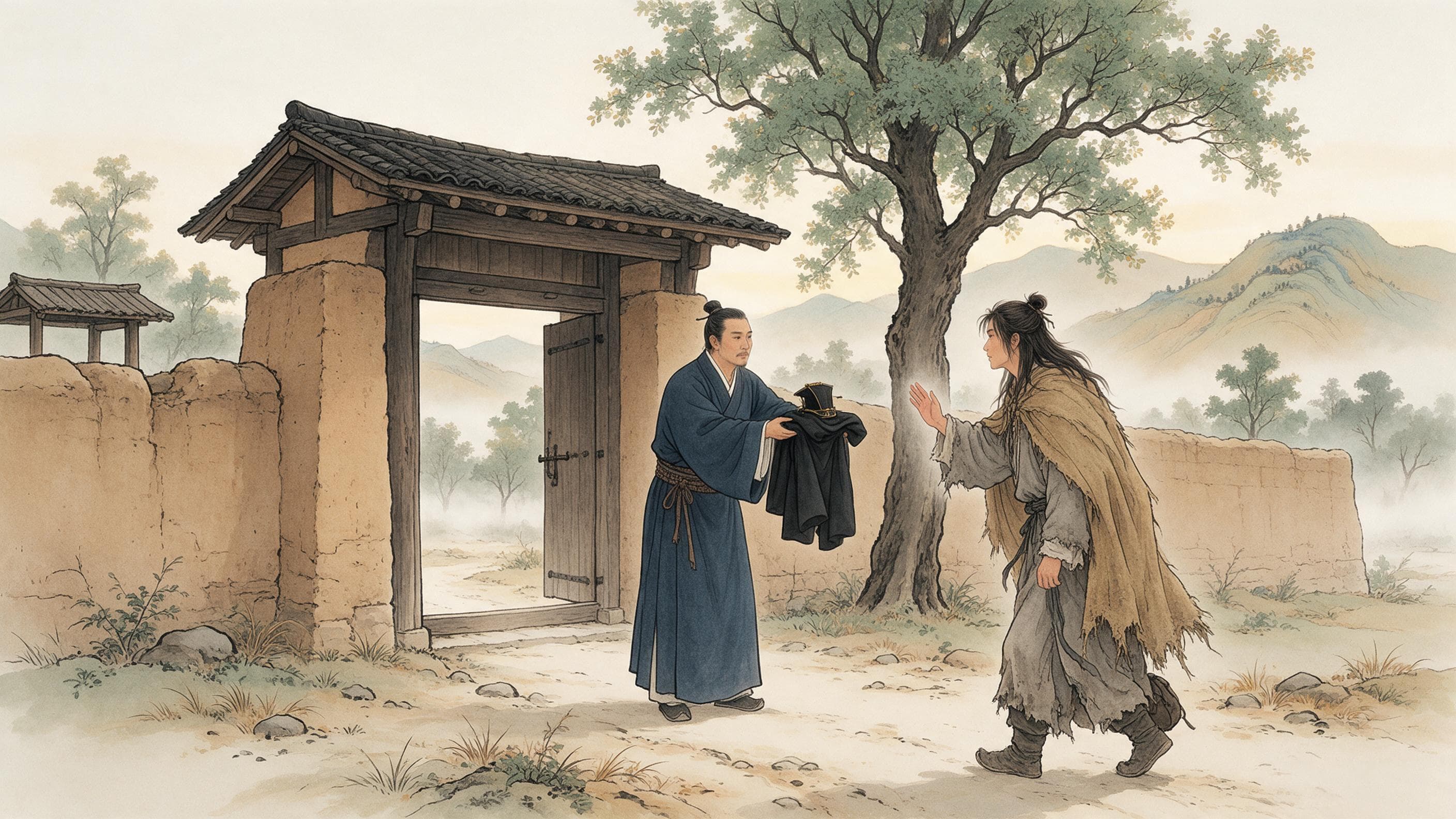
The return has a date and no scene: 惟三祀十有二月朔. The preface line counts the same interval as 三年, three years; the chapter counts 三祀 — 祀, the sacrifice-cycle word this book uses for a year. Both stand as written, neither a calendar nor a modern date. Then: 伊尹以冕服奉嗣王歸于亳. 冕服 is a cap and a ceremonial robe, 奉 is to hold up or to escort, and 以 can be read as 'with' — carrying the cap and robe — or as 'in' — Yi Yin in cap and robe. The page says neither and has no note to settle it. What the garment was made of, how tall the cap stood, who wore it: none of that is here. The one object in the story is given as a word.
Then two bows in the same words: 王拜手稽首曰, and later 伊尹拜手稽首曰 — hands over the head, head to the ground; the page names the gesture twice and describes it never. The king speaks first: 予小子不明于德,自厎不類。欲敗度,縱敗禮,以速戾于厥躬。天作孽,猶可違;自作孽,不可逭。既往背師保之訓,弗克于厥初,尚賴匡救之德,圖惟厥終 — I was not bright in virtue and brought myself to what is not good; desire broke measure, indulgence broke rite, and I hurried punishment onto myself. Calamity sent by Heaven can still be turned aside; calamity made by oneself cannot be escaped. Before, I turned my back on the guardians' teaching; I still rely on the virtue that corrects and saves.
What Yi Yin writes that day is again a document: 民非后,罔克胥匡以生;后非民,罔以辟四方 — without a lord the people cannot help one another live; without the people a lord cannot open the four quarters. After the confession Yi Yin returns the same bow, then gives a list of conduct: 修厥身,允德協于下,惟明后; 奉先思孝,接下思恭。視遠惟明;聽德惟聰 — serving the ancestors, think of filial duty; receiving those below, think of respect; to see far, be clear; to hear virtue, be acute.
Five: handing it back
The third chapter opens by returning the government in seven characters: 伊尹既復政厥辟 — Yi Yin, having given the government back to his sovereign — 將告歸,乃陳戒于德: about to announce his departure, he set out a warning about virtue. The longest speech on the three pages begins 天難諶,命靡常 — Heaven is hard to trust, its mandate has no constancy — and goes on: 德惟一,動罔不吉;德二三,動罔不凶; 非天私我有商,惟天祐于一德;非商求于下民,惟民歸于一德. Two lines read like rules for office: 七世之廟,可以觀德。萬夫之長,可以觀政. The last is the plainest: 無自廣以狹人,匹夫匹婦,不獲自盡,民主罔與成厥功 — do not widen yourself by narrowing others; if one common man or woman cannot do their utmost, the lord of the people has no one to finish the work with. The speech ends, the chapter ends, and Yi Yin does not leave in it: 將告歸 is a man about to ask to go home, and the page shows neither the asking nor the going.
- The material: all three pages are the Documents as this edition attributes them, 梅賾 in the author column; the group is usually called the 偽古文尚書, later composition presented as the ancient book. Not a Shang archive, not read here as a record of a Shang court; the pages carry no commentary at all.
- Preface and chapter are two layers: 放諸桐 is in the 序; the chapter says 營于桐宮 and 王徂桐宮居憂. Both stand, not merged, not ruled.
- Three unknowns stay unknown: who guarded Tong, where Tong was, what he did for three years. 密邇先王 is copied as close to the former kings, not turned into temple or tomb.
- Numbers and ceremony as written: 三年 and 三祀, 十有二月朔, 冕服 — no Gregorian equivalent, no filling in the cap or the robe, the reading of 以冕服 left open.
- No verdict on Yi Yin, loyal or otherwise; no essay on ruler and minister, and no modern political word for 放.
- Lines kept apart: Tang's three reasons against Jie, the lines at Muye, the Shang ministers the Zhou remembered are other articles. This is the line 放, 歸, 告歸, without 太甲下, which is not among this round's sources.
The end of the story stands on the same page but not in the chapter. After 咸有一德 the page prints a run of 序 lines for chapters it does not include: 沃丁既葬伊尹于亳,咎單遂訓伊尹事,作《沃丁》 — Wo Ding buried Yi Yin at Bo. That is the only death in the set, a preface to a lost chapter, in the same small line as the 放諸桐 that opened the story. Below it the page goes on in the same form: a mulberry and a grain growing together in the court, a capital moved to Ao, a king at Xiang, another ruined at Geng — one line a reign, the chapters gone.
Related reading:Jesters: The Men Who Talked Back to Kings · Worthy Women: A Few Women, A Few Sentences · The Duke Entertains: One Meal Under the Rites
Sources & further reading
- 《尚书·太甲上》(旧题梅赜所献古文《尚书》一系;维基文库本,白文无注;页头作者栏题「尚書太甲上梅賾」) — Prefatory line: 太甲既立,不明,伊尹放諸桐。三年復歸于亳,思庸,伊尹作《太甲》三篇. Then 惟嗣王不惠于阿衡, 伊尹作書曰 先王顧諟天之明命……祗爾厥辟,辟不辟,忝厥祖. 王惟庸罔念聞, 伊尹乃言曰 先王昧爽丕顯,坐以待旦……若虞機張,往省括于度則釋. 王未克變, 伊尹曰 茲乃不義,習與性成。予弗狎于弗順,營于桐宮,密邇先王其訓,無俾世迷。王徂桐宮居憂,克終允德. Page navigation: 伊訓 ← 太甲上 → 太甲中.
- 《尚书·太甲中》(同上,古文《尚书》一系;维基文库本,白文无注;页头作者栏题「尚書太甲中梅賾」) — The return: 惟三祀十有二月朔,伊尹以冕服奉嗣王歸于亳,作書曰 民非后,罔克胥匡以生;后非民,罔以辟四方。Then 王拜手稽首曰 予小子不明于德,自厎不類。欲敗度,縱敗禮,以速戾于厥躬。天作孽,猶可違;自作孽,不可逭。And 伊尹拜手稽首曰 奉先思孝,接下思恭。視遠惟明;聽德惟聰. Navigation shows a third chapter, 太甲下, which is not used here.
- 《尚书·咸有一德》(同上,古文《尚书》一系;维基文库本,白文无注;页头作者栏题「尚書咸有一德梅賾」) — 伊尹既復政厥辟,將告歸,乃陳戒于德, then 天難諶,命靡常……德惟一,動罔不吉;德二三,動罔不凶……七世之廟,可以觀德。萬夫之長,可以觀政……無自廣以狹人. The page then prints the 序 lines of chapters whose texts are lost, beginning 沃丁既葬伊尹于亳,咎單遂訓伊尹事,作《沃丁》, followed by 伊陟相大戊,亳有祥桑谷共生于朝 … 仲丁遷于囂 … 河亶甲居相 … 祖乙圮于耿. These are prefaces, not chapter text, and the article marks them so.