A day, an hour and a place in eleven characters: 'At the hour of jiazi, before dawn, the king in the morning arrived at the waste of Muye outside the Shang capital, and then swore his oath' (時甲子昧爽,王朝至于商郊牧野,乃誓). That is all the opening the Book of Documents gives. This piece stays inside that one morning: what the oath told the army to do, how the ranks were ordered to move, and what one song made of the day. The date is kept as written, jiazi, not converted into a modern calendar date.
One: the oath as a field order
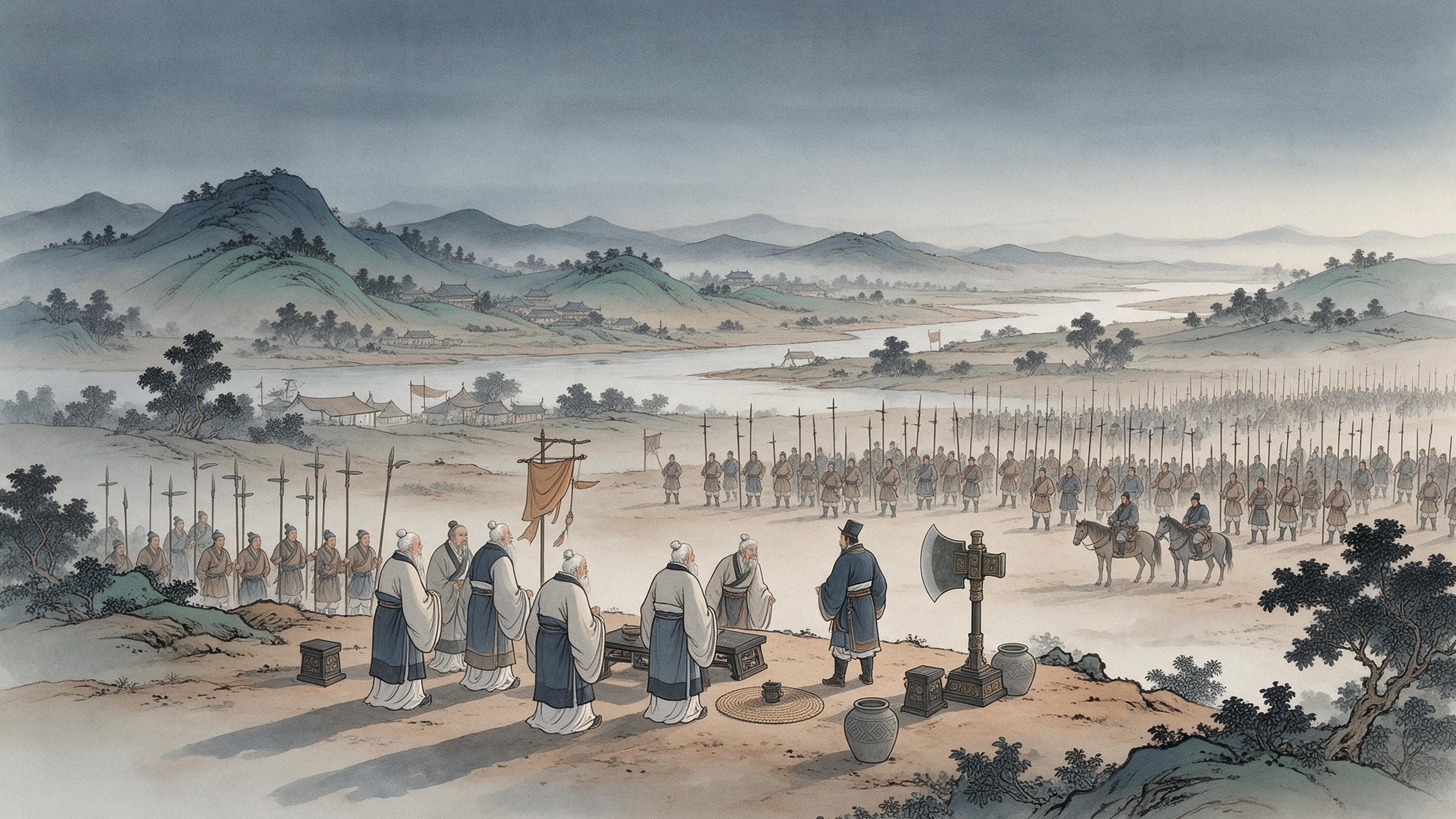
Before the oath becomes speech there is a pose: 'the king held the yellow axe in his left hand and the white ox-tail banner in his right, to signal, and said: Far off are the men of the western soil' (王左杖黃鉞,右秉白旄以麾……逖矣西土之人). Then he names the army, and the list is the most concrete thing on the page: 'my friendly states' chiefs; the officers, the Ministers of Education, of War and of Works; the junior and senior ranks; the masters of the clans; the captains of a thousand and of a hundred; and the men of Yong, Shu, Qiang, Mao, Wei, Lu, Peng and Pu' (嗟!我友邦冢君……及庸、蜀、羌、髳、微、盧、彭、濮人). Eight allied peoples are named, standing with the westerners. The page marks variant readings here — Lu written 纑 in one reading — and they are quoted as printed.
Then the order about weapons, three things and three verbs: 'lift your ge; join your shields; set up your spears; I shall swear the oath' (稱爾戈,比爾干,立爾矛,予其誓). Ge, shield, spear — and 'lift', 'join', 'set upright'. It is a command, not a diagram: the page gives no formation, no spacing, no number of men in a rank or file, so this piece draws no plan of the field.
The charge follows, and begins with a proverb: 'the ancients said: a hen does not crow at dawn; if a hen crows at dawn, that household is ruined' (牝雞無晨……惟家之索). Applied to the king of Shang: 'he uses only a woman's words; he has cast off his sacrifices and does not answer them; he has discarded the uncles and brothers left to him; and the many criminals who fled from the four quarters he honours, exalts, trusts and employs, making them ministers and officers' — therefore 'I, Fa, reverently carry out the punishment of Heaven' (今予發,惟恭行天之罰). The label matters: this is the Zhou camp's charge, the case it published before the fighting, not a finding.
Two: six or seven paces, four to seven strokes
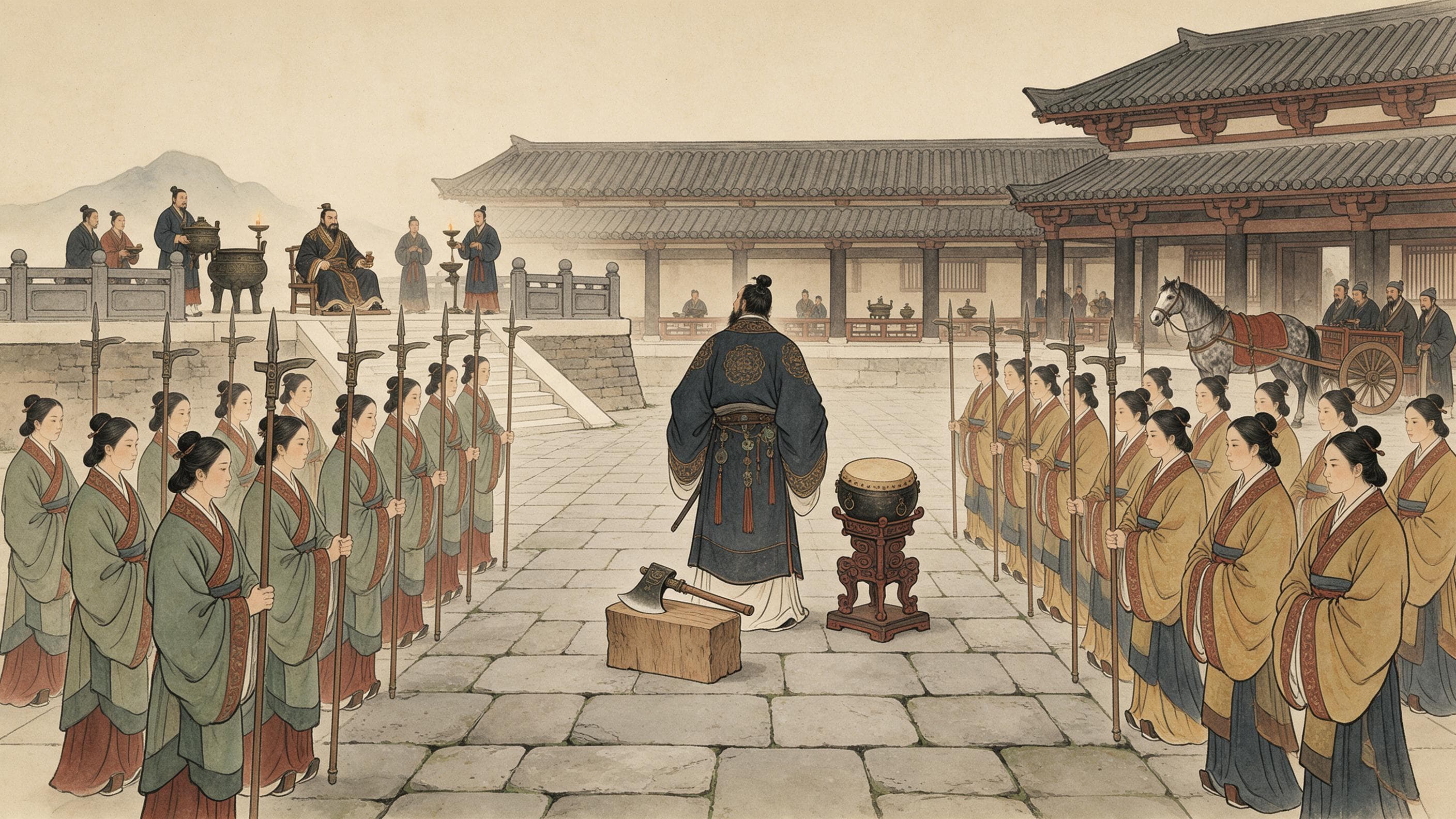
The closest the page comes to drill is this: 'in today's business, do not go beyond six or seven paces, then halt and dress the ranks; … do not go beyond four, five, six or seven strokes, then halt and dress the ranks' (不愆于六步、七步,乃止齊焉……不愆于四伐、五伐、六伐、七伐,乃止齊焉). Paces and strokes, each with a limit and each with a halt. The page carries one note on the stroke: 'one blow and one thrust make one fa' (一擊一刺爲一伐), quoting Zheng's commentary to the Record of Music. That is a note, not the oath, and is marked as such here. How many men stood in a rank, how far apart, how the line was dressed: the page does not say.
Two more lines put teeth in the order: 'be fierce, fierce as tigers, as leopards, as bears, as grizzlies, at the Shang outskirts' (尚桓桓,如虎、如貔、如熊、如羆), and 'those who come over we do not strike; let them serve the western soil' (弗迓克奔,以役西土). Then the penalty: 'if you do not exert yourselves, you will be punished in your own persons' (爾所弗勖,其于爾躬有戮). A field order, with death written into its last clause.
Three: the same morning in two voices
The Book of Songs gives the same day another voice. From the Da Ming: 'the hosts of Yin Shang came, their companies like a forest; they shot arrows at Muye; it was we who rose. God is with you; do not doubt your hearts' (殷商之旅,其會如林。矢于牧野,維予侯興。上帝臨女,無貳爾心). And then: 'Muye was broad, the sandalwood chariots shone, the teams of red horses were strong. Our Master Shangfu was like an eagle on the wing; he aided King Wu, who struck great Shang; the morning of the meeting was bright' (牧野洋洋,檀車煌煌,駟騵彭彭。維師尚父,時維鷹揚……會朝清明).
The two texts must not be fused. The oath is an order given to soldiers before anything happened: paces, strokes, penalties. The poem is a song about the day, in fixed stanzas: a forest of companies, shining chariots, an eagle. The poem gives no paces and no weapon orders; the oath gives no forest and no teams of red horses. The page also prints the Mao preface — 'Da Ming: King Wen had bright virtue, and so Heaven again gave its command to King Wu' (文王有明德,故天復命武王也) — which is a later statement of what the poem is for, not the song. So this piece keeps three things apart: order, song, preface.
Four: the numbers, and the turning of weapons
The numbers are in the Shiji, and they are a Han history's numbers: 'Wu Wang led three hundred war chariots, three thousand tiger braves and forty-five thousand armoured men to attack Zhou in the east' (率戎車三百乘,虎賁三千人,甲士四萬五千人,以東伐紂). The date is repeated — 'in the second month, on jiazi, before dawn, Wu Wang arrived at Muye' (二月甲子昧爽) — and after the oath, 'the troops of the feudal lords who joined were four thousand chariots, and they drew up the army at Muye' (諸侯兵會者車四千乘,陳師牧野). Three hundred chariots at the oath; four thousand when the armies met. The page does not reconcile the two, and neither does this piece.
The battle is two sentences. 'King Zhou heard that Wu Wang had come, and also sent out seven hundred thousand men to meet him. Wu Wang sent Master Shangfu with a hundred men to challenge, and charged Zhou's army with the great levies' (亦發兵七十萬人距武王……以大卒馳帝紂師). Then the sentence the passage turns on: 'Zhou's soldiers were numerous, but none had the heart for battle; they wanted Wu Wang to enter quickly, so they turned their weapons and fought, and opened the way for Wu Wang' (紂師皆倒兵以戰,以開武王). Zhou went up to the Lutai terrace, wrapped himself in his precious jades and burned himself to death. These are a history's figures and a history's scene: recorded, not measured — and this piece does not set seventy thousand against forty-five thousand to explain the outcome.
Five: what later men said
One later sentence can be added, if it is labelled. In the eleventh year of Duke Zhao, in the Zuo Commentary, Han Xuanzi asks whether Chu can take Cai; Shu Xiang answers: 'Jie overcame Youmin and lost his state; Zhou overcame the Eastern Yi and destroyed himself' (桀克有緡,以喪其國;紂克東夷,而隕其身). The speaker is named, the occasion is a question about Chu, and the line is a judgement on Zhou — not a record from the end of Shang, and nothing about how the ranks stood. So it appears here only as what later men said, in one sentence, under Shu Xiang's name. What the pages do not give: the actual formation (how many ranks, what spacing), the proportion of weapons, casualties, how long the fighting lasted, where on the plain it happened. None of it is supplied, no map is drawn, no date is converted, no total is computed. This piece keeps to three things from that morning: an order, a song, and the few numbers a history wrote down.
Related reading:Tribute Turtles: Where Divination Shells Were Said to Come From · The Suburban Sacrifice: Where the Emperor Met Heaven, and How Often · Golden Elixir: What Ge Hong Cooked on Mount Luofu
Sources & further reading
- 《尚书·牧誓》(维基文库本,未与点校本复核) — The oath itself, short enough to read in a few minutes: 'At the hour of jiazi, before dawn, the king in the morning arrived at the waste of Muye outside the Shang capital, and then swore' (時甲子昧爽,王朝至于商郊牧野,乃誓); the axe and banner; the list of ranks and of the eight allied peoples; 'lift your ge, join your shields, set up your spears'; the charge about the hen that crows at dawn and the king who uses a woman's words; the orders of six or seven paces and of four to seven strokes; and the closing threat. The page marks variant readings in its own brackets — 盧/纑 and others — and carries one note, quoting Zheng's commentary to the Record of Music for 'one blow and one thrust make one fa' (一擊一刺爲一伐); that is a note, not the oath, and is marked as such here.
- 《诗经·大雅·大明》(维基文库本,未与点校本复核) — The song, eight stanzas, with the two that concern Muye: 'the hosts of Yin Shang came, their companies like a forest; they shot arrows at Muye… God is with you, do not doubt your hearts' (殷商之旅,其會如林……無貳爾心) and 'Muye was broad, the sandalwood chariots shone, the teams of red horses were strong; our Master Shangfu was like an eagle on the wing' (牧野洋洋,檀車煌煌,駟騵彭彭……時維鷹揚). The page also prints the Mao preface ('King Wen had bright virtue, and so Heaven again gave its command to King Wu' 文王有明德,故天復命武王也) and a note on the stanza count. The preface is a later statement of the poem's purpose, not part of the song, and is kept separate here.
- 司马迁《史记》卷四〈周本纪〉(维基文库本,未与点校本复核) — The Han history's account: 'Wu Wang led three hundred war chariots, three thousand tiger braves and forty-five thousand armoured men to attack Zhou in the east' (率戎車三百乘,虎賁三千人,甲士四萬五千人,以東伐紂); 'in the second month, on jiazi, before dawn, Wu Wang arrived at Muye' (二月甲子昧爽); after the oath 'the troops of the feudal lords who joined were four thousand chariots, and they drew up the army at Muye' (諸侯兵會者車四千乘,陳師牧野); Zhou 'sent out seven hundred thousand men'; 'Wu Wang sent Master Shangfu with a hundred men to challenge'; and 'Zhou's soldiers all turned their weapons and fought, opening the way for Wu Wang' (紂師皆倒兵以戰,以開武王). The chapter also records the crossing of the Meng ford in the eleventh month and the year count 'nine years' and 'eleventh year' — dating the Han history uses and the oath page does not.
- 《春秋左氏传》昭公十一年(维基文库本,未与点校本复核) — Used for one later sentence only, and marked as later. Answering Han Xuanzi's question whether Chu would take Cai, Shu Xiang says: 'Jie overcame Youmin and lost his state; Zhou overcame the Eastern Yi and destroyed himself' (桀克有緡,以喪其國;紂克東夷,而隕其身). The speaker is named in the text (叔向), the occasion is a question about Chu in the eleventh year of Duke Zhao, and the sentence is a Spring and Autumn judgement on Zhou, not a Shang or early Zhou record.